Bee Diary: Supplemental

September 6, 2010 on 9:20 pm | In Bees, GeekWorld | No Comments yet, your thoughts are welcome »

Lughnasa                            Waning Artemis Moon

The varroa mite count is in and my bees had–1.  That’s one mite for the sample of some 225 bees.  I didn’t get the optimal 300, see the business about the bees not volunteering for freezing to death, but finding only 1 mite makes me feel pretty comfortable.  Wednesday I’ll check the divide and see  how it’s doing mite wise.

I’ll have to become more facile with this procedure since I need it to do at least twice a year, more if the counts begin to go high.

We had a thunderstorm that knocked out the power and turned on our generator earlier tonight.  My computers were not unplugged, but they seem to have survived.

Bee Diary: September 6th, 2010

September 6, 2010 on 11:40 am | In Bees | No Comments yet, your thoughts are welcome »

Lughnasa                               Waning Artemis Moon

Speaking of labor unions.  The AFL-CIO or even the Wobblies and the Western Miner’s Union (Joe Hill’s crowd) have nothing on bees.  Today I took off the honey supers.  Mistake.  I should have stored them wet rather than dry.  Turns out the bees feel proprietary about the honey supers even though all they’re supposed to do is clean them off 400honey-extraction_0234so I can store them.  Nobody got the memo.

I began the morning in veil and my garden gloves with a sweatshirt on for arm protection.  Hmmm.  Several stings later I learned, again, the rule of not working with the bees when it’s overcast.  The more safe bee suit and gloves had to go on.

They were all home and not in any mood to receive visitors.  Gosh.  So, I removed all the honey supers but left them sitting in the bee yard because I have no idea what to do with all the bees that are still on them.  I’m hoping they’ll give up and go home after a while.  We’ll see.  This falls, I think, in the realm of wishful thinking.  I imagine I’m going to have to brush them off or blow them off, neither of which will make them happy.

Today and cloudy Tuesday they can stay in their supers if they want to.  The landlord will not start eviction proceedings until sunny Wednesday. I have to get them out by then because I head out for Robbins AFB and Bonaire, Georgia on Thursday to see Joseph.

I spent some of the morning creating a gizmo (the technical term the U uses) to collect 300 bees.  We had some corrugated sheet metal, so I began the process of cutting the sheet metal with tin snips.  This is easier than it sounds, especially since I can’t recall the last time I used tin snips to actual cut any metal other than fence wire.  Probably never.  After fits and starts, I got’er done.  Lots of raggedy edges though so I covered the sharp stuff with masking tape.

After bending it into sort of a gutter shape, I found a 4 ounce laundry dispensing cup and a half pint canning jar.  Marking the 4 ounce level on the dispensing cup, I gathered up my gizmo and canning jar, heading out for the first round of what would prove a painful mission.

It became clear to me that I was not going to count the number of pollen frames, 3-6 are best, and only guesstimate the amount of honey, that top hive box of 3 had some weight, but not 50 pounds.   They need more than that.  I’ll check the bottom two hive boxes on Wednesday.

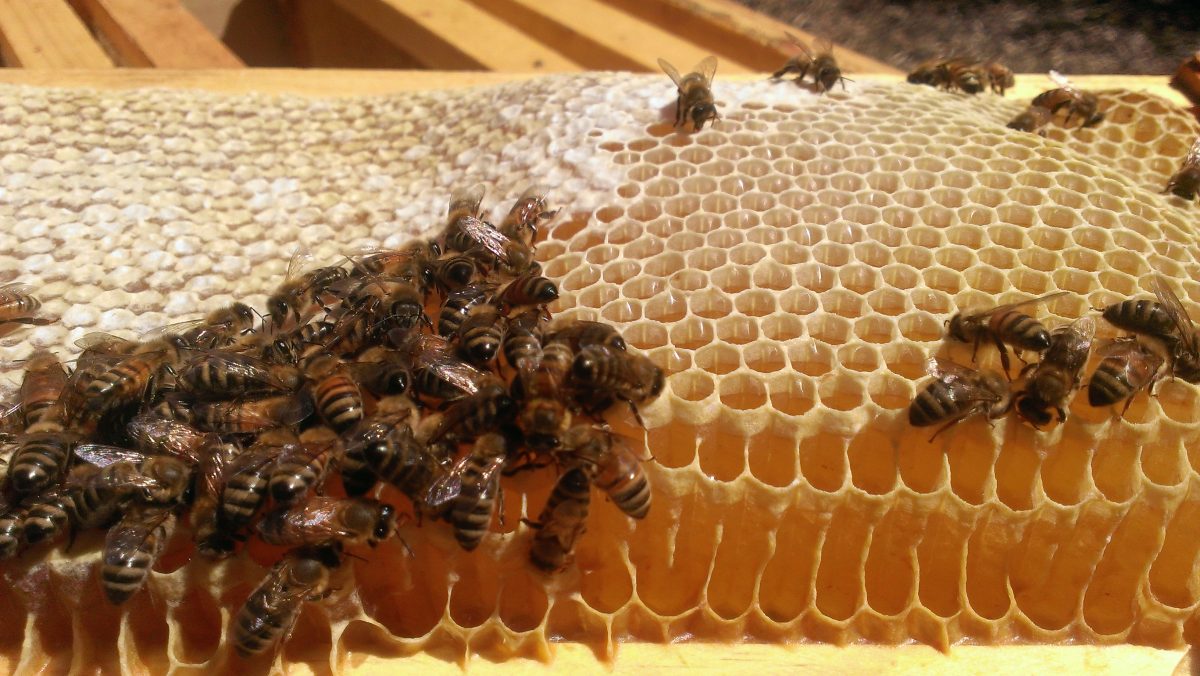
So, anyhow, I was ready to collect my 300 bee sample for the varroa mite test.  The gizmo went on the top of the second hive box, hanging over the third near me, while I 400_honey-extraction_0225extracted a central frame with brood.  A quick shake of the frame over the gizmo caused a whole bunch of bees to tumble onto the corrugated metal.  It also caused a whole bunch of them to fly directly into the hood and leather gloved hands.  Taking the gizmo over to the table I have set up near the bee yard (a mistake), several of the little literal buggers flew away before I could pour them into the canning jar and close the lid.  After comparing the number of bees in the canning jar to the 4 oz. mark on the dispensing cup, I decided that this was all I was gonna get anyhow, so I went with that sample size.

I want, for these first few counts, to be as accurate as possible and that requires freezing the sample, then counting the bees to be sure I have around 300, the minimum sample size.  After that, they go in an alcohol bath.  Shaking them knocks off the mites and then they come off through a 1/8″ screen filter, falling into a light colored cup so I can count them.  We’re shooting for under 10%.

When the count is in the book, I’ll rest the bees until Wednesday, supposed to be sunny, and then try to estimate the amount of pollen and honey in the package colony and the divide.

Neither Special Nor Unique

September 6, 2010 on 8:06 am | In Bees, Holidays, Memories, Politics, US History | No Comments yet, your thoughts are welcome »

Lughnasa                                             Waning Artemis Moon

Our play date with the role-playing citizens of the Renaissance Fair has ended.  Kate works 9-2 today, a long day for her, all that time on her feet.

I have hive inspections and a varroa mite count.  In the hive inspections I have to find out if my hives have enough honey and pollen stored for the winter.  Not sure how to tell if they have 75-95 pounds of honey and three frames of pollen.  The honey supers also come off today, all of them and entrance reducers go on.  So, a busy day in the bee yard.

It’s Labor Day so Kate and I have our own way of celebrating.

When I grew up in post-WWII central Indiana, the labor movement had begun to flex its muscles.  Manufacturing in industries like steel, tire and automobile factories labor-dayconcentrated workers in large numbers, often in shift work.  In Anderson, Indiana, near my hometown of Alexandria, for example, Guide Lamp (headlights and tail-lights for GM cars) and Delco Remy (alternators and batteries) employed as many as 25,000 workers, all pulling into the same parking lots, punching the same time clocks and working together on the factory floor.  This kind of concentration in jobs that seemed then as if they would go on forever allowed the United Auto Workers to demand and received impressive salary, pension, health and sick leave benefits for the workers.

If necessary, the UAW chose one of the big three (remember them?):  Ford, General Motors or Chrysler, and threatened to strike.  If they could negotiate a settlement, it served as the template for the other two.  If they couldn’t negotiate, they struck.  After the settlement, it served as the template.  The steel workers were strong, too.  The labor movement played a big role in politics since the one sure counter point to lots of political cash is lots of people.  The unions had people and the Republicans had money.  That was the throw down for many, many elections when I was young.

Alexandria had a booming downtown with a men’s store, a women’s store, two dime stores, a PN Hirsch department store, a couple of taverns, two movie theatres, a bakery, two banks, a Carnegie library, barbers and tailors.  It also had a daily newspaper.  All this in a town of 5,000 people.  No Wal-Marts or K-Marts or CVS or Walgreens or McDonalds.  Instead we had Murphy’s and Danner’s, Bailey’s drugstore and the Rexall Drugstore, the TopHat Drive-in and Cox’s Supermarket.

It may have been a good time for labor.  It was.  It may have been a good time for small town America.  It was.  It was not a good time for African-Americas as the 1960’s would prove.  It was not a good time for world peace as we insinuated ourselves into the Vietnamese Civil War, faced down the Soviet Union in Cuba and fought that most peculiar of conflicts, the Cold War.  Dicken’s may have had it right for all times.

Now many if not most of Alexandria’s store-fronts have plywood over them.  Dollar stores and discount chains are downtown, the movie theatres are closed and the creeping franchise serpent has swallowed the rim of the town while hollowing out the center.  General Motors employs around 800, not 25,000.  It is no longer a good time for labor.  It is no longer a good time for small town America.  It is a better time for African-Americans, though they now have to cope, too, with the onslaught of Latinos main-street-blueswho have become the nation’s largest minority group.  It is not a good time for world peace–has there ever been a good time for world peace?  We have only this month pulled out of Iraq, mostly.  Our effort in Afghanistan grinds on and on.

Joseph will be deployed next month to Qatar and will fly missions in this latest of the conflicts of a conflict riddled start to the 3rd millennium.  There are jobs in the military.

On October 2nd, I’m returning to Alexandria for the first time since my father’s funeral.  Alexandria is a sort of litmus paper for the health of the country. It is not special, not unique; rather, it gets hit by all the changes that have riven our country and has no levee’s to protect it from them.  That is, I should say, it is neither special nor unique to the rest of the country, but for those of us who grew up there, my friends in the class of 1965 with whom I will ride on a float in the homecoming parade 45 years after our graduation, for us it is more than special or unique, it is or was home.

Waning Day

September 4, 2010 on 5:54 pm | In Andover Weather +, Bees, Garden | No Comments yet, your thoughts are welcome »

Lughnasa                     Waning Artemis Moon

The evening of a fine day is a silk garment laid on to welcome the night.  It caresses, soothes.  It wraps itself around the shoulders and extends a brief embrace as light fades cradlingwheat1938and the stars come out.  It is, as my ancestors knew, a sacred time.

These days of September are the evening of the growing season, a transition to the colder, fallow season of late fall and early winter.  I’m glad they’re here.

As with each day, each week, each month of the growing season there are tasks appropriate to the time.  Here are a few of the ones we have left:

Garden

  • put a riser on the irrigation head nearest the deck
  • put composted manure and/or compost on the raised beds
  • Weed  perennials
  • harvest potatoes, beets, greens, tomatoes
  • save seeds:  tomatoes
  • plant bulbs
  • plant garlic
  • transplant:  gooseberries, hosta, bugbane
  • black plastic and mulch along truck path

Bees

  • sample for varroe mites and nosema
  • check honey and pollen supply
  • feed if necessary
  • in november prepare for winter

Sitting Back

September 3, 2010 on 5:22 pm | In Aging, Art, Bees, Garden, humanities | No Comments yet, your thoughts are welcome »

Lughnasa                                       Waning  Artemis Moon

The big push on honey extraction, preceded by the push to mulch the orchard and the vegetable garden, has left both Kate and me happy the weather has soured.  She sews,fillory now in the room right above my study, and I tap tap tap away following this lead and that down the cyber rabbit hole.

After reading Romance of the Three Kingdoms and Blind Descent, I’ve veered off into fiction, a sort of relief has taken my reading and I’ve plowed through 2 1/2 novels this last week +.  None of it so far is noteworthy, just pleasant diversions.

Worked this last week on a project for the office of Learning and Innovation at the Museum.  It involved responding to a new exhibition of heads and masks to be installed in the hallway in front of the antiquities galleries.  It’s part of the Art Remix concept.  Thinking in this way, finding connections between the new installation and other parts of the museum, stimulated me, shot off a spark or two.

Bee Diary: Honey Extraction, Photos

August 30, 2010 on 6:05 pm | In Bees | No Comments yet, your thoughts are welcome »

Lughnasa                                           Waning Artemis Moon

By Kate’s calculation we have 4.875 gallons of honey.  Not bad.  In terms of, say, filling up your car, 4.8 gallons doesn’t sound like much, but in terms of filling up canning jars filled with honey, it’s a lot.  The following photos will give you an idea of how the day went.

400_honey-extraction_0225

The gear.  I wore the white suit and the gloves for the extraction because it protects me better when the bees get defensive.

400_honey-extraction_0226

Each time I have tried to work in the hives without this essential tool, the smoker, I’ve gotten stung.  Every time.

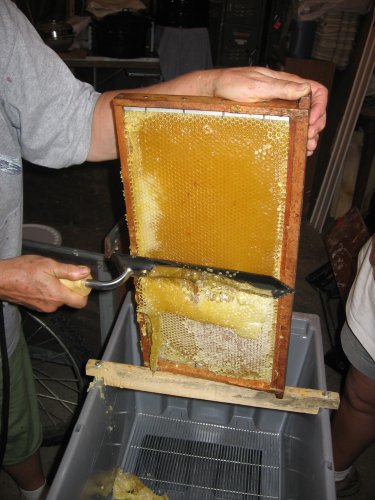
400_honey-extraction_02391Doing the extraction. The frames with honey go in the extractor, lid up.  Then they whir around and centrifugal empties them of their honey while leaving the honey comb intact.  That means next year’s bees won’t have to waste energy building comb.  They can go straight to honey production.

400_honey-extraction_0240

Afterward, my fastidious wife (as she referred to herself), hit the extractor with soap and water.

400_honey-extraction_0248

The lawn tractor got a workout today.  Here I’ve loaded it with honey supers that now have empty frames.  They go back on the hives for a couple of weeks so the bees will clean them out before storage for winter.

400_honey-extraction_0244

The bees on the parent colony just before I put back on the recently spun out frames.  BTW:  Kate made all the wooden ware you see here.  I think it’s beautiful.

Bee Diary: Honey Extraction, Day 2

August 30, 2010 on 1:48 pm | In Bees | No Comments yet, your thoughts are welcome »

Lughnasa                                       Waning Artemis Moon

Artemis Hives have given up their surplus honey, all under the Artemis moon.  We started this morning with Kate putting a plastic drop cloth down on the deck while I went out to the colonies to see what was still there.  The divide had, as I expected, nothing.  That means, oddly enough, that they will need to be fed over the next few weeks before winter sets in.  The parent colony, the big dog as far as honey production, produced a good bit.  Two full supers plus maybe half of a third.  We’re well over three gallons now, probably closer to five.  I’ll get an exact count soon.

Honey extraction has its straightforward side.  Take the full frames, stick them long side up in the honey extractor and turn it on.  If there is a significant amount of 400_honey-extraction_0239capping, there is an additional step, uncapping.  Kate did this chore with the electric uncapping knife.  We had at least one extractor run with 80% or more capped.  This honey was darker.  We can bottle it right out of the extractor after filtering.

(Kate inspecting a frame to see if the honey has been extracted.)

The rest had less to no capping.  That honey has a higher moisture content and, as I said yesterday, has to be heated to kill the yeast and thereby avoid fermentation.  The taste difference is insignificant to my palate.

When we spun out the first six frames, all went well.  We emptied the extractor, took the honey in and Kate heated it.  By the time I brought the next two supers full of honey frames, however, the bees had found us.  It took a bit longer because we were further from the hive than the honey house (at least the building I’d intended to serve as a honey house.), but they found us.  After that, all sticky, sweet operations had numerous bees in attendance.  They were not aggressive, but they made the process a bit more nerve racking.

Once again the heat caused sweat to cascade over my eyebrows and into my eyes, inside the bee suit where the eyes cannot be reached by hand.  I wore the bee suit because the bees are more defensive during honey removal.  Makes sense.  But that damned bee suit amps up the humidity and heat.  Not fun.

We now have half-pint, pint and quart jars filled with an amber liquid, a sweet product made, collected and bottled right here at Artemis Hives.

Bee Diary: Honey in the Jar

August 29, 2010 on 9:44 pm | In Bees | No Comments yet, your thoughts are welcome »

Lughnasa                                    Waning Artemis Moon

The waning Artemis moon has a golden hue tonight, honey colored, as it sits on the northeastern horizon.  A band of clouds created two dark lines, parallel to each other and about a third of the way down.  It looked like a view of the moon from an ukiyo-e print.

We have bottled our first honey.  Those four frames from the package colony, not even full frames at that, yielded almost a full gallon of honey.  We strained it through a coarse, medium and fine filter and put it into half pint jars for the most part.  It looks beautiful and very satisfying.  Artemis Hives has begun to produce.  I think I’ll tip a half-pint out in the woods to honor the namesake goddess.

Tomorrow I’ll work first on the divide, since I know it has very little honey in the supers.  It plugged up the third hive box with honey back in late May, early June.  After that I’ll move to the parent colony.  The parent colonies produce the most honey because they are vigorous and are not storing honey for the next year.  It will be interesting to see how much we get from the parent colony since next year, if everything goes well, we’ll have two parent colonies and two divides.  Four colonies should produce plenty of honey for our own use and to give as gifts.

It’s going to be hot with dewpoints in mid-70s.  That’s good for working with the honey because it flows well when the temperatures are high; that’s bad for working with the bees because I have to wear a veil at least.

We bolted the honey extractor to the deck instead of using the honey house.  Did that for a couple of reasons.  First, it’s much further from the colonies and second, it’s much closer to the kitchen.  Also, the mess, and it is a messy process, can be contained with drop cloths.

Bee Diary: Honey Extraction

August 29, 2010 on 4:42 pm | In Bees | No Comments yet, your thoughts are welcome »

06-27-10_package-colonyLughnasa                                   Waning Artemis Moon

The honey extraction has begun.  Kate and I assembled the extractor this morning.  I am not at my best during the accomplishing of mechanical tasks and got a bit testy.  Kate gave me some space; reengaged.  Then I considered aligning myself with the flow of our day–instead of bucking it because I felt incompetent, got my head and heart back in connection and we solved a problem together.  The directions for attaching the power unit were, to be kind, vague.  Bordered on the non-existent, really.  Together, however, we figured out to raise the drive shaft far enough to makes its union with the industrial strength Baldor motor work tight.  It’s a work-around for now, but I’ll connect with the folks at Dadant and we’ll get it done right after we’re finished with the honey harvest tomorrow.

I removed four frames from the package colony, a gift really, since its primary job this year was to grow into a parent colony that I can divide next spring.  The bees do not like it when you take their honey.  I have one sting to show for that.

There were several lessons from the honey super removal.  First, I put the empty super that held the frames after I removed them from the hive in the wagon attached to the lawn tractor.  Worked well logistically for me, but I ended up with an inch deep and foot square pile of mad bees on the bed of the wagon.  I had to use the bee-brush to brush them all onto the ground.  That made them even less happy.  I realized that doing several colonies and working each colony in turn would result in one bee yard full of mad bees.

So, tomorrow I will put the empty honey super on my standby, the wheel barrow with a wire dog crate door on it.  Don’t laugh.  It works.  That way the left over bees will be either in the wheel-barrow or on the ground, not in the wagon bed.

Second, the package colonies frames were not 80% capped, so I had to heat the honey to 145 to kill yeast and avoid fermentation.  Heating the honey turned tricky when it climbed above 145 to 160. I’m sure the yeast are dead now, but I don’t know yet what we’ve done to the taste of the honey.

Our extractor holds six honey super frames and we only put in four so that made balance a little tricky at first.  The extractor is very much like a washing machine, though the extracting baskets rotate rather than agitate.  It acted like a washing machine with a load of rugs, really gyrating at much above 60% speed.  So, we ran it at about 58%.  Took about 20-30 minutes.

We got a lot of honey.  From four frames.  I’m thinking we may have more than I imagined. We’ll see tomorrow.

Photo Time: Late Summer

August 28, 2010 on 9:38 am | In Bees, Garden, dogs, permaculture | No Comments yet, your thoughts are welcome »

Lughnasa                                            Waning Artemis Moon

cr400_late-summer-2010_0200

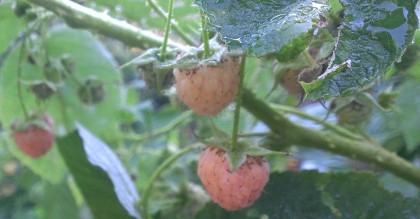
Late summer taste treats.  We have red and golden.

400_late-summer-2010_0182

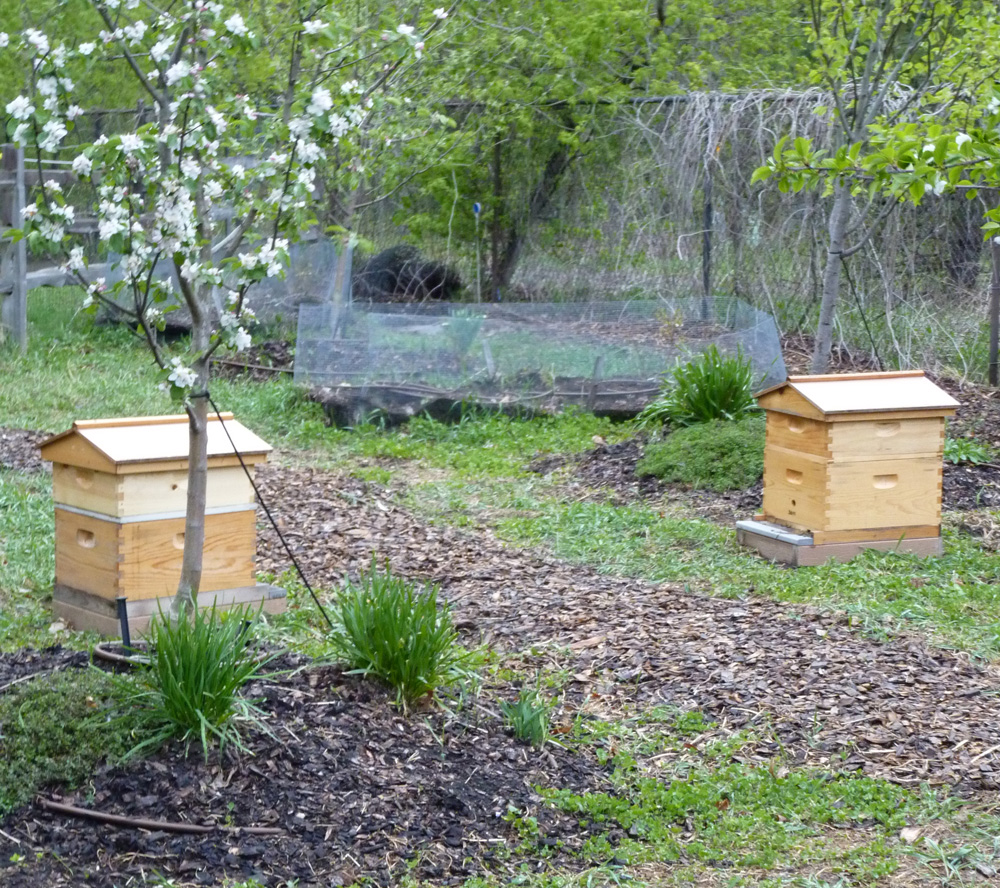
These are the hives with their maximum honey supers.  We extract honey on Monday.

400_late-summer-2010_0181

This is just one of several deep cave descents attempted by the Andover Speleological Society, Rigel and Vega founding members.

400_late-summer-2010_0164

The newly mulched orchard from the perspective of one of our sand cherry bushes.

400_late-summer-2010_0170

Our fruit trees have not really begun to bear yet, but there are six apples on this tree.  More as the years go on.

400_late-summer-2010_0175

Kate spearheaded this project and it looks great.  Not only does it look great, but it is more functional, too, especially from a weed suppression point of view.

400_late-summer-2010_0202

Kate plants coleus all round the yard; they add needed color to shady spots.

08-28-10_late-summer-2010_400

Next Page »

Entries and comments feeds. Valid XHTML and CSS. ^Top^ Powered by WordPress with jd-nebula-3c theme design by John Doe.