For Everything
August 26, 2010 on 4:48 pm | In Garden, Great Wheel, dogs, humanities | No Comments yet, your thoughts are welcome »Lughnasa Full Artemis Moon
A full day today and another one tomorrow. Late August through early September are busy times here at 7 Oaks and Artemis Hives. Kate’s worked like a Trojan, the
Norwegians of Greece, pulling weeds, making piles, churning through task after task. She wears me out. And she’s older than I am.
Each month has its own qualities, tasks appropriate to the time of year. August’s tasks include harvest, weeding, ordering bulbs for fall, considering the garden for next year, mulching, honey extraction. It also includes getting ready for the busy season at the MIA, the school year when students come through the museum in amazing numbers and the special expeditions go up. This year we’ll have the Thaw collection of Native American Art, Embarrassment of Riches, a photography show curated by David Little and the Titian Exhibition. The State Fair begins, kids get their last fond looks at the lake or the backyard or the baseball field, and adults take advantage of the heat. In Minnesota we know that often the best month of the year lies ahead, either September or October.
Just finished a book, Blind Descent, that narrates the search for the world’s deepest cave. The story line gripped me from the beginning, especially the technical descriptions of work in super caves. It recounts the culmination in 2004 of two of the most promising super cavers of the current era: Bill Stone and Alexander Klimchouk of Georgia. It was Klimchouk’s work in the Arabika highlands that yielded Krubera, the world’s deepest cave, at over 7,000 feet below the surface. Worth reading.
Vega and Rigel have a new project. They have dug several holes, some of them deep enough that their heads disappear in them. I can only assume they’re chasing something that burrows, probably a gopher. They seem to be doing a good deal more digging than catching. It was this kind of behavior last fall that led to the two fences that we have now. Seeing them dig as Kate and I worked in the orchard, inside one of those fences, I was so happy we had them. Right now Vega barks in her crate, ready to go back and hunt some more. We’ll wait her out.
War Games
August 1, 2010 on 9:19 pm | In Family, Great Wheel | No Comments yet, your thoughts are welcome »Lughnasa Waning Grandchildren Moon
The days have begun to grow shorter though the light still dominates. At the equinox the balance will shift with night overtaking the day until the long night of the Winter Solstice.
Joseph heads off for Tucson tomorrow for some kind of war game. He flies there in the JSTAR plane. Though he had
concerns about the heat, it looks cooler right now than Georgia. He goes to Qatar the end of September through early January for his first deployment. That will be hotter than either one, though the Qatar website says the best weather is between October and January. He’s lucky there.
Today is Jon and Jen’s 6th anniversary. How time flies when you’re having kids.
Lughnasa: A First Fruits Festival and Beginning of the Harvest Cycle
July 31, 2010 on 3:53 pm | In Faith and Spirituality, Great Wheel, Holidays, humanities | 1 CommentLughnasa Waning Grandchildren Moon
Turning round the star wheel we have come again to the first day of the month named after Augustus Caesar, First Citizen of Rome. In Celtic lands this month was: Welsh–Awst, Scots Gaelic–an Lunasdal and in Irish: Lughnasadh.
Though the coming of Autumn is not visible, the wind tells us it has come. Fujiwara no Toshiyuki
The Japanese word risshu means the first day of Autumn. By solar equinox reckoning we are a good 8 weeks away from that day, yet Toshiyuki’s poem suggests another
way to look for the fall of the year. Are there signals in the air, in the plant world, among the animals? Yes, there are. Lughnasa, a cross-quarter holiday in the Celtic calendar, marks the half-way point of the changes from the summer solstice to the fall equinox.
The bees have put away honey all July and August is the month when their honey production wanes. Many flowers and vegetables have already grown, flowered and fruited: iris, daffodil, tulip, lily, dicentra, coral bells, hosta and phlox. The long grasses have seeded as have many of the tall weeds, including the hemp that grows here in abundance. There are stalks, brown stalks, in the garden, the signs of a more general senescence that will over take all the flowers and vegetables as August continues and becomes September. Animal babies have begun to mature, witness the opossum pictured here a few weeks ago.
The main signal of seasonal change though, for me, is the change in the angle of the sun light. By August 20th, the sun’s angle of declination at its highest point in the sky, noon, will be 12 degrees less than the 69 degrees it achieved on June 20th, the summer solstice and the sun’s highest angle at our 45th degree of latitude. This changed angle, subtle at first, becomes obvious as August moves on and creates the tone of seasonal change in advance of temperature and other meteorological signals. We now journey toward the sun’s lowest angle of declination here, 22 degrees, reached at the Winter Solstice on December 21st.
In many webpages you will find confident reference to Lugh as the Celtic sun-god and to Lughnasa as his festival. Maybe. Celtic lore has a number of obstacles to clear understanding. The most difficult obstacles lie in the sources of information that we have for ancient Celtic life. Whatever written information, if any, the Celts left behind have been lost in the wake of the Roman invasions that began in 55 BC with the arrival of Julius Caesar. As a result we always look at the Celts through the eyes of their conquerors. Tacitus, for example, records the story of the Druids and their last stand across the Menai Straits in northwestern Wales. It is Caesar’s accounts of the Gallic Wars (Celtic Wars) that gives us much of the scanty information we have about Celtic religious life.
The next main source of information about the Celts comes from the Roman Catholic Church that overtook and weeded out both the ancient faery faith and the peculiar and attractive version of Christianity that evolved on its own before the Roman Church came. This Celtic Christianity emphasized a close relationship with the natural world and retained practices resonant with the Celtic faery faith.
Nowadays a different, but no less problematic type of interpretation occurs when the neo-pagan community takes up these holidays and puts into them the mythological narratives that appeal most to their sensibility. They can do this, of course, and, in fact, they do, but it does not mean that the interpretation they place on the sacred days have much, if any, congruence with the practices and beliefs of the ancient Celts.
Thus, the Celts and their ancient life exist behind by shrouds of interpretation motivated by ancient political exigency, motivated by medieval religious arrogance and now motivated by contemporary irrational adoration.
Lugh, in other words, is a name put on a Celtic deity by the Romans, who tended to associate the gods of conquered tribes with gods of their own. Lugh came to be equated with Hermes, Mercury to the Romans. We have very little direct information about the Celtic pantheon, though there is some.
What we do know for certain is that on and around August 1, for centuries, Celtic and English peoples celebrated the first fruits of the harvest on a day called Lughnasa. Brian Friel’s wonderful play, Dancing at Lughnasa, gives an excellent account of the holiday as it was still practiced in the early part of the 20th century. As the Burns poem below* attests, part of its celebration included going out into the fields of barley or wheat or rye or whatever, to practice human fertility rites.
Like the rest of the Celtic holidays, Lughnasa involved a week of fairs and markets, a time of celebrations, gatherings of people from various rural areas.
These holidays were and are significant in the daily lives of rural folks in the Celtic Countries and England. The Lammas Meadows are an example. Lugg Meadows in
Herefordshire, England are the largest and best preserved of 20 Lammas Meadows in England today, some of which still follow the medieval land tenure system that created them in the first place.
In this system the lord of the manor, who owned the fields, would rent the prime bottom land to those who could afford the rent. Bottom land was the most valuable land in the middle ages because it often had a sandy or rocky bottom with layers of fertile silt on top, creating a well-drained and rich field for growing hay. Hay was critical for it fed the many animals used in farming and in the other work of the manor through the winter.
The fee-holders would mark their holdings with ‘dole stones’, the holding being irregular strips of the bottom land on which they purchased the right to harvest hay. From Candlemas (the Catholic holiday laid over the Celtic celebration of Brigid, the triple Goddess, Imbolc) to Lammas (the Catholic holiday laid over the Celtic Lughnasa) the fee-holders and the Lord kept the Lammas Meadows ’shut for hay.’ Over this time only the Lord and the fee-holders could enter the land. On Lammas Day, however, the fields would open to the commoner–the person who used the common land–who could browse his animals in them until Candlemas, February 1st of the next year.
The farmer making hay from the Lammas Meadows (see pic) has an interesting graphic about his concept of sustainability. It involves a triple bottom line: social, environmental and economic. Here it is:
from a fascinating website: Wilson’s Almanac
*It was on a Lammas night,
When corn rigs are bonnie,
Beneath the moon’s unclouded light,
I held away to Annie:
The time flew by, wi tentless heed,
Till ‘tween the late and early;
Wi’ sma’ persuasion she agreed
To see me thro’ the barley.
The sky was blue, the wind was still,
The moon was shining clearly;
I set her down, wi’ right good will,
Amang the rigs o’barley
I ken’t her heart was a’ my ain;
I lov’d her most sincerely;
I kissed her owre and owre again,
Among the rig o’ barley.
I locked her in my fond embrace;
Her heart was beating rarely:
My blessings on that happy place,
Amang the rigs o’barley.
But by the moon and stars so bright,
That shone that hour so clearly!
She ay shall bless that happy night,
Amang the rigs o’barley.
I hae been blythe wi’ comrades dear;
I hae been merry drinking;
I hae been joyfu’ gath’rin gear;
I hae been happy thinking:
But a’ the pleasures e’er I saw,
Tho three times doubl’d fairley
That happy night was worth then a’.
Among the rig’s o’ barley.
CHORUS
Corn rigs, an’ barley rigs,
An’ corn rigs are bonnie:
I’ll ne’er forget that happy night,
Among the rigs wi’ Annie.
Robert Burns
A B- Garden
July 25, 2010 on 8:39 am | In Faith and Spirituality, Garden, Great Wheel | No Comments yet, your thoughts are welcome »Summer Full Grandchildren Moon
Lugnasa, August 1, the Celtic first fruits festival heralds the beginning of the harvest cycle of holidays. Lugnasa, Mabon (Fall Equinox) and Samain, October 31st, carry our sacred calendar though the bread made from the first wheat to the last of the crops gathered into storage. This means that the tenor of the year, changed at the Summer Solstice, has begun to gather force, no longer is the emphasis on growing and nurturing, but on collecting and senescence. At least in the vegetable garden and at Artemis Hives.
The flower garden still has a few licks to get in yet as the chrysanthemums, monk’s hood, fall blooming crocus, clematis
and asters preen themselves as the light begins to fade from the sky and the air cools. Right now the hemerocallis are going strong, creating a lively dance of color in the perennial beds.
Truth in writing disclosure: this has not been the best gardening year. I’ve not put in the amount or quality of labor I have in the past and the garden shows it. I’ve had trouble keeping my focus focused, my priorities prioritized. This is a fact for me in the best of times, but when I don’t pay close attention my center can shift often. Elsewhere I’ve called this the valedictory life, that is, a life in which I try to get an A in everything I do, instead of settling for a B or a C once in a while.
To make the valedictory life more challenging I find the world has many things that fascinate me, as any reader of this blog will have learned by now. Right now, at very best, I’d give the garden a B- this year. Sad to say.
On the other hand, I can make it better and that’s what I’m going outside to do right now.
Seeing What We Really Have Here
July 23, 2010 on 8:58 am | In Faith and Spirituality, Garden, Great Wheel, Great Work, Our Land, hydroponics, permaculture | No Comments yet, your thoughts are welcome »Summer Waxing Grandchildren Moon
We are well past midsummer here in the northern latitudes. The garden’
s peak bearing season will commence although we have already had blueberries, strawberries, raspberries, currants, garlic, lettuce, greens, onions, parsnips, beets and sugar snap peas. Ahead of us are tomatoes, green peppers, potatoes, more greens, onions, beets, lettuce, butternut squash, leeks, wild grapes and carrots plus the odd apple. Our orchard has a ways to go before it matures. And I have a ways to go before I can care for the fruit trees in the manner to which they need to become accustomed.
All of which opens up the purpose of this little experiment in permaculture and the tending of perennial flowers and plants. A long while back I bought three quarter-long horticulture classes from the University of Guelph in London, Ontario. It took me a while to complete it, maybe a year all told. The course helped me integrate and deepen what I’d learned by trial and error as I cared for the daffodils, tulips, day-lilies, hosta, croci, roses, trees and shrubs that then constituted our gardens.
In its salad days (ha, ha) the notion involved a root-cellar and the possibility of at least making it part way off the food grid. Fewer trips to the grocery store, healthier food, old fashioned preservation. A mix of back-to-the-land and exurban living on our own little hectare. Last year the notion began to include bee-keeping. Now called Artemis Hives.
As the reality of the size of our raised beds, the likely peak production of the fruits and vegetables possible has become clear to me, I have a more modest though not substantially different goal. We will eat meals with fresh produce and fruits during the producing part of the growing season. We will preserve in various ways honey, grapes, apples, pears, raspberries, strawberries, blueberries, tomatoes, potatoes, onions, garlic, squash, beets, greens and parsnips. These we will eat during the fallow days that begin as the garden goes into senescence in late August and early September and last through the first lettuce and peas of the next growing season. We will supplement these with greens grown hydroponically and use the hydroponics to start seeds and create transplants for 2011.
None of this will remove us in any major way from the store bought food chain. We will not solve or resolve much of our carbon footprint. But some. More than most perhaps, but far too little to claim even a modest victory. So, should we give up?
Not at all. Why? Well, there is a richer, deeper lesson here than living wholly off our own land. That lesson, taught again, day by day and week by week, and again, lies in the rhythm of the plants, the bees, the land and the weather. An old joke from the 50’s asked, “What do you call people who practice the rhythm method?” (Catholics at the time) Answer: “Parents.” The permaculture and perennial flowers here at Seven Oaks is a rhythm method. What do you call folks who practice this rhythm method? Pagans.
Ours is a life that flows in time with the seasonal music of the 45th latitude, the soil on our land, the particularities of the plants we grow, the energy of the bee colonies that work alongside us, the various animal nations that call this place home. This is the profound lesson of this place. Seven Oaks is a temple to the movement of heaven and the bees of Artemis Hives are its priestesses.
Whew
July 21, 2010 on 8:47 am | In Aging, Andover Weather +, Family, GeekWorld, Great Wheel, Great Work, Politics, Woolly Mammoths | No Comments yet, your thoughts are welcome »Summer Waxing Grandchildren Moon
OK. This will be last of this. But. Kate reminded me of her surgery on June 30th. Which preceded preparation for and the arrival and stay of Jon, Jen, Ruth and Gabe followed then, as I said yesterday, by our too inclusive preparations for the Woollys. No wonder I wore out yesterday. Let my prop it up and keep going inner coach have the day off. Better rested and more clear-eyed today. Ready for ancient Rome.
These two paragraphs came my way in the last two days. Their conjunction speaks for itself.
“Speaking of heat, NOAA reports that June was the hottest month in recorded history, worldwide. That is the fourth
month in a row of record warmth for planet Earth. June also marked the 304th consecutive month “with a global temperature above the 20th century average.” The last month with below-normal temperature worldwide? February, 1985. 2010
temperatures from January to June were the warmest ever recorded for both land and ocean temperatures, worldwide. Stay tuned.”
Check out Paul’s blog startribune.com/pauldouglas
(I imagine it’s photoshopped, but still…)
Mark Odegard found this quote in a book he’s reading about walking with caribou:
Henry Beston in the beginning of book.
“We need another and a wiser and perhaps a more mystical concept of wild animals. Remote from universal nature and living by complicated artifice, man in civilization surveys the creatures through the glass of knowledge and sees thereby a feather magnified and the whole image in distortion. We patronize them for their incompleteness, for their tragic fate for having taken a form so far below ourselves. And therein we err, greatly err, For the animal shall not be measured by man, In a world older and more complex than ours, they move finished and complete, gifted with extensions of the senses we have lost or never attained, living by voices we shall never hear. They are not brethrern, they are not underlings; they are other nations, caught with ourselves in the net of life and time, fellow prisoners of the splendour and travail of the earth.”
Just Loved This One
July 6, 2010 on 4:29 pm | In Commentary on Religion, Faith and Spirituality, Great Wheel, humanities | No Comments yet, your thoughts are welcome »Summer Waning Strawberry Moon

You Say You Want A Revolution? Yep.
July 4, 2010 on 1:23 pm | In Aging, Great Wheel, Great Work, Minnesota, Politics, US History, health, humanities, hydroponics, permaculture | No Comments yet, your thoughts are welcome »Summer Waning Strawberry Moon
It’s been done, I know. Still, I’d like to put in a call for a 2nd American revolution. Oh, ok, I don’t care what number it is. I’ll settle for another American revolution.
My American revolution has a bit of Norman Rockwell, a touch of Helen and Scott Nearing, more than a dab of Herbert Marcuse, Paul Goodman and C. Wright Mills, some Benjamin Franklin, the spirit of pioneers and
native Americans alike when they relied upon on this seemingly limitless land for food and space. There’s a Victory Garden or two in there as well, plus generations of smart women who canned, dried, jellied, smoked and pickled all sorts of produce and meat. This New American Revolution demands no marches, no banners, no barricades, no guns and no repression. And you can dance all you want.
What is it? It is a revolution of and for and with the land. It is a revolution that takes the wisdom of a 7th generation Iroquois medicine man who said: “We two-leggeds are so fragile that we must pray and care for all the four leggeds, the winged ones, those who swim in the waters and the plants that grow. Only in their survival lies the possibility of ours.”
What is it? It is a revolution of and for and by the human spirit. It is a revolution that insists, but gently, that we each put our hand and our back to something that feral nature can alter. It could be a garden. It could be a deer hunt. It could be a potted plant outside where the changing seasons affect its growth and life. It could be a regular hike in a park, through all the changes of the seasons, seeing how winter’s quiet fallow time gives ways to springs wild, wet exuberance, the color palette changing from grays, rusts and white to greens, yellows, blues, reds the whole riot.
What is it? In its fullest realization this revolution would see each person responsible for at least some of their own food, food they grow or catch or kill. In its fullest realization each person would use whatever land they share with the future in such a way as to increase its natural capital, using the land in such a way that it improves with age and gains in its capacity to support human, animal and plant life.
What is it? In its fullest realization this revolution would find each person closer, much closer to the source of their electricity, their transportation and its fuel, their work and their family. In its fullest realization this revolution would shut down the coal-fired generating plants, shutter the nuclear generating plants and have maximum and optimum use of wind, geothermal, hydro, solar and biomass generation. In its fullest realization each person would eat food that had traveled only short distances to their table, the shorter the better, the best being from backyard or front yard garden to the table.
What is it? Well, we have a ways to go yet. Perhaps a long ways, but if we want our descendants to have a chance to enjoy the same wonders in this land that we have known, we will have to change. We will have to change radically. We need, as I suggested, another American revolution.
Thanatophobia
June 25, 2010 on 8:45 am | In Aging, Asia, Commentary on Religion, Faith and Spirituality, Great Wheel, humanities | No Comments yet, your thoughts are welcome »Summer Full Strawberry Moon
It has, so far, been a death saturated beginning to summer. Emma. Now Hilo’s bleak prognosis and Gyatsho’s one year dead ceremonies. In reading some material about the Tibetan attitudes toward death they were helpful to me, and echo feelings I’ve long had, but find difficult to internalize due to my Western, Christian thanatophobia.
Death, in the Buddhist perspective, is natural. It comes, in other words, with life. As one comedian put it, “Life is a terminal disease.” Given this it doesn’t make sense to get too excited about it, or too fearful. In
fact, the Tibetan Buddhists believe that your emotional state at the time of death impacts your next reincarnation significantly. The more peaceful and calm you are at the moment of death, the more likely you are to reincarnate in a situation improved over your last life.
[Yamantaka Mandala (Overcoming Death Mandala) at the Minneapolis Institute of Arts]
I don’t know about that, reincarnation may be a fact, but if it is the evidence is hidden from me, still the notion of meeting the inevitable with equanimity feels right to me. I say this aware of the grief, sadness and loss I feel when a dog dies. I’d have to guess that Emma will reincarnate up, since I imagine her exit was peaceful. Can’t tell until the moment comes, but my sense about myself is that I will face death with a calm and peaceful demeanor.
It is ironic, and ironic is not a strong enough word, that the Christian influenced Western culture has such a strong thanatophobia. A religion that bases its message on the surety of salvation and the confidence, often expressed in obituaries, that the deceased has “gone to be with Jesus” or “was greeted by their husband, mother and father” or “entered the gates of heaven,” has produced a peri-death experience far too often involved with extreme and obviously futile medical measures to prolong life, no matter the quality of that living or the expense with which it is bought.
There is some evidence that this thanatophobia is weakening, people wanting to die at home, services emphasizing celebration as well as grief, but we could all take a page, or even a whole chapter, from the Tibetan Book of the Dead and greet this inevitable visitor with the ease and hospitality accorded any important guest.
So, from this view, a death saturated June is no cause for alarm or railing against the unfairness of it all, rather it is a time for acknowledgment, sadness and acceptance.
Summer. It’s About Time.
June 21, 2010 on 10:35 am | In Aging, Bees, Faith and Spirituality, Garden, Great Wheel, Great Work, Holidays, Myth and Story, humanities | No Comments yet, your thoughts are welcome »Summer Solstice Waxing Strawberry Moon
The longest day of the year. Light triumphant, streaming, steaming. The darkness held at bay.
Summer Solstice
This is an astronomical phenomenon transformed and translated into a spiritual one. We humans have over millennia taken solstice and equinox alike as moments out of time, a sacred caesura when we could review our life, our path as the Great Wheel turns and turns and turns once again.
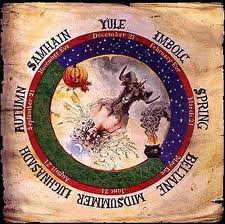
The Celts first divided their year into two: Beltane, the beginning of summer, and Samhain, literally summer’s end. As their faith tradition developed, they added in both solstices and equinoxes. Since Beltane and Samhain occurred between the spring equinox and the summer solstice and the autumnal equinox and the winter solstice respectively, they became known as cross-quarter holidays. Imbolc and Lughnasa filled in the other two cross-quarter spots.
It is the eight holidays, the four astronomical ones and the four cross-quarter, that make up the Great Wheel. In the most straight forward sense the Great Wheel emphasizes cyclical time as opposed to linear or chronological time. This seems odd to those of us raised in the chronological tradition influenced by Jewish and Christian thought in which there is an end time. With an end to time the obvious influence on our perception of time is that we progress through the days until they become years, which become millennia until the Day of the Lord or that great risin’ up mornin’ when the dead live and time comes to a stop.
That this is an interpretation rather than a fact rarely crosses the mind of people raised on birthdays, anniversaries, celebrations of one year as it comes followed by the next. Our historical disciplines from history itself to the history of ideas, art history, even geology and the theory of evolution all reinforce the essentially religious notion of time as a river flowing in one direction, emptying eventually into an unknown sea which will contain and end the river.
Immanuel Kant, in attempting to reconcile the dueling metaphysics of two apparently contradictory philosophical schools (rationalists and empiricists), hit on the notion of time and space as a priori’s, in a sense mental hardwiring that allows us to perceive, but is not inherent in the nature of reality. That is, we bring space and time to the table when we begin ordering our chaotic sense impressions. My interest in the Great Wheel and in the traditional faith of my genetic ancestors came in part from a long standing fascination with the question of time. We are never in yesterday or tomorrow, we are always in now. What is time? What is its nature and its correct interpretation relative to the question of chronological versus cyclical time?
I have not settled these questions, not even in my own mind, and they continue to be live topics in philosophy. Learning to pay attention to the Great Wheel, to the now, and to the specific place where I live has pushed me toward the cyclical view, as has gardening and now the keeping of bees. It is, today, the Summer Solstice. Again. As it was the last time the earth visited this location in space (ah, yes, space. another conversation which we’ll bracket for now) and as it will be the next time. This is a literally cyclical view of time based on the earth’s orbit around the sun, one which returns us, over and over to much the same spot.
Next summer when the solstice arrives the asiatic lilies will be ready to bloom, Americans will be getting ready to celebrate the fourth of July and kids will be out of
school. The mosquitoes will have hatched, the loons returned and basketball will finally be over. These kind of phenological observations depend on the repetitive, cyclical character of natural events. There is a real sense in which this time does not move forward at all, rather it exists in a state of eternal return, one solstice will find itself happening again a year later. Is there any progress, from the perspective of the solstice, from one to the next? Not in my opinion.
I don’t deny the intellectual value of arranging knowledge in what appears to be a rational sequence. It aids learning and explanation, but it may well be a mistake to think that sequence exists outside our mental need for it. It may just be that time is, in some sense, an illusion, a useful one to be sure, but an illusion none the less.
Even if it is, we still will have the Summer Solstice and its celebration of light. We will still have the Winter Solstice and its celebration of the dark. We can see each year not as one damned thing after another, but as a movement from the light into the dark and back out again. We can see the year as a period of fallowness and cold (here in the temperate latitudes) followed by a period of fertility and abundance. This is the Great Wheel and it currently makes the most sense to me. That’s the light I have today anyhow. Let’s talk next year at this time.
Entries and comments feeds. Valid XHTML and CSS. ^Top^ Powered by WordPress with jd-nebula-3c theme design by John Doe.