Category Archives: Asia

Sunday in the Snow

Samhain                                                       Thanksgiving Moon

Drove in.  Plows had moved snow, but on all roads only one or two lanes were open.  The traffic, as a result, moved slow, but steady, somewhere between 30 and 45 mile an hour, mostly a function of congestion.

The Rav4, which has not had a lot of winter driving, performed well.  I felt safe as it shifted from 4D to 2D, from slip and slide stabilization to none.

The tour was good, had a lot of folks, maybe 20-30.  I thought they were attentive, stayed with me, but at the end just a thank you.  Not sure what it meant.  I thought we bonded along the way, maybe they were just undemonstrative.

An hour plus both ways, on what is a maximum 45 minutes and often less.  Shot the afternoon.  Back home.  Had stew, some bread.  Now to read a bit.  Sundays are slower than the other days.  Habit, I guess.

Endings

Samhain                                                    Thanksgiving Moon

Took my final quiz.  Graded my five assignments of others.  The mythology class is over for me.  This week, too, I finished the first revision (not at all the last) of Missing.  And, too, it was just this week, Friday, that all the research I’d done prior to the Terra Cotta Warrior exhibition finally came together and created a good tour, maybe a very good one.

That means three areas where I’ve put a lot of energy over the last three months, since September, have all come to fruition and closure in the same week.  An accident, I think, but it has left me feeling exhilarated on the hand and let down on the other.  Sort of a dip, a consequence of juggling three large balls for a significant period of time, then having them all disappear.  What do I do now?

(Hermann-Hendrich-The-Norns-1906)

Well, I know the answer to that.  Latin.  This whole next week will be focused on translation.  Then, the week after that I’ll turn to learning how to print out my manuscript using the new software, making a few revisions of location and joining of scenes–and, I’ll add a scene I realized over dinner that I need to include.  A result of a change made earlier.

In the last week of the month, Christmas week, I’ll start writing Loki’s Children, Book II of the Tailte trilogy.  Looking forward to that.

TCW

Samhain                                                                   Thanksgiving Moon

A public tour of the Terra Cotta Warriors today.  Hitting my stride.  All the work beginning to pay off.  Interested, engaged attendees.  Lots of questions.  Folks hanging around after.  Felt good.

Tours Today

Samhain                                                                       Thanksgiving Moon

A good day of tours.  5th graders with great imaginations and college students from Manitoba, history students and studio arts.  Both groups attentive, excited, questions.  Good affirmations in several ways.  My tours are improving.

Energizing the Tour

Samhain                                                  Fallowturn Moon

A follow-up to my last post.  Sent as e-mails to my docent colleagues.

After reflection on what I wrote to you (often get my best ideas from writing things down), I’ve asked two of my leads to let me begin in the 4th gallery.  While touring the Sports Show last year, I had a similar problem with energy, beginning in the room with the smaller photographs.  When I begin using the Zedane video first (the last piece in the show) and going backwards, my tours got recharged.


This may be a similar situation.  My hope is that by focusing on what drew people in the first place, their excitement about the tomb and the objects will energize them enough to learn the history of the Qin state.  Also going to be working on my questions.

Touring Terra Cotta, #2 and #3

Samhain                                                                 Fallowturn Moon

OK.  Three tours under my belt.  I’m not finding interest like I expected.  It may be my presentation which is long on history and perhaps not as attentive to the terra cotta figures.  It may be the groups.  Today was a group of kids from Lacrosse who had ridden three and a half hours in the bus and were sleepy and an online art history class who’d never seen each other before.  Yesterday’s group, the friends, was more lively.  Could be both.  Maybe my selection of objects?

I’m actually spending about half an hour in the first two galleries, trying to focus on the development of the Qin state from its beginnings in the horsebreeding days of the early Sping and Autumn Period, to its gradual consolidation in the Warring States Period.  Maybe that’s too much?  Just not interesting?  This seems like a really important story to me, a story about the formation of Chinese political culture against the backdrop of hundreds of years of violence.

The information is, to me, fascinating and the objects, Bo Bell, Dagger, Ceramic Cavalry figure and the Hu vessel all engaging.  The energy overall seems low.  Wonder if anybody has a similar or very different experiences?

I want to do this well and I don’t feel like I’m hitting the right notes.

Touring Terra Cotta, #1

Samhain                                                   Fallowturn Moon

First terra cotta tour today.  A bit of gear crunching, absent minded passing of objects, but the questions were good, the attention regular.  These were Rochester Friends.

I have the right combination of objects for my story, the rise of the Qin state and its peak during the dynasty of Qin Shi Huang Di.  Forgot to show the illustrations on the pits and give the discovery story, been so immersed in the data that I forgot where beginners are.

This group had heard a lecture that focused (at least according to the announcement) on much of the same material I wanted to cover.  Didn’t seem to be much overlap though.

Tomorrow two more so I get a chance to work on my game.

Tour Introduction

Samhain                                                          Fallowturn Moon

Introduction to a tour of the Terra Cotta Warriors exhibit:

In the 2002 movie, Hero, directed by Yimou Zhang, Sky, an assassin from the state of Zhao confronted Qin Shi Huang Di in sword play; yet, when the decisive moment came, sheathed his sword and fled.  Later, he tries to dissuade Nameless, played by Jet Li, who has trained 10 years to assassinate Qin Shi Huang.

“Why,” Nameless asks, “Do you try to stop me?”

“Two words,” says Sky.

He writes two characters in the sand of the desert with his sword.

When Nameless, too, lets Qin Shi Huang Di live; the king of Qin, soon to become the first emperor, asks him, ‘What were the two words?”

“Our land.”

Hero continues an ongoing campaign, begun under Mao’s leadership, to rehabilitate the image of Qin Shi Huang Di, whose early representations in Chinese history, especially in the Records of The Grand Historian, written by Han historian Sima Qian, were of a cruel, heartless ruler.

Now, we see Qin Shi Huang Di compared to George Washington as the father of his country.  The bit from Hero supports this view.

The terra cotta figures themselves, unique and special as they are artistically, have the primary function now of pointing to the achievements of Qin Shi Huang Di and, by extension, to the story of the Qin state, a story that begins in 771 b.c. with the Zhou dynasty, once secure in the areas inhabited by the early Qin, fleeing to the east as nomads, barbarians from the steppes and grasslands invade.

A Qin armed escort saw the fleeing royals of the Zhou dynasty safely to their new capital, now well to the east.  In gratitude the Zhou gave the Qin leadership a title approximating Duke with a large land grant which became both the Qin state and the western border of Zhou dynasty.  The Qin had had land out there on the frontier previously, but this they held not as rulers, but as horse breeders, a skill for which they were prized.

The 771 bc invasion breaks the Zhou dynasty’s reign, begun in 1100 bc, into an Eastern Zhou realm, nominally controlled by the Zhou kings, and a Western realm, now under the control of warlords like the Duke of Qin.  Thus begins the Spring and Autumn period of Chinese history, running from 770 bc to 476 bc.  During this time there were numerous small states, perhaps as many as 200, each with a king or a duke.  This period ends with the inevitable consolidation of these states into 7 larger ones:  Qin, Zhao, Qi, Chu, Han, Wei and Yan.

Just before the end of the Spring and Autumn Period comes China’s 100 schools of thought.  In this era Chinese intellectuals tried to limn a a way out of the awful, ongoing violence.  In this period Confucius, Lao Tze, the Mohists and the Legalists among many others present different models for a peaceful state.  Confucius suggests a harmonious state based on harmonious relations:  ruler to people, husband to wife, father to son, older brother to younger brother, friend to friend.  He also developed rituals to bind the whole together.  Lao Tze, the Taoist school, sought to retire from action, to live with the flow of events and the natural world.  The Mohists spoke of unconditional love and actively tried to intercede in violent confrontations.  The Legalists, like Qin Shi Huang Di’s advisor Han Fei, believed in strong, clear laws applied equally to all and in harsh, certain punishment when the laws were broken.

This was, globally, the Axial age, the time of the Buddha, the Hebrew Prophets,  Upanishads, Lao Tzu, Homer, Socrates, Parmenides, Heraclitus, Thucydides, Archimedes, Elijah, Isaiah, Jeremiah, and Deutero-Isaiah as well as  Socrates, Confucius and Zoroaster.

The 100 schools did not end the violence.  Mutual warfare continues from 476 bc to 221 bc, the Warring States period in Chinese history.  The Warring States Period ends when Qin defeats and absorbs the last of the seven.  This is Qin Shi Huang Di’s most visible accomplishment, the unification of China, and the one for which he earns the designation, the George Washington of China.

It is not, however, his most important accomplishment.  His dynasty lasts only 14 years, followed by the rise of another of the Warring States, the Han.  His most lasting legacy lies in the centralization of rule and his rejection of the old method of allowing warlords to become kings, which lead to the Spring and Autumn period.  Qin Shi Huang Di standardized currency, chariot axle-widths, script, weights and measures and he tried to standardize the interpretation of the past.

It was, however, his creation of a court supported by highly trained officials and ruling directly through appointed positions that became the Chinese model for governance, a model still in place today.
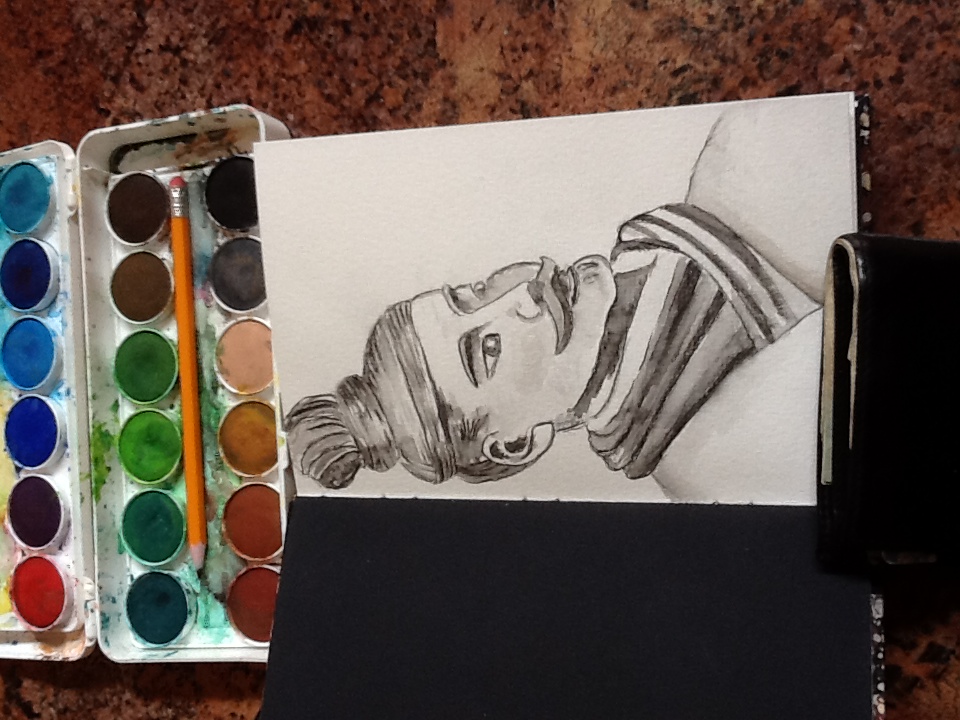


My Vote’s With Barack, But My Heart’s With Qin Shi Huang Di

Samhain                                                                    Fallowturn Moon

As Mitt and Barack go into the ring for real tomorrow, my attention remains focused on an earlier political figure, Qin Shi Huang Di, and the Qin state.  Of course, I’ll break out of my ancient Chinese reverie to head down to the polling place tomorrow.  Can’t miss that.  Haven’t done since I was old enough to vote.  Which was, BTW, 21 for me.

I’ll be surprised if Obama loses, not sure I’ll be happy if he wins.  There are, of course, those Supreme Court justices and the execution of the Health Care act.  Still, he’s not made my lefty heart flutter and if Gus Hall were around I’d vote Communist again.

Meanwhile I’ve defined a tour route using the Bo Bell, the gold and iron dagger, the early tomb figures (small), the Hu vessel, the kneeling archer, a nod to all the various acts of standardization, the chariot horse and the various pits, the General and the water birds.  My focus remains the rise of the Qin, including the reforms of Shang Yeng and the broader and deeper reforms of Qin Shi Huang Di.  This is a wonderful moment to help people grasp a bit of Chinese history, and not just any history, but history that shaped and shapes the Chinese state.

The story, too, can be told using wonderful, beautiful objects.  A great honor.

Woolly Art

Samhain                                                       Fallowturn Moon

I’ve asked the Woollies for American cinquains in response to our tour of the Terra Cotta warriors.  Already have two responses and we’ve not gone to the museum yet.

From Bill Schmidt:

Wonder. . .

Why men of clay,

Buried many eons

Show us rustic, simple beauty.

Awesome.

From Mark Odegard: