Category Archives: Politics

Mining

Lughnasa                                                               Honey Moon

On a similar track to the post below, though in a different direction, all those mining proposals have begun to gnaw at me. (They’ve concerned me at a deep level for a long time, but they’re emerging again in my heart.) Managing the Sierra Club’s legislative program taxed me even though it was satisfying work.  I’m beginning to wonder, just wonder at this point, if a more targeted engagement, say around the sulfide mining proposals might be a way to continue to make a contribution without the administrative load of a committee chair.

Politics is largely a matter of the heart for me and these proposals trouble me both for what they are and what they portend.  They are a dangerous technology proposed for siting in a fragile ecosphere.  More.  They predict a future hungry for natural resources stored in the commons and willing to override natural catastrophe for temporary gain.

How Can We Let This Happen?

8/13/2013  Lughnasa                                                                       Honey Moon

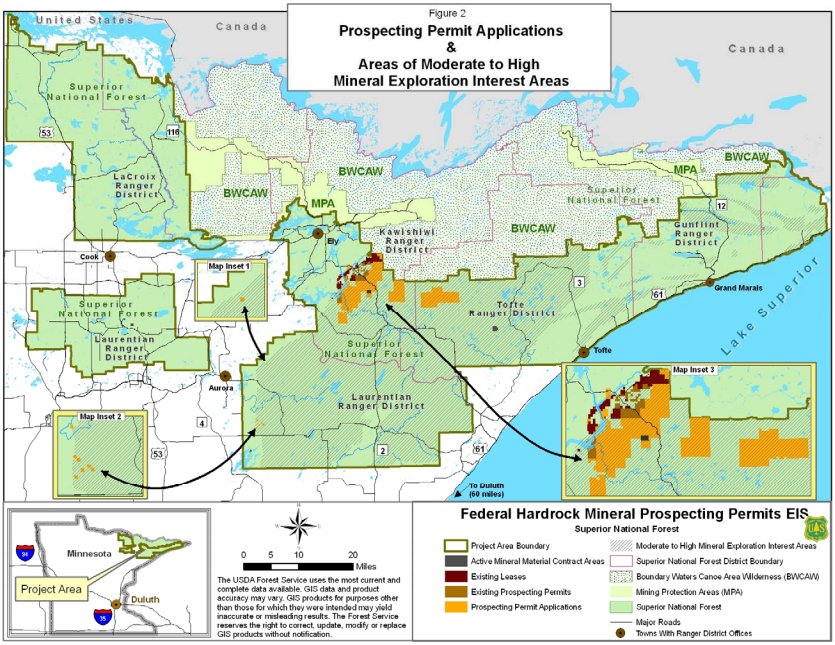
To the EPA meeting in Chicago to discuss sulfide mining in the BWCA:

mining_exploration_map

You may not have been to the Boundary Waters, a magical part of America the Beautiful, filled with lakes and rocks and fish and silence.  If not, I hope you get the chance to go sometime in the future.  There you will find rest as well as a place to celebrate the wonder that is our planet.

Would you locate a landfill so that it drains its waters into the baptismal fount of a Catholic cathedral?  Would you site a noisy factory with its emissions of smoke and toxins next to a spot dedicated to meditation?  Of course not.

The argument from Polymet and other would be miners of copper and nickel and magnesium locked in sulfides near the Boundary Waters is that their technology will not pollute the three watersheds that send water from its site to Hudson’s Bay, the Pacific and the Atlantic.  The trouble is that there has never, NEVER, been a technology that prevented sulfuric acid runoff from these kinds of mines.  Never.

Can we trust them when the EPA says this claim is suspect?

Reverb

8/11/2013 Lughnasa                                                                         Honey Moon

Having an intellectual experience with a lot of reverb right now.  I read the Communist Manifesto as I said above, but I also read estranged labor, also by Marx.  The two together make for surprisingly contemporary and trenchant critiques of our political economics.  A key point Marx makes is the problem for the working class is that their labor becomes, literally, objectified.  That is, the thing they make, whatever it is, contains their effort and energy but belongs to another, usually, too, becoming unavailable to the ones who made it.  I thought of workers on a Cadillac assembly line or LPN’s working in hospitals but not having adequate health care.  The object, the product of labor, leaves the hands of the worker and his/her life, then becoming estranged from them.  Thus, labor is an act of self-estrangement from the product of your labor.

Marx believed that labor should reveal and reaffirm the who that you are, make you more of, better than, the you were before your work.  In this case the work is subjective, or the subject of the laborer, not an object.  Here is an article from the NYT yesterday about the arguments over raising the minimum wage.  And another about worker deaths in Texas.  And, most tellingly, this one:  U.S. Companies Thrive as Workers Fall Behind.  These are from just this last week.  I never immersed myself in Marxist thought so I don’t know the objections to his analysis, but from my cursory look at it, it explains a lot of the headlines.

Here’s the thing.  In the third phase I have been promoting the idea of doing the work only you can do.  Does that sound like work that reveals and reaffirms who you are, work that makes you more of, better than, the you before the work?  It sure does to me.  And that congruence feels fine to me, reinforcing.  But.  What if the third phase of life, life after formal education and life after full-time work, is the first time you can take up the work that only you can do?  Doesn’t that mean you engaged in alienating labor that estranged you from the product of your labor?

Living the Dream

Lughnasa                                                                       New (State Fair) Moon

Life seems to run from one irony to another, offering a wry twist often when you least expect it.  This irony is not one of those.  It’s been building for about 19 years, but it has begun to peak.  The irony is this.  The U.S. like the rest of the world, continues to urbanize with central cities beginning to outstrip ‘burbs.  “In 2011, for the first time in nearly a hundred years, the rate of urban population growth outpaced suburban growth, reversing a trend that held steady for every decade since the invention of the automobile.”*

What’s the irony here?  Now I find myself willing to defend the suburban or, in my case, exurban experience.  Why is that ironic?  Because I spent 24 years living in Minneapolis and St. Paul deeply involved in all manner of urban politics, working as an urban minister and eventually in charge of urban ministry for the Presbytery of the Twin Cities Area.  Though raised in a small town, I made the transition to solidly urban guy.  It was my profession, the city.

Cities burst with energy, offer sophisticated amusements, diverse places to live, a variety of foods to eat and the sort of jostling with others that sparks creativity.  They also make obvious the divisions in our society that a drive from the Northside of Minneapolis to Kenwood, directly south of it, epitomizes.  Even that last creates a juicy political scene with lots of different actors.  Fun.

And I love it.  Note the present tense.  I love it.  I enjoy being in the city and I love the kind of people who make cities their home.

Even so.  I now live in an exurb of the Twin Cities.  Only a couple of miles north of our home there are cornfields.  Surrounding our development is a huge truck farm with tractors and warehouses and rows and rows of carefully planted vegetables.  This is where the metro proper ends.  The MUSA line, the Metropolitan Urban Services Area, runs less than a mile south of our home. (see map)

Over the years Kate and I have made a life here that would not have been possible in the city.  We have a woods, several garden beds for flowers and vegetables, an orchard and a fire pit.  Our house has about 3800 square feet with the finished basement and we could never afford that much space in the city.  This combination of a large, relatively inexpensive home and land enough to create our own footprint has given us a rich and full life.

We have the suburban dream, that is, country living close enough to the city to access museums, orchestras, restaurants and political activity.  In my first days here I felt isolated and unhappy, far away from the things that had made me who I was.  As time passed though, I began to find a new person emerging based on what we had here.
It is, in some important respects, a narrower life.  Kate and I spend most of our time either outside or inside our home, but on our property.  In this sense the community oriented life of the city does not have a domestic equivalent here, at least for us.

Here there is silence.  Here we can focus on our creative activities:  horticulture, writing, sewing/quilting.  Here our life concentrates at our home.  This is similar to the farm life of millions of Americans prior to WWII.  Yes, it has its privations, but it also has unique benefits.

It remains to be seen how third phase life can be lived here, especially the waning years of that time.  We may find the distances too great for us, the isolation dangerous.  I hope not because I have learned to love this exurban spot as much I love the city.


*Time Magazine article, The End of the Suburbs

Short Takes

Summer                                                                     Moon of the First Harvests

Who am I to judge?  Out of the mouth of a Pope.  Extraordinary and welcome.  Can’t help but wonder what the crabbed mind of our local bishop, The Most Reverend John C. Nienstedt, makes of it.  His diminished understanding of what it means to be human must be scuttling around wondering how things could change in such a short period of time.

Orcas are the largest dolphins?  You probably knew this, but I didn’t.  Killer whale stuck to them because some of their number hunt whales.  They are versatile hunters and can exist on whatever is in plentiful.  The film Blackfish and the book, Death at Seaworld, have added to the increasing criticism of keeping intelligent, social animals in captivity at all:  dolphins, chimps and I imagine elephants, gorillas, orangutans, too.

shaun peterson


Human Trafficking

Summer                                                             Moon of the First Harvests

9 years ago this November I went on a significant trip paid for by money inherited from my father.  It took me to Singapore where my sister, Mary, hosted me and showed me her adopted city.  After Singapore I flew Tiger Airlines to Bangkok where I spent 5 days getting acclimated to Thai culture and the particular culture of Bangkok’s China Town. My hotel there cost $17.00 a night.

(Yaowarat Road.  Bangkok’s China Town)

On the 6th day I took a flight from Bangkok’s old airport on Bangkok Air to Siem Reap, Cambodia.  We landed late at night and the customs area looked like a prison detainee facility in a bad B-movie.  At one box I applied for my visa and at one right next to it, a Cambodian official stamped in it and I was in country.

The taxi scrum had all kinds of vehicles and people, but I happened, quite by accident, on a wonderful driver, Mr. Rit.  He drove me around for the entire time I was in Siem Reap, including several trips out to Angkor, the ancient Khmer region where over 75 different temples built by many different rulers dot the landscape, among them what westerner’s call Angkor Wat, which actually means, Angkor Temple.

(Siem Reap)

Tonight I watched a movie called Trade of Innocents.  It’s a Netflix streaming movie, so it’s easily available.  The focus is human trafficking, based on real events, in the city Siem Reap.  This lovely city, deep in the Cambodian jungle, has what I guess you could say is the misfortune of being the gateway to Angkor.  As such, it has seen a hotel building boom of enormous proportions, making it possible to stay in Siem Reap at almost any price point.  My hotel was $25 a night for a room with teak furniture and a tiled complete bath.  You could pay then $500 a night at Hotel D’Angkor, the old French colonial hotel of ridiculous elegance.

(Bayon Temple.)

All this tourist traffic has apparently made Siem Reap a center for the trade in Cambodian and Vietnamese girls.  The problem gets reinforced by a culturally acceptable practice of sending a daughter into the city brothels to support her family.  This was a side of Siem Reap that was invisible to me.  I saw a small city with contradictions between rich and poor, with beautiful buildings and a friendly people, with local artisans of incredible skill, but I didn’t see the backrooms and back alleys where children, young children, were bartered and rented for an evening.

My friends Paul and Sarah Strickland have made the trafficking of girls a priority issue.  It’s easy to see why.  Girl Rising, the movie Kate and I saw earlier this month, also pleads the case for girls, a vulnerable population everywhere, vulnerable not only to human trafficking but to enforced ignorance, too.  If you have a daughter, or a granddaughter, or if you love a woman who was a daughter once, then these two movies should make you pause a moment.  And wonder how to help.

This One Is A Miracle

Summer                                                            Moon of the First Harvests

What a wonder.  A black president speaking as a black man about the lived experience of young black men.  Trayvon Martin, he said, could have been him 35 years ago.  A young black man in hoodie, suspected of, what?  WWB?  Walking while black.  Maybe about to do, something.  And something, wrong.  Bad.  Hearing clicks on car door locks as you walk by.  Being followed in stores.  Indelible and seemingly inevitable.

Yet, of course, he is not Trayvon.  No, he is the president of the most powerful nation the world has ever known.  Maybe the most powerful it will ever know.  And even he, with all that power at his disposal, literally at his command, can imagine himself into the life of a young man seen, paradoxically, as both powerless and invisible and all too visible and dangerous.

Racism and its even more evil progenitor, slavery, stand out as the original sin, the stain on this city on a hill, this beacon of freedom and hope.  We white folk have done this and that, but not too much and now the time of our dominance is passing.  This nation will become a colorful quilt with white as one shade among many rather than the shade against which all others stand inferior.  May that day come soon.

There are many things I feel privileged to have witnessed.   The civil rights movement. The anti-war movement.  Feminism and the rise of women. A world in which the whole planet must be taken into account when making decisions.  A man walking on the moon. Routine space flight. The discovery of extraterrestrial planets.  The discovery of DNA.  The global recognition that the people can challenge their government.  And win.  So many things.  These and more.

But, this one, a black president speaking about the lived experience of being a young black man.  This one is a miracle.

Bad News, Man

Summer                                                           Moon of the First Harvests

Reading the paper this morning made me choke several different times.  First two related to horticulture.  The spotted drosophila, a fruit fly variant, lays eggs and larvae in blueberries, strawberries and raspberries especially.  We have all three.  Managing them may be very difficult without insecticides which I’ve avoided all these years.  They may force me into a difficult position if they show up here.

The second horticultural item involved the now seen as inevitable spread of the Emerald Ash Borer.  I’ve not done a census of our trees, but a reasonable estimate would be that 25% are ash.  That means a lot of holes over the next few years.  My plan is to get proactive and start taking them down, a few each year, and planting other species where it makes sense  .

Then there were all the articles about the Zimmerman trial.  Yecchhh.

Student loan rates.  This student loan business is a scandal.  Saddling kids, especially poor to lower middle class kids, with loans the size of mortgages in my day, before they even get started in life, is a real burden on the future.  It’s like attaching a drag chute to the lives of today’s college grads.

Not to mention that bank profits have jumped.

Guess the good news is that getting irritated by the news means I’m still alive.


Clybourne Park

Summer                                                                          Solstice Moon

Theater has been a passion of mine since early high school.  I acted in high school, college and seminary, quitting only when the time demands of theater exceeded what chunks I could give.  Not only did I act in college, but I had nearly enough credits for a theater minor, most of those credits in the history of theater.

Live performance, perhaps even more so in the age of high technology, has a sacred aspect, as it did in antiquity.  It bridges the solitary creative act in the playwright’s mind and yours with real people, not paint or notes or words on a page, but people who choose to imagine themselves into other people’s lives and feelings.

Tonight it was Bruce Norris’s edgy, often nasty Clybourne Park, a play willing to grasp the charged cable of race, in this case a cable stripped of its insulation, fully alive to our past and present predicament.  This play is worth reading, but even more it is worth seeing.  It is on the page minimalist, clever and spare; but on the stage it snakes like a downed power line, sparking here and there, totally dangerous.

( photo of the Guthrie performance)

If you believe race has settled down in our culture, see this play.  It will remind you that the road is long and the journey often bleak.