Category Archives: Asia

Gong Fu Cha

Lughnasa                                                             Harvest Moon

Kate and I were out before 8 am today harvesting raspberries, tomatoes, cucumbers and IMAG0898ground cherries.  The tomatoes and cucumbers are in their last week +.  The ground cherries seem set to keep on producing through the first heavy frost and the raspberries have only begun to ripen.  We still have peppers and leeks, a few greens left.

During our weekly business meeting we melted more bees wax and this time attempted to fill the mold.  Only I had not melted enough wax so I had to melt some more.  That means the molds which didn’t fill ended up with two layers of wax.  That worked out ok in a couple of cases, not in two others.

Discovered that the wax has to be washed since the remnant honey, which has a different specific gravity than the wax, gathers and in two cases created a plug of honey between two layers of wax.  Those two have gone back in the bowl for remelting.  I have seven beautiful sweet smelling candles and will have a few more, probably made this time in half-pint canning jars for gifts.  Rendering some more wax as I write this.

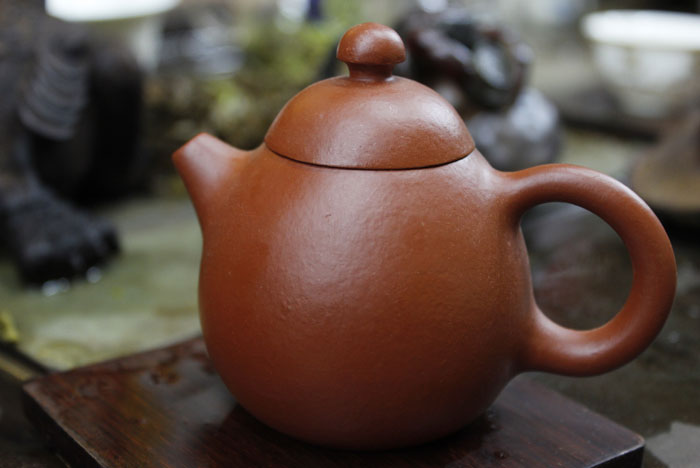
After the business meeting, I drove into Verdant Tea and bought two yixing tea pots.  This Zhu-ni-teapot_is a present to myself for finishing Missing and getting ready to write Loki’s Children.  They’ll be in constant use.  Yixing teapots are perfect for the Chinese way of tea, Gong Fu Cha.  Each teapot goes through a seasoning process (at home) and then makes only one type of tea.  The porosity of the yixing clay fills up with the oils of that particular tea and enhances the flavor.  This is a centuries old tradition in China.


Honorary Docent Lost

Lughnasa                                                           Honey Moon

Back in the MIA yesterday morning before my lunch with Tom.  Wandering around, absorbing the images and the galleries, felt good–but unfocused, I was unclear as to my purpose for being there.

(5th century painting, Poet on a Mountain Top by Shen Zhou.  not in MIA collection)

A long segment of a Chinese scroll, a landscape of black and white mountains, exhibited in a narrow corridor beside the Wu reception hall, sent me into a wistful, calm place and a sudden realization why I like Asian art, especially Chinese and Japanese.  Much of it is soothing, contemplative.

As these thoughts and feelings slowly tumbled down the stream of my experience, I came to an explanation of this “spilt ink” and discovered the scroll had been done by a literati artist waiting for his son at a mountain monastery.  His son was overdue and he felt, he said, “Lonely and sad.”

The exhibition, “Sacred”, has pieces scattered around the atrium on the second floor, some mostly installed, others not.  It focuses on surfaces, as an art exhibition must:  clothing, dance, fluids, walking.  This is something I’ve learned recently, that the modern was a turn toward keen appreciation of the surface of things, logical since philosophy from Kant on down has hammered away at our inability to see the thing in itself, the real behind our perceptions, leaving us with what our senses bring to us, the surface of things.

Modern science, Darwin being a keen example, constructs its wonders on observation and recognizes that it cannot explain what it cannot apprehend.  Yes, there is lots of inference, electron fields, quantum action at a distance, the brain/mind link, but about these things we recognize only what we can measure about them, that is, apprehend. There is no other tool.

So, yes, I understand the “Sacred” exhibition’s focus on the surface of things, but it will not, cannot touch what causes a man to wear a chasuble or a yarmulke.  It will not show the Shiva who dances in the heart of the faithful Hindu or the Buddha mind of the adherent inspired by the Thai walking Buddha.  It will, in this regard, I think, fall several measures short of its mark.  Too facile, too straight forward.  A nice try but not bent enough to capture the mysterium tremendum, the awe that comes with the experience of the holy.

Zeitgeist

Lughnasa                                                               Honey Moon

It’s happening again.  Today.  We’re getting all historical and misty over an event that happened in my lifetime, while I was in high school.

That speech in 1963.  When I went to Washington, D.C. in March I walked past the Obama Whitehouse out to the Lincoln Memorial.  There’s a plaque there, on one of the steps, that marks the spot where MLK stood.

I’d like to say I remember the speech and the reactions to it, but I don’t.  Or, at least, those memories have become submerged in the later, copious reactions in print and in other media.  I can hear his voice, as I imagine you can, soaring and dipping.  “That check came back marked insufficient funds.”  “I have a dream.”  It was the rhythm of call and response preaching, a hallmark of the black church, a tradition that retained, and retains, a respect for rhetoric, for the art of speaking persuasively.

In those days, those same tumultuous times, President Kennedy had authorized American military adviser’s presence in Vietnam.  So even as Dr. King spoke in Washington the seeds of another great domestic conflict were sown, the dragon teeth of Cadmus, and they would come to life in a great battle fought conterminously with the expanding civil rights movement.

And there was more.  As the civil rights movement and the anti-war movement blossomed into a decade of radical protest, another cri de coeur had begun to gain critical mass, the feminist movement.

This was at the end of my first phase, all this roiling pitching crowded press, idea upon idea, action upon action, analysis followed analysis into praxis with the quiet, inhibited era of the post-war atomic age bulging at its anger constricted arteries, veins pulsing with affronted blood.

How could I not have been shaped, reshaped, torn down and built up again by exposure to the racism, the militarism, the sexism that was my birthright, a right mess of potage handed down to me as God’s honest truth?  No wonder those old ties sundered, split apart by cultural sclerosis.

It was King, yes, but it was also the times, the zeitgeist.  This was a moment almost out of time, a moment when the old was no longer adequate, when antiquity could no longer be a reason.  It was a time like the one Ralph Waldo Emerson wanted:

“Our age is retrospective. It builds the sepulchres  of the fathers. It writes biographies, histories, and criticism. The foregoing generations beheld God and nature face to face; we, through their eyes . Why should not we also enjoy an original relation to the universe?  Why should not we have a poetry and philosophy of insight and not of tradition, and a religion by revelation to us, and not the history of theirs?”

Today we are still learning how to put enough into the bank so the check will not come back marked insufficient funds.  Today we are still learning how to control a military adventurism that displays American imperialism and idealism in equal measure.  Today we are still learning how to integrate women into all phases of our social existence.  And more.  Now we are learning, too, the same for LGBT citizens, for Muslims, for the disabled and the old.

Yes, things have grown quieter again, but that is only because the zeitgeist is not one of boiling change.  At least not here in the U.S.  That does not mean the problems have been solved or that the need for protest is past.  It will come again.



New History for a New China–a surprise

8/12/2013  Lughnasa                                                              Honey Moon

Obviously Ancientrails remains down.  This form of instant communication has its pluses and minuses.  Big plus:  write it and publish it.  Right now.  Big minus:  when it’s down, everything going forward waits.  So it’s instant except when it isn’t.

Worked on various tasks like reorganizing files, finishing up to do list stuff from three months ago, watching the last of the New History for a New China lectures.

This New History MOOC has some startling things to say, if its data actually supports them.  For example, the lecturer today claimed that the justification for the Chinese Communist revolution, land distribution overwhelmingly in the have-a-lots hands, up to 90%, turns out not to have been the case.  The implication?  The Chinese revolution was a top down revolution engineered by a revolutionary organization, not a from below uprising.  This is definitely surprising.  Their use of data and their sources did not always seem to justify their conclusions.  Too few data points, or data supposedly used as comparative, but actually comparing unlike things.  Or, in a few instances, the data simply did not conform to the conclusions based on it.  Weird.

So, I’m loafing and inviting my soul.  To what?  Not sure, but it feels fine right now.  I have poked around in some of my short stories and other novels to see if I might start revising other work.  I could/can do that, just don’t know whether I want to start right now.

New History for A New China

Lughnasa                                               Moon of the First Harvests

Two weeks ago I began a MOOC (massive open online course) from Hong Kong University called New History for a New China*.  This is a quicky, a four week dip into a data driven approach to near history in China, near history in China’s case going back to the latter Song Dynasty (1000-1100) with some sources.  The work they are doing is similar to Big History and history from the longue duree (the long term) perspective most often encountered in French historiography.

Using records of students taking the national examinations for positions in the bureaucracy, a practice begun in the Sui Dynasty (605) replacing preferment from the ranks of the nobility, the practice since the origin of the bureaucracy in the Han Dynasty, the scholars at Hong Kong University look at demographic details such as age, parent’s occupation and education, place of residence, age at taking the first exam and age when the exams were passed or failed and positions achieved.

An advantage to using these records is that they are relatively consistent over a long period of time allowing a longitudinal examination of mobility in Chinese society, at least as education influenced it.

So far I find the data produced fascinating and its revelations about the workings of Chinese society often brand new though I’m not so sure about the comparative method that the scholars say lie at the heart of their work.  They contend that this work can make neutral or objective comparisons between east and west, countering and sometimes correcting the Eurocentric nature of much social science research.

I’m hopeful that this work will get there though what I’ve seen so far is only a beginning and has some weaknesses that beginnings tackling a problem of this magnitude might be expected to have.  Still, it’s proven an interesting ride so far.


*A New History for a New China, 1700-2000: New Data and New Methods, Part 1

James Z. Lee and Byung-Ho Lee

The purpose of this course is to summarize some of the new directions in Chinese history and Chinese social science produced by the discovery and analysis of new historical data, in particular archival documents and datasets, and to organize this knowledge in a framework that encourages learning about China in comparative perspective.

Human Trafficking

Summer                                                             Moon of the First Harvests

9 years ago this November I went on a significant trip paid for by money inherited from my father.  It took me to Singapore where my sister, Mary, hosted me and showed me her adopted city.  After Singapore I flew Tiger Airlines to Bangkok where I spent 5 days getting acclimated to Thai culture and the particular culture of Bangkok’s China Town. My hotel there cost $17.00 a night.

(Yaowarat Road.  Bangkok’s China Town)

On the 6th day I took a flight from Bangkok’s old airport on Bangkok Air to Siem Reap, Cambodia.  We landed late at night and the customs area looked like a prison detainee facility in a bad B-movie.  At one box I applied for my visa and at one right next to it, a Cambodian official stamped in it and I was in country.

The taxi scrum had all kinds of vehicles and people, but I happened, quite by accident, on a wonderful driver, Mr. Rit.  He drove me around for the entire time I was in Siem Reap, including several trips out to Angkor, the ancient Khmer region where over 75 different temples built by many different rulers dot the landscape, among them what westerner’s call Angkor Wat, which actually means, Angkor Temple.

(Siem Reap)

Tonight I watched a movie called Trade of Innocents.  It’s a Netflix streaming movie, so it’s easily available.  The focus is human trafficking, based on real events, in the city Siem Reap.  This lovely city, deep in the Cambodian jungle, has what I guess you could say is the misfortune of being the gateway to Angkor.  As such, it has seen a hotel building boom of enormous proportions, making it possible to stay in Siem Reap at almost any price point.  My hotel was $25 a night for a room with teak furniture and a tiled complete bath.  You could pay then $500 a night at Hotel D’Angkor, the old French colonial hotel of ridiculous elegance.

(Bayon Temple.)

All this tourist traffic has apparently made Siem Reap a center for the trade in Cambodian and Vietnamese girls.  The problem gets reinforced by a culturally acceptable practice of sending a daughter into the city brothels to support her family.  This was a side of Siem Reap that was invisible to me.  I saw a small city with contradictions between rich and poor, with beautiful buildings and a friendly people, with local artisans of incredible skill, but I didn’t see the backrooms and back alleys where children, young children, were bartered and rented for an evening.

My friends Paul and Sarah Strickland have made the trafficking of girls a priority issue.  It’s easy to see why.  Girl Rising, the movie Kate and I saw earlier this month, also pleads the case for girls, a vulnerable population everywhere, vulnerable not only to human trafficking but to enforced ignorance, too.  If you have a daughter, or a granddaughter, or if you love a woman who was a daughter once, then these two movies should make you pause a moment.  And wonder how to help.

A Tough Culture

Summer                                                               Moon of the First Harvests

Sister Mary begins teaching early this year, a course beginning in August at the National Institute of Education in Singapore.  The haze has lifted there, but the suicide rate has replaced it as a concern.  Suicides are up significantly over last year.  As I noted here a while back, Singapore came in very low in overall happiness in a global ranking.

It’s a tough culture.  As Mary told me when we discussed this finding then, parents routinely tell their children that they have only themselves to count on, that you can’t trust others.  My sense is that a same or similar message gets passed onto children in mainland China where it must get some strange reinforcement from the one-child policy.

As I’ve tried to learn about contemporary and ancient China, the question of what matters most in Chinese society has puzzled me.  In ancient times, like the Warring States Period for example, there were many schools of thought contending, notable and surviving were Taoism, Confucianism and Legalism.  Legalism had less purchase after the end of the Qin Dynasty, but Taoism and Confucianism both vied for attention among the elites.  Buddhism came in and added another ingredient to the stew just when Taoism and Confucianism seemed to have lost favor.

But by the time we get to the 20th century there was no longer a consensus, if there had been even a tentative one before, about what might guide the Chinese individual or Chinese society.  The revolution with Mao and his communist party as victor seemed to settle the question for a time.  Communism would provide moral and ethical authority.

Then, the Great Leap Forward and other self-inflicted disasters killed millions of Chinese and communism lost a lot of its traction.  After Deng Xiaoping, the central economic premises of communism began to fade away as capitalism, albeit a highly altered and state stimulated capitalism, made getting rich glorious.

Now it is not clear what the guiding values of China are.  If they are only getting ahead, either financially or politically, then China will face significant and growing strains as the years push ahead.

I admit my knowledge of China and Chinese history is rudimentary and I may have missed something obvious, probably have missed something obvious.  I hope so because a world power without a value center is a scary thing to contemplate.

Links to songs in Mandarin from a tumblr post.

gondoleia:

❝ 知人知面知己知彼又知心//古人说这就是所谓知音 
or: a collection of mandarin songs that are worth a listen

the kind-of oldies 

teresa teng the moon represents my heart ● tian mi mi ● dan yuan ren chang jiu● little town story fei yuqing a sprig of plum blossoms ● this handful of soil kris phillips clouds of my homeland zhang yusheng ocean blues luo dayou childhood ● pearl of the east tsai chin heartbreak station dadawa story of the red-crowned cranes faye wong red bean ● mortal world qi yu olive tree

the newer stuff

raymond ma jade robes jay chou red dust tavern ● shanghai 1943 ● east wind breaks ● blue and white porcelain wang leehom still in love with you ● sun washed in spring rain ● mistake of the flower fields ● bo ya breaks the string ● do you love me a’bao lan hua hua han hong endless love (with sun nan)  jing boranbu guo qing ren jie ● can’t stop jolin tsai wandering poet jason zhang under heaven ● after tomorrow anthony neely wake up ● sorry that i loved you tan jinglove at kangmei ● love south of the river khalil fong close to you ● bb88 sa ding ding love in 2012 sodagreen little love song ● (ft. ella) i was written in your song ●swallow’s nest phoenix legend moonlight over the lotus pool ● above the moon wulan tuoya plastic flowers ● lassoing horses liu huan  crescent moon han geng clown mask ● wild cursive li yugang the drunken concubine ● (ft. shi tou) yu hua shi

theme songs

free-floating flower (reign of assassins) ● wander (swordsman) ● flying together (butterfly lovers 2007) ● far away (butterfly lovers 2007) ● heaven and earth are in your heart (legend of the condor heroes 2003) ● mulan qing (hua mulan 2009) ●mulan star (hua mulan 2009) ● painted heart (painted skin 2008) ● painted heart (painted skin: the resurrection 2012) ● jiang hu yao (rose martial world) ● ru hua (da ya huan) ● hui bu qu (spell of the fragrance) ● shang shan ruo shui (spell of the fragrance) ● buddha says (jade palace lock heart 2) ● hawthorn blooming (under the hawthorn tree) ● under the hawthorn tree (under the hawthorn tree)

Goin’ In, Fishin’ Around

Imbolc                                                                      Bloodroot Moon

“Things never were “the way they used to be.”
Things never will be “the way it’s going to be someday.”
Things are always just the way they are for the time being.
And the time being is always is motion.”

Alexander Xenopouloudakis

Warren, Frank, Bill, Mark, Scott and I gathered at Frank’s for the traditional St. Patrick’s dinner.  It was a light turnout for this always festive meal featuring tonight shamrock shaped ravioli.  This was a mixing of cultures, a bit of culinary diversity.  Otherwise it was the corned beef, cabbage, short bread and potatoes.  What I’ve always imagined as the peak meal in a year for poor Irish folk.  It sure tastes good to this one-half Celtic guy, with half of that coming from the auld sod.

We had an interesting evening discussing what I described as the mechanist versus the vitalist debate.  This is an oldy but goody from the 19th century, a debate very far from over and anyone who follows the neurobiological thinking about the brain will find it much alive in the third millennium.  Here’s a review of Ray Kurzweil’s (the Singularity guy) new book: How to Create a Mind: The Secret of Human Thought Revealed.  It focuses on this topic through careful thinking about the distinction between the brain and consciousness.

We also had a brief encounter over a topic dug into deep to my psyche, that of our solipsism.  We construct our own reality using sense data, organized and turned into information by the brain, then utilized as part of consciousness to define the world as we experience it.  This solipsism makes the existential argument that existence is prior to essence; that is, that our life is not being human; it is about being ourselves, a particular instance of human.

In a book I’m reading right now:   Where the Heart Beats: John Cage, Zen Buddhism, and the Inner Life of Artists by Kay Larson (reviewed at this link) the author describes the Zen idea of no permanent identity, no permanent reality, that is, we are what we are in this moment, then what we are in the next moment and so on.  It fits very well with this conversation, the uneasy, slippery grasp we have on who we are as individuals and what we’re experiencing at any one time.  In a sense Zen increases the degree of relativity created by our solipsistic situation to an infinite number of slices, not even necessarily threaded together by an identity.

If embraced, this is deeply disturbing.  It shakes the foundations, as Paul Tillich said.  In fact the earthquake is so severe that intellectual structures built over thousands of years come crashing to the ground and disappear.  We do not like this stripping away of the animal cunning that gives us the illusion of permanence.  What then is left?

Not very damned much.  If embraced, this is profoundly liberating.  Those structures fall to the ground and disappear.  Religion and tradition and politics and culture no longer have power to frame us, shape us, define us.  We are free.  Free in a radical, personal, cosmic sense.  Neither chained to the earth or to the past or to each other, not even to self.

The world moves through and in us, just as we float through and in it.  When I can bring this awareness to consciousness, when I experience it, at first I feel disoriented, tethered no longer.  At moments it seems I (the I of this aware moment) might split apart, shred into molecular portions and drift away.


Serpentine

Imbolc                                                                            Valentine Moon


Off to celebrate the year of the snake at Peking Garden.  Lots of seafood served at round tables.  Twirling the lazy susans and grabbing at morsels with wooden chopsticks.

Mary’s been at this for awhile.