Category Archives: Art and Culture

Enlightenment’s Dark Side

Fall                                                                                  Samhain Moon

It was wet and chill, but the red and gold fruit warmed me as it slid off.  The raspberry canes grabbed at me as I moved among them as if wanting me to stay awhile longer, to chat or linger.  Once in a while I threw an over ripe berry over the fence to Rigel who watched my progress with head moving up and down, patient, waiting.

Before the berry picking I spent a couple of hours reading 34 pages, the introductory chapter to Adorno and Horkheimer’s, Dialectic of Enlightenment.  As this MOOC moves toward the end, we come closer to the current time and to thinkers with whom I’m familiar not through academics but through the politics of the 1960’s.  Adorno and Horkheimer are part of the Frankfurt School philosophers, most of whom emigrated to the US during WW II.  I was most familiar with the work of their colleague Herbert Marcuse, but I have come to know the work of Jurgen Habermas, too.

This is dense material and the argument is provocative, far from obvious.  In essence Adorno and Horkheimer argue that the enlightenment has become an instrument of oppression.  Some characterize the enlightenment as a movement designed to make the earth a home for humanity.  Instead of moving toward freedom and liberation the focus on repeatable natural laws and the tools of technology enabled control and domination, both of the planet and citizens of nation-states.  I’ll do better with this at another time, but this is heart of it.


Ceramics and Wolves

Fall                                                                   New (Samhain) Moon

Kate said she likes this time, when the gold colors have just begun to appear, because “it seems like Robert Briscoeall of fall is ahead.”  Yeah.  I like it in the rain and mist we had today, an atmosphere that makes me think of falls gone by, the ones I thought of as normal.

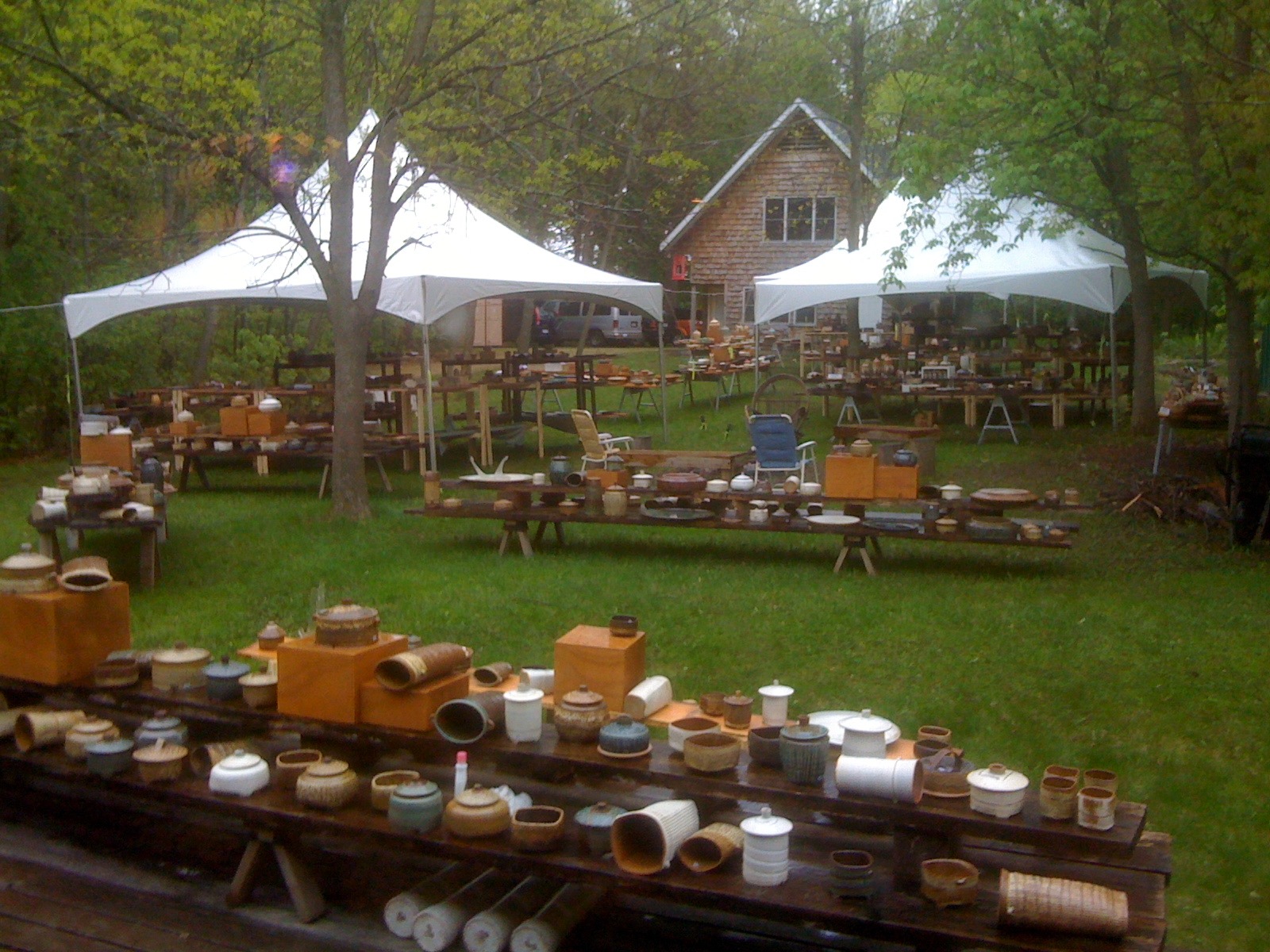
(Briscoe’s showroom is the building at the rear.)

We drove up to Stark, Minnesota today to Robert Briscoe‘s home and studio.  He has a fall sale, a 24 year tradition.  It includes other potters.  This year Jo Severson,  Jason Trebs and Matthew Krousey.  His home and studio sit on a high point surrounded by a maple, beech and birch forest.

Long, maybe 20 feet long sawn boards, 2x2x18, placed on metal sawhorses held the pottery.  Some it was under a white tent, but most of it sat out in the rain.  We bought a large vase and I poured two inches of rain water on the ground.

Briscoe is a big bluff former Kansan.  We talked about tornadoes.  He said his dad would gather the kids on the front porch and point out the funnel clouds as they descended from the sky.

All four potters make pottery meant for home use.  We bought bowls and plates, the vase, a small bowl with a top and two cups.  Having handmade items, varied in design and color, makes each meal special.  Too, we get to know the people who made them so the pieces are personal, not anonymous.  Both things appeal to me.  A lot.

After leaving Stark, we headed back down Highway 65 to Anoka County 18.  18 runs through the largest nature reserve in the metro area, Carlos Avery, and on the grounds of Carlos Avery is the Wildlife Science Center.  Today was an event there called the Harvest Howl and sounded very interesting.  Local vendors.  See wolves and other wild animals. Support good work.

The center is just beyond two stone and cement pillars topped with an old worked iron arch that says Carlos Avery Game Farm.  It was better in my head than on the ground.  It was wet, for one thing, which lifted the urine and feces scent from the ground and distributed it.  For another, the center focuses on real science.  That is, they train DNR, Animal Control personnel on how to handle bears, wolves and other critters.  They also train scientists in how to tranquilize and examine various species.  What I’m trying to say is the area is not spiffed up for an afternoon’s stroll on a wet day.

It looks clunky, down at the heels.  It’s a shoe-string operation and it shows.

Worth going to once.  Probably not for a return visit.  Except maybe in dry weather.

The Clark Collection

Fall                                                                     Harvest Moon

Tom Byfield and I had lunch at D’Amico’s.  He brought two pounds of bees wax from also former docent, Glenn Keitel.  Glenn took up bronze casting just to see what it was like. Did a piece and decided he knew.  So, I got the wax intended to be lost.  Thanks, Glenn and Tom.

After the lunch, a lecture by Andreas Mark, the new curator for Korea and Japan.  (Shibata Zeshin, 1807–1891  Detail from a screen, the four pastimes)  This will be a show with a lot to see.  Andreas, a funny guy, has arranged the show chronologically, starting with an 8th century piece that had fire in it, but just how it was used, “Don’t ask me.” he said. The Clark collection was put together by Bill Clark, a leader in the field of artificial insemination of cattle and who, according to Mark, was accused of collecting mostly images of bulls.

Well, not so.  There are over 1000 objects in the collection, formerly housed in Hanford, California, and the ones I’ve seen are very high quality.

Japan’s artistic tradition has a substantial Chinese influence, but the Japanese found a way to make Chinese style their own.  That will be a major theme of this show and one with quality objects to tell the story.  We are lucky to have the Clark collection objects here in Minneapolis and I look forward to seeing more of them as time goes by.


Days of Rain

Fall                                                                           Harvest Moon

Looking forward to the lecture on Audacious Eye, the upcoming Japanese exhibition at the MIA.  Tom Byfield and I have lunch plans before the lecture.

Asian art continues to be a passion for me, so this exhibit, which showcases pieces from a large collection donated to the MIA, is a great opportunity to learn more about Japan.

Rain over the next few days allows me a chance to focus on the MOOCs and Loki’s Children.  Sunday looks like the next good gardening day.

I’m feeling a bit overwhelmed with the startup of Ovid tomorrow.  Gotta think about how much it means to me.

A Stein Is Not A Tankard

Fall                                                                          Harvest Moon

Working with the poetry of Gertrude Stein.  Tough stuff.  She does break.  Through the usual patterns.  And forces a new way viewing seeing connecting word thing thing to word or not.  Word to word.  Forcing nouns to squiggle out of their links, forcing them to talk to each other like, well, like California girls talking to each other, like.

[Karel van Mander III man drinking beer from a tankard   1630-1670 (work pd.)]

Close to impenetrable, at least for the lone reader.  In collective reading with a guide like Al Fireis her work can jump, come alive though whether it makes sense.  Not supposed to make sense, I guess.  To make word. Yes. Words to words.  A world of words, a languaged world still or as always unreachable by sense so that world is nonsense.  Only words adhere to words within which we find ourselves worded and sentenced to life without sense.  Amen.


Threads

Fall                                                                          Harvest Moon

Breakfast at Keys.  In Spring Lake Park.  Mark (soon t0 be Mario again) Odegard and I discussed the Hack Factory, which sounds very cool.  The Twin Cities manifestation of the Geekworld maker movement.  We also talked about Bruce Dayton and his astonishing collection of art–in his home.  Plus the Matisse prints hung at the Marsh.  Ode saw both on Saturday.  He and Elizabeth are getting cranked up for four months in California, house sitting in the mountains and tending 10 chickens.

Casual time with friends is not so easy to accomplish when living in the ex-burbs and I look forward each opportunity.  I’ll see Tom Byfield this Thursday for lunch before the lecture for Audacious Eye, Japanese material part of an entire collection recently donated to the MIA.   Next week Allison Thiel at the Walker.

These threads of connection constitute a significant part of the living matter out of which the weave of our lives forms its fabric.

The Sacred and The Profane

Fall                                                                         Harvest Moon

Kate and I ate at Gather last night before seeing Episode 1, the Nature Theater of Oklahoma production in the Walker’s McGuire Theater.  We had a table beside the window that projects out over the side walk, giving a panoramic view of the Basilica, St. Marks Episcopal, Hennepin Avenue Methodist, Loring Park and part of the Sculpture Garden while Hennepin Avenue, filled with bustling cars and bicyclists and individuals walking, walking ran just below.

On the east side of Hennepin, the location of the three churches, the transcendent has precedence.  And the past.  The deep Western past. On the west side of Hennepin though modernity has sway.  The noumenal realm swept away in favor of the phenomenal, the religious by the secular, the surface and the particular gaining favor over the ideal.  It fascinates me that we have here in our built environment such a bald dividing line and that that line either begins or ends in a cemetery and disappears among the industrial detritus of the early part of the last century.

Hennepin Avenue runs roughly north and south in front of the Walker Art Center, coming up from Lakewood Cemetery, then taking a gentle right, curving until it runs east and west through downtown Minneapolis and across the Mississippi to peter out among the brick warehouses, off brand filling stations and small manufacturing businesses of east Minneapolis.

( CLAES OLDENBURG, COOSJE VAN BRUGGEN   Spoonbridge and Cherry, 1985-1988)


Right at the Walker though it creates an interesting division between then and now, past and prologue, the modern and the pre-modern.  On the west side, fittingly, sits the Walker Art Center, a premier museum of contemporary art with a wide-ranging performing arts program that brings globally significant musicians, dance, theater and film to the Twin Cities.  North of the Walker building complex is a sculpture garden filled with modern and contemporary sculpture including the iconic spoonbridge and cherry.

On the east side of Hennepin, beginning diagonally south from the Walker and in order moving toward the north are Hennepin Avenue United Methodist Church, St. Mark’s Episcopal Cathedral and then the Basilica of the Archdiocese of Minneapolis and St. Paul. These churches are, respectively, dominant congregations in the case of Hennepin Avenue and St. Marks and the second congregation of Roman Catholicism in the state. (after the Cathedral of St. Paul)

These days I find myself a west of Hennepin sorta guy.


The Kafka Quote Behind the Nature Theater of Oklahoma

Fall                                                                           Harvest Moon

Personnel is being hired for the Theater in Oklahoma!  The Great Nature Theater of Oklahoma is calling you!  It’s calling you today only!  If you miss this opportunity, there will never be another!  Anyone thinking of his future, your place is with us!  All welcome! Anyone wants to be an artist, step forward!  We are the theater that has a place for everyone, everyone in his place!  If you decide to join us, we congratulate you here and now!  But hurry, be sure not to miss the midnight deadline!  We shut down at midnight, never to reopen!  Accursed be anyone who doesn’t believe us!

Franz Kafka, Amerika

The Nature Theater of Oklahoma

Fall                                                            Harvest Moon

Just back from the Walker and the Nature Theater of Oklahoma’s unusual theatre piece. As improbable as it may sound, the entire presentation consists of a single phone call in which one of the company members began to tell her life story.  The theater, which gets its name from a Franz Kafka quote in Amerika, has now produced five complete theater pieces which continue this method, that is, each one is a further phone call transcribed and each one represents a continuing part of the same woman’s story.

The piece is 3 1/2 hours long.   The script, or better, the book, because this is a musical, does not change the transcription at all.  Every uh, um, yeah and wait is in it.  And it is all sung.

It affected me on several levels, the most obvious its evocation of childhood and what it was like to remember things from the perspective of a child.  The Nature Theater uses what they call extreme movement, a form of dance that is difficult to describe, but it has the effect of enhancing and expressing emotional content.  The libretto or whatever you would call it is a wonder, giving musical expression to the ums and the yeahs as much as the story lines about her father, the silent strong person or the time she jumped off a fixture in the front yard with a home made parachute.

Both men and women perform, coming on and off the stage at intervals that did not make a lot of sense to me, but they seemed to work dramatically.  Both men and women sing, too, so sometimes the words of a young girl have a bearded bald man giving them voice.

Worth seeing if you have the chance.

Loki and Scansion

Lughnasa                                                                                                            Harvest Moon

“Someday you will be old enough to start reading fairy tales again.”  C.S. Lewis

After a day with Loki and scansion, I got tired and was happy to have supper and watch Wire in the Blood with Kate.  Loki’s fascinating, an original bad jotun, and just can’t help making mischief, a festering ball of chaos.  He’ll make a great character once I figure out how to include him in the story.

(Gullinbursti, the Golden Boar.  Part of the Loki saga)

Scansion, on the other hand.  Oy vey!  I find recognizing meter, the stressed and unstressed syllables difficult.  I’ve never learned it and I need to now in order to finish my essay on Dickinson’s poem.  After locating some handy brief exercises, my head hurt.  So, I stopped.

Tomorrow.

The gong fu cha goes well.  I have a rhythm with it now and I produce six pots of tea out of a single batch of tea leaves.  The last two infusions, surprisingly, are the best.  At least so far.