Category Archives: Art and Culture

A Year Ago

Samhain                                                                    Thanksgiving Moon

one of my favorite days on our cruise…

Follow The Green Sidewalk

Posted on November 19, 2011 by Charles

Spring Moon of the Southern Cross

Montevideo, Uruguay On the banks of the Rio de la Plata, overlooking the Atlantic to the East

Travel brings the unexpected. A primary purpose, of course, but after tours with guides, I had become a bit dulled to the canned formula of the best this and the most that and the very special music. Not saying it was all boring, far from it, but too predictable.

Not today. In Montevideo, a city of which I had no expectations, Kate and I had a wonderful day. After being pressed sideways into the dock, we ended up within walking distance of the old part of Montevideo. At about 10:30 I suggested to Kate that we walk into town, something we could do in only a handful of ports. She agreed.

Our way took us first past two warehouses, both as I described earlier, three stories high with iron doors spaced about 50 feet apart on each story, brick with chipped and rusted concrete outlining the doors and interior bays. The iron doors, once gray now have rust blooms, some just a few, others with the gray vanishingly small.

When we got past these, a painted walkway led us through a port welcome area with guides hawking city tours and a free shuttle to a leather factory. Beyond them a memorial to the sinking of the Graf Spee shared a park-like space with painted anchors and their chains, or sheckles, as we learned from our Captain. Policia Turistica sported chartreuse fluorescent vests and stared off, wherever people stare who face an entire day of standing in roughly the same spot.

Across an intersection a sign said, “Tourists Follow Green Sidewalk.” Guess what that made me want to do? Kate said, “We’re following the green sidewalk.” Oh, ok.

A large boulevard with some cobblestone lanes opened in front of us. The buildings were somewhat dilapidated, like the warehouses, concrete and brick that had seen better days. Or, maybe not. There was a shabby chic to it that appealed to me.

A wandering fellow tourist told us about a market hidden by buildings ahead. We walked over that way. Sure enough there was a large open air market with many different things for sale, many of them tourist oriented, but just as many artisans selling their products.

Off the market area, pedestrian only somewhat like Florida Street in Buenos Aires, a large building held more shops and a number of restaurants each of which featured huge fires and metal grills filled with roasting meat: chicken, sausage, beef tenderloin, pork, lamb. Each restaurant had an awning with its name around four sides of an island that contained the fire, the roasting meat, a bar and an area for washing dishes. Tables and chairs flanked the islands in the open area created by the building, fans turning, cooling the diners.

When we firsts went through, tables were set and glasses sparkled. The smells of roasting meat had only begun to fill the room.

We looked in several shops, but continued up another, older pedestrian way with a slight incline. This had a few tourists shops, too, but began to sport a carneteria here, a fruit and vegetable market with their wares colorfully displayed in wooden crates on the sidewalk there, a bar named “Los Beatles” and a petfood store.

The buildings have a colonial look, similar to the older part of Panama City that we saw well over a month ago, balconies, molded cornices, plaster decorations. A few of the buildings had pastel colors, recently added.

Like the warehouses and the building across from the green tourist sidewalk these buildings had a shabby but not run down look to them, more like a neighborhood in which people really lived. As the mid-day heat had begun to settle on us, Kate started talking about air conditioning. About 45 minutes before that, I told her I’d give my 12:30 tour a pass to meander around Montevideo with her.

We walked back down the hill toward the large building with the restaurants.

Inside we walked past several folks hawking their restaurants, “Sir, a refreshing drink?” “Some lunch, mister?” and found a table underneath a fan at the Cafe Veronica.

The waiter welcomed us to Montevideo and to Uruguay with a genuine and warm greeting. When Kate got up to take a quick picture of the fire, another waiter came up and encourage her to go inside the kitchen to take her picture. After some insisting, she did. We had a meal that exceeded our expectations and a dessert, pancakes con leche that would bring me back to Cafe Veronica in a hurry if it weren’t so damned far away.

This was the kind of day I’d been missing, a day of just poking around, meeting some folks, sticking our heads into various places, seeing the layout for ourselves, discovering rather than being led.

We had a great day together then came back and took a nap.
Challenge a God

Samhain                                                                  Thanksgiving Moon

My course on Mythology finishes week 8 Sunday with a quiz on material about Sophocles’ Oedipus at Colonus and Euripides’ The Bacchae.  Over Thanksgiving week we have another 250 word essay due, the final writing assignment.  I’ve chosen to answer this question:  “In tragedies, the worlds of the divine and the human often come into direct contact, but in different ways in each tragedy. Choose one tragedy and analyze how it imagines the relationship between humans and the divine.”  Just weeks 9 and 10 to go.

(Caravaggio, 1595, Uffizi)

Don’t know how many of the 50,000 world wide students have stuck it out, but this is a wonderful way to refresh and deepen knowledge about Roman and Greek mythology.  It has also increased my analytical skills for use in approaching any myth, which includes, of course, the Metamorphoses.

In the Bacchae Sophocles approaches the story of the doubter Pentheus, king of Thebes, from the perspective of Dionysus, a god challenged.  The same incident occurs in Book 3 of the Metamorphoses and I translated it.  My main goal in all this work in the Latin is to embed the stories and the characters firmly in my mind.

While reading The Bacchae, a sudden burst of insight.  Here’s the insight:  The focus of this myth is how a god demonstrates his/her divinity when challenged.  The story of the golden calf in Genesis is a similar story.  So is the story of Adam and Eve.  Even Job.

This is, if you consider it, an ur-story since at some point every god or goddess had to establish their bona fides to persons who would worship them and so people would worship them.  We tend to come at religious life after this delicate and not at all obvious in its outcome encounter has already happened.  In the Bacchae and the story of Pentheus in Ovid Pentheus gets the ultimate penalty for challenging Bacchus.  He dies, his kingdom perishes and his people go into exile. Powerful demonstration of divinity on the part of Dionysus.

Tours Today

Samhain                                                                       Thanksgiving Moon

A good day of tours.  5th graders with great imaginations and college students from Manitoba, history students and studio arts.  Both groups attentive, excited, questions.  Good affirmations in several ways.  My tours are improving.

Energizing the Tour

Samhain                                                  Fallowturn Moon

A follow-up to my last post.  Sent as e-mails to my docent colleagues.

After reflection on what I wrote to you (often get my best ideas from writing things down), I’ve asked two of my leads to let me begin in the 4th gallery.  While touring the Sports Show last year, I had a similar problem with energy, beginning in the room with the smaller photographs.  When I begin using the Zedane video first (the last piece in the show) and going backwards, my tours got recharged.


This may be a similar situation.  My hope is that by focusing on what drew people in the first place, their excitement about the tomb and the objects will energize them enough to learn the history of the Qin state.  Also going to be working on my questions.

Touring Terra Cotta, #2 and #3

Samhain                                                                 Fallowturn Moon

OK.  Three tours under my belt.  I’m not finding interest like I expected.  It may be my presentation which is long on history and perhaps not as attentive to the terra cotta figures.  It may be the groups.  Today was a group of kids from Lacrosse who had ridden three and a half hours in the bus and were sleepy and an online art history class who’d never seen each other before.  Yesterday’s group, the friends, was more lively.  Could be both.  Maybe my selection of objects?

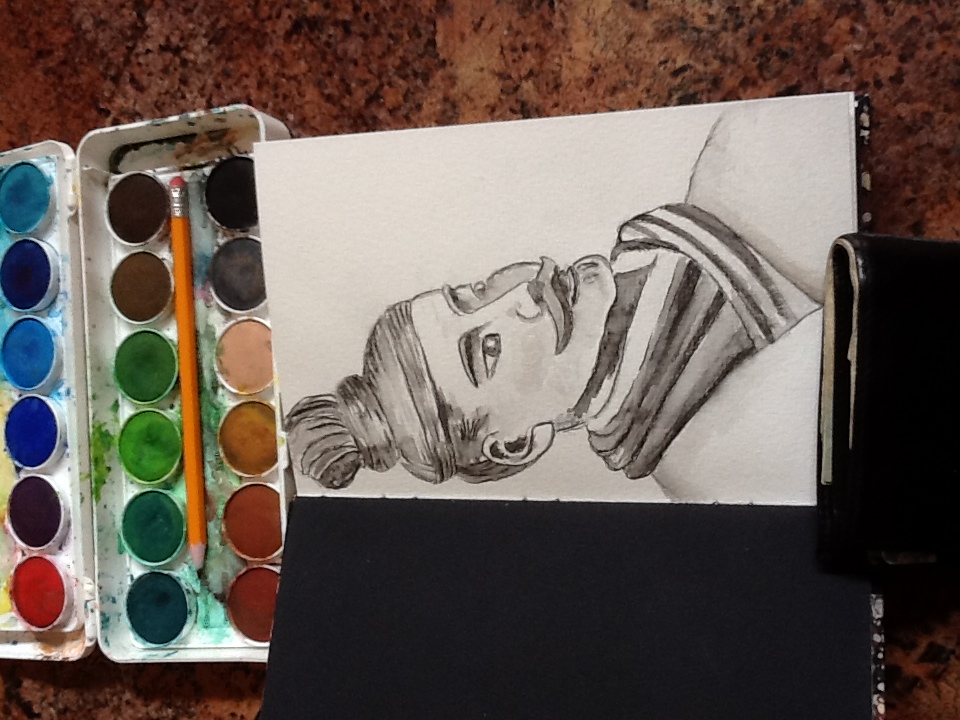
I’m actually spending about half an hour in the first two galleries, trying to focus on the development of the Qin state from its beginnings in the horsebreeding days of the early Sping and Autumn Period, to its gradual consolidation in the Warring States Period.  Maybe that’s too much?  Just not interesting?  This seems like a really important story to me, a story about the formation of Chinese political culture against the backdrop of hundreds of years of violence.

The information is, to me, fascinating and the objects, Bo Bell, Dagger, Ceramic Cavalry figure and the Hu vessel all engaging.  The energy overall seems low.  Wonder if anybody has a similar or very different experiences?

I want to do this well and I don’t feel like I’m hitting the right notes.

Touring Terra Cotta, #1

Samhain                                                   Fallowturn Moon

First terra cotta tour today.  A bit of gear crunching, absent minded passing of objects, but the questions were good, the attention regular.  These were Rochester Friends.

I have the right combination of objects for my story, the rise of the Qin state and its peak during the dynasty of Qin Shi Huang Di.  Forgot to show the illustrations on the pits and give the discovery story, been so immersed in the data that I forgot where beginners are.

This group had heard a lecture that focused (at least according to the announcement) on much of the same material I wanted to cover.  Didn’t seem to be much overlap though.

Tomorrow two more so I get a chance to work on my game.

Tour Introduction

Samhain                                                          Fallowturn Moon

Introduction to a tour of the Terra Cotta Warriors exhibit:

In the 2002 movie, Hero, directed by Yimou Zhang, Sky, an assassin from the state of Zhao confronted Qin Shi Huang Di in sword play; yet, when the decisive moment came, sheathed his sword and fled.  Later, he tries to dissuade Nameless, played by Jet Li, who has trained 10 years to assassinate Qin Shi Huang.

“Why,” Nameless asks, “Do you try to stop me?”

“Two words,” says Sky.

He writes two characters in the sand of the desert with his sword.

When Nameless, too, lets Qin Shi Huang Di live; the king of Qin, soon to become the first emperor, asks him, ‘What were the two words?”

“Our land.”

Hero continues an ongoing campaign, begun under Mao’s leadership, to rehabilitate the image of Qin Shi Huang Di, whose early representations in Chinese history, especially in the Records of The Grand Historian, written by Han historian Sima Qian, were of a cruel, heartless ruler.

Now, we see Qin Shi Huang Di compared to George Washington as the father of his country.  The bit from Hero supports this view.

The terra cotta figures themselves, unique and special as they are artistically, have the primary function now of pointing to the achievements of Qin Shi Huang Di and, by extension, to the story of the Qin state, a story that begins in 771 b.c. with the Zhou dynasty, once secure in the areas inhabited by the early Qin, fleeing to the east as nomads, barbarians from the steppes and grasslands invade.

A Qin armed escort saw the fleeing royals of the Zhou dynasty safely to their new capital, now well to the east.  In gratitude the Zhou gave the Qin leadership a title approximating Duke with a large land grant which became both the Qin state and the western border of Zhou dynasty.  The Qin had had land out there on the frontier previously, but this they held not as rulers, but as horse breeders, a skill for which they were prized.

The 771 bc invasion breaks the Zhou dynasty’s reign, begun in 1100 bc, into an Eastern Zhou realm, nominally controlled by the Zhou kings, and a Western realm, now under the control of warlords like the Duke of Qin.  Thus begins the Spring and Autumn period of Chinese history, running from 770 bc to 476 bc.  During this time there were numerous small states, perhaps as many as 200, each with a king or a duke.  This period ends with the inevitable consolidation of these states into 7 larger ones:  Qin, Zhao, Qi, Chu, Han, Wei and Yan.

Just before the end of the Spring and Autumn Period comes China’s 100 schools of thought.  In this era Chinese intellectuals tried to limn a a way out of the awful, ongoing violence.  In this period Confucius, Lao Tze, the Mohists and the Legalists among many others present different models for a peaceful state.  Confucius suggests a harmonious state based on harmonious relations:  ruler to people, husband to wife, father to son, older brother to younger brother, friend to friend.  He also developed rituals to bind the whole together.  Lao Tze, the Taoist school, sought to retire from action, to live with the flow of events and the natural world.  The Mohists spoke of unconditional love and actively tried to intercede in violent confrontations.  The Legalists, like Qin Shi Huang Di’s advisor Han Fei, believed in strong, clear laws applied equally to all and in harsh, certain punishment when the laws were broken.

This was, globally, the Axial age, the time of the Buddha, the Hebrew Prophets,  Upanishads, Lao Tzu, Homer, Socrates, Parmenides, Heraclitus, Thucydides, Archimedes, Elijah, Isaiah, Jeremiah, and Deutero-Isaiah as well as  Socrates, Confucius and Zoroaster.

The 100 schools did not end the violence.  Mutual warfare continues from 476 bc to 221 bc, the Warring States period in Chinese history.  The Warring States Period ends when Qin defeats and absorbs the last of the seven.  This is Qin Shi Huang Di’s most visible accomplishment, the unification of China, and the one for which he earns the designation, the George Washington of China.

It is not, however, his most important accomplishment.  His dynasty lasts only 14 years, followed by the rise of another of the Warring States, the Han.  His most lasting legacy lies in the centralization of rule and his rejection of the old method of allowing warlords to become kings, which lead to the Spring and Autumn period.  Qin Shi Huang Di standardized currency, chariot axle-widths, script, weights and measures and he tried to standardize the interpretation of the past.

It was, however, his creation of a court supported by highly trained officials and ruling directly through appointed positions that became the Chinese model for governance, a model still in place today.


My Vote’s With Barack, But My Heart’s With Qin Shi Huang Di

Samhain                                                                    Fallowturn Moon

As Mitt and Barack go into the ring for real tomorrow, my attention remains focused on an earlier political figure, Qin Shi Huang Di, and the Qin state.  Of course, I’ll break out of my ancient Chinese reverie to head down to the polling place tomorrow.  Can’t miss that.  Haven’t done since I was old enough to vote.  Which was, BTW, 21 for me.

I’ll be surprised if Obama loses, not sure I’ll be happy if he wins.  There are, of course, those Supreme Court justices and the execution of the Health Care act.  Still, he’s not made my lefty heart flutter and if Gus Hall were around I’d vote Communist again.

Meanwhile I’ve defined a tour route using the Bo Bell, the gold and iron dagger, the early tomb figures (small), the Hu vessel, the kneeling archer, a nod to all the various acts of standardization, the chariot horse and the various pits, the General and the water birds.  My focus remains the rise of the Qin, including the reforms of Shang Yeng and the broader and deeper reforms of Qin Shi Huang Di.  This is a wonderful moment to help people grasp a bit of Chinese history, and not just any history, but history that shaped and shapes the Chinese state.

The story, too, can be told using wonderful, beautiful objects.  A great honor.

Woolly Art

Samhain                                                       Fallowturn Moon

I’ve asked the Woollies for American cinquains in response to our tour of the Terra Cotta warriors.  Already have two responses and we’ve not gone to the museum yet.

From Bill Schmidt:

Wonder. . .

Why men of clay,

Buried many eons

Show us rustic, simple beauty.

Awesome.

From Mark Odegard:


Looking

Fall                                                                      Fallowturn Moon

Glaucoma keeps my eye-docs in spare change since I have to go twice a year to get my nerves photographed (retinal), pressures taken and on one of the appointments play space invaders, a visual field test.  I’m happy to say that this effort, now over 20 years long, has kept this sight robber at bay and I’m grateful for the care.

Also got an intermediate prescription today, for the computer.  Certain things are not as clear as I’d like on the screen and since I spend a lot of time in front of one, seemed like a good plan.

After that I went to the museum, not far from the Phillips Eye Institute where my doc works.  Looking at the Terra Cotta Warrior exhibition again, walking through thinking about tours and touring logistics.  This will be a fun show.  I’ve got a good bit more research to do for I feel fully ready, but I’m gettin’ there.