Category Archives: Bees

More Bee Stuff

Spring                                           Waxing Awakening Moon

The bulk of the bee woodenware has come:  frames for honey supers, honey supers, foundations for honey supers, a bee brush, a feeder for syrup and a bunch of pollen patties and goop to make my own if I need to do so.   While this may seem like a lot of gear, and it is, by next year we should have four colonies with two producing a lot of honey and two ready to divide to create two more good honey producers and two more developing parent colonies that will provide the honey for the year after that.

This system can work with any number of colonies, but if focuses on producing two at a time and can reach a steady state at any multiple of two.  In the first year (last year’s for me) the goal is to create a parent colony that can divide in mid-May.  With the division there are now two colonies, one with an established queen, the parent colony, and the division, which initially has no queen.  The parent colony produces a lot of honey while the division with a new queen builds itself up to three hive boxes and may produce some honey.  Over the winter the parent colony bees die out–the usual life span of a queen is two years and worker bees somewhere between 30 and 90 days on average.  The parent colonies hive boxes get cleaned out and accept the division from the new parent colony and so on.  By adding a new package of bees this year in a new hive box in the orchard, I’m preparing a parent colony for division next year there.

After next year we will have four colonies, two producing a good bit of honey and two strengthening themselves toward division in the upcoming year.  With careful attention to bee diseases, hygiene and good management this can self-perpetuate.

On April 24th or so I get my new 2 pound package of Minnesota Hygienic bees.  They’ll go in the orchard with the fancy new copper hivery top.  We’ll see these two hives out our kitchen window year in and year out so I wanted them to look good.  Mid-may I divide the old colony and start stacking up honey supers.  Then we should be off to the races.
A Warm-Blooded Insect?

Spring                                         Waxing Awakening Moon

Sunny, but cool though warm weather seems fated to come our way.  Ice out has advanced on Round Lake though there is still rough, weak ice over most of its surface.  Many daffodils have speared their way up through the leaves and other detritus from last falls end of the growing season.  I’ve seen a few hosta roll-ups, too.  I put in my last order of bee stuff yesterday, bringing seven honey supers, 70 super frames and 50 super foundations, a copper hive cover and 75 frame and foundations for the deep hive bodies.

The old machine shed, now to be the honey house needs a thorough cleansing which will be an early task once the weather moves away from soggy and I have some time for outside work.

Today, in just a couple of minutes, I have a call about Matt Entenza’s gubernatorial campaign.  They want my thoughts on environmental issues.  They can have every one of them.  After the call, on to the language of ancient Rome.  Later in the day I may revise Liberal II.  That novel just sits there right now.  Waiting.  Meanwhile my promiscuous creative spirit entertains other guests, a new project, a big project, that will follow After the Hawthorn Wars.

Here’s another jaw dropper that I learned about bees during my bee course.  Over the winter the colony becomes a large cluster with all the bees hanging, literally, together, shivering.  The shivering produces heat and keeps the colony alive during the temperature drops of winter.  This means, said Marla Spivak, that in winter the colony, the whole colony, acts like a warm blooded animal.  The colony is a super-organism that gathers food, births larvae and nurses them, takes diseased and deceased members, defends itself and takes up a lot of time with architecture as well.

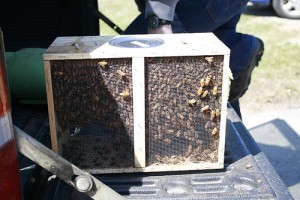
Since the cluster happens inside the hive boxes, it is difficult to picture.  I’ve chosen a swarm in the picture here, to show you a cluster, but not like the one I had in my first colony this winter.

Putting the Stuff Together

Imbolc                                   Waxing Wild Moon

A tour for Academia Caesar Chavez this morning.  Delightful 4th graders with lots of questions and energy.  I think they liked looking over the railing into the fountain court about as much as anything.   The talent level in the docent corps always amazes me.  The two women docents who shared this tour with me were, respectively, a professor of New Testament at Luther Seminary and a retired professor of epidemiology from the Public Health department at the UofM.deep-hive-body

After the tour I had lunch at Keegan’s Pub with Frank Broderick.  He gives me the leftover corned beef after his St. Patrick’s day meal for the Woollies, but he forgot on Monday.  He had a corned beef sandwich for lunch and I had bangers and mash.  The bangers were much smaller than the ones I remember from England.

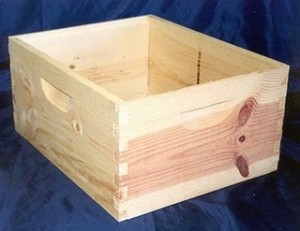
The first order this season from Mann Lake Bee Supply came yesterday.  It had eleven hive bodies and seven honey supers.  Kate has a hive body and a honey super already put together.  A hive body is deeper than a honey super since it contains frames that house brood, the queen and the nurse bees.  A honey super is about half the size to fit the honey frames.

(pics:  a deep hive body and a honey super with frames)super-frames

We’re buzzing.

Mid-Session, Mid-March

Imbolc                                           Waxing Awakening Moon

A sunny, bright day, but cooler.  44 right now.  Temps will trend downward over the next week toward more normal March weather.  This week we’ve melted all of our snow away, unusual.

Put in a large order at Mann’s bee supplies for deep hive boxes, honey supers, frames and foundations, hive tools, feeders and pollen patty mix.  Kate’s taken over the woodenware phase of the process, agreeing to put stuff together as it comes.  This is great for me since handling such matters tends toward large amounts of frustration and blue language.

Spent yesterday AM doing travel arrangements for Kate’s trip to Denver (car) and her trip to San Francisco (air), writing our CPA, signing up for a healthy eating class from Brenda Langston and moving money around.  A fussy, businessy day with our business meeting in the AM.

The mid-session for the Sierra Club Legislative Committee finds us fighting defense on the Nuclear Moratorium and the Polymet Mining proposal, pushing a few bills, but, for the most part, working in the trenches.  An old flame of mine, now a tax staffer for the Minnesota Senate used to say “No one’s wallet or rights are safe while the legislature is in session.”  That emphasizes the need for constant surveillance as bills go into committees, especially after Friday, the 2nd deadline which winnows legislation down further.  As bills miss deadlines, authors begin to look for creative ways of pushing their legislation like getting it added to omnibus bills or arranging for amendments once a bill is on the floor of either house.

Today is a day for Liberal II:  Liberalism-the present (and, I think, the future since I have no slot this year to finish a trilogy.)  Research all day.  Writing starting over the weekend perhaps.  So I’d best get to it.  Later.

Birds Sing, Sun Shines

Imbolc                                             New Moon (Awakening)

Since last Friday when I had two tours through this afternoon around 5 (when I got stung), I’ve been on high intellectual alert touring museum goers, learning about Apis mellifera, doing Latin homework, going over the Latin with Kate, teeth cleaning (OK, that’s anti-intellectual), having a tutoring session and using all the faculties I possessed to fend off various small creatures intent on driving a food bearer away from their home.  I’m tired.

But.  Boy, I’d rather have this kind of exhaustion in my life than be sagging toward 75 with a remote in one hand and my putter in the other.  So to speak.

From a gardening perspective this is a time when the sun and the greening and the weeds returning make working outside seem very attractive, but it’s still about a month early.  Even the early veggies normally don’t go in the ground until the first of April or even a bit later.  The birds sing, the sun shines, the moist air smells of soil and the bees sting.

The Grout Doctor has replaced the tiles that had become loose over the shower door.  Now he has to seal the grout once, then come back and seal it one more time.  At some point in here the new door gets installed and then I can get back to my steam baths after my work out.  I’ll be glad to have it functional again.

OUCH!

Imbolc                                      New Moon (Awakening)

A virgin no more.  I went the whole last season without a single bee sting.  Today, when I brought food out to the hive, so they have something to eat until there are blossoms, I got stung.  Twice.  On the face and neck.  OUCH.  With the first one I forgot the wisdom from the weekend, threw up my hands, let loose with a few poorly chosen words and danced like ol’ St. Vitus.  The second came after I suited up and discovered that I had enclosed a bee inside my veil.  She was unhappy and it cost her.  When honeybees sting, their abdomen comes out along with the stinger.  So they die.

I’m glad it’s finally happened.  No more suspense.  I didn’t die, so I imagine I’ll react better next time.  Maybe.

While I was out there, I cleared the mulch from the garlic.  They like this kind of cool, wet weather.  We have daffodils breaking the surface.  Unfortunately, our magnolia tree thinks it’s mid-April.  That’s not good for its blooms.

The Awakening moon finds our land here doing just that.

Here’s something I’m playing around with.  I think there’s a difference between living on the land and living with the land.  To live on the land means we place our house there, perhaps a swing set, grass, maybe even a few flowers and trees, but our daily life happens on the land or in our dwelling.  To live with the land means some engagement with your land’s seasonal changes.  There’s something here I think.

Echoes of Narcissus

Imbolc                                     New Moon (Awakening)

An all day Latin day, this time 3rd conjugation verbs, the notorious bad boys of Latin grammar.  Due to a weak vowel they got jiggered around by spoken Latin until they’ve become most unusual, irregular in some ways.  Got remember the paradigms for present, future and imperfect.  Just gotta remember.  Latin has become easier and harder, reflecting, I suppose, past learning and present state of ignorance.  It is true though that I have begun to be able to read sentences without looking up a single word. That’s pretty exciting.

Ovid here I come.  Of course, that’s Owid to English speaker’s ears.  I have a plan to put my Latin and my affection for Ovid to good use.  When I get closer to its realization, I’ll let you know.

Talked to Mark Nordeen.  He has some pollen patties and has agreed to give me one for the live hive.  I’m gonna see him tomorrow.  Then, in April, I’ll hive the package bees and wait until mid-May to divide the new one, feeding and caring for both of them in the interim.  Kate has volunteered to be assistant apiarist.  Her first job involves whacking together ten hive boxes, eight supers plus frames and foundations.  It will be fun to have help.

All the fruit trees are now visible.  No rabbit or vole damage on any of them.  That’s a relief because I was exasperated at the end of the last growing season–trying to keep Rigel and Vega in the yard, then out of the gardens.  As a result, I didn’t put up the hardware cloth protective barriers around them.

It hit 64 here yesterday and its 56 today.  Geez.  The sun feels good.  When I walked out to pick up the mail today, I felt warmth on my neck.  It surprised me.

A Parent Colony, A Divide, And a Package Colony

Imbolc                             New Moon (Awakening)

Bees.  Bees.  Bees.  Bees.  I’ve had two 8 hour sessions of nothing but bees.  And more stuff about bees.

Today I learned about dividing a colony, a successfully wintered colony, which is our situation here.  As Marla Spivak says, “If you’re not sure, just let the bees do it.”  That conforms to my work late last fall with the bees.  Mark, my bee beepackagementor, had a traumatic autumn and we just didn’t get together quite enough.

Now, though, I understand the next step, which will create a parent colony–the old queen with two hive boxes–and a child colony, which I will treat in the same way I did the current one.  That is, the goal with it will be to get to late fall with three hive boxes with a combination of brood, pollen and honey sufficient to see the child colony through this coming winter.

(2 lb package of bees)

Here’s the difficult part.  The parent colony gets no care after the honey flow stops.  This means that its queen will die of old age and since the colony will then have lost its egg layer, the entire colony will die out over the winter.  There’s nothing cruel about this since it follows the essential biology of bees.  That is, queens live around 2  years and the workers 60 days, so the entire colony would die out under any circumstances without a new queen and even if a new queen were added, the bees that would become the new colony under her reign would be entirely new bees.

There’s a big upside to this for all bees.  We can clean out the old hive bodies and frames, check for disease and virus and if necessary we can burn the old frames and start over.  This means that each bee colony will have a young, prolific queen and each hive will get a complete going over ever other year.  Both of these elements, cleaning and a young, prolific queen increase the colonies capacity to survive and thrive.

The good news is that the parent colony begins making honey the minute the divide is complete.  Honey supers go on the parent colony right away and they start filling up.  A honey super is about half the size of a deep hive box and honey filled frames are their only result.  A queen excluder is put on the parent colony deep hive boxes, so the queen does not crawl up in the honey supers and start laying eggs, therefore only honey ends up in them.

In addition to the divide Mark the bee mentor called and said he had an extra package of bees on the way.  I agreed to buy it because I thought my bees were dead.  Since they’re not, taking on another package of bees means we’ll end up with four hives next spring if everything goes well.  At that point, we should be producing some serious honey, possibly enough to sell at farmer’s markets.

The Dead Live

Imbolc                                  Waning Wild Moon

Big news.  The dead live.  Or, rather, the bee colony I declared dead last fall turns out to be very much alive.  I checked busy-honey-bees_1712this afternoon.  That means the whole bee thing looks more and more rosy here at 7 Oaks.  In the second year we can expect honey.  And a second hive.  Good thing I’m taking this  class.

All about bees.  Nothing about birds.  Marla Spivak is the charismatic professor of entomology at the University of Minnesota who has a lot of knowledge about colony collapse disorder.  She runs this weekend program for beginning beekeepers, a tradition at the University of Minnesota since 1922, as well the Bee Lab and the whole Bee program at the U.

You might not think much more about this, but when you realize that, as I learned today, the Upper Midwest is the primary honey producing area in the United States, flanked by California and Florida, and that there is no bee program in any of our surrounding states, Nebraska is the closest, then you understand the significance of her role and the U’s bee program.

Last year there were 160 people in the beginning bee-keepers class.  This year there were 250 with a waiting list of 150.  Interest in bee-keeping has taken on the characteristic of a small groundswell.  This is great news for bees, not so much for the 250 of us who sat in a theatre today that had little air circulation and 250 human furnaces pumping out BTU’s.  It got hot.

Bees

Imbolc                      Waning Wild Moon

Tomorrow and Sunday I study bees.  The U puts on this course for beginning bee keepers each year.  It’s popular, there are 250 signed up.  I need better information because all my bees are dead.  I think.  I suppose I should check one more time just to be sure.

Have to have my Latin done by Tuesday afternoon because the tutor is going up north.  With the next two days devoted to bees, that will make Monday and Tuesday Latin days.

Not much else right now, so, see ya on the backside.