Category Archives: Our Land and Home

Kona

Summer                                                                  Moon of the First Harvests

Kona died this morning.  Both Kate and I spent time with her just before she died.  She was alert and responsive to the end.  She died knowing we loved her and in the crate she knew as her safe place.
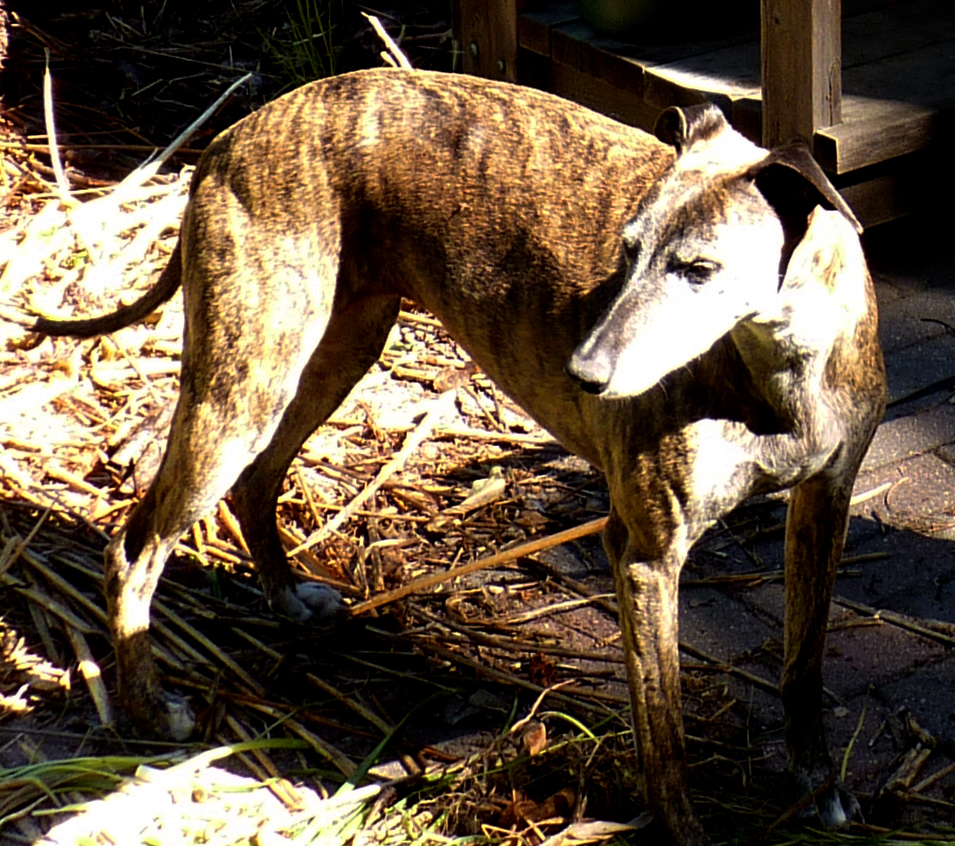
(Kona)

We cried, both of us.  Yes, in spite of an end obvious long ago, the actual loss still opens a chasm between the living dog and the dead one.  That chasm represents the never will agains.  And those made me cry.  I would never again feel her nuzzle into my hand.  Never again see her smile.  Never again see her run the trails in our woods.

Her corpse no longer retained her; it was a symbol now, not a reality.  This is a wonder to me.  When I spoke with her about a half hour before she died, she looked at me, put her nose in my palm, caressed me with her muzzle.  Kona was 100% there.  Then, she was gone.  The light left her eyes and her body no longer moved.

The wonder is this, that life has a magic about it, seen most clearly after it is lost.  That which was Kona was there, then not.  Yes, her memories live on, that’s true.  But Kona does not.  The personality, the somewhat aloof I’m living life as I intend to personality of the sighthound, has vanished.  Just like that.
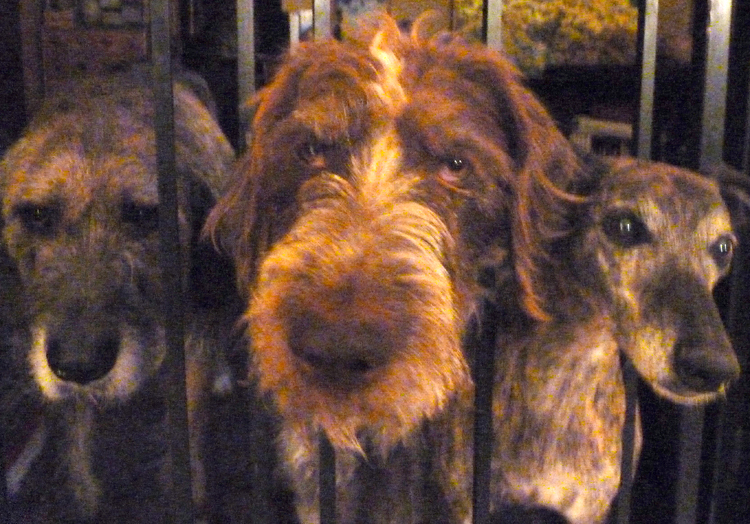
(Rigel, Gertie, Kona)

Life is a miracle, ordinary in its profusion and ordinary as long it exists, yet when it has gone, then we know.  So, each death gives us a moment to reflect on the precious gift we have.  The one carrying us forward into tomorrow.  A gift others give to us, too.  Each death is an opportunity to affirm and celebrate life and living.

Kona’s father was a whippet champion named Drum.  When we picked up Hilo and Kona from the breeder, the puppies and the parents were watching Animal Planet.  We brought them home and they began a series of escapes from the property, going under the chain link fence in pursuit of prey or delight, often both.

We held them on our laps when they were young.  Hilo would squirm, sit up, stretch, jump down.  Kona, the much larger of the two, would lie quietly, happy to be there.  

In her early days Kona was a predator.  I remember one day Kona came up on the deck, dropped something there, then ran back out into the woods.  The something was the still warm and clear eyed head of an adult rabbit.  Why she brought it to the deck I don’t know.   Over a long period Kona would kill rabbits and we would pick up the dead rabbits, put them in a plastic bag and dispose of them.  This never deterred Kona.  She just kept at it.

Hilo died three years ago of kidney failure and was never much of a hunter.  She liked to be with her people.  Kona kept to her self, finding places to sit nearby, sometimes with us, often not.  She kept her own counsel and determined what her day would be like, pretty much independent of us.

After her death this morning, I went out into the garden and sat on one of the raised beds.  Gardens heal.  Surrounded by life and life producing food, the cycle of life was concrete.  Kona fit into this cycle.   It helped me remember that at some point the light in my eyes will go out, too.  And, more.  That will be fine, it will fit into this cycle.

(Vega and Kona)

Kona had privileges the other dogs didn’t.  She would go with me into the garden, mainly because we could count on her not to dig holes in the garden beds.  She would also be outside on our brick patio with us because we could count on her to stay around the house.

She has been part of our lives for 12 plus years, as real and regular a part of our lives as we are to each other.  True she was a dog, but as a companion and fellow traveler on this pilgrimage she was with us, part of our pack as we were part of hers.

We travel on now with one less pilgrim immediately in our presence, yet at the same time, the whole pack with us, all 17 dogs, two parents and two sons.  Amen.


Harvest Continues

Summer                                                             Moon of the First Harvests

Spent some time picking currants, stripping them off the branch reminded me of milking a cow.  This time our crop, a slender one, yielded around 4 cups.  This is hobby level horticulture for sure.  To pick a commercially successful crop of currants would be very time consuming.  In this case we’ll end up with one currant pie.

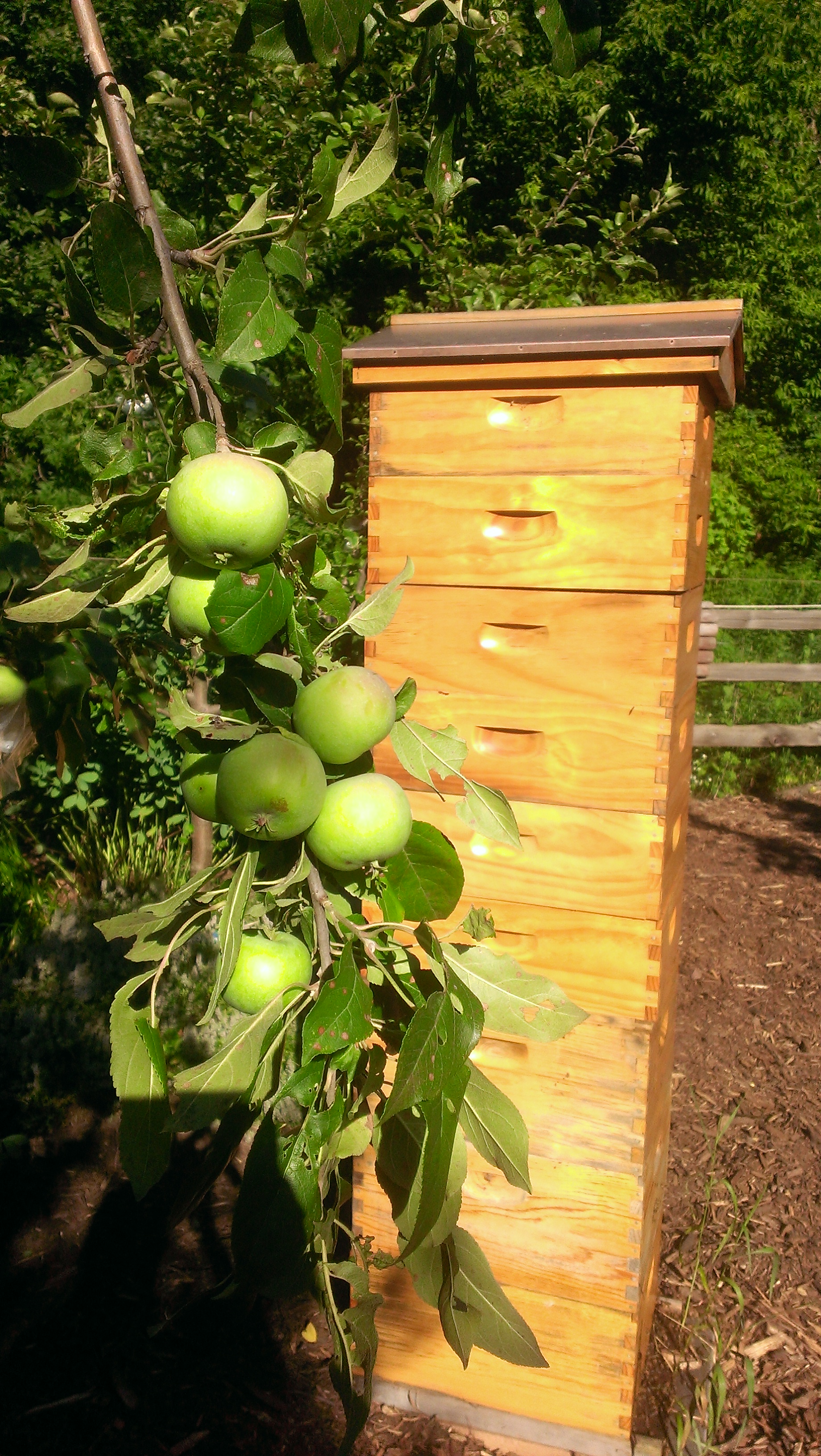
We have had wonderful cherry tarts from our two cherry trees and have some cherries frozen.  The plum crop, though large, has not yet produced an edible plum. Not sure what the deal is with them, more to learn.  Meanwhile the bagged apples are growing inside their ziplocs and the few I couldn’t reach on each tree look great, too.  Maybe the cold, wet spring fouled up the maggots.

The bees continuing working at their in and out pace, workers flying off in all directions seeking the nectar while the the nectar flow still runs.  Our six supers make the colony look like an entomologically designed high-rise apartment complex.  Thousands of inhabitants, food and nursery service included.

Kate brought in a tomato and a cucumber, our first of either of those.  They’ll be in a salad for lunch.

Cherry picking low hanging fruit

Summer                                                                      Moon of First Harvests

Cherry picking.  This morning.  Blueberry picking, too.  Also pears from two trees, their entire crop.  First, the low hanging fruit, then up the ladder.  A lot of cliches come from the world of the orchard and the garden.  Let’s wait til it bears fruit.  He planted the seed on fertile ground.   In the not so very long ago, maybe one or two generations, perhaps three depending on your age these sayings were not culture; rather, they were everyday experience, or, every appropriate season occurrence.  Now, with increasing urbanization, the rapid decline of the family farm and a rush to do all things with technology the hand in the tree which picked the cherries is on the keyboard checking Facebook or more likely on the iPhone checking Snapchat.

Delivering vast numbers from the mind numbing toil of subsistence agriculture is a good thing.  No doubting that.  Even having agriculture and horticulture done by the few is not necessarily a bad thing.  We need food and flowers.  If they come to our table full of nutrients and vibrant, well then.  If however, we create a system where the food we eat has been modified not for its nutritional value but for the positive economics of its growing, harvesting and processing, well then.

Somewhere a tectonic plate of public opinion has begun to shift.  I can feel it in the newspapers, the magazines, the websites I read and visit.  That shift is toward action against global warming.  My hope is that this shift, which will ride over the continent of fossil fuel and through subduction bury it in the mantle below the crust where it belongs, will include within it a return to the tree, the wolf, the tomato and the onion.  May it be so.


The Land

Summer                                                              Moon of the First Harvests

One with the land.  A cliche perhaps, though little used today.  I hope it has again some of the powerful connotation it had long ago.

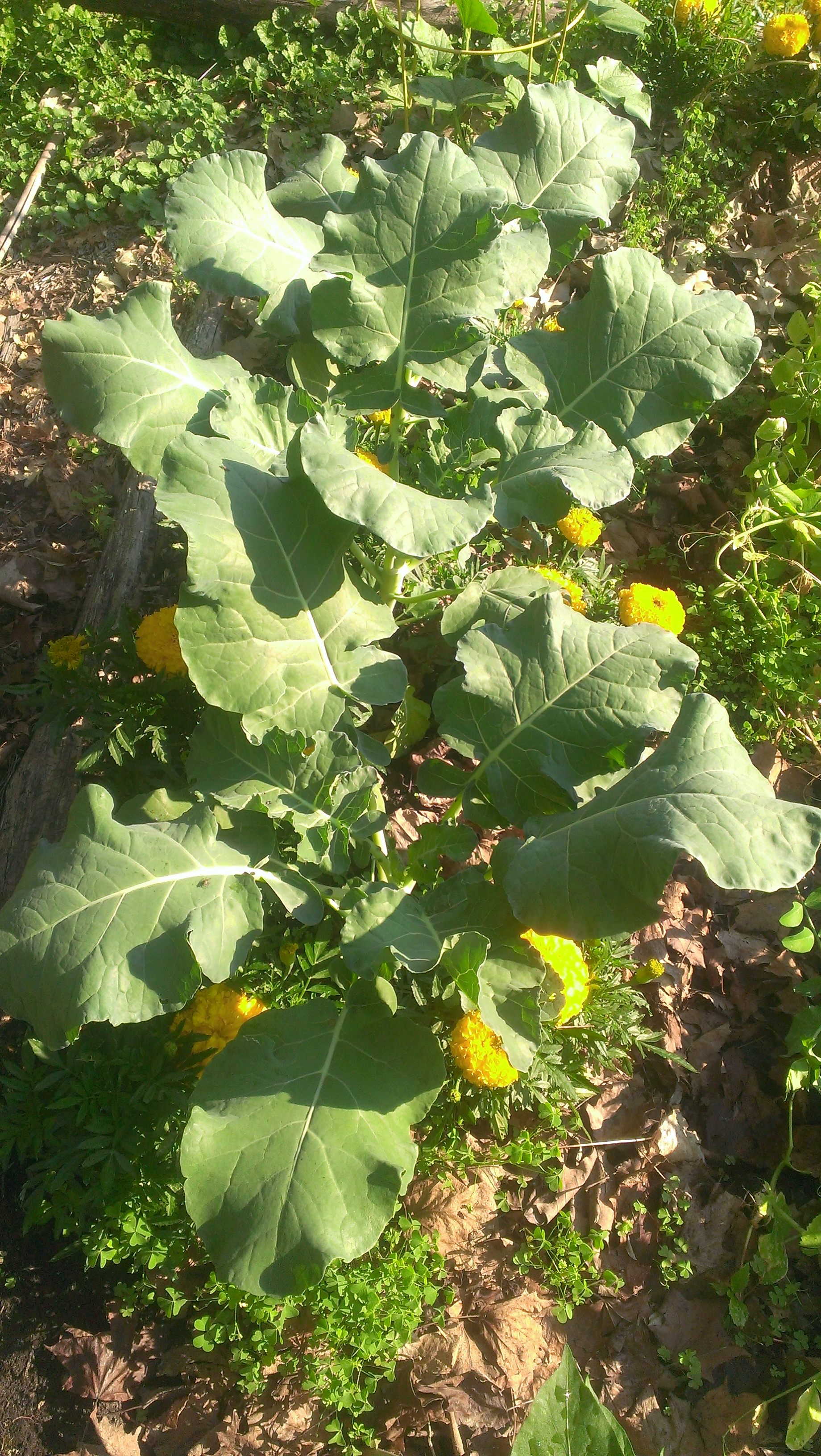
On a fine cool morning like this one, not even really cool, 68, to step outside with tools in hand, tools for working with plants, and feel the morning air surround you, to see the plants green and the flowers vibrant, to step into the vegetable garden and see tomato blossoms, fruit, eggplant fruit, cucumbers vining up the bamboo, the carrot’s feathery leaves, the brave leeks tall and proud and to know, know in the biblical sense, that is, to have direct sensory knowledge unmediated by book or story, but present and available, that you and those plants share the workload.  To know further that the bees buzzing and dipping into the flowers are likewise colleagues, not just insects, but partners.  Yes, I know it’s overwritten, sorry about that, but it hits the feeling tone I want to convey.  Over the top.  Not overwhelming, maybe, but certainly whelming.  Intimate.  Holistic.

It’s a feeling, come to think of it, or come to feel it might be better, that synchs up with the mystical moment I had back long ago in college.  I’ve written about it here before so just a synopsis.  After a philosophy class I experienced a sudden moment of integration with the whole, with everything, with the cosmic.  I was in it and of it, as it was in me and of me.  This feeling I have, this oneness with this land, this particular place, is a discrete yet parallel feeling.  I am in this land and of it, as it is in me and of me.

Out on a Limbing

Summer                                                                Moon of the First Harvests

Sprayed brix-blaster and qualify this morning.  Breakfast. Then limbing the ash trees I cut down over the weekend.  As the dewpoint and the temperature rose, my inclination to do that work inverted.  I have one tree fully limbed, the four sapling ashes limbed and pulled away from the fence and a brush pile organized, ready to move.  Tomorrow limbing the second ash and either moving the brush pile (which will be a big job) or cutting the limbed trees into fire pit sized logs.

Yes, I’m doing as much as I can with my felling ax and my limbing ax.  I like the direct work with no engine in between me and the task.

In the summer the cliche about wood seems to mock.  You know.  Wood heats you five times.  When you cut it.  When you move it.  When you split it.  When you stack it.  When you burn it.  No splitting or stacking now, but the first two, cut and move, yes. They do generate heat.


The Arc of Summer Begins to Bend Toward Fall

Summer                                                            Moon of the First Harvests

A light rain falling as I went out this morning.  The garden continues to look strong, the tomatoes are about to enter their bearing and ripening phase, maybe a week, maybe a little more, then Kate will have the stove filled with canning and the counters with canning equipment.  Later on the raspberries, which is a bulk harvest, too, and the leeks, even later, will also be a bulk harvest.  Around the time the leeks are ready, the apples should begin to ripen.

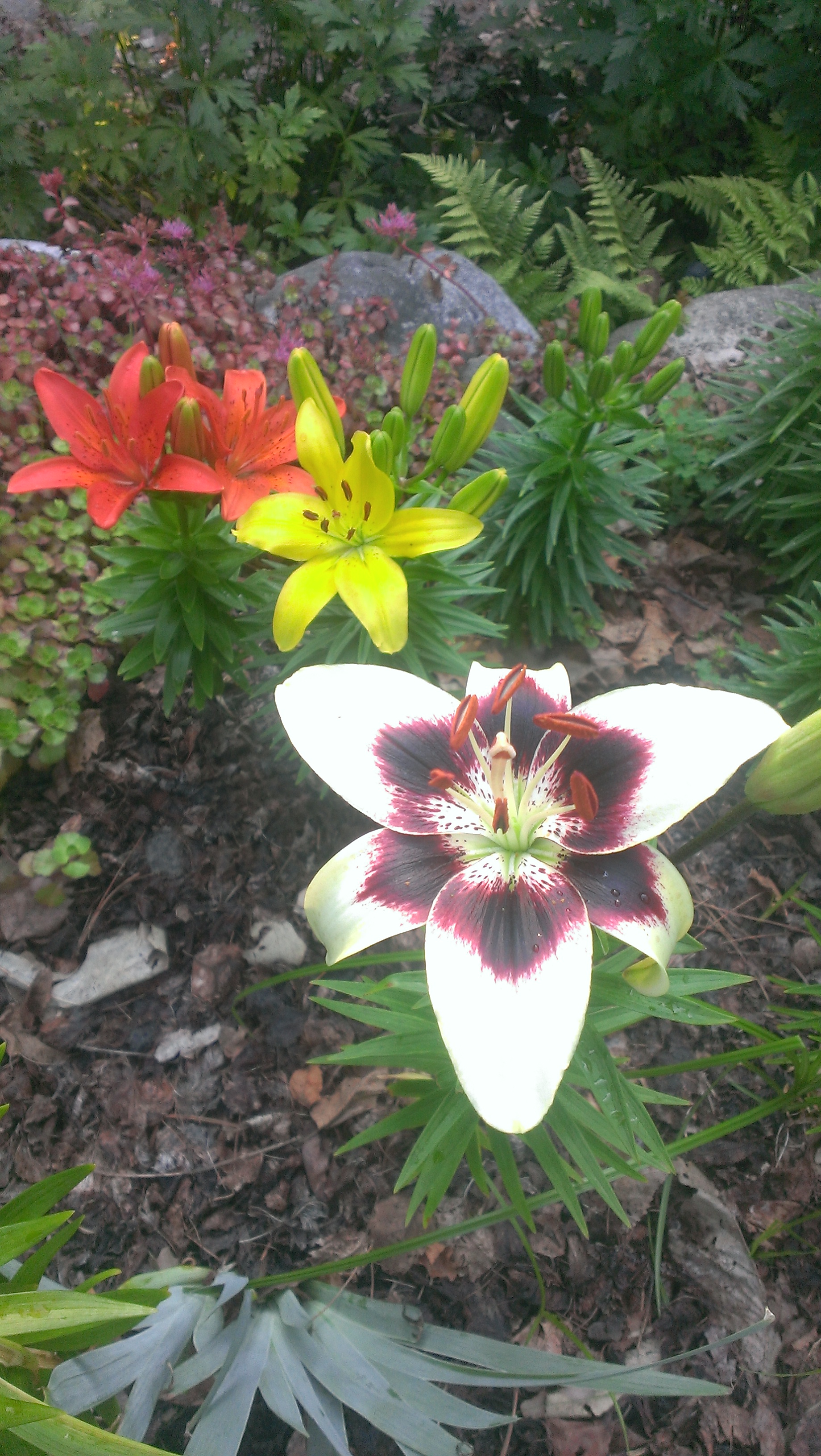
I’m especially pleased with my new lilies from the Northstar Lily society:  the dark purple, the trumpet of white with yellow, the cream colored vase shaped, bright yellows and pinks. Their colors are vibrant.  They pulsate.  Mid-July is my favorite flower season.  Well, mid-July and early spring.  I also love the spring ephemerals.  The rest I enjoy, but these flowers make my flower growing season.

Sprayed again this morning, this one an oil based spray to strengthen the plants against insects.  It does seem to be the case, with the exception of the beets and the cabbage that insect predation is down from years past.  This has been such an odd year, especially compared to last year–hot and dry, that it’s a little hard to generalize.  It does seem to be the case that stronger plants equal better insect control, by the plant.

While the Woollies were here, I commented on the amount of money we’ve put in the outdoors.  Initially, the landscaping by Otten Brothers.  Then clearing the land for the vegetable and orchard areas. (cost here mostly stump grinding and renting the industrial strength wood-chipper.) The raised beds.  Then the ecological gardens work with the orchard and some in the vegetable garden.  Fences around the orchard and the vegetable garden and the whole property.  Irrigation zones.  The fire pit.  Mulching the orchard and the vegetable garden.  Bulbs in the fall for many years.  We’re raising expensive tomatoes.

But, this kind of accounting leaves out the most significant parts of all this work.  It keeps us outside, using our bodies.  The whole grounds are a joint effort, in work, planning, and hiring.  It also allows us to produce a good part of our vegetables at quality we effect and flowers for our tables.  Fruits, too.

Best of all it keeps us focused on the rhythms of the earth.  Winter puts the garden to sleep and relieves us of its care (for the most part).  Spring sees our fall bulb planting rewarded and our earliest vegetables planted.  Summer finds us intensely involved with weeding, thinning, managing the various crops for the year.  Fall finishes the harvest and brings senescence.


Chain Saw and Ax

Summer                                                         Moon of the First Harvests

Chain saw and ax.  The ash is a prolific tree, much like the black locust, spreading itself with some vigor.  Two especially large young ash had grown up in the area where we originally planted prairie grass.  I cut one down today using the felling ax and the other, too close to the chain link fence for my skill level with the ax, I cut down using the chain saw.  The chain saw also took out saplings grown close to the fence.  Now the orchard will have the benefit of the sunlight previously blocked by these trees.

These ash were on the west side of the house, which creates an additional problem since derechoes and tornadoes come out of the northwest.  In a nasty storm they could be blown into our garage.  They needed to go.

Over the next few weeks, picking up the pace as fall arrives I’m going to continue clearing the forest and stacking up firewood for our bonfires.

Having the time without the guilt for these chores has me leaning toward setting aside Latin for the growing season, later April through late September.  This is, oddly, the old schedule which most public schools still follow, letting the kids out for farm and other agriculture work that 99.9% no longer have to do.

Bad News, Man

Summer                                                           Moon of the First Harvests

Reading the paper this morning made me choke several different times.  First two related to horticulture.  The spotted drosophila, a fruit fly variant, lays eggs and larvae in blueberries, strawberries and raspberries especially.  We have all three.  Managing them may be very difficult without insecticides which I’ve avoided all these years.  They may force me into a difficult position if they show up here.

The second horticultural item involved the now seen as inevitable spread of the Emerald Ash Borer.  I’ve not done a census of our trees, but a reasonable estimate would be that 25% are ash.  That means a lot of holes over the next few years.  My plan is to get proactive and start taking them down, a few each year, and planting other species where it makes sense  .

Then there were all the articles about the Zimmerman trial.  Yecchhh.

Student loan rates.  This student loan business is a scandal.  Saddling kids, especially poor to lower middle class kids, with loans the size of mortgages in my day, before they even get started in life, is a real burden on the future.  It’s like attaching a drag chute to the lives of today’s college grads.

Not to mention that bank profits have jumped.

Guess the good news is that getting irritated by the news means I’m still alive.


The Woollies At Our Home

Summer                                                      Moon of First Harvests

The Woollies came.  Stefan, Tom, Scott, Bill, Charlie H., Warren, Frank, Mark and me.  We sat around the fire pit, ate Kate’s tasty and thoughtfully prepared food, told stories of our lives as we almost always do.  Relationship trouble.  A son’s successful, so far, focus on alcohol.  A journey to see children and grandchildren.  A good experience in home repair.  Painting, the fine art kind.  Plein air even.  A cousin who drunk himself to death.  A trip to the polar regions with walrus and polar bears and knowledge.  A sister-in-law with Alzheimer’s, early.  Consulting with a group, helping them become creative.

The woods were there as witness.  The sun set and the moon rose.  We talked about home, my question, wondering why we want to stay home rather than go to a nursing home, why we want to die at home.  What is this home idea that is so powerful that it can penetrate even the fog of Alzheimer’s?  How do we know home?  How do we make a home?  When does a house become a home?  We only got started, stories and poems and few notions, but there is so much more here.  And it will only become more and more important as we live further into the third phase.

A conversation not yet finished.

Paths Not Taken

Summer                                                       Moon of First Harvests

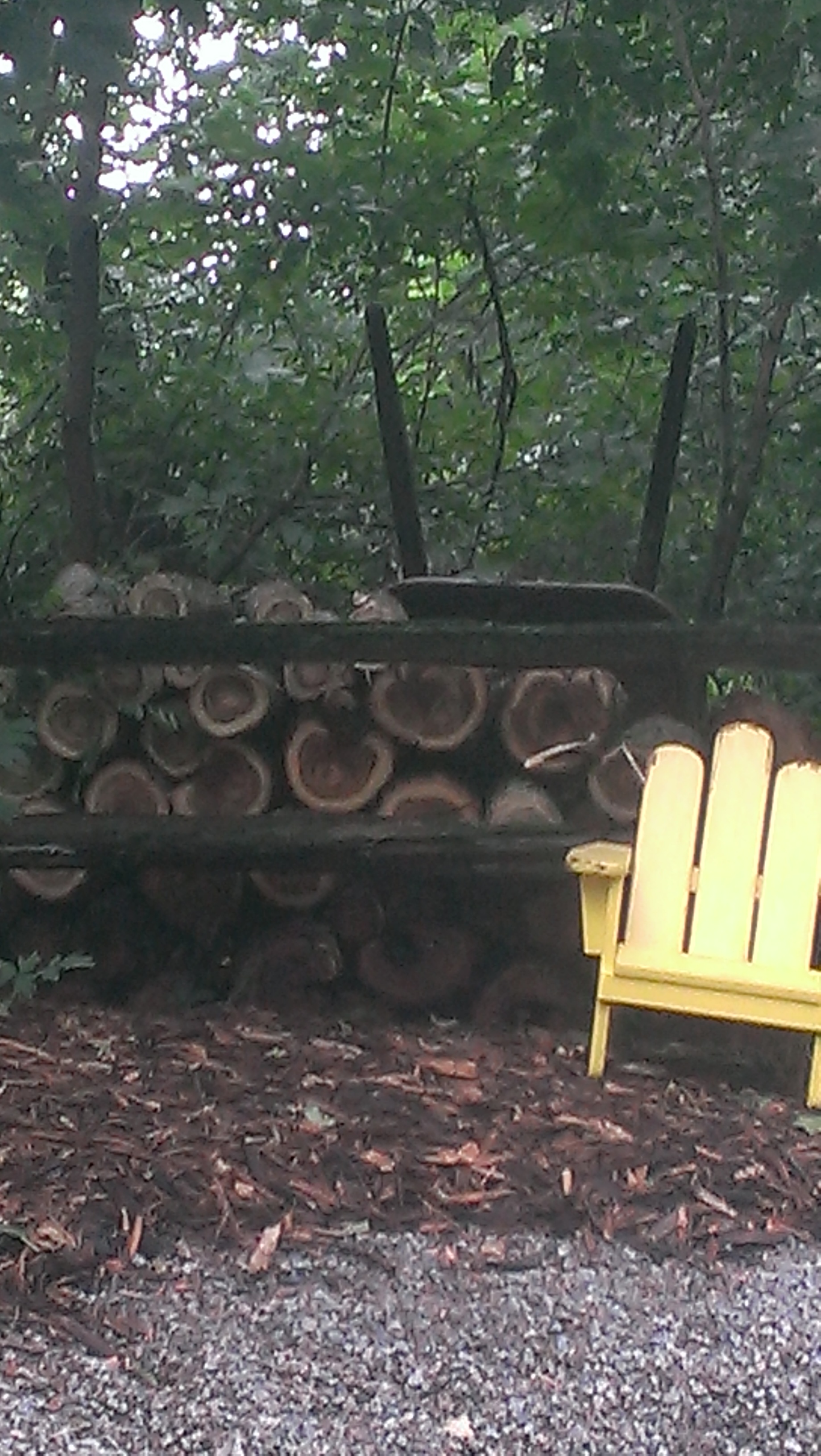
One thing I learned here early on was that decisions to not do things had important consequences.  Sections of the ash that grew so long undisturbed in the midst of our vegetable garden will now provide seating for the Woollies this evening and others in the future.  We chose, for example, to  not plant a full lawn in front, but to bookend the main lawn with prairie grass and wildflowers.

I chose to leave three oaks growing on what is now the northern border of the vegetable garden.  They’re 20 years older now, a small clump of strong young oaks.  I also chose to leave an ash sapling in the area where Jon and I cleared out the black locust, an area now covered by our vegetable garden and orchard.

As the years went by that ash grew, no competition, plenty of water and great sun.  It grew so big that it shaded out two raised beds and threw shadows onto much of the northern section of the vegetable garden.  Finally, we decided it had to go because we were not going to expand our vegetable gardening space and needed all the sun we could get for the beds we had.

Now that it’s gone we have a sunny garden which feels very open and airy.   And that ash    was not grown in vain.  It will now provide seating for years to come.  I like the cycle of growth, transformation and reuse.