Category Archives: Poetry

Out There, Man

Fall                                                               Samhain Moon

The beats.  for beatific.  A generation I have begun to feel more now, reading them in ModPo.  I never read them, ignored them as quaint, anachronistic for the rebellion, my rebellion, our rebellion, the 60’s.  Now looking back at them, imagining them as outriders on the buttoned up, nuclear overcast, post-war suburban build out to conformity culture in which I was young, now I can see.  And hear.  They inhabited a margin unimaginable from the center of Levittown, a world of China and tea with no oriental associations, a rootless, roving busload of wearers of black, makers of poetry, listeners to jazz, respecting no sexual or social conventions.  Out there, man.

(Jack Kerouac, Allen Ginsberg, Peter Orlovsky, Lafcadio Orlovsky, and Gregory Corso in 1956)

Now.  Now I hear the Howl and have listened to Kerouac’s strangely charismatic voice, speaking through digital technology only barely coming to be in his own time.  These are not my people.  I am not of them.  But they are our people, our American outsiders.  Buoys on the shipping lanes of middle class culture warning out beyond here there be monsters.  My people are political.  The beats were not.  We used acid and mescaline and peyote, they turned to heroin.  They found their place in poetry and wandering and improvisation; we found ours in the street, organizing, fighting.  Different.  But the same.

(Carl Solomon, Patti Smith, Allen Ginsberg and William S. Burroughs at the Gotham Book Mart, New York City, 1977)

American outsider voices.  All amplified in that strange alien language spoken only where the commuters never ride.  Where the matron never serves tea.  Where the only hope is purity and clarity and the archetypal.  Never sullied by bills and jobs and diapers and cars breaking down.  Out there surfing the big breaks of idealism that crest upon the shore of America the Capitalist and America the Conformist.

(Train Station, by Bernice Sims)

I hear them now, speaking in their cadences at night in coffee houses, pounding small drums and shouting into the microphone about pain and angels and doomed love.

Lines from “Howl”

Fall                                                                           Samhain Moon

Never read it or, if I did, forgot it.  Studying it now in ModPo.  Howl has some outrageously good lines.  Here are a few:

I saw the best minds of my generation destroyed by madness, starving
hysterical naked,
dragging themselves through the negro streets at dawn looking for an angry
fix,


run down
by the drunken taxicabs of Absolute Reality


who barreled down the highways of the past journeying to the each other’s
hotrod-Golgotha jail-solitude watch or Birmingham jazz incarnation,


the madman bum and angel beat in Time, unknown, yet putting down here
what might be left to say in time come after death,
and rose reincarnate in the ghostly clothes of jazz in the goldhorn shadow
of the band and blew the suffering of America’s naked mind for love
into an eli eli lamma lamma sabacthani saxophone cry that shivered
the cities down to the last radio
with the absolute heart of the poem of life butchered out of their own bodies
good to eat a thousand years.

A Stein Is Not A Tankard

Fall                                                                          Harvest Moon

Working with the poetry of Gertrude Stein.  Tough stuff.  She does break.  Through the usual patterns.  And forces a new way viewing seeing connecting word thing thing to word or not.  Word to word.  Forcing nouns to squiggle out of their links, forcing them to talk to each other like, well, like California girls talking to each other, like.

[Karel van Mander III man drinking beer from a tankard   1630-1670 (work pd.)]

Close to impenetrable, at least for the lone reader.  In collective reading with a guide like Al Fireis her work can jump, come alive though whether it makes sense.  Not supposed to make sense, I guess.  To make word. Yes. Words to words.  A world of words, a languaged world still or as always unreachable by sense so that world is nonsense.  Only words adhere to words within which we find ourselves worded and sentenced to life without sense.  Amen.


Pedagogy. Distributed.

Lughnasa                                                               Harvest Moon

Cooling down.  Again.  Good. But. I’m waiting for a light frost to plant my garlic.  Looks like I might wait a while.

ModPo (Modern and Contemporary Poetry) has given a lot of thought to pedagogy.  They’ve imagined ways to get folks to interact in non-judgmental ways, no grades or points on the essays, for example.  The essays themselves will be peer-reviewed by at least 4 fellow students (the norm for MOOCS) and Modpo will post, after the essays are in, a close reading video on the poem about which we wrote our essays.  In addition, the essays and their assessments will be posted to forums.

(Douris. Man with wax tablet)

The forums themselves, which encourage discussion of individual poems, are open-ended and helpful.  A part of getting a certificate is posting to at least one thread on a particular poem each week.  This pushes each of us to engage the online discussion.  A good push.  Otherwise I might ignore the forums or be a lurker.  This is an each-one teach one pedagogy with quality information and guidance.  Perfect, from my perspective.

In other MOOC news this week MIT plans to start offering what it calls Xseries classes.  In the first instance this will be seven MOOCS on computer programming and networking.  At the end, for $100 a class, $700 total, the student can get a certificate of learning from MIT.  They consider the Xseries to be equivalent to maybe 2-4 classes on campus.  This is exciting because it begins to open the door to degrees earned through MOOCS for little cash, making high quality education available to more and more people.

None of the MOOC entities, Coursera, Udacity or Edx, are, as the article announcing the Xseries said, universities, but the Xseries suggest that sentence could have ended with yet.

What an exciting time of autodidacts everywhere.


Loki and Scansion

Lughnasa                                                                                                            Harvest Moon

“Someday you will be old enough to start reading fairy tales again.”  C.S. Lewis

After a day with Loki and scansion, I got tired and was happy to have supper and watch Wire in the Blood with Kate.  Loki’s fascinating, an original bad jotun, and just can’t help making mischief, a festering ball of chaos.  He’ll make a great character once I figure out how to include him in the story.

(Gullinbursti, the Golden Boar.  Part of the Loki saga)

Scansion, on the other hand.  Oy vey!  I find recognizing meter, the stressed and unstressed syllables difficult.  I’ve never learned it and I need to now in order to finish my essay on Dickinson’s poem.  After locating some handy brief exercises, my head hurt.  So, I stopped.

Tomorrow.

The gong fu cha goes well.  I have a rhythm with it now and I produce six pots of tea out of a single batch of tea leaves.  The last two infusions, surprisingly, are the best.  At least so far.

I taste a liquor never brewed–

Lughnasa                                                                   Harvest Moon

Second draft of my essay for ModPo (Modern and Contemporary Poetry) finished.  It’s emily-dickinson-photo1here and shows what close reading (at least my still learning version) is.  The poem is by Emily Dickinson.

I taste a liquor never brewed —
From Tankards scooped in Pearl —
Not all the Vats upon the Rhine
Yield such an Alcohol!

Inebriate of Air — am I —
And Debauchee of Dew —
Reeling — thro endless summer days —
From inns of Molten Blue —

When “Landlords” turn the drunken Bee
Out of the Foxglove’s door —
When Butterflies — renounce their “drams”
I shall but drink the more!

Till Seraphs swing their snowy Hats —
And Saints — to windows run —
To see the little Tippler
Leaning against the — Sun —

In your short essay, do a close reading of this poem. Use as a model the close readings done in the several filmed discussions of other poems by Dickinson.

You may, for example, discuss at least briefly every line of the poem. Or you may choose what you consider to be key lines (or metaphors or terms) and explain each of them fully.

Your essay will be evaluated according to how well you addresses the poem’s form, its use of (shifting) metaphor, and the extent to which its meaning is open. You should try to explain the story Dickinson tells here. For instance, you might say what happens to the speaker as the result of her inebriation? What does this have to do with the way the poem is written?

My answer (so far, I have more work to do on the question of form and how the poem’s story relates to its form.)

The poem explores a connoisseur’s palate for the ecstatic, probably the ecstasy of creation.fb-seek-those-who-fan-the-flames-rumiShe (Dickinson? Another I?) tastes this ecstasy as a liquor, not one found in package stores, but a liquor never brewed. She drinks it from a beer hall stein that has been filled not with liquid but with pearl or pearls, indicating, I suppose, that it’s used for finery stuff than Alcohol. Dickinson refers to wineries on the Germany river, the Rhine. This is the chief wine producing area of Germany now and was in the mid-nineteenth century, too. Even the famous Rhenish wine makers could not produce a liquor as fine as the poet drinks.

She gets inebriated from breathing alone, an “Inebriate of Air.” It’s easy to imagine here in stanza 2 an early morning walk, breathing in the cooled air of the night and getting wet from the dew; perhaps she picks her feet up and begins a dance, a reeling. This dance becomes an ecstatic one, perhaps like the whirling Dervishes, that continues “thro endless summer days”.

The fourth line of stanza 2 seems to me to read with the first line of stanza 3. The endless summer days—inns of Molten Blue (the gambreled sky of “Tell all the Truth but tell it Slant”?)—have guests. “Landlords” remove the drunken (ecstatic) bee from the Foxglove, could be the flower, could be the name of a pub or bar or inn. The Butterflies give up, renounce, their drams, their tots of liquor. Renouncing is a temperance flavored term or a religious one related to repentance. The Butterfly gives up their nectar willingly while the drunken Bee gets ejected.

Neither ejection or renunciation works for the poet. Dickinson resolves to keep right on drinking. This reminds me of the Sufi poets for whom inebriation and intoxication were euphemisms for religious ecstasy though; I think the poet has a similar, but secular meaning in mind.

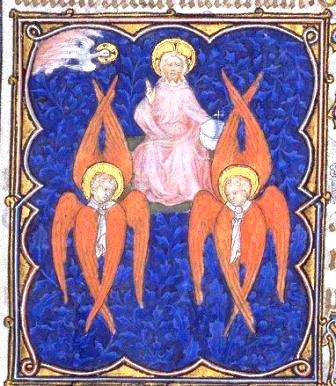
The abstract and pantheistic ecstasy of the first three stanzas however, seems to curve seraphim__1acutely toward the explicitly religious when we come to Seraphs and Saints in the fourth. Seraphs were fiery angels, the burning ones, who flew round and round the celestial throne singing holy, holy, holy. Saints, in the context of New England circa nineteenth century probably referred to church goers, not Catholic saints, but church goers still. Both the burning ones and the ordinary Saints of the church stop their explicitly religious activity, the Seraphs “swinging their snow Hats” and the Saints to (church?) windows run. Drawn by voyeurism toward a pagan ecstasy, they see the poet, the little Tippler, the inebriate of air and debauchee of dew, leaning.

Ah. Does she lean on the everlasting arms of Jesus or in the strong arms of the Father? No. We’ve never really left the abstract and pantheistic ecstasy of stanzas one through 3. No, she leans against the Sun, the burning one that exists within this realm and a metaphor for her creative ecstasy.

Virgil

Lughnasa                                                                     Honey Moon

(William-Adolphe Bouguereau, Dante and Virgil, 1850, oil on canvas.  Musée d’Orsay, Paris)

Tom Crane found this poem by Virgil:

Virgil’s Bees


Bless air’s gift of sweetness, honey

from the bees, inspired by clover,

marigold, eucalyptus, thyme,

the hundred perfumes of the wind.

Bless the beekeeper


who chooses for her hives

a site near water, violet beds, no yew,

no echo. Let the light lilt, leak, green

or gold, pigment for queens,

and joy be inexplicable but there

in harmony of willowherb and stream,

of summer heat and breeze,

each bee’s body

at its brilliant flower, lover-stunned,

strumming on fragrance, smitten.


For this,

let gardens grow, where beelines end,

sighing in roses, saffron blooms, buddleia;

where bees pray on their knees, sing, praise

in pear trees, plum trees; bees

are the batteries of orchards, gardens, guard them.

Technology

Summer                                                                  Moon of the First Harvests

What’s the railroad to me?

What’s the railroad to me?

I never go to see

Where it ends.

It fills a few hollows,

And makes banks for the swallows,

It sets the sand a-blowing,

And the blackberries a-growing.


About This Poem

Henry David Thoreau was cautious about the effect of technological progress on mankind, feeling that it often could be a distraction from the inner life. In his book Walden he famously writes, “We do not ride on the railroad; it rides upon us.”

75%

Summer                                                                Moon of the First Harvests

Today was an inside day.  9o degrees, 73 dewpoint.  Definitely a writing day.  I’m at the 75% revised point, so I’m looking at the end of revision III in a matter of a week, two at the most.  There are still futzy things to do after that.  Connect up separated sections, change some section and chapter headings.  That sort of thing.  Not a lot of time, but some.

Then, I’ll be ready for my beta readers, if they want, to go over this revision.  I’m asking Kate to give it a thorough reading for grammar, spelling, other technical matters.  She’s very good at that and this is, I hope, the last revision before submission to agents.

As they tackle that task, I’ll set it aside completely.  I’ll signal Greg to turn the Latin back on for the week after Labor Day and I’ll start writing Loki’s Children, the second novel in the Unmaking Trilogy.  I have a good start with material cut from Missing and a good deal of research I did while the beta readers were at work.

I’m also taking two MOOC’s at the end of the summer, one new historical methods for a new china and another on modernism and post-modernism.  Both are core interests of long standing.  Also, in September, a MOOC I’m really looking forward to, Modern and Contemporary American Poetry.

With end of the gardening and bee season chores there will be no moss growing on this rolling stone.

The poetry course will include 19th-century proto-modernists Emily Dickinson and Walt Whitman.