Category Archives: Weather +Climate

Cities built on Vesuvius

Lughnasa                                                                          College Moon

War is a terrible act. It marshals the forces and treasure and precious lives of foes into a bloody knuckle, don’t stop till the last soldier is down fog. Intentions, plans and often nations disappear in that fog and sometimes never re-emerge. Yet Barak Obama, the get-us-out of Iraq and Afghanistan president, is about to have his Woodrow Wilson moment.

My wife is a pacifist, my son a manager of war planes in battle. I’m an anti-Vietnam war era foreign policy realist who recognizes the anarchy existing at the level of nation-states. The always combustible atmosphere of geo-politics is even more flammable in the Middle East where oil and playing with matches has become the third millennial Great Game.

Add to that a world-defining struggle between Enlightenment rationalists and those who inhabit the caves which still project a dead God’s shadow (see post below) and we may be living during a world historical turning point. The irony, of course, is huge. We fight those inflamed by their commitment to a desert storm god not only because they harass us with bombings and public beheadings, but because their god’s realm includes the very fuel we need to continue poisoning the climate in which we all have to live.

This is a struggle between the god-drunk and those who live the dangerous life in which “knowledge (has) finally (stretched) out her hand for that which belongs to her: she means to rule and possess, and you with her!” We are out-numbered and out-flanked as the Chinese dragon grows stronger every day. What could possibly be more dangerous than this life? And, if we follow Nietzsche, “the most fruitful and enjoyable.”

As this blog says in its tagline, Welcome to the journey.


Wide-eyed Amazement

Lughnasa                                                                           College Moon

The winds howled last night like a winter storm. It’s wet and 50 degrees here in Andover. The Denver forecast has the possibility of snow showers on Thursday. Phoenix had 3-5 inches of rain and streets flooded. September is a month of transition. California would like a transition with an astounding 58% of the state in the exceptional drought category, the highest. 95% of the state, that’s 95% is in severe drought and 82% in extreme drought.

Intensity:

  • D0 – Abnormally Dry
  • D1 – Moderate Drought
  • D2 – Severe Drought
  • D3 – Extreme Drought
  • D4 – Exceptional Drought

We’re a big country with a lot of natural variation in weather. That’s true. But there are climate change signals in a lot of these extremes.  Even our cool weather, caused by the stuck polar vortex, may have its root cause in the melting of Arctic sea ice.

No, not another climate rant here. Just a bit of wide-eyed amazement at the differences in this nation’s weather.


Nocturne

Lughnasa                                                            New (College) Moon

Rain so hard it sounded like hail has scoured the air, washing the dust out and dropping the temperature. The tornado watch expires in half an hour though we’ll have more thunderstorms later tonight. Weather is local; climate is global. Climate change in this case has given us days with more moisture in the air, driving up the chance of stronger storms and more concentrated rain fall.

(Curry The Line Storm)

Robert Jay Lifton, a grand old man of American letters, known for his psychological and psychiatric work on war and nuclear weapons, has written an interesting article in the NYT, The Climate Swerve. He’s careful, doesn’t overstate the evidence, but he makes a point similar to one I made here a month or so ago. Something’s happening to public opinion about climate change. Something pressing the public toward concern, possibly creating the political climate necessary for making difficult choices. Read the article for his thoughts about “stranded assets.” It’s a concept you will hear about more often in the future.

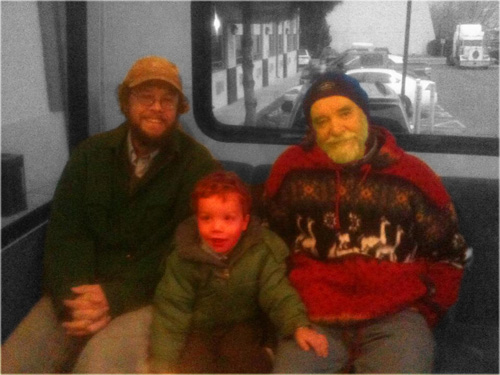
Had lunch with Jon today at the Craftsman on Lake Street. He was in town, briefly, for the wedding of a long time friend, flew in yesterday and out today. Dressed in a new blue striped dress shirt, dress slacks, neat beard and his curly hair, he hardly looks 45, almost 46. More like mid-30’s.

The bond of this family has begun to gel, why now I’m not sure, though it must have 500Jon Gabe Mesomething to do with Ruth and Gabe getting older. There’s a realization about our own aging, our fragility that comes as kids advance in years, but in this case it’s a sweet realization, a realization that the future, as the song says, is not ours to see. But that that’s ok since we know well some who will inhabit it, shape it, lead it.

The future they inhabit will have its own set of agonies and joys. When Ruth and Gabe confront a world altered by climate change, by the polarization of political parties in our time, by the struggles to drag some of the Middle East back to a seventh century golden age(that was never golden), by the rise of China and India and Brazil and Indonesia, they will be in that world as we are in ours: a bit confused, somewhat hopeful, mostly living their lives from day-to-day just as we do.


Higher Powers

Lughnasa                                                                    New (College) Moon

Thunder crackles, makes low rumbles as the day, heated to 91, cools down. 77 at the moment. This is weather balancing itself, the heated, humid air making storm clouds which transfer cooler air and moisture from higher in the sky down to earth. The process is effective, but it can be dangerous. Lightning and tornadoes and straight line winds and hail.

Our lives are, in this sense, like trees. Our homes, our gardens, our orchards must remain in place, subject to changes in temperature, moisture and wind. Like the tree our built environment can sustain damage beyond our ability to repair and then we must rebuild. The tree has its saplings; we have construction crews.

Even though these storms raise the possibility of havoc, their power, well, it’s like nothing else. They may not be alive in the strictly scientific sense, but they give the earth a voice and a strong hand. Like many Midwesterners I’ve been listening to this voice my whole life, humbled by it. Anyone who has seen and heard a tornado knows that there are forces greater than our own. A higher power, in the AA parlance.


Wild, Wild Grapes

Lughnasa                                                                 Lughnasa Moon

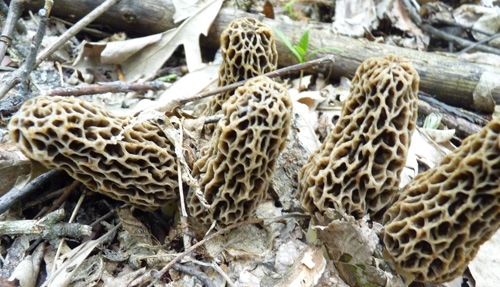
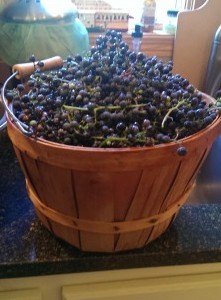
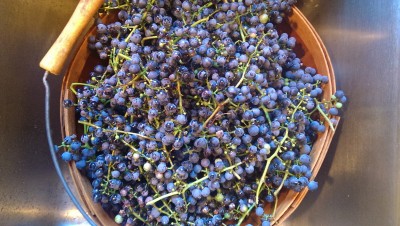
500P1030676A cool breeze predicted autumn as I picked wild grapes this morning . These wild grapes have overgrown our amur maples and will get cut back when the lawn restoration work is done later in the fall. That will hardly diminish their presence though because wild grapes grow all over our woods, some branching out from vines thicker than my upper arm. The woods also provides morels in the spring.

Over the years I’ve highlighted the opossum, the great horned owl, wild turkeys, pileated woodpecker, woodchuck, salamander, newt, toads, frogs, dragon flies, deer, rabbits, chipmunks, squirrels, bumblebees, raccoons and snapping turtles that live on this property, too. A significant aspect of living in the exurbs is the diversity of wild flaura andIMAG0506 fauna, often on the chunk of land on which you live. This is a melding of the human built and the wild.

The Denver Post recounts encounters with bears, mountain lions and rattle snakes. In Minnesota residents encounter bears and wolves, perhaps the occasional lynx. Most of these encounters occur because human habitation encroaches further and further into formerly wild lands.

These predators are certainly part of the wild eco-system, but the bulk of wild life are prey species, amphibians, reptiles and birds. It’s these we humans encounter most often and which we often discount, as if their small size or lack of tools for killing make them less significant. Yet the woodchuck, or land-beaver, that occupied a tree here for a day, is a wild animal just as much as the wolf or bear. So, too, the opossum and all those others that flee when humans arrive, who try to keep their visibility to a minimum.

We are co-habitants, not owners really, of this land. Though we will sell it to other humans, we are not selling the wild life. Their lives will adapt to the new humans just as they adapted to us, either by leaving or hiding or just going on about their day.

The wild flaura includes not only morels and grapes, but ironwood, jack-in-the-pulpit, oaks white, red and burr, elm, ash, black locust, cedar, nine-bark and rhus radicans, or poison ivy. Barring a clear cut of the woods, which I consider unlikely, they, too, will remain.

Goldilocks and the Family Garden

Lughnasa                                                         Lughnasa Moon

There’s a Goldilocks’ quality to gardening. Not too much, not too little, but just right. The Goldilocks’ formula applies to water, soil additions, number of plants and temperature. The gardener can control soil additions and the number of plants with relative ease, confident in her adviser’s soil tests and their recommendations for additives. Likewise, though the temptation may be too either over plant or under plant, get more vegetables per square foot or give the plants room to grow, a wise gardener develops a feel for how the beets perform in her garden, carrots, tomatoes and spaces accordingly.

The temperature, especially in northern or high altitude climes, might need some control though here at Artemis Hives and Gardens we’ve not added hooped plastic over our beds to extend the growing season, either early or late. Plants can be started inside to counter the prevailing outside temperatures of late winter and early spring. But, for the most part, we’ve accepted the temperature that the sun and the clouds and the zigzagging jet stream have given us.

We can, and do, add water during periods lacking rain, but we cannot adjust the water that comes from rain. This year we’ve had too much. A sticky fungus has attacked the peppers and the raspberries, a not uncommon result of too much water. Each year brings some challenge, this year it’s too much rain and that’s the one element we can do little about. We need not too much water, not too little water, but just the right amount.

Heading Toward the Festival of First Harvests, Lughnasa (August 1st)

Summer                                                           New (Lughnasa) Moon

The harvest now. Onions, more and more lying down. The batch from last week have had their curing in the sun and are now in the shed on the screen. The garlic has begun to mature as well, about half of it is in the sun now as are the onions newly ready. The garlic are not large, at least the ones I’ve pulled so far and last year’s were not either. Last year we got a garlic crop when many who farmed garlic got none. Not sure what the issue is but it’s cut into the bulb size for sure.

This next week’s cool temperatures do not favor the tomatoes, so their ripening might be delayed. More green beans, collard greens, chard are ready. Overall, an abundant harvest so far.

Mudslides, sinkholes and…craters?

Summer                                                               New (Lughnasa) Moon


Russian scientists say they believe a 60-meter (66-yard) wide crater discovered recently in far northern Siberia could be the result of changing temperatures in the region.  Andrei Plekhanov, a senior researcher at the Scientific Research Center of the Arctic, told the AP Thursday that the crater was mostly likely the result of a “build-up of excessive pressure” underground due to rising temperatures in the region.

Plekhanov on Wednesday traveled to the crater, some 30 kilometers (18.64 miles) from the Bovanenkovo gas field in the far northern Yamal peninsula. He said 80 percent of the crater appeared to be made up of ice and that there were no traces of an explosion, eliminating the possibility that a meteorite had struck the region.

Read more : http://www.geologypage.com/2014/07/66-yard-crater-appears-in-far-northern.html#ixzz38V5KlWeU
Follow us: @geologypage on Twitter | geology.page on Facebook


Positive Signs

Summer                                                             Most Heat Moon

Some positive signs. News about climate change has gone from whether to when, how much and what do we do. Though this is a fight that will require joint effort beyond anything I’ve seen short of a war, the U.S. can lead if it finds the will. A change in the public opinion atmosphere, in this case, may lead to a change in the less gaseous atmosphere.

Another. News reports have begun to notice inner city America. Again. Urban poverty became prevalent long before climate change arose. Roman and Chinese cities in ancient times already grappled with its problems. Over the course of my life urban issues have had their cycles, reaching a zenith during the Presidency of Lyndon Johnson and his Great Cities programs.

Today’s Star-Tribune has an article that grazes the issue written by Chicago Tribune conservative Steve Chapman who quotes Ta-Nehisi Coates of the Atlantic.  This link to the Atlantic collects several of Coates’ fine essays on urban America, particularly urban black America with a focus on Chicago. He’s making a case for reparations, that is, some form of restitution for all those effected by chattel slavery. Well worth reading.

Cities and their issues were the focus of my professional and political life. It’s heartening to me to see these matters beginning to take up space in various media. The amount of human heartache and the egregious loss of raw talent occasioned through urban poverty is stupefying.

May both climate change and urban poverty see more of our combined attention over the next few decades. They both need it. (Another bit on the intractability of urban poverty later.)