Category Archives: Art and Culture

Gong fu cha diary: Second Day

Lughnasa                                                           Harvest Moon

Beginning, slowly, to get the hang of the chinese way of tea.  Yes, it requires a bunch of beginning moves like warming the pot, the pitcher, the cup and rinsing the leaves after that.  It also involves a quick count to pour the water on the tea, then over the pot, then pour the tea out of the pot.

But.  The tea tastes great and you can keep using the same tea leaves for at least six infusions.  That means after the first pot, the next five are straight forward and one pot of tea can last almost a day.

Still a long way from having the nuances, especially when it comes to buying the tea itself, but that will come with time.

Gong Fu Cha diary: 1st tea

Lughnasa                                                             Harvest Moon

OK.  I have my yixing teapots made from the special clay of that region.  I have seasoned them both in the removing of the wax and boiling them in a pot full of the type of tea they will make.

Finally this afternoon I felt I had the uninterrupted time to begin learning this ancient art.  It was the Chinese monks of Chan Buddhism who introduced cha or tea to visiting Japanese monks in the 12th century.  The tradition in China was old, very old, at that time.  The character for tea, thought to have originated in Burma, was simplified in the 8th century BC.

The Chan monks practiced a Taoist influenced Buddhism that would translate itself in Japan into Zen Buddhism.  They used tea to help them stay awake in all night meditation settings.

Here are the steps according to the guide I’m using right now.   First, fill the teapot with boiling water of the right temperature.  This heats the pot.  Pour this water off.  Then, add the amount of tea appropriate for your teapot.  In my case three large Chinese tea scoops or approximately three Western tablespoons.

Add boiling water to the pot, letting it run over the top until clear.  Then pour off the water immediately.  This is rinsing the leaves.  Tilt the lid on the pot so the heat does not cook the leaves.  Now add water again, again letting it run over the top.  Put the lid back on and count 6 seconds, pouring boiling water over the pot to equalibrate temperatures.

At the end pour the tea into a small pitcher.  Serve.

One of the aspects of gong fu cha that differs from all other tea making methods I know is that you reuse the tea leaves as many as six times.  The process repeats but the steeping times vary from pour to pour, going down for the second and then up slowly through the 5th or sixth.

When I finished this process this afternoon, I couldn’t honestly tell whether all of that was helpful.  I have several different kinds of tea and many tea pots so I’ll try different teas in different pots with different methods.  I’ll eventually hit on a method that makes my palate happy.


Prospective Nostalgia

Lughnasa                                                             Harvest Moon

Do you ever have a twinge of regret or a moment of disappointment about all the things you won’t be able to read, to learn?  I do.  And sometimes the ache is terrible.  It can be non-specific.  The library, that is my library, has more threads than I can follow in one life time.  My own library.  What about the UofM library?  The internet?  A good bookstore?

(Amour, Foi, Esperance – Maurice Denis)

It can be specific.  I won’t be learning Mandarin this time through.  I’m not going to get a good feel for geology either, or biochemistry.  Even sociology, beyond a brush in college, is out.  So are most of the world’s literatures and all those paintings and sculptures I just can’t get to see.  It could be, of course, that I wouldn’t want to know the sociology of Poland, but I bet I would.  I’m sure I’d like to understand the working of plate tectonics at a deeper than cursory level, but I won’t.  The same for the chemical exchanges that make life possible.  Nope.

This makes me sad.  Not in a terrible sadness way, not grief, not even really regret, more a prospective nostalgia for something that will not happen.  I can fell it creeping up on me when I look at book, say a history of Japan, and wonder if I’m really going to devote time to reading that.  If I’m honest and say to myself probably not, that’s when the feeling rises.  Oh.  But if only I could give some time in the evening.  Maybe then.  But no.  Not likely, not really.  Oh.

(Psyche’s Kin Bid Her Farewell on a Mountain Top – Maurice Denis)

Most of us have, I imagine, a small collection of sayings that recur to us, sometimes often, that help guide us in making decisions.  One that comes to my mind a lot is this:  Purity of heart is to will one thing.  When I have to prune, to focus my life, to move my attention toward some task that will take a long time, I remember it.  It feels important to me, true.  Right.

Yet.  To will one thing is to rule out all those others.  To leave them on the shelf, to abandon their discovery, the excitement of learning what they may have to teach.  Thus I have this difficult (to me) internal contradiction between wanting, even needing, to focus my energy and desiring broad as well as a deep learning.  This is one of those paradoxes with which I have to make my peace, I suppose, but I don’t find it easy.  It may not be possible.

Honorary Docent Lost

Lughnasa                                                           Honey Moon

Back in the MIA yesterday morning before my lunch with Tom.  Wandering around, absorbing the images and the galleries, felt good–but unfocused, I was unclear as to my purpose for being there.

(5th century painting, Poet on a Mountain Top by Shen Zhou.  not in MIA collection)

A long segment of a Chinese scroll, a landscape of black and white mountains, exhibited in a narrow corridor beside the Wu reception hall, sent me into a wistful, calm place and a sudden realization why I like Asian art, especially Chinese and Japanese.  Much of it is soothing, contemplative.

As these thoughts and feelings slowly tumbled down the stream of my experience, I came to an explanation of this “spilt ink” and discovered the scroll had been done by a literati artist waiting for his son at a mountain monastery.  His son was overdue and he felt, he said, “Lonely and sad.”

The exhibition, “Sacred”, has pieces scattered around the atrium on the second floor, some mostly installed, others not.  It focuses on surfaces, as an art exhibition must:  clothing, dance, fluids, walking.  This is something I’ve learned recently, that the modern was a turn toward keen appreciation of the surface of things, logical since philosophy from Kant on down has hammered away at our inability to see the thing in itself, the real behind our perceptions, leaving us with what our senses bring to us, the surface of things.

Modern science, Darwin being a keen example, constructs its wonders on observation and recognizes that it cannot explain what it cannot apprehend.  Yes, there is lots of inference, electron fields, quantum action at a distance, the brain/mind link, but about these things we recognize only what we can measure about them, that is, apprehend. There is no other tool.

So, yes, I understand the “Sacred” exhibition’s focus on the surface of things, but it will not, cannot touch what causes a man to wear a chasuble or a yarmulke.  It will not show the Shiva who dances in the heart of the faithful Hindu or the Buddha mind of the adherent inspired by the Thai walking Buddha.  It will, in this regard, I think, fall several measures short of its mark.  Too facile, too straight forward.  A nice try but not bent enough to capture the mysterium tremendum, the awe that comes with the experience of the holy.
Lunch with a Friend

Lughnasa                                                                         Honey Moon

Had lunch with Tom Byfield.  An extraordinary guy.  After 37 years of living, as he said, “on the lake bucolic” and conducting a dental practice in Bagley, Minnesota, he and his wife moved to the Twin Cities.  He became a docent 17 years ago.  We both resigned this year, he to take care of his ailing wife, who has since died, and me to finish my novel.

He draws, paints, writes humor articles, has traveled the world and knows a lot about art.  He can, and I have seen him do this, take very legible notes in the dark.  A useful skill in art history lectures.

We’ve both found friendships in the docent program, not the least of them each other.

The Voice of Autumn

Lughnasa                                                                     Honey Moon

Even though the heat blazed down like mid-July today, the twilight comes much earlier. The wind moving among the trees in our woods sounds like the voice of autumn, not the return of mid-summer.  May it be so.

My heart has already begun its turn inward, the work of Loki’s Children and Changes, a novel after the trilogy is done, beginning to dominate my early morning and post-nap moments.  No, I’ve not made the complete transition yet, the bells have not yet rung, but soon, soon the night will begin falling earlier, the state fair will be finished and Michaelmas just around the corner.

September 29th is daughter-in-law Jen’s birthday and Michaelmas.  Michaelmas was the date that began school terms in England and can be seen, as a friend once noted, as the springtime of the soul.  It is the holy day of St. Michael, the archangel, the warrior of god.  A complicated day with many threads woven into to its tapestry.  All this is within a month or so now, the year has begun to change.

Virgil

Lughnasa                                                                     Honey Moon

(William-Adolphe Bouguereau, Dante and Virgil, 1850, oil on canvas.  Musée d’Orsay, Paris)

Tom Crane found this poem by Virgil:

Virgil’s Bees


Bless air’s gift of sweetness, honey

from the bees, inspired by clover,

marigold, eucalyptus, thyme,

the hundred perfumes of the wind.

Bless the beekeeper


who chooses for her hives

a site near water, violet beds, no yew,

no echo. Let the light lilt, leak, green

or gold, pigment for queens,

and joy be inexplicable but there

in harmony of willowherb and stream,

of summer heat and breeze,

each bee’s body

at its brilliant flower, lover-stunned,

strumming on fragrance, smitten.


For this,

let gardens grow, where beelines end,

sighing in roses, saffron blooms, buddleia;

where bees pray on their knees, sing, praise

in pear trees, plum trees; bees

are the batteries of orchards, gardens, guard them.

Doubled Vision

8/11/2013   Lughnasa                                                             Honey Moon

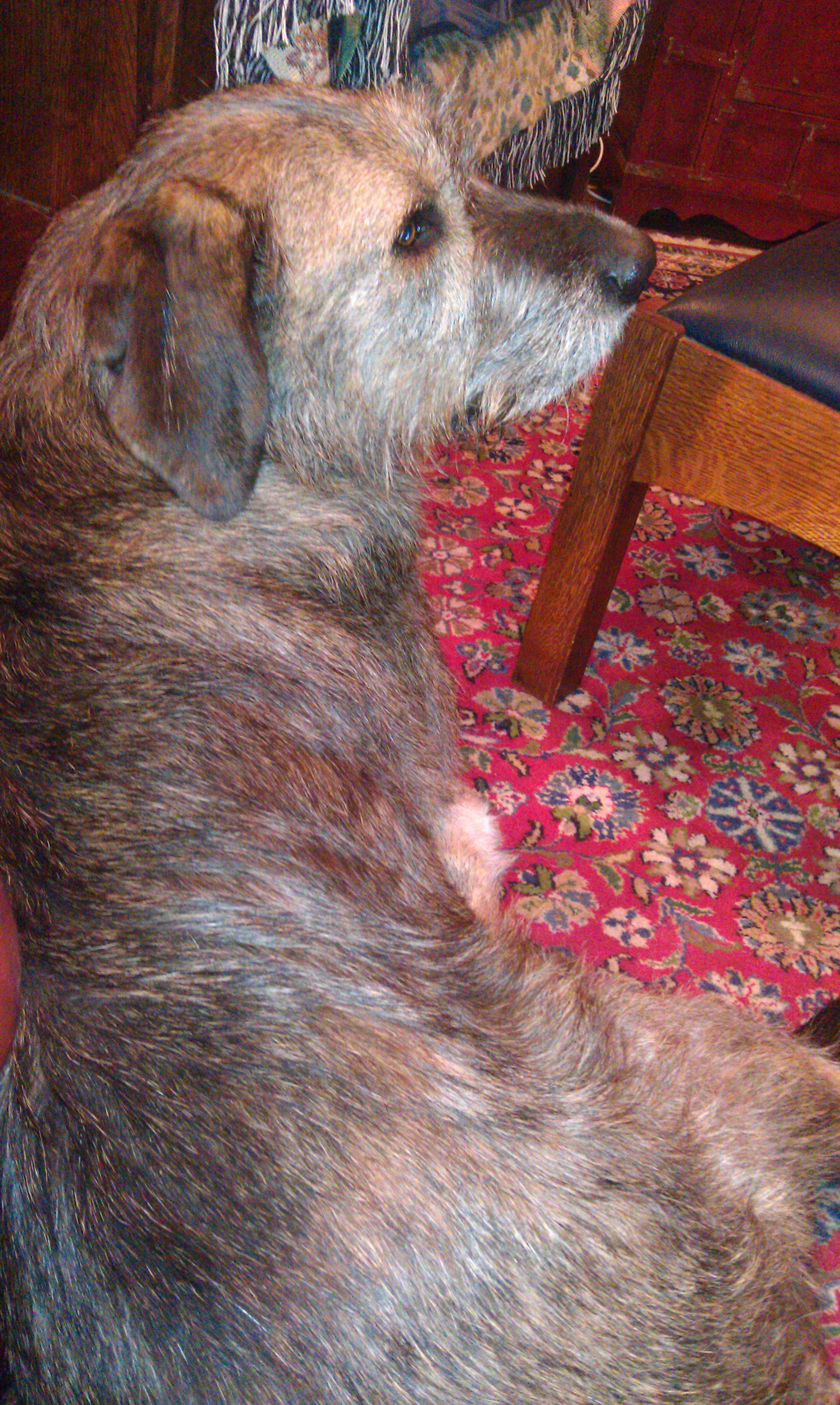
Rigel, who weighs about 120/130, likes to come up to my chair while I’m reading, then put first one leg, then another in my lap.  Her head, now close to my chest, looks up at 2012 05 01_4255me, then she rests it there.  Not long.  But for a bit.  How long she stays in my lap varies, usually not more than a minute, if that.

In years before I might have shrugged her away, wanted to get on with my reading, not realized the precious moment that was happening.  With Tor, our great yellow Irish Wolfhound, a true sweetheart, much like Vega, Rigel’s sister, I began to have a doubled vision. No, not double vision, but doubled.  I would see Tor, smiling at me from the carpet, and I would see Tor dead, lying stiff and lifeless.  This may seem gruesome, and perhaps it is, but it comes from having experienced the deaths of so many dogs.

The phrase, how terrible it is to love something that death can touch, had become a present reality for me.  This doubled vision, a long and painful lesson taught to me by so many dogs, has changed my life.  When Rigel comes to visit in my chair now, I see the moment for what it is.  A time that will never come again.  A time that means everything, all of it, right in that instance.

In the way of tea the Japanese tea-master takes unbelievable pains to ensure that the tea ceremony you attend is a once in a lifetime experience, ichigo ichie.  The tea-master chooses art, flowers, tea cups, fresh water vessels, waste water vessels, foods and candies all with you in mind.  The Japanese tea-ceremony reminds in an elegant way, that every moment has the potential to be a once in a lifetime moment.

With the giant breed dogs, whose lives are so short, each moment is so clearly once in a lifetime.  They have taught me to cherish those ordinary moments, a dog crawling in my lap, as a time of unique tenderness.  This doubled vision, though I don’t encourage it necessarily, has taught me that it is this moment, this time, right now that is the time we have together.  Much better to embrace it than wish for it after death has already come.

Nude Summer Camp

Lughnasa                                                            Moon of the First Harvests

Went into Minneapolis today, to the Black Forest, for Nude Summer Camp.  This was actually a reunion of Nude Summer Campers from 2008.  The campers were, with one exception, from the docent class of 2005.  Today the topic was the contemporary nude.  The conversation rolled and rocked from issue 0 of Playboy, thank you Tom Byfield, to relational aesthetics, Joy, the ecstasy of Bernini’s St. Teresa and the general question of why nudes are a topic at all.  We sat in the rear booth of the Black Forest’s outdoor dining area for a couple of hours.

Do I miss giving tours?  No.  Do I miss the continuing education at the MIA?  Wish it was of such quality that I could say yes, but no.  Do I miss driving in every week or so?  No.  But.  Do I miss my classmates and fellow docents, the conversations and the camaraderie?  Definitely yes.

I felt lighter after leaving this conversation.  In the presence of friends.  A life shared with friends is a full life.  And I’m lucky that way with the docents and the Woollys.  I’m grateful for all of them.

A Trip Into The City

Summer                                                             Moon of the First Harvests

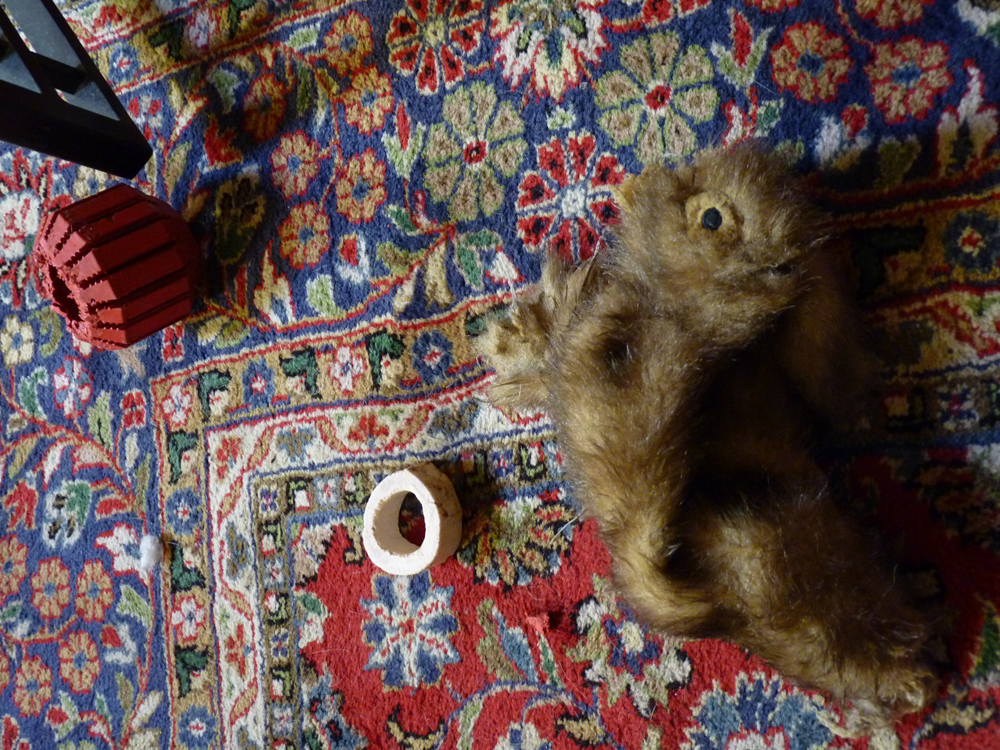
When I picked up our rug from American Rug Laundry, the guy said he couldn’t believe how much dirt he got out of it.  I told him, but I’m not sure it registered, that our dogs really, really like this rug.  All of them.  And they come in and lie down on it.  Roll on it.  Transfer the sand from the Great Anoka Sand Plain to it, deep in its fiber.  As he now knows.  Not many folks let dogs on their multiple thousands of dollars oriental rugs, I imagine.

(this rug.  with favorite dog objects.  the one to the far right is a stuffed squirrel.  a big hit.)

On the same trip I took a baby quilt in to Margaret Levin.  She’s due sometime in the next couple of weeks.  Says a lot about our society that she’s in her last term of pregnancy and still running the Northstar Chapter of the Sierra Club.  Kate makes lots of baby quilts. This one used cloth made from our neighbor’s mother’s stash.  When she died, it fell to Pam who gave it to Kate.  This particular cloth was from the 1930’s.

We talked about politics, of course.  That was my entré to the Sierra Club and what I did with them for 5 years or so.  I asked her if she has the same sense I do that a cultural shift has begun on global warming.  A positive one.  She said yes, but she also said the movement thought one was happening in the 1970’s, too.  Still, you add in a Democratic President and Senate, plus the changing demographics of the U.S. population and there could be real grounds for optimism.  Whether such a shift would happen soon enough to matter? Hard to tell.

Stopped by the Northern Clay Center as well.  It’s only a block from the Sierra Club. There are a lot of able potters represented there.  I’m in the market for another tea pot since I plan to return to brewing tea from tea leaves rather than tea bags when I start Loki’s Children.  A reward for finishing the third revision.  Didn’t find anything.  I plan to look on Sunday at a large pottery show, but if I don’t find anything I’ll head up to St. John’s and Richard Bresnahan.  I’ve wanted one of his teapots for some time.