Category Archives: Great Work

Nothing Alien To This Neighborhood

Beltane                                                                      Summer Moon

We have had rain. And then some. And will get still more. The Great Anoka Sand Plain soaks it up and funnels it on down to the aquifers below our land, recharging them, then putting more flow into the streams like Rum River and the lakes like Round Lake.

The Summer Moon watches it all, as it has watched all since it split away from its partner the earth. Like the split aparts of Plato’s lovers the earth and the moon have continued together locked in a long term relationship, a dance in the coldness of space. The moon is our seer, an audience for all that we do, we creatures and rocks and clouds and waters of this spinning planet.

The whole solar system is a dynamic ballet. The sun’s selfless and profligate dispersal of energy feeds those of us closest while it’s gravitational pull keeps even those outer planets in our company.

And we humans, we think of ourselves as different from all this, unique, special but look at us from a solar perspective. We’re the deer and the whale, the paramecium and the volcano, the mammoth and the brontosaur. We are nothing more-and nothing less-than parts of this planet we ride. Yes, parts come alive, come animate, even come conscious, but we are creatures of this earth nonetheless and in the most literal sense and we are given energy in the same way all our solar system is given energy. By hydrogen fusion in the nuclear furnaces of the sun.

Terence, Roy Wolf reminded us at sheepshead last Thursday, said, “Nothing human is alien to me.” I’ll paraphrase: “Nothing human is alien to our sun’s neighborhood.”

An Underlying Question

Beltane                                                              Summer Moon

As I saw the video and read the article on fire in Colorado, the underlying question became slowly evident to me. Here it was couched in hotshots, firemen, national forests and parks employees and the complex budgetary manipulations of the Forest Service. Along the ocean coasts of the Atlantic, the Gulf of Mexico and the Pacific in this country it will involve underwater construction crews, builders of seawalls and levees and drainage systems, the Coast Guard and numerous other federal and state agencies and their employees. And the underlying question is this: how much money, state or federal, and how many lives will we spend in defense of neighborhoods, businesses, cities built in predictably dangerous environments?

Climate change has begun to push the numbers of such places higher and higher: whole nations like Vanuatu and the Maldives, large portions of heavily populated coastal areas, those spots where humanity, in wealthier and stupider times, has planted itself in defiance of environmental barriers like deserts (the American Southwest and California), wildfire, and many riverine settings.

(from the Phoenix city guide: Phoenix rises from the floor of the northern tip of the great Sonoran Desert)

This is the question of adaptation, how much will we modify our current reality as the climate changes, as opposed to the question of mitigation which the EPA has put on the front pages of America’s newspapers. It is not a question of doing one or the other, we will have to do both. But. How much should we do to defend poor decisions on the parts of others?

(The Waldo Canyon fire in Colorado Springs last year.)

There are, of course, as always, a lot of gray here. It’s one thing to buy a lovely forested home in a Colorado red zone and another to have an apartment built years ago near the Atlantic Ocean. Much of the change will be gradual and the costs to adapt can be made gradually, too. This is true of sea level rise, though the sums of money involved are enormous. But. There are others, like moving into wildfire habitat as its frequency escalates by factors as high as 400%, that are not gray at all.

400%

Beltane                                                                 Summer Moon

New state, new realities. I’m reading the Denver Post online now and there was a story in today’s edition: THE FIRE LINE: WILDFIRE IN COLORADO. The 27 minute video is worth watching, especially if you contemplate purchasing a home in Colorado. Even if you’re not, you might find its underlying argument, made by fire researchers and fire fighters and natural resource professionals alike, intriguing. The oldest of them, John Maclean, draws an analogy between flood plains and fire habitat. If people move into a flood plain and experience a catastrophe, is it the Federal Governments responsibility to take care of them? Well, he goes on, fire habitat is the same.

From 2000 to 2010 100,000 people moved into red zone areas. What are they? Areas with a high likelihood of unmanageable fire. Just like a floodplain. Here’s the big question: how much money and how many firefighters should we risk saving structures willingly built within high likelihood fire habitat? Not much, according to the tone of this video. And it makes sense to me.

It’s an interesting case in the politics of the West where local control and individual choice are part of the political culture. It means state legislatures and even county boards hesitate to control developers and home buyers as they create neighborhoods, beautiful, yes, but also dangerous. Without getting engaged (yet) in these struggles it seems to me that it’s a false libertarianism which champions local control and individual choice on one end of a decision making chain, but then looks for the Federal Government and local firefighters to compensate for the risks on the other end.

Out of all the climate change material I’ve read and learned over the last year one of the standout predictions is that fire incidence will increase by 400% in the West. That’s 400%. I look forward to working with the Rocky Mountain chapter of the Sierra Club on issues like this one.


Sustainable, Nutrient Focused Horticulture

Beltane                                                         Summer Moon


The purpose of our company is to
make soil better as we grow quality crops

Planted the 3 blueberry plants I abandoned in the orchard. Forgot about them when I planted the egg plant, collard greens and chard in the vegetable garden. Then, I sprayed the orchard for the first time, brixblaster, an international ag labs concoction that feeds plants focused on reproduction: fruits including tomatoes, peppers, egg plants, beans and peas. This feeding program for the orchard goes on twice weekly, ideally before 8 am or after 4 pm. Before is the best for me but I couldn’t make it happen today, so I settled for the good over the best.

On June 20th the spraying program begins in the vegetable garden. Lest you have an organic twinge here, let me explain the philosophy behind the (International Ag Labs) I.A.L. recommendation. The goal is to produce the highest quality foods (measured by nutrients, not ease of picking and processing) while supporting a soil chemistry that is sustainable over time. This is very different from traditional ags NPK focus which takes out nitrogen, phosphorus and potassium from the soil each year, then pumps them back in the following year.

NPK farming misses the critical elements of soil chemistry that supports microbial plant and animal life, as well as the critical trace minerals that make for healthy plants. Healthy plants = healthy food. There’s a reason for the plough and fertilize model. It produces high quantities of food, but over time the plants become modified not for nutrition but for their capacity to be easily harvested and stored, then optimally usable for food processing. In the past three decades or so the plants have also been modified to contain herbicides and insecticides as part of their genetic material.

Again, the emphasis is not on the nutrient quality of the food, but on the ease of growing and harvesting. This story is not new to me. Michael Pollan is probably its most gifted narrator right now. I remember a 1974 book, Hard Tomatoes, Hard Times, that told the story of the unfortunate collaboration between land grant universities (like the Ag campus in St. Paul, Purdue in Indiana) and farmers/food processors. It’s titular story involved the problem of tomatoes. They were thin skinned and had to be harvested by expensive manual labor. The solution? A tomato with a hard skin, pluckable by mechanical arms. That’s the source of the tough hide you get on store bought tomatoes.

Criticizing the system is easy and the push back predictable. How would you grow sufficient quantities of food for all America and the other peoples of the world to whom we sell produce? It’s a fair question and one that has to be answered.

There are many competing solutions, often followed with dogmatic zeal, the cults and sects of the horticultural opposition: Permaculture, organic farming, bio-dynamic farming, no till agriculture, the long term project at the Land Institute to develop perennial grains, among others. While of all these organic has created the most scale, it has a huge flaw that should have been obvious from the beginning, but zeal blinded most of us to it.

Its whole focus is on a negative, the removal of chemicals and their replacement with organic/natural products used to grow food. A good thing, in many ways, but it leaves the more important question unanswered: is organic food better to eat? Well, in that it is grown in a minimalist insecticide/herbicide environment, yes. But. Is organic food more nutritious than NPK farming? Oddly, the answer is not so much.

That’s where the I.A.L. idea comes in. Improve the soil so that it can sustain its own chemistry and create a healthy environment for microbial life. Recognize that inputs to the food growing process move toward that goal. Make clear that the purpose of this program is not the creation of food for the food industry, but of good food for all. This strikes me as a balanced solution, accessible to individuals and growers for local markets alike.

I don’t know how the I.A.L. ideas work on the large scale though I know their primary customers are farmers and not gardeners.

Think about this. The path to a sustainable human future on this planet must start with agriculture that can continue indefinitely. I.A.L. is one approach that focuses on that goal. It’s worth a look.

And, They’re Off

Beltane                                                                   New (Summer) Moon

The heat has returned. As has our irrigation. That combination plus the International Ag IMAG0357Labs program seems to have gotten us off to a good start. I was afraid I’d burned the tomatoes and peppers (too much nitrogen), but they seem to be coping.

(2013 garlic)

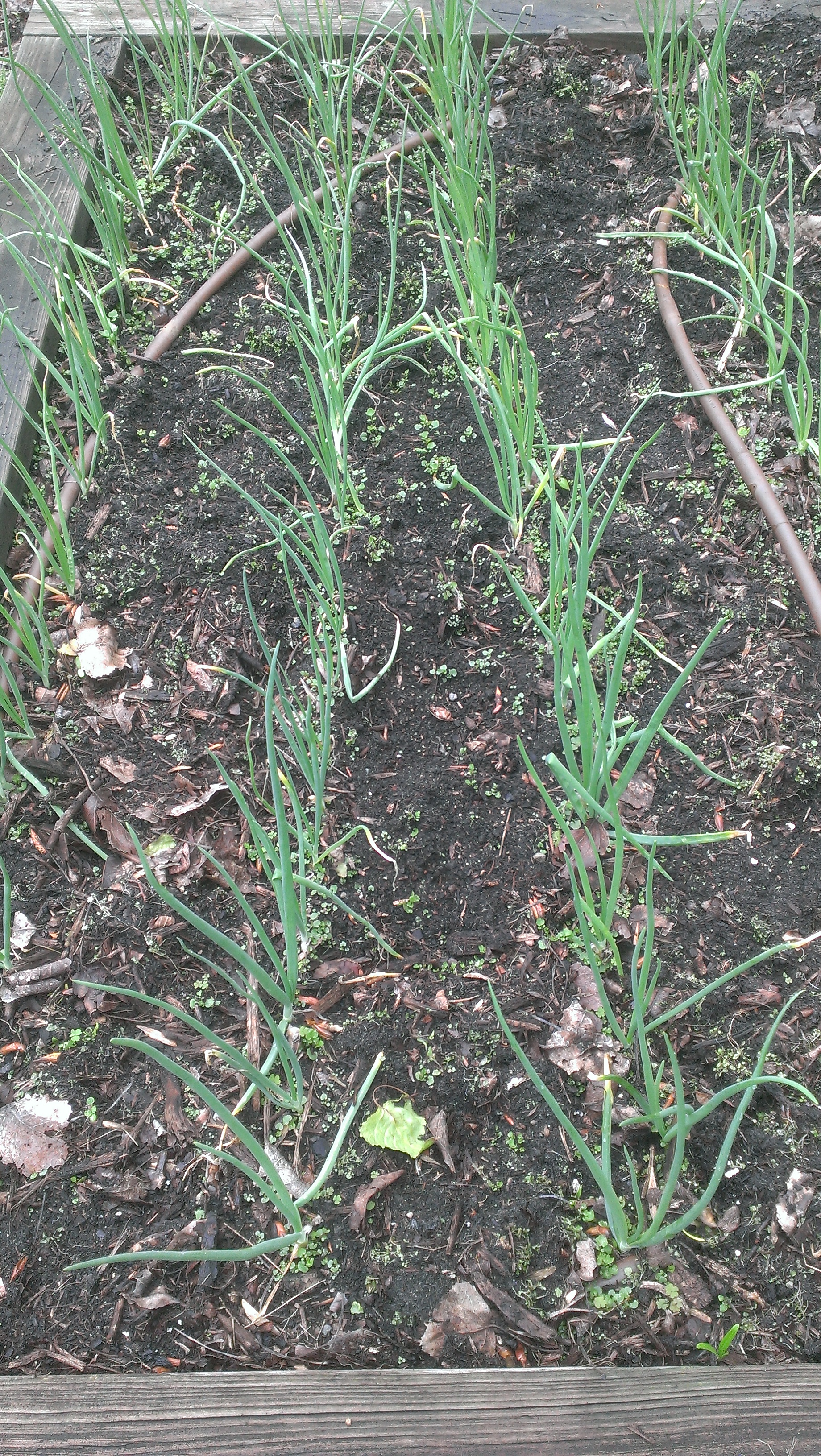
The tomatoes, with one exception, look strong and so do the peppers. The collard greens, chard and egg plant have put on a growth spurt with that vivid color which signals good health in a plant. The onions, garlic and leeks have made good progress, too, though they’re a bit slower in general than the others. Beans and cucumbers have sprouted, except for one row which has just begin to push up, sugar snaps if I remember correctly.

The tomatillos, planted a week or so ago, have done poorly, and I don’t know why, but we’ll have to replant them. The beets and carrots, planted before we left for Denver, have sprouted, too, the carrots looking as good any I’ve had. The golden beets, beautiful on the plate, just don’t germinate well, at least the variety I’ve planted for three years. Which should be a signal to me. The bull’s blood variety grows with the kind of vigor you might associate with, well, a bull.

Kate went out today and weeded, weeded, weeded. The garden looks neat and organized. Tomorrow afternoon or Saturday morning I have to lay down mulch, seems awful close to planting, but the heat and the cold brushed against each other this year.


Earth Bound

Beltane                                                               Emergence Moon

That Kate and Charlie gardening team have begun another year of plant wrangling. Kate planted the herb spiral, cut a space so we can more easily harvest raspberries in the fall and mended the flower bed wounded by Rigel. Meanwhile tomatoes, peppers, chard, collard greens and ground cherries found themselves spots for the growing season.1000Kate and Charlie in Eden

There is nothing more literally grounding than planting.  We move the soil aside, add some nutrients and water. All the time we have to consider the type of plant, what it needs, how the soil is (though that process here is largely over) and what its requirements for sun are. Most vegetables need full sun and we had the big ash in the midst of our garden cut down last year to open up more areas of full sun.  A seed (its package) or a plant (its plastic container) leaves a temporary home for a place it can flourish, reach its optimum.

Caring for a garden together is so much like raising a family, caring for dogs. Nurture. It helps us stay in touch with our home and as a by product we get nutritious food. A pretty good deal.

Tender Planting

Beltane                                                                   Emergence Moon

Finally the temperature regime has begun to warm, making it safe for the tomatoes, peppers, egg plant, beans, cucumber and tomatillos. We drove to Green Barn this morning to pick up egg plant, tomatillos, blue berry plants, chard and collard greens. They’re already out of kale.

After getting my head straight about the international ag labs recommendations, I put together a batch of transplant water, 3 gallons. Then I poured Jubilate, a microbial inoculant into an old dog dish, tossed the urea in its jar on top and carried all this out to the vegetable garden. To get into the garden I had to step over the copper bird feeder pole I inserted just below the gate’s bottom to keep Rigel out.

Setting those things down I retrieved the tomato and pepper plants from the deck where they have been sitting since coming last Tuesday. Kate’s been taking them out and bringing them in at night since the weather was too chilly for them. Now it’s all good.

Putting two tablespoons of urea (small white pellets) and two tablespoons of Jubilate (a 670_0299brownish thick powder) into each hole, I put the midgets, the romas and the Cherokee Purples in their places atop the sun trap. Then, using an old Tide measuring cap, I spooned a pint of transplant water onto each tomato plant.

The peppers went into a raised bed and they received identical treatment except the amounts were one and a half tablespoons instead of two. Then the transplant water.

By that time the sun had come out. It was noon. Having just seen the dermatologist yesterday I decided to stop and return later in the afternoon, when the sun’s angle is more gentle. I want to get all the tender plants, including the beans and peas, planted today. Then we’ll be into maintenance mode for the next two and a half to three months.

Of course, with the international ag lab’s system, maintenance is more intensive than in the past, but that’s fine. The results are worth it.

Sinners in the Hands of an Angry Climate

Beltane                                                                            Emergence Moon

A word about religious language. Though rooted in a metaphysics with which I no longer agree, much of the language developed by Christian theologians has earthly application.

Here are some examples. Atonement describes the process of reconciliation between one estranged and the one from whom they are estranged. Atonement is just what we need for a species estranged from its home, no longer aware of the rich and intimate love only footsteps away from most doors.

(Antonio Palomino. Saint Michael Vanquishing the Devil, 1700-14)

It is, I suppose you could say, the story of the prodigal son, the wastrel who fled parental care and set out wandering far from home. Only atonement, the return of the prodigal to his home, can overcome the estrangement.

But, before atonement comes repentance. That is, the estranged must come awake to the hamartia* that creates their current condition. Most of us know only vaguely (we see through a glass darkly) of our implication in the reduction in Arctic sea ice, the acidification of the oceans, the gradual warming of the temperate latitudes. We are even mostly ignorant of the web of decisions we make daily to draw more oil from the sands of Arabia or the fracking fields of North Dakotas, decisions that also push the coal trains out of the Powder River Coal Fields in Wyoming, snaking like a plague along our nations railroads.

(Peasant family returns home paint by the Belgian artist Eugène Laermans (1864-1940) – Boekarest:National Museum of Art of Romania (Romania)

Hamartia, in its classical understanding, results in tragedy. It is often related to hubris, that overweening pride that causes blindness. There is little doubt that our estrangement from mother earth is reinforced by our hubris and that the result of that hubris is humanity’s fatal flaw. The end will be not a triumphant Christ hurling sinners into hell but the sinners themselves creating hell above ground as temperatures and sea levels and extreme weather events rise.

The Great Work for our generation, as Thomas Berry describes it, is to create a sustainable path for humans on this planet. In religious language this means we must guide each other back home, to a home where we will be received by a loving mother and father (the earth and the sun). We prodigals must prostrate ourselves before our parents and end our estrangement. And, of course, the curious, paradoxical truth is that in doing so we will save ourselves, not the planet.


*Hamartia is a concept used by Aristotle to describe tragedy. Hamartia leads to the fall of a noble man caused by some excess or mistake in behavior, not because of a willful violation of the gods’ laws. Hamartia is related to hubris, which was also more an action than attitude.


The Grandchildren Project

Beltane                                                       Emergence Moon

A shift in public opinion concerning climate change seems to be accelerating. We may be near a tipping point where acceptance of climate change science corresponds to acceptance of evolution. Yes, there will always be outliers, just like the Texas and Kansas school boards exhibit every once in a while on evolution, but the mass of us will finally hear the very clear science behind many changes impacting us already.

Proof? Jon Huntsman, former governor of Utah and a possible GOP candidate for President in 2016, wrote this remarkable sentence in an op-ed piece for the NYT: “If Republicans can get to a place where science drives our thinking and actions, then we will be able to make progress.”  Paul Douglas, local and national meteorologist and a conservative, too, has long observed the conundrum behind conservatives who refuse to conserve.

It may be that the long game for climate politics is about to bear fruit. For those patiently (and not so patiently) working on climate change related issues the era of solution based debates rather than denial and obfuscation might be coming near. This will be an exciting but also frustrating time as those only recently convinced try to digest the difficult realities ahead of us.  Those of us who’ve wanted to see forward motion will be in danger of refusing to listen to solutions that don’t fit our already existing paradigms.

It will be important to recall that our solutions have largely been developed among those of us who already agree with each other. Gaining political consensus for policy will require including those who don’t share many of our assumptions. Here’s a clear one. Nuclear energy may well be an important component of a transition to a non-carbon based energy regime. We need critical mass for the generation of electricity while renewable sources begin to catch up and storage technologies improve. We simply may not have time to ignore capable non-emitting nuclear power plants.

I’m excited that this push for solutions may happen in my lifetime and that those of us with grandchildren might help create the change. Call it the grandchildren project.

Not Hope, Grief and Agency

Spring                                                                    Bee Hiving Moon

Wanted to say a bit about Paul Kingsnorth, the environmental activist who has given up on activism. If you want to read the NYT article about him, follow the link.

You might be tempted to dismiss his analysis, or you might not want to hear what he’s saying and deny it. But from what I learned in the climate change course recently completed he’s right in an important sense.

The goal identified at Copenhagen is to limit warming to 2 degrees centigrade or between 3.6 and 4 degrees Fahrenheit.* This amount of warming is baked in already.  That is, we’ve already loaded enough CO2 into the atmosphere to ensure it. So, the Copenhagen goal will be exceeded.  The question at issue now is by how much.  See below for a definition of RCP.**

The year to pay attention to is 2050.  That’s the year that the pathways begin to diverge, representing the amount of emissions in that year. RCP2.6 assumes a successful reduction in emissions worldwide of 80% by 2050 and 100% by 2100. This can be done. There are several different pathways that get us there. The problem is the politics of carbon emission control.

Most of the lecturers in the climate change course thought this was not going to happen. That puts us into the range of RCP4.5 to RCP8.5.  4.5C=8F and 8.5C=15.3F. I don’t agree with Kingsnorth’s word ecocide because the plant and animal world will adjust to all of these temperature ranges.  Yes, many species will not be able to adapt, but many will.

Still, and I think this is where Kingsnorth is right, the world as we know it is beyond saving. We will have to adapt and adjust to a dramatically changed reality, a new climate reality that may cause the death of billions of people from starvation, dehydration or heat exhaustion.

I also believe he’s right in saying that we need to accept dramatic change as inevitable and that we need to grieve the loss of our familiar world. Only in grieving will we touch the new reality.

Here’s where I think he’s wrong. There is still time and there are workable strategies that can limit the magnitude of the changes we face. With no action, the up ramp of CO2 that continues to pump into the atmosphere will ensure the RCP8.5 scenario.  Somehow we must combine working through our grief over a lost world that may seem like paradise in another 100 years with our determination to moderate the degree of change as much as possible.

If we stick to the 2C goal of Copenhagen, the world will see failure and failure cuts the nerve of political agency. We need to accept that goal as simply wrong and work now to do what’s possible. The future demands that we do everything we can, only much later will we know how well we did.


*”Fahrenheit (symbol°F) is a temperature scale based on one proposed in 1724 by the physicist Daniel Gabriel Fahrenheit (1686–1736)”… wiki.  Just occurred to me that I didn’t know the origin of the word.

** Representative Concentration Pathways (RCPs) are four greenhouse gasconcentration (not emissions) trajectories adopted by the IPCC for its fifth Assessment Report (AR5).[1]

The pathways are used for climate modeling and research. They describe four possible climate futures, all of which are considered possible depending on how much greenhouse gases are emitted in the years to come. The four RCPs, RCP2.6, RCP4.5, RCP6, and RCP8.5, are named after a possible range of radiative forcing values in the year 2100 relative to pre-industrial values (+2.6, +4.5, +6.0, and +8.5 W/m2, respectively).[2]