Category Archives: Great Work

Ending

Imbolc                                                              Hare Moon

In that slightly down place that completing a course produces.  Yes, it feels great to have stuck with it, finished.  And, yes, it feels very good to have the new knowledge.  But there’s now a hole where the climate change course was.  This is not the same feeling I had when ModPo and the Modern/Post-Modern courses finished.  That was more like exhilaration.

This one mattered to me.  I’m not sure where or what I’ll do next. There are books to read, several recommended by the professors.  There’s the America Votes work and the possibility of using Great Wheel as some kind of vehicle to further mitigation and adaptation in Minnesota. But right now I feel deflated, a bit overwhelmed by the magnitude of the task that lies ahead for all of us.  This will pass.  But it’s there.

Since I finished earlier than I imagined, I’ll be able to work on my query letters tomorrow. I am also starting a new course focused on personal change that I don’t expect to be as demanding as this course was.  I let Whitman slide, did basically nothing and that’s the first one I’ve done that with, but I had overextended myself and something had to give.


Kairos

Imbolc                                                      Hare Moon

A bit more on an old topic, inspired by thinking about Jenkinson’s remarks that appear below.

The humanities are important as just that, the human forming portion of our educational deposit.  Over the millennia, stretching back to the time of gods emerging from the deserts of the Middle East and continuing right through the poetry and literature and painting and sculpture, the movies and television and games, the sports and horticulture and domestic arts of our day, we have had to grow into our lives, into our identity as human beings. It is not easy, but it is the most important task we have and the one which the family, the schools, our societies and cultures exist to engage.

This is not an argument for the humanities over science, technology and mathematics.  Far from it.  We have needed and will continue to need the valuable insights that come from deep thinking about the atomic structure of things, the hard rock science of the earth, the softer touches of the biological inquiries and the neuroscientific and all the other forms of scientific endeavor with which we humans engage.  But consider the difference in importance between raising a boy or a girl and lifting a rocket ship to the moon.  Which matters more?

It is not in the theory of evolution or in the biological sciences or in matters astronomical that we find the answer to such a question.  Even though we often pretend it is in this insecure age the answer is not in the psychological studies.  No, the answer to a question of value, of significance, of which is more than this lies only in the realm of culture.

The most important task of our time is said simply and defined humanistically, but requires the sciences in all their potency to finish:  create a sustainable human presence on this earth.

Why is this most important?  Because if it is not accomplished, the earth, no matter our scientific prowess, will scour us from her face.  She will make the thin layer of our habitation, from maybe 6 inches below the surface of the soil, to maybe 12 miles or so above the earth-the troposphere where most weather occurs-outside the parameters necessary for our existence.  That is, as the biologists are found of saying, an extinction level event.

So we are at a moment of kairos, a greek word meaning the opportune time.  Paul Tillich a theologian of the last century saw kairotic moments as “…crises in history which create an opportunity for, and indeed demand, an existential decision by the human subject.” Wiki His clearest example from the mid-point of that bloody hundred years was World War II, but even WW II and WW I put together do not equal the crisis we face now, a kairotic moment which, as Tillich said, demands an existential decision by us all.

(damaged relief of the Greek god Kairos of 4 century. BC)

The will and the skill to make that decision, a decision for or against our children and our grandchildren’s future, lies not in the sciences, but in the humanities.  It is in our sense of who we are as a species, as a being with a history, that we will find what we need to decide.  And, contrary to many, I am now convinced that the biggest barriers confounding our ability to make a non-suicidal decision lie in the realm of governance, a thoroughly humanistic endeavor.

Strip away those disciplines that force us to consider our humanity and we will be left with the calculus of Malthus.



A Letter To Saudi Arabia

Imbolc                                                               Valentine Moon

Brother Mark, within a hundred miles of the Rub al Kahli, the empty quarter, asked me about the winter and the garden.  Here’s my reply:

It has been our most severe winter since 1978-79, which was only 8 years after I moved up here.  We just got 10 inches of snow and the temperatures are headed back down.  It’s 2 right now and we have -15 for a low forecast this Thursday.  Snow in our front yard is as high as my hip.  The raised beds in the vegetable garden have disappeared.

All the dogs are good right now.  Gertie gets around much better since she had the surgical crimp removed from her left rear knee.

Kate’s away at quilting retreat with her sister Anne.  Just me, the dogs and lots of snow.

Last year I began using products from International Ag Labs and they increased our production even though I used them for only part of the season.  The broadcast fertilizer went down fall and this spring I add nitrogen.  There’s also a transplant formula to use when planting.  These products improved the microbial life in the soil and add minerals found missing through soil tests.  I tested the vegetable garden and the orchard last fall.

International Ag labs moves gardens and farms toward sustainable agriculture by creating healthy soil.  This has always made sense to me and I’m pleased to have found them.  Bill Schmidt found them.

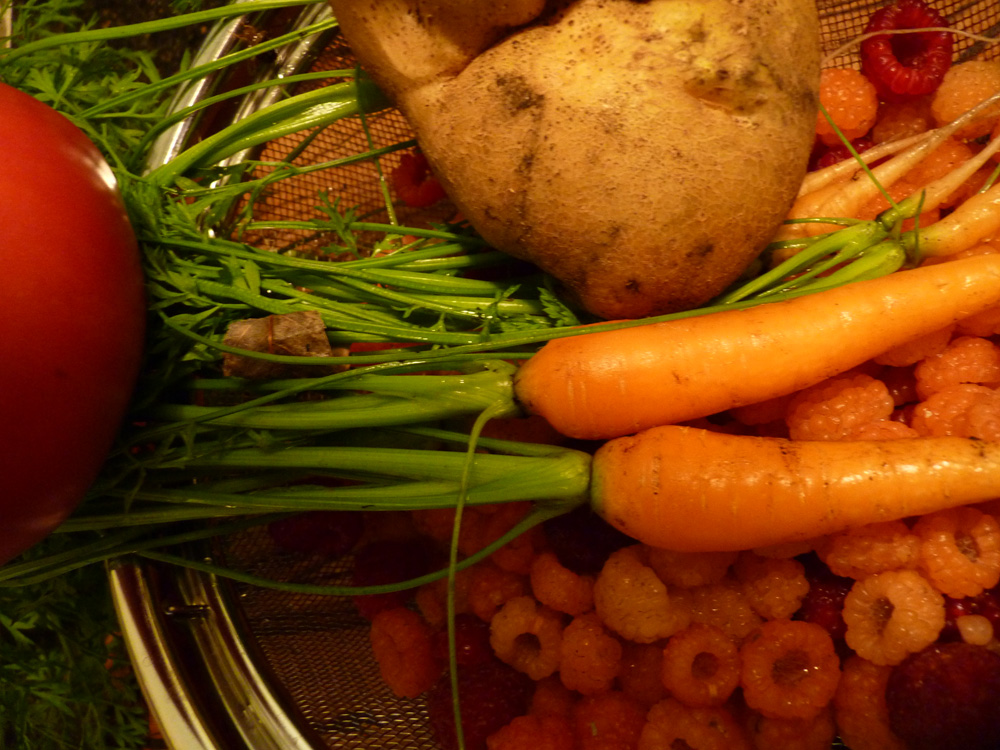
Over this weekend I plan to place my seed and plant orders.  Once I’ve done that I can 10002010 09 25_0301order nitrogen in forms specific for specific plants.  This means I will no longer have to rotate my crops because I’m building soils designed optimally for each plant type.

Tomatoes, beets, cucumbers, melons, bush beans, sugar snap peas, leeks, greens, herbs and peppers.  The garlic’s already in the ground.  This fall I’ll plant scallions at the same time I plant garlic.

The orchard is part of the program this year.  That means I’ll be spraying the trees as well as the vegetables.  These are foliar feedings, not insecticides.  That’s a weekly, sometimes twice-weekly job. There, are, too soil drenches every other week.

Aren’t you glad you asked?

A Snow Day

Imbolc                                                                    Valentine Moon

My first meeting with the America Votes’ folks canceled. All that snow.  There was an hour long presentation over the phone with accompanying slides on an Adobe platform, adobe.connect.  Polling data.  Very interesting and completely confidential.

The technology interested me. I listened to the presentation on my cell phone while the presenter clicked through a PowerPoint presentation, using small green arrows to indicate his focus.  There were 25 of us on the call and there were few questions.  Over the phone without video is a terrible way to have a meeting.  I should know.  I conducted them weekly during legislative sessions for three years for the Sierra Clubs Legislative committee.

(a screenshot of adobe connect)adobe.connect

Even so, like today, when participants are dispersed or the timing is inconvenient, then the phone allows everyone access to information and decision making.  That advantage makes the phone a reasonable alternative, if not a desirable one.

This meeting ended with a time for questions, but there were few.  Phones isolate us as much as they connect us.  We were each participants in a meeting for one.  Not much to discuss with yourself.

I look forward to meeting these folks in person in April.  I’ll be in Tucson during the March meeting.

Merchants of Doubt

Imbolc                                                            Valentine Moon


Spent yesterday doing the Climate Change course.  A fascinating series of lectures titled Merchants of Doubt.  Primary author of the book, Naomi Oreskes, is a historian of science at U. Cal. San Diego and a lecturer in this course.  This book and her lectures make a compelling and important case that climate change denial has its roots in the work of a small group of distinguished scientists, three initially:  Robert Jastrow, Frederick Seitz, and William Nierenberg.  All three were cold war physicists working on nuclear arms.  All three distinguished themselves.  Jastrow became head of the Goddard Institute for Space Studies, Seitz was president of the National Academy of Science and Rockefeller University, Nierenberg headed the Scripps Institute for almost two decades.

Read Great Wheel for the expanded story. The three of them worked on an advisory panel for Reagan’s Star Wars Defense Initiative.  When 6,500 scientists refused to take SDI money or work on it in any way by signing a petition stating their intentions, it caused great concern among these three cold war physicists.

The three created the George C. Marshall Institute to challenge the scientific consensus against Star Wars.  Seitz also worked for RJ Reynolds as a consultant.  In 1989 the cold war ended. The U.S. had won the cold war.  This deflated the rationale for the Institute; but, using the strategies developed by the tobacco industry, “doubt mongering”, the Institute went on to attack the science behind acid rain, ozone holes and eventually, global warming.

This methodology, honed in tobacco wars and practiced against acid rain and ozone (unsuccessfully, as it turned out), has been blisteringly effective against climate change science and its policy implications.  Why?  Read the rest of the story on Great Wheel later today or early tomorrow.


The Week Ahead

Imbolc                                                              Valentine Moon

Weather has warmed up over 40 degrees from the last few weeks and it’s still cold. That’s about where we live.  No volcanoes erupting to interfere with our lives though.

Today or tomorrow I’ll finish reviewing the edits made by Bob Klein to Missing.  Then it’s off to the agents.  I’ve probably taken more time getting to this point than a novel of this type warrants, but I’ve wanted to produce as good a book as I can.  The first two or three books sold can determine success over all (that is, being allowed to continue publishing) and I want to present clean, focused stories.


Also tomorrow I’m going to resume my P90X workouts.  I’ve taken a week + off to allow my chest to heal and it seems mostly calmed down now.  Dave Scott, the handy-man I mentioned a bit ago, has installed the new pull-up bar, the Stud Bar (Tm).  It will not pull out of the ceiling studs (aka Stud Bar) and I will not drop unceremoniously onto the concrete anymore.  This last makes me happy.

When Kate and I discussed my attendance at an Ira Progoff workshop, I initially wanted to go to an event in early May.  It was in Asheville, N.C. and the thought of contemplative work in the Blue Ridge mountains appealed to me.  But, she rightly observed, this was soon after our Colorado trip for Gabe’s birthday and at the beginning of the growing season.  Other dates and places I liked were either in the middle of the growing season or at the time of the honey harvest.  That’s how we chose the end of March.  No planting, no bees.  And I can make Denver on the way home, wishing an early birthday to granddaughter Ruth.

Another way of saying Tucson was not on the top of my list for places to go.

The polishing begins on the story of Deucalion and Pyrrha this week. Back to the beginning with careful attention to commentaries, dictionaries and other English translations.  The goal:  as well spoken a translation as I can muster plus commentary notes.

(st. jerome, patron saint of translators. and yet another great beard model)

It’s also week 7 of the Climate Change course.  This course has proved as influential for me as a weekend Kate and I spent in Iowa City with PSR, Physicians for Social Responsibility, a conference on climate change. That one propelled me into my work with the Sierra Club. Just where I’m headed now is not yet clear to me, but I’m for sure going to increase my activity level on adaptation.

Enough. Almost.

Imbolc                                                                          Valentine Moon

Reimagining my faith, as I understand now, lies in the synthesis of the work here on the vegetable garden, the orchard, the flowers, the woods, the bees and the Great Work.  The work set out by Thomas Berry in his book of that name.  The great work for our generation is to create a sustainable path for human presence on the planet.  The carbon loading information alone makes this both true and necessary.

Placing my faith in the praxis of work at home and in the political world means it is incarnational and immanent in nature, key for me.  Incarnational means the sacred has no meaning apart from the corporal, the material world. Immanent means it is not about the transcendent, but about the here and now.

And that’s enough.  Almost.  There are though the mystical, the emotional aspects of the life of faith.  They were once deeply important for me.  And I miss them.  Liturgical music, contemplative prayer, the sense of mystery and profound depth.  Not transcendence, never a God or a power above, but the calm strength of the Ave Maria or a session of lectio divina or a quiet meditation sinking into the inner chapel.  The emotional resonance of these familiar, ancient practices still speak to my soul, but the metaphysical structure which validated them has crumbled and fallen away.

(Thomas Cole, Expulsion From the Garden)

Just noting this, not sure what to do with it, as I have not been for the last 20 some years. Perhaps a new path will open for me that includes these things.  Or, perhaps I will have to create one of my own.  Might be part of the task of reimagining faith.


Back on Tailte, Peering Into the Climate Future

Winter                                                        Seed Catalog Moon

After a frustrating morning with a balky computer, I got into Robert Klein’s work on Missing.  He’s good.  Careful, detailed.  I’ve only rejected one of his edits so far and that one I understood what he did, but chose my construction over his.  I didn’t get far, but I’ll keep at it.

I wrote a private post earlier about my anxiety as I approached this stage.  It’s still there, but the anxiety decreased as I worked.  I hope that continues to be the case.

As I mentioned on Great Wheel, my computer is running a climate model with its unused processing power.  This is part of an Oxford Study to determine the results in a particular model if it is run many times with slight variations.  These slight variation can be very significant (think butterfly flapping wings), but without running these complex models over and over, tweaking them in slightly different ways each time, it’s impossible to know for sure what a particular adjustment will do.

Climate and weather modeling are big users of super computer resources and the work on my computer is part of a massively parallel processing strategy to, in effect, mimic super computers without having to buy them.  The concept is simple.  Each home computer has many times the computing power necessary for almost, if not all, the tasks it performs and, in addition to that, most of them sit idle most of the time.  By downloading parts of larger task onto many, many home computers use can be made of both the idle and under-utilized processing power.  The first one of these projects was SETI, the Search for Extra-Terrestial Intelligence, and I was part of that one, too.

They are resource intensive, however, so some of my computer frustrations might have come from it modeling global climate in the background.  I’m 95% with the task the Oxford folks assigned to me (well, my trusty Gateway is 95% done) and it may be a while before I take on another one.  This run takes approximately 350 hours of processing time.

I can and do shut it off at times.


Carbon on the Go

Winter                                                                  Seed Catalog Moon

This am in the climate change mooc listening to lectures about the international policy dimensions.  Boy, there are very real dilemmas.  Let me mention just one.  Coal.  To get emissions down coal use has to drop and drop a lot.  But.  Energy use in a nation has a linear relationship to the country’s wealth.  So.  If country A significantly reduces its coal consumption, two things follow.  1.  It will have to use a lot more of some other kind of energy unless it wants to beggar its citizenry.  2.  Country B, perhaps with less financial resources, now discovers that a lot of coal is available, cheaper than ever since one larger user has stopped or greatly diminished its use.  Result?  Country B buys the coal and uses it to generate electricity, thus increasing both its wealth and its emissions.  Hmmm.

There’s a knock-on here that amplifies the problem, embodied emissions.  Sounds like a horror movie premise and that’s not far off.  An embodied emission is when one country produces a product using a polluting energy source, say coal, but instead of consuming the product sells it on the global market.  Which country is responsible for the emissions?  The producer or the consumer.  That’s an embodied emission, when the product you consume sent up its production emissions in another country.

(international movement of coal)

Guess where that happens a lot?  Yep, China exporting to U.S.  So, while our emissions have fallen modestly thanks to first the 2008 great recession then the increasing use of natural gas, China’s been scarfing down coal reserves, many from Australia, then selling the furniture, electronics, appliances here in the U.S.

Embodied emissions have become a big problem since 1990.  Over that time international shipping has undergone a remarkable transformation lowering, then lowering again, the price of shipping even bulk goods like coal and, then, the products created by its use.

The solution to this happens to be simple but politically very unpalatable:  border tariffs. Tariffs are a big no-no to free market ideologues and they do raise the specter of tariffs used as weapons not just to balance the embodied emission problem.  Makes my head ache.

Accentuating the Negative

Winter                                                            Seed Catalog Moon

Again the even heat is so fine.  Makes this feel like a work space instead of a commandeered backroom.

Most of the time today reading materials for the Climate Change MOOC and then listening a set of lectures by Richard Somerville.  He’s a theoretical meteorologist which means that his work includes creating and running weather prediction and climate models.  He is understandable and dispassionate.  And all the more troubling for it.

(this “ski slope” graph shows the rates at which emissions have to reduce when peak CO2 emissions happen on three different dates, one already past.  And we’re currently accelerating. again, see Great Wheel for particulars.)

It’s bugging me right now that I’m putting up all this negative information on Great Wheel, but the terrain ahead of us has become clearer and clearer the further I go in this course. The world needs to act soon and the developed world needs to show leadership.  The EU has committed to emission goals that will meet the challenges and they have more people and a larger economy than we have.  We need to act.

Then, we have to figure out the issue of sustainable development in the developing world, especially China and India, but in Brazil and Russia, too, the BRIC countries.  And we really don’t have much time.  In order to avert literal disaster (see Great Wheel for particulars) emissions worldwide have to peak no later than 2020 and begin then a very sharp reduction.  By very sharp reduction I mean getting to a world with 80% less carbon emissions before 2050.  80%!!!!!!!!!!!

This, the Great Work of Thomas Berry’s work of the same name, is one on which we cannot fail.  If we do, we consign our grandchildren (Ruth and Gabe) and their children to a world of currently unimaginable extremes in sea level rise, temperature, significant rainfall events, coral bleaching, ocean acidification and probably an increased severity of hurricanes and typhoons.  You wouldn’t want to live in this world and your children’s children won’t want to either.