Category Archives: Great Work

Bee-ing

Beltane                      Waning Flower Moon

Tomorrow morning Mark Nordeen and I will zip up our white bee suits, put on Wellies and gloves, secure the veiled bonnet that makes us look like prim Victorian ladies headed for a stroll in Hyde Park circa 1880 and do the third check on the bee hive.

When I checked it a week ago, I saw capped cells and a lot of activity.  As I’ve watched scouts come and go over the last week, I’ve noticed that between 1/4 and 1/3 of them return with pollen on their hind legs.  This is a key transition, meaning they will be able to make their own food, wax and propolis.

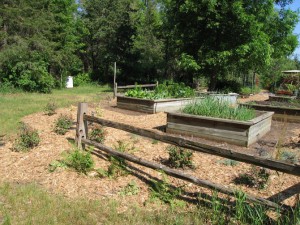
As each new piece has become a part of our overall property, the gestalt increases.  It grows in size, has grown in size, from the first decisions about boulder walls and perennial flowers, through bulb planting, hosta and ferns, the multiplication and division of iris, day lilies, true lilies, hosta, bug bane, ligularia, dicentra.  When Kate began to grow vegetables, the gestalt pushed out some more.

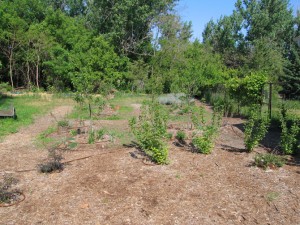
Hiring Ecological Gardens and putting in the orchard last fall has pushed the boundaries of the whole further out, while integrating it more.  The bees have added an animal component, a lively and complex bee-ing.

Growing vegetable plants from seed under lights, then planting them outside adds another layer.  The work that Ecological Gardens plans for May 26 and May 27 will enrich it yet again.

The feeling is hard to express, but wonderful.  Mabye the bee hive is a good analogy.  It feels to me like the whole property has become an interdependent whole, with the land working for us and us working for the land.  I’m not talking about just food production.  The beauty of the flowers, the grace of the ferns, the broad green presence of the hosta are part of it, too.  Each part feeds into and amplifies the other.  The bees enhance the fruit trees, the vegetables and the flowers; in turn they provide pollen to the hive.  We care for the whole and harvest food, aesthetic pleasure and a sense of connectedness.

Plants I’ve Known From Seeds.

Beltane                       Waning Flower Moon

The peas and turnips and beets and new onions are up and wriggling toward the sky.  I planted all of the hydroponic plants today with the exception of the cucumbers.  They go in tomorrow.

This was satisfying, putting in plants I grew myself from heirloom seeds.  The next satisfaction will come as they grow, another when we harvest, but the best will be when I replant them next year grown from seed I harvest this year.

I already have garlic growing from bulbs I planted two years ago.  Once the new beds are in we will plant the beans, all of which are from last year’s beans.

Good to get all this done before I leave for Hilton Head.

Now it’s in to MIA to pick up  the Sin and Salvation catalogue for the Pre-Raphaelite show I will tour through the remainder of the summer.

A Cool Night.

Beltane                    Full Flower Moon

This is the kind of weather that can scare a Minnesota gardener.  Right now the temperature is 42.  It could, will, go lower, though the prediction says no lower than 40.  If I thought it were going to get down to freezing, I’d have to cover my new peas and turnips.  They have just poked above the soil and would suffer and most would die.

My baby plants from inside are now adolescents; they stayed outside six hours today.  Tomorrow, I’ll put them outside by the beds where they’ll be planted and give them one more day in the peat pots before digging them in to their permanent homes.

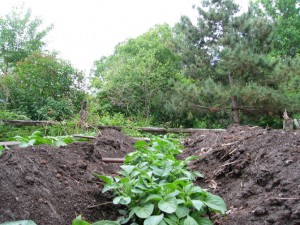
I cut up the potatoes today, readying them for planting, too.  They may be a little late, so we’ll see what we get.  A lot of new plants in this year’s garden: leeks, parsnips, turnips, greens, brocolli, cauliflower, plants I may not understand too well.  Again, we’ll have to see what we get.

That kind of experimentation is one of the joys of gardening, eating something fresh that you’ve only ever had from a produce section of a supermarket.  This year marks a large expansion in our vegetable and fruit crop.  That means a lot of uncertainty, a steep learning curve with some plants.  All part of the deal.

The Moon of Full Flower

Beltane                     Full Flower Moon

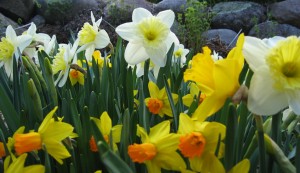
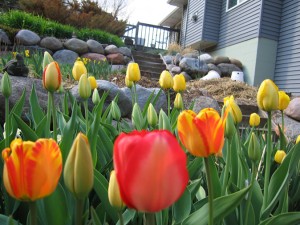
The full flower moon rises tonight on beds full of daffodils, tulips, snowdrops and small blue flowers whose name I don’tdaffodils675 recall.  The furled hosta leaves that come up in a tightly packed spiral have begun to uncurl.  Dicentra have full leaves now, though no flowers yet.   A few iris have pushed blossoms up, a purple variety I particularly like opens early.  Even though they will not bear flowers until July the true lilies have already grown well past six inches, some with gentle leaves and others with leaves that look like a packed icanthus, an Egyptian temple column rising out of this northern soil.
My hydroponically started plants will stay outside today for four hours, working up to seven until they graduate to full time outdoor spots.  All of the three hundred plants began as heirloom seeds and have had no chemicals other than nutrient solution.   Unless we paid Seed Savers to ship us transplants, there is no other way to get heirloom plants that need growing time before the date of the last frost.  Too, the selection of vegetables and their varieties is of our choosing, not the nurseries.  I don’t have anything against nurseries; I just like to grow what I want, not what’s available.

The big daylilly move underway will make way for a full sun bed of sprawlers like squash, watermelon and cucumbers.  The perennial plants like the lilies, iris, daffodils, hosta, ferns, and hemerocallis have their complexity but I’ve majored in them for the last 14 years.  Now I understand their needs, their quirks, the rhythm of their lives and their care.  Vegetables, on the other hand, only this last two growing seasons have received any concentrated attention.  Their complexities are multiple because there are so many varieties and species with so many varying needs related to soil temperature, ph, nutrients, length and temperature of the growing season.

The learning curve has been steep for me so far, though the experience gained from the perennial plants has kept me from being overwhelmed.  In another couple of years I should have a good feel for what does well here and what does not.  After that, the vegetable garden will become more productive while at the same becoming easier to manage.

By that time, too, I hope to have had two successful bee-keeping years under my belt and have grown my colony to three hives or more, enough to justify purchasing an extractor.  At that point this should be an integrated and functioning micro-farm.  If it works well, I hope it will serve as a model for what can be done on 2.5 acres.  We’ll see.

Our Life And This Land Are One

Beltane                      Waxing Flower Moon

The garden beckons, so a short one this morning.  I’m set for having the garden planted before I leave next Friday, atulips674 week from tomorrow.  Everything I need to get in the ground before I get back will have a spot:  various tomato plants and potato eyes, broccoli, cauliflower, egg plant, onions, leek, chard, greens and cucumbers.

There is a sense of wholeness now as the orchard begins to blossom, the vegetable garden for this year starts to grow and the perennial flowers, hosta, ferns and bugbane blossom and emerge.   With the ecological garden’s work later this month we will have a yet more integrated homestead, with food and flowers, bees and a home of their own for the grandkids.

This must be a similar feeling to a farmer’s, a feeling that our life and this land are one.  That means, too, that as the garden comes to life, a certain part of my Self also comes to life, when it grows, so do I.  As the harvest comes in so do I harvest fruits within my Self.

When the garden begins to go fallow in late August through October, another aspect of my Self blossoms.  In this light I can see September 29th, the Feast of  St. Michael the Archangel, as the springtime of the  soul.  This begins a period more reflective and contemplative, a period, too, when my creativity flowers.  As outside, so inside.

Blessed be.

This May Night Has A Sacred Presence

Beltane                Waxing  Flower Moon

When I walk outside at night, on the back deck, the flower moon shines, almost full.  A May rain has dampened all the earth in the back, where the vegetables seeds wait for the right combination of moisture and heat to spring to life, begin their season.  The earth on this May night gives off a scent, a strong scent,  the odor of fertility.

It was said that the odor of sanctity, a scent associated with saints, was the smell of roses.  I’ll go with the smell of roses and leave the sanctity to the theologians, but this May night has a sacred presence, the presence of life and the inanimate in an intimate union.

Moon light on a growing garden, an orchard beginning to leaf out, tulips and daffodils folded up for the night, are the early signs of a northern summer.

A northern summer has a marked difference from the southern US or Southeast Asia, which my brother refers as the land of endless summer.  We come to summer after a long, cold, sometimes difficult winter.  The greens, the yellows, the reds and blues of summer gladden the heart, create a sense of openness and possibility, so welcome.  In lands where the seasons are only dry or wet, but always hot there is no caesura, a fallow time, for contrast.

Right now, to step outside in the dark, with a fine bright moon, is to walk into the Otherworld straight out of the Land of Winter.  Magical.

A Flag Hanging From A Tree On The Mississippi

Beltane                   Waxing Flower Moon

Windows Without Walls.  Microsoft has this new advertising slogan.  I keep wondering if they realize that without walls there are no windows?

2 hours today for my baby plants getting ready to head out to the garden.  They’re done right now and I have to go get them before my treadmill workout.

As I passed over the Mississippi on the way out to the endodontist this morning, I noticed a tree with an American flag attached to a branch, fluttering.  Somehow the artlessness of it reminded me of days gone by, of a world in which there were fewer right angles, fewer stone bridges and no steel and concrete ones, no cars.  This triggered a revery at first between art and artifice which went away almost as quick as it came.  Not the point.

What was the point?  Permaculture has something to do with it.  So does our very American and persistent yearning to return to the land, to become one with nature.  This flag without a flag pole, without dramatic lighting suggested this.  What was there here?

The red car sped along Highway 252 headed toward Highway 100.  The reflections kept coming.  Nature and artifice.  No.  Not nature and artifice.  Nature and the human drive to build and decorate, artifice.  Both natural.  Then, the city, where I feel such energy and hope, and our home with its orchard and vegetable beds, its perennial flowers like the tulips and daffodils up now, where I also feel energy and hope, these two must walk together.  The tight gathering of humans and their shelters is no different from the mud daubed home of the wasps or the cave of the hibernating bear.  Likewise humans earning their food from mother earth is no different from the bass dining on minnows or the moose eating duckweed from a wilderness lake.

Yes, that was it.  The flag on the tree branch reminded me that we humans and, all of what we do, are natural.  This whole earth in the balance rhetoric is wrong; it is not earth that is in the balance, it is rather humankind.  We may live in such a way that we eliminate our own niche.  It has happened before and it will happen again, naturally.

We Have 6,000 New Residents In Multi-Hive Housing

Spring               New Moon (Flower)

The bees have come.  Mark Nordeen drove over today with our first packet of bees.  This is a picture of a bee package off the web.  The circle at the top contains a can of nutrient syrup for the bees while in transit.  The can comes out and the bees pour out of the opening into the hive, which has four middle frames removed.

Mark and I donned our bee suits (mine is borrowed from him), me for the first time.  He pulled the can out.  It had seepage on the bottom from three very tiny pricks in the bottom.

He then turned the box over the opening in the hive and shook the bees out of the box through the circle which held the can.  The bees poured out, most landing on the floor, then climbing up the frame of already built combs.  A few bees remained so he shook the box, spilling the rest out into the hive.

The queen comes in a smaller wooden box with a screen over one side.  Mark uses the direct release method, meaning he opened the small wooden box on the bottom of the hive and let the queen walk out.  Queen acceptance is the first critical move in the hive.  That seems to have happened.

We replaced the four frames and then put a patty of pollen replacement on top of the frames.  Pollen substitute comes as a soft material that looks much the inside of a fig newton bar.  Over the frames themselves and the pollen patty substitute went the hive cover, a particle board piece as big as the top of the hive with an ovoid slot in the middle.  Over this slot goes a plastic pail with sugar water.   The pail’s lid has a small screen, smaller than a quarter in the center.  The bees come up to this screen to feed until the plant world provides enough pollen for them to make their own food.

I was a little nervous before Mark came, excited, too.  The most unexpected part of the process for me was the sound.  The hum of the bees as they took up residence gave off a sense of vitality and unity.

Much more to learn, a years long course I believe.

Humans or Nature?

Spring                    Waning Seed Moon

Yesterday I cleared the corn stalks out of their old bed and loosened the soil where I will plant peas, good legumes that will replenish the nitrogen lost due to the corn.  Oh, and we’ll get peas for the table in the bargain.  I’ve always been impressed with legumes, a class of plants that gather nitrogen in little nodules on their roots.  They used rhizobia, a symbiotic bacteria that pull the nitrogen into the root nodules where they live.

In a recent article, likely by a conservative commentator, I read a grumbling about how the United States bifurcates into those who believe nature is salivific and those who see civilization in a similar vein.  Environmentalists and their (our) ilk clothe themselves in leafy greens when they attack the polluters:  fossil fuel consumers, pcb producers, sulphur mining, chemical based industries and nuclear waste generating power plants.

What they forget is the wonder of electricity, plastics, rapid transit, the movement of goods and services that has created the richest economy in the world.  Environmentalists also stand accused, in this perspective, of creating a false tension between bad humans and good nature.  Humans have a right to live, too, just like the damned spotted owl and snail darter, right?

When looking at arguments with apparently polar positions, I find it useful to search the middle ground, see if there might not be a place either camp has missed.  There is a large middle ground here.  Humans, as animals, are part of the natural order, not apart from it, and as animals our home building and self-sustaining activities are as important to us as are those of any species.  I love humanity, the civilizations we have created and want to see us healthy far into the future.

In this sense the dichotomy is false.  This argument becomes problematic, however, when we examine certain aspects of our self-sustaining activities such as the burning of fossil fuels, the pollution of fresh water with sulfuric acid in hard rock mining and the devastation of eco-systems with pollutants like pcbs and ddt.

Now we loop back to the middle ground.  We are part of, not apart from nature.  When we harm whole eco-systems on the one hand or tamper with climatological mechanics on the other, we not only press the snail darter, the spotted owl and the Galapagos tortoise toward extinction, we press ourselves in that direction, too.  If we create a natural order no longer friendly to human beings, our time on this blue marble will end.  If, in other words, we make the planet too hot, the oceans too high, the fresh water and soils poison, we will no longer have a place to live, literally.

So, on the one hand, I embrace Mozart, Lao-Tze, Shiva, Isaac Newton and the techno-computer industial complex, while on the other hand I recognize my need for clean water, renewable energy and food grown in safe conditions.  Humanity and nature are not either/or choices, but embedded and intimate partners, dependent upon each other for wise use of the resources we have.

This Is The Question I Face Now. One I Have Not Answered.

Spring            Waning Seed Moon

Agency.  There’s been a lot written in psychology and history about agency.  We have agency when we can affect the flow of events in our own lives or in the world around us. (No, I’m not going to get into the subtle no-free-will arguments floating around.)  A lot of the historical work has concerned how those without agency–say women, slaves, workers–get it or why they don’t have it.  In the case of the individual agency refers to our capacity to direct our own life.

A sense of agency underwrites our sense of self, or our sense of group identity.  Note that our agency or our group’s agency can be positive or negative.  A more negative sense of agency, that is, sensing that others or factors outside your control influence your life or your group, leads to a feeling of diminished capacity or is a feeling of diminished capacity.  A positive sense of agency promotes a feeling of active and successful engagement with the world, the ability to act in ways congruent with your self-interest or your group’s self-interest.

Here’s where I’m going with this.  In my regression back into the ministry after 8 or so years out I made the move because my writing career had not produced the hoped for results.  I had lost a sense of agency in the work area of my life and moved backwards on my psychological journey to retrieve it.  Going backwards to pick up something left behind is a key element of regression.  Its flaw lies in a return to a previous reality no longer relevant.  The ministy was what I had done, a minister what I had been.  The experience of return to the ministry produced missteps and a low level of energy for the actual work.

Now, about ten  years later,  once again I have reached back into my past, this time even further, to retrieve a sense of agency, the ur-agency, for me, the political.  This is the work with the Sierra Club. (hmmm.  just realized I did the same thing two years back when I studied Paul Tillich.  That was a return to life as a student, a potent form of agency for me.)

What the work with the Sierra Club, the study of Tillich and the ministry have in common is an attempt to regain a positive sense of self through a form of agency already well-established and presumably easily recaptured.  None of these activities in themselves is a bad thing, but that is the lure, the  seductive call of regression.

Back there, if only I could go back in time, and become the captain of the football team again.  Prom queen.  College radio jockey.  The actor I became after college.  My successful years as a bond trader or nurse or carpenter.  Back there I was strong, able.  I had a way with the world, a position of respect and self-confidence. Continue reading This Is The Question I Face Now. One I Have Not Answered.