Tigers and Bees and The Great Mesh of Being

Summer                                                   Under the Lily Moon

Thursday night Kate and I watched Conflict Tiger, a movie by Sasha Snow that followed the same story retold in the book, Tiger.  It’s a powerful, gritty movie about the reality of life in the taiga.  The characters in the movie, especially Yuri Trush and Ivan Dunkai, have a powerful presence, Trush as the hard-bitten but compassionate eco-policeman and Dunkai as a shamanic character with intuitive grasp of the tiger and taiga learned practical wisdom.

(Ivan Dunkai, Sasha Snow)

Today I did bee business.  Moved six honey supers, put two on the south colony and took the remaining four into the third garage bay.  The trailer on our lawn tractor is a handy piece of equipment.

Two colonies:  the south, filled with bees, boiling up out of it like angry vengeance, not wanting a stranger pawing around in their home; the other, docile and less populated.  When the south colony residents went into their angry buzz and started slamming against the veil and gathering on my right glove, my body zoomed back to last fall when I made a mistake.  You may recall that I decided to replace a honey super on a hive without veiling up?  OMG.  WTF.  OUCH.  My heart rate went up today.

Since I use nine frames in ten frame hive boxes, the bees often construct comb in the empty spaces and they had done this in the south colony.  Since I had to reverse the hive boxes on that colony today–this forces the bees to fill up both hive boxes with brood which makes for a better crew to harvest and make honey–one of the chunks of non-frame comb fell off.  It had honey it.
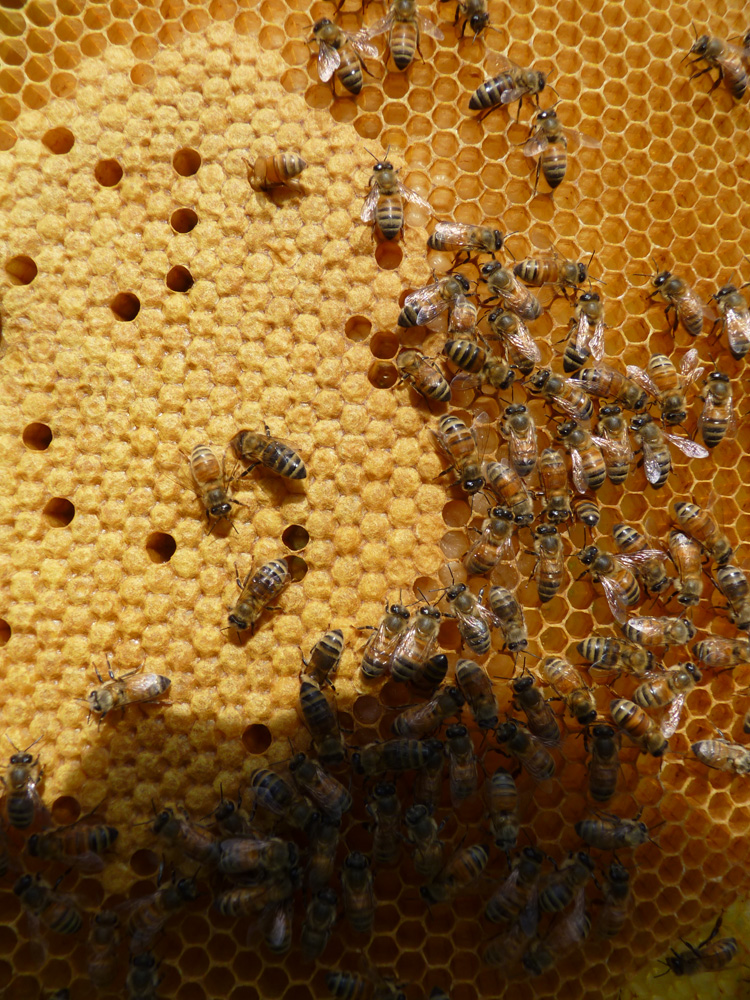
It’s now on the kitchen table.  Fresh honey in the comb.  Worth that bit of pit-a-pat.

Bee keeping is a collegial activity.  I keep the frames clean and coming while the colony builds up, adding sugar syrup if necessary.  Once the honey flow starts, if the colonies are strong enough, I put on honey supers and harvest the honey they make that is in excess of what they need to survive over the winter.

In other words I provide a home and its maintenance, they pay the rent with honey.  It is nothing less than a partnership with both parties putting in their own labor and each party getting benefit.

It is, in that way, a very tangible micro-instance of the relationship we have with our mother, the earth.  In that macro relationship we are the dependent party, yet we have work we put into the relationship, too.  It can be constructive work or destructive work, we choose, but the feedback systems in play make destructive work dangerous, too often causing mother to remind us of our place in the order of things, the great chain of being.

In fact the great chain of being does not run from earth to heaven, rather it runs around the skin of the earth, more like a great mesh.


Summer             Under the Lily Moon

Harvested chard, Fordhook Giant, dark green leaves and pale white stems.  Two armfuls.  Beets, too.  Burpee’s Golden, Bull’s Blood and Detroit Dark Red.  This is the third or fourth bunch of beets and this was the largest harvest so far.

The temperature not too bad, aided by cooling breezes.

The Heat, Man. It Cometh.

Summer                                                             Under the Lily Moon

Paul Douglas, local weatherman, Republican and a critic of the climate change deniers has various locutions for our heat wave.  Today it was: Dubai (with lakes).  Also, Phoenix heat with Louisiana bayou humidity.

We’re like fish out of winter in the soupy steam that passes for our daytime air.

Meanwhile our vegetables soak it up, the leeks looking dark green, potato plants now leaping above the mounding (considerable) I did last week.  Tomato plants stand tall, some with fruit.  I’m going out now to harvest chard and beets.  Over this weekend I’ll plant beets, chard, collard greens and carrots.

The heat makes me much less interested in working outside unless I get it done early in the morning; a shift in time I’ve found in hot countries I’ve visited.  In Merida, for example, capitol of the Yucatan, the city park filled up with people by 5:30 am, most of whom had gone on  to something else by 9:30 or 10:00.

As humans have done since we left Africa (and there, too, for that matter), we will adapt to whatever change occurs.  We will have no choice.  Just how much change we have to endure remains a choice; though anyone familiar with the CO2 loading numbers, which steadily increase, will have a pessimistic attitude.

A Friend’s Response to the “Observation” of the Higgs

Summer                                                Under the Lily Moon

Here’s an interesting response from friend, former nuclear engineer and former Jesuit, Bill Schmidt:

Just read your blog entry about Higgs.  Thought you might enjoy reading this from Huntington-Post. Be aware that the top of the page says Comedy.   I am especially taken with the wording included in one of the paragraphs about a trail – perhaps an ancient trail.   http://www.huffingtonpost.com/tony-phillips/theres-no-god-damn-partic_b_1645525.html


Here’s something no one in a white coat will say outright, “Of course we didn’t really find anything.” But they didn’t. They can’t. Not according to the very rules of their own game. The Higgs boson and all other subatomic particles are too small to be detected directly. What one finds in a particle hunt is evidence. One finds a trail, a trail left behind in the microseconds of a particle’s death throes after it is spun out of a somewhat larger particle that collides at incredibly high speeds with yet other particles under circumstances that can only occur in supercolliders, rare cosmic events…


This all makes me think that this may lead to revisiting and re-imagining faith.  All too much faith in 17 mile magnetic explorers who choose to accept only what their machines tell them, based on theories they created to persuade others that they really know what makes all of this tick. Not enough faith in our ability to explore what is between the two notions (the word notions is a pointer to abstractions) of a goddamn particle (undiscoverable) and a god particle that is now named Higgs Boson.  Perhaps instead of living 500 feet below ground with their magnets, these guys should take a walk in the woods with the likes of Emerson, Wordsworth, Thoreau, and others.  They like the happy Anoka gardener allowed their direct experience to tell them a lot about life, the world, and the way it all works.  Or the way it is.


No matter what anyone says, it may all be a great human comedy. Or, tragedy.


Blessings,

Bill

A Small Town

Summer                                                          Under the Lily Moon

Independence Day eve.

Memories.  American memories.  A small town, like any small town.  You might call it Small   Town, U.S.A.  Kids played outside until 9:00 pm, hide and seek and kick the can, using neighbor’s yards as hiding places.  Lightning bugs blinked off and on.  Bats swooped down after July mosquitoes.

The labor unions fought for wages, benefits and a whole town, this Small Town, went out on strike.  And won.  Workers had houses, boats, vacations.  Their kids went to college.  Health insurance came with the job.

This small town had a daily newspaper.  Each afternoon at 3:30 pm after school let out paper boys gathered in a small wooden shack attached to the back of the press room, green paper bags in hand.  The circulation manager would count copies and hand them out.  Some paper boys would stay a bit, folding the papers into tiny, compact squares with a folded down corner.  They flew 20, 30 feet with astonishing accuracy, curve ball accuracy.

One newspaper boy bought a transistor radio, clipped it to his belt, stuck the ear piece in and listened to baseball games as he walked down Monroe Street, flipping the small squares onto porches from the sidewalk.

This was a time, maybe about the year, that the Spunik satellite went up, pinging its bright metallic way across the sky.  Before that there were no human objects in space.

Kids collected pop bottles from trash cans, pulling Red Flyer wagons, loading them up.  At Cox’s grocery store a nickel a bottle, ten cents for some.  A lot of money.  Buy some marbles.  Firecrackers.  Ice cream.  Essentials for hot summer days.

Pot bellied veterans would carry the colors in this small town’s parades, their pink flesh peeking through the no longer form fitting white uniforms.  Tanks from the local armory left tracks in the hot asphalt.  An Independence Day parade.  Marching bands, baton twirlers.  A queen of something doing the wave.

Folks lined up along the street, the folks whose husbands had gone on strike.  Who received the copies of the newspaper.  Folks whose kids played outside until therr was no time left and mothers called from their doorsteps.  They stood there in the heat and watched the parade.  A big event for a small town.

Far over ahead, a ping.

“To laugh often and much; to win the respect of intelligent people and the affection of children; to earn the appreciation of honest critics and to endure the betrayal of false friends. To appreciate beauty; to find the best in others; to leave the world a bit better whether by a healthy child, a garden patch, or a redeemed social condition; to know that even one life has breathed easier because you have lived. This is to have succeeded.”

Ralph Waldo Emerson

Still Advancing

Summer                                                     Under the Lily Moon

My translating pace has picked up noticeably with fewer headaches and WTF’s.  This encourages me; I might be able to set a pace for translating rather than just slogging through as many verses as I could manage.  Over the course of a particular period of time, for example, I could finish a whole book.  There are fifteen books in all in the Metamorphoses.  Wow.

This is exciting for me.  It means I’ve actually learned a new skill.  I’m far from perfect in my translation and have a long ways to go before I can produce my own confident idiomatic English translations, but I can see that moment coming.

So, this afternoon.  Rembrandt.

Aha Moments

Summer                                                   Under the Lily Moon

In the long ago faraway I took symbolic logic.  My freshman year of college.  I’d never struggled academically and German had already taken my measure in the first semester, so I was in no way ready for another problem.

Larry Hackestaff was the professor, a philosopher who carried a six-pack of Bud attached to his belt through the plastic rings holding it together.  He was a young guy and he enjoyed the campus gatherings which were 1950’s typical boozy events with beer kegs and purple Jesus.

Six weeks into symbolic logic my mind had turned to mush.  This stuff just didn’t make sense to me.  Not because I wasn’t trying.  I studied hard, but I wasn’t getting it.  After my debacle with German, my self-image was in trouble.  I took my green copy of our text to the library for one last go, before our first exam.

Somehow that evening, the propositions and logical symbols and proofs and fallacies jumped off the page for first time and entered my brain.  Never worried about logic or my self-image in that way again.

I’ve been studying Latin for 2 and a half years now, starting almost from scratch and aiming toward my goal of translating Ovid’s long poem, The Metamorphoses.  The grammar made sense to me; the vocabulary is not difficult, but the application of the two in translating Ovid has proved hard.

Lots of reasons for that, reasons that reflect my still developing grasp of both grammar and vocabulary, the nature of poetic Latin and, I learned yesterday, my own overly analytical approach to the task.

I wrote down every word and every possible meaning and case or conjugation.  Then I began to assemble a translation, matching the singular neuter ablatives with other singular neuter ablatives, checking out the various meanings of the words and locating verbal forms and their possible use in the sentence.

This was satisfying in one respect.  I ended up with a lot of notes and information.  And I imagine that did me some good.  I had, however, missed the primary point Greg had been trying for over a year to get me to see.

I saw it yesterday.  Look at the verb.  Translate it by itself.  Find a noun that is the subject of the verb.  Find an object if there is one.  Everything else modifies one of these three.  Greg has championed this “mechanical” style of approaching translation as best for novices.

I believed him.  I thought I was doing that; but, I wasn’t.  Now, I see it.  The next 10 verses fell into place quickly.  It was an aha moment even greater than that one at Wabash all those years ago.  More satisfying, too.