Warring States

Fall                                                                         Fallowturn Moon

Today begins the journey to Shaanxi, the province of the Qin state as it emerged during the Eastern Zhou dynasty, a peripheral state on the frontier.  In the lecture today I learned that there is some debate on the origin of the Qin state.  Did it emerge from the barbarians to the west?  Or, did it have, at least in its ruling family, linkage with the east coast?

Yang Liu, Curator of Chinese Art and Head of Asian Art Department, acknowledged this debate, then said, “Why is it important?”  The problem is this.  The Qin unified China and Qin Shi Huang Di is a national hero.  Dynastic China as we come to know it after the Qin has its roots in many of the reforms of Qin Shi Huang Di.  What would it mean if that founding state was not, after all, Chinese?

This show is going to be a big deal, a very big deal.  Schools have already booked nearly all the available slots between now and the show’s end.  The museum has asked docents to sign up for additional tours.

What Yang Liu wants to do is place the tomb, its guardians and other wonderful burial objects like life size water birds and half-size bronze chariots, in the context of the rise of the Qin state during the Eastern Zhou in the Spring and Autumn period, then its emergence as a powerful state during the Warring States Period.  Only then can this massive tomb complex, of which the warriors are, after all, only a small part, be understood in its full historical significance.

Over the next few days I’ll post research I’ve located and things I learn at the Qin dynasty symposium over the weekend.
A Year Ago Today

Fall                                             Fallowturn Moon

posted on this day, 2011.

Fall                                                                                        New Moon of the Southern Cross

We will spend the next lunar cycle south of the equator so I’m choosing the iconic southern constellation, the Southern Cross, to name its moon…

Thoughts on cruising. Think of a really nice hotel in which you have stayed. Not five stars, but maybe 4. Good food, attentive staff, interesting public areas and a good gym. Add to that several swimming pools, a theatre, a casino, a library with comfortable chairs, clothing, liquor and jewelery stores, a basketball and tennis court, a quarter mile wooded track. Now float all of that on an ocean. That’s a cruise ship. The hotel, a nice hotel, remains constant no matter where on the journey you are.

Now add in the ocean as a constant companion, 11,000 or feet of it where we sail right now, north of Ecuador headed south. The ocean gives the hotel experience a special character, changing it from very nice to special. That, too, is constant.

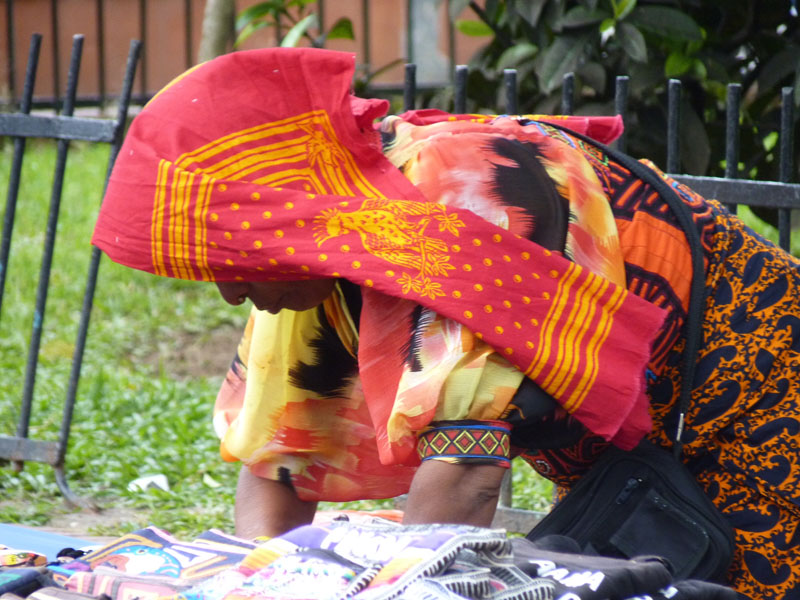
Also, the hotel moves from port to port and from country to country, culture to culture. Here the advantage lies in the number and variety of countries and cultures experienced, not the depth of the experience. I’ve now been to Santa Marta, Colombia and Panama City, Panama, both places about which I knew virtually nothing and came away from them realizing I would enjoy seeing them more. I also have a fleeting sense of their culture, their daily life, but a fleeting sense rooted in concrete experience rather than travel books or documentaries.

From this point forward Kate and I will collect similar impressions of six more countries: Ecuador, Peru, Chile, Argentina, Uruguay and Brazil, with multiple stops in Ecuador, Peru and Chile. At the end we will have, I’m sure, a gestalt of South America. It will be fungible and impressionistic, but it will have its roots in on the ground experience.

Cruising of this sort, then, provides an overview of a continent, say, with all the limitations of an overview, but with the utility of a solid overview, too.