Spring Bee Hiving Moon
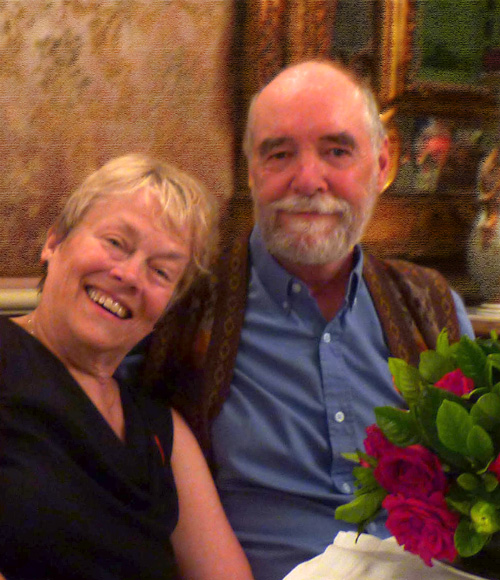
Travel. Kate and I, discussing her limited mobility, have investigated various modes of  travel that can accommodate both of us. So far the ideal is the cruise. Kate can enjoy the ocean, the dining, lounging on the deck chair with knitting or hand-work and take the shore excursions that use buses. I can take some of those same excursions but I can also take ones that involve more walking. Train travel has some of the same benefits, too, as long as we get to a city or destination that allows Kate a place to enjoy herself and gives me some room to wander. Driving in an R.V. is a good option, too, because she lie down, “unload my spine,” which brings her solid relief.
She said, in that conversation yesterday, “Travel is important to your soul.” Never thought of it that way, but I realized she was right. Something in me needs to experience the not before seen, the food not eaten, see ways of life different from my own. I suppose it’s in part voyeurism, but that’s only a very small part. The rest of it comes from the same motivation that leads me to fiction, to the unimagined place, the unfamiliar narrative, the quirky characters.
In our intimate isolation, the existential nature of our solitary lives, each of us reaches out, tries to find the other whether friend, spouse or the creators of Chilean culture. We search for clues, shards of evidence about interior lives other than our own, but they’re difficult to find and hard to interpret. Those for whom travel is necessary, and I would include myself in that number, find seeking those clues easier when the environment is most different from home.
Wandering among the ruins of Angkor, for example, the traveler finds a world based on god-kings who ruled in a time saturated with divinity and filled with magic. These were not deluded, naive ancients, but vigorous powerful people who built with fine architectural skills, mastered the art of using water for transport and defense, supported a large military and offered themselves to their gods with passion.
Walk the streets of Ephesus, marble streets and communal latrines, a large library and the ampitheatre where Paul preached to the Ephesians. This was an outpost of the Roman empire located on what had been a thin ribbon of Greek settlement in Asia Minor stretching from Byzantium to Miletus and Rhodes. Again, not deluded or feeble ancients but a civilization that conquered the peoples of the Mediterranean, Adriatic, and Aegean seas. They had trade with countries far to the east and even, by the time of Caesar, had conquered also what is now Spain and France. Their language, their customs, their beliefs differ from ours in ways we find difficult to fathom.
Or, walk the streets of Beijing, Bangkok, Singapore, Lima, Peru or Rio de Janiero. All different, all humming with the commerce, art, politics and the family life of people, our contemporaries, who do not share beliefs we consider fundamental. They might reject democracy, or Christianity, might display native dress that seems exotic to our eye, eat foods that would disgust us or engage in recreational activity incomprehensible to us as fun.
Travel places us in the culture that chooses ideals and values different from or even in opposition to our own. It makes clear, on the one hand, our own insularity and helps us see our values over against those of others while at the same time demonstrating that humans deal with similar problems and needs though the solutions may differ, the satisfaction of the need may have very different inflections.
Holding ourselves intact, honoring our own beliefs and values, our own foods and art, our solutions to life’s problems and the ways we satisfy basic human needs while also honoring the beliefs and values, the foods and art, the solutions and satisfactions of others is the most direct route I know to self-knowledge and self-acceptance. It’s tempting in those other places to go native, to adopt the ways of the other, but that’s a different way, one that involves sublimating your own in favor of the others.
What I want is to embrace the American flag, English, hot dogs and hamburgers, football and television, wide open spaces, democracy and our strange but wonderful struggle to include others not as guests but as fellow citizens while celebrating sushi, the Crescent and Moon, that other football, Bollywood, Mandarin and even, though with more hesitation, modes of governance that have more centralized authority. In this way I can come to understand that my interior life, solitary and isolated though it may be, is not, at its core, so very different from that of the other billions of my kind, living and dead, who’ve faced loneliness, love, fear, hunger, desire, ambition, anxiety, dread, awe, wistfulness and the myriad of other emotions that drive the lives of all of us, us humans.