Inhabiting the Move

Beltane                                                        Emergence Moon

Planning on an hour or so a day, maybe two some days. Today the garage. Clustering yet another batch of toxic chemicals for a run to the hazardous waste depot. Old motor oil, gasoline preservative, brake fluid, paint. I put in that pile the ambitious collection of items I got when I decided to tackle small engine repair.

In my usual avidity I dove into it, buying manuals, tools and imagining the things I could fix: snowblower, lawn tractor, weed whacker, chainsaw. Why? I can’t recall now, but, like the irrigation system I reasoned, it can’t be that hard. Oh. Yes. It could. Wrenches and screwdrivers danced out of my hands. Things weren’t where they were supposed to be, or at least where I figured they should be. Turning screws, cranking off recalcitrant nuts, slipping belts off and on and connecting metal latches all had unanticipated problems for me. I’m sure they were the kind of thing a kid learns with a father or brother who enjoys these things, but I skipped that part of my education.

Finally I admitted what could have been obvious to me in the beginning. This required more patience than I had and more skill than I was willing to learn. I felt a bit defeated, somewhat ashamed of myself as a man, not being able to get simple mechanical tasks done.

This sequence of imagining myself into some new skill began with lock smith ads in the Popular Mechanics and True magazines I read as a child. Boy, if I knew how to pick locks, make keys, install safes, I’d have a real, useful craft. Over time this theme of having a real, useful craft would, oddly, lead me to attend seminary and learn how to be a minister. Ministry was not, however, equivalent to being a locksmith. It was both more and less complicated, more and less useful.
Learning’s Limits

Beltane                                                                    Emergence Moon

In the basement, next to the softwater tank, is a blue pressure cylinder that holds water from our well as it waits distribution to the rest of the house. Coming out of it is a copper pipe that goes straight up for about six feet, has an elbow, then penetrates the envelope of the house to connect our well to the irrigation system. This pipe has a small butterfly valve, often locked with a lead seal though not this year. After screwing in a bolt that prevents water from bypassing the irrigation system and landing in our orchard, used for fall blow out, I hopefully opened both blue butterfly valves.

Then I plugged in the irrigation clock and hit run on an overhead water zone for our one half of our vegetable garden, the north half where I’ve planted tomatoes, bush beans, egg plants, swiss chard, cucumbers, collard greens and peppers. Waiting expectantly, my contrarian thrill ready to exult, I. Waited. Nothing. Hmmm. Let’s see, water on. Yes. Clock running. Yes. What was I missing?

I went to the valve outside and turned one butterfly valve in the opposite direction, imagining I had turned them off instead of on. Water gushed out against the siding. So. The water has gotten from the well to the valve itself. I turned that off and noted that it meant I had in fact turned the water to the system off with the other valve that gates the water from the well to the system itself. This must be it. I turned that one to the open position and went back to the clock.

Punched manual start on zone 1 which is in the front. Waited for the spume of water to arc out. Nope. OK. RTFM. I got on the web and discovered I’d missed pressurizing the lines. Sigh. At that point I decided my self-education in all things sprinkler start-up had exceeded my willingness to learn.

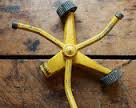
sprinklerThat was when the hose came out, three hoses really, and, connected to a house spigot, the yellow, three-armed irrigation spinner began to twirl in the vegetable beds. I have no need to learn how to start up the irrigation system, I just wanted my plants to get water and I thought the startup would be simpler than it was. Something I could learn, no doubt, but with probably only one more spring to practice my knowledge, I’d rather spend the time on my Latin.

Home Alone?

Beltane                                                           Emergence Moon

Yesterday morning, while planting cucumbers in hills, making rows of bush beans to cover their base, fanning the collard greens out along the north side of the bed, the swiss chard to the east and the eggplants to the west, leaving room for marigolds in the center where it’s hard to reach, I called Mickman’s, our irrigation company.

We pay Mickman’s a yearly fee to come out and start up our irrigation system, checking for heads damaged over the winter and making sure everything works correctly. They also close it down in the fall, bringing an air compressor to blow out the lines so no water remains in them to freeze and burst the pcv pipes and the plastic heads. This year I realized I had had no word from them about the spring service.

When I called them, yes they had my service contract, yes they would get to me, no they hadn’t tried to contact me yet because they were far behind due to the cold weather. When I told them I had plants (vegetables just planted) that needed water, the earliest they could get out here was next Wednesday. With full sun and some heat projected for today and tomorrow I pressed them. “What are you asking for?” Water for my plants.

After I hung up, settling for a late Tuesday appointment, a strain of contrarian thought streaked through my head. Who needs them? I’ll start it up myself. I’ve never done it, still haven’t, but I’m going to try today because my vegetables need to be watered in. We’ve had them do this start up for the last 20 years and in all that time starting up the system never occurred to me. Strange. It made me wonder how much else I have done for me that I could do myself.

This loops me back to a thought that comes to me, often about this time of year, that I am lord of the manor. In an odd way we have replaced the old English manor house. No baize doors. No downstairs and upstairs. Yet we have a cleaning lady, lawn care service, irrigation specialists, arborists, electricians, septic cleaners, window washers, a handyman, roof and siding replacers, generator maintenance guy, painters and a contractor for home remodeling.

This list does not include, but can, the washing machine and the dryer, the refrigerator, the television, the fitness equipment, a lawn tractor, the microwave, the electric sewing machine, several computers, cell phones, a landline, a freezer and a horseless carriage. These last are all labor saving devices. Yes, they replace actual laborers who at one time would have been employed for laundry, bringing in ice, cooking, lawn care, message delivery and transportation outside the home.

This means that though we have the patina of a single family living in their own home, alone, the reality is much more complex and all of it requires management of one sort or another. Relationships have to be built, skills assessed, work evaluated, checks written, needs for service monitored. None of this is, in itself, remarkable, but when looked at in the aggregate it shows how a family serves as the nexus of a complex web of services, some engaged by humans who live outside the home in their own home, some by machines, but often machines far too complicated for a home owner to service, which requires appliance repair and/or replacement people.

I guess it’s not odd that starting up the irrigation system never occurred to me.