All posts by Charles

Reimagining/Reconstructing

Winter                                                                           Moon of the Long Nights

Alan James Garner - Own work, CC BY-SA 3.0, https commons.wikimedia.org
Alan James Garner  Own work, CC BY SA 3.0, https commons wikimedia org

Last night, third night in a row at Beth Evergreen, was the MVP, the mussar vaad practice group. Tuesday was the unveiling of the third stained glass window. Wednesday was the first class of the third in the first year kabbalah curriculum, the Mystical Hebrew Letters. On a personal, physical level this many evening sessions, which extend well beyond my usual 8 p.m. bedtime and then require a half hour ride home afterward, exhaust me. But on a psycho-spiritual level the nourishment I receive more than compensates.

As I wrote this last sentence, I looked up at Black Mountain and noticed a pink glow, a penumbra at its peak. A good symbol for the new understanding that is beginning to dawn on me.

In the mid-day mussar class, where we are near the end of the Messilat Yesharim, the path of the upright, by the 18th century kabbalist, Rabbi Moshe Luzzato, Jamie commented, “Remember, these are kabbalists. They include proof texts as an invitation to rethink them as metaphor, not to accept their literal meaning.” Jamie has said this before, in the kabbalist classes especially. “The Torah is a metaphor, not history.”

Torah being read at a Bar Mitzvah

A bit later, he asked, “What is Torah study?” This was a topic we covered over a year ago when beginning Luzzato’s work. Torah study is not about content. It is not, in other words, limited to scholarship about Genesis, Exodus, Leviticus, Numbers, and Deuteronomy. Torah study is a method and it involves paying close attention to the person next to you, to the sunrise over Black Mountain, to the cry of a sparrow, to the way a lodgepole pine sloughs off snow, to the needs of the dog sleeping beside your chair. to the nature of fire crackling in the fireplace. Torah study is about loving attentiveness. It is a way of engaging the sacred world which we can know first from within our own person and which permeates that which we encounter throughout our lives.

And, again, aha! The sun, the sacred sun with its life-giving light, just lit up Black Mountain and showed me a sign, a way of illustrating a literally dawning awareness. The wind, the finger of the sacred blows as the ruach, the breath of spirit, the breath of life and moves the lodgepole pines in our front yard. The pines themselves erupt out of the stony Shadow Mountain ground, able to express life in a soil mostly barren of the rich nutrients available in the farmlands of the American Midwest.

Marily, Tara, the Burning Bush
Marilyn, Tara, the Burning Bush

I find this means I can read the word God in a new way. Shortly after Jamie commented on Torah study, we read a sentence in Messilat Yesharim that included the English word omnipresence, as in God’s omnipresence. I asked Jamie what Hebrew lay behind this translation. He looked it up, “Hmm. Something like, permeated knowledge.”

God lit up for me. Ah, if I do Torah study, if I engage in loving attentiveness to my Self, my own Soul, and those of others and of the broader natural world, then I can find the knowledge which permeates all things, that very same shards of the sacred that shattered just after the tzimtzum to create our universe. That is God being available everywhere. This is far different from the Latinate imponderable of omnipresence, sort of an elf on the shelf deity lurking in every spot, finding you everywhere. And judging.
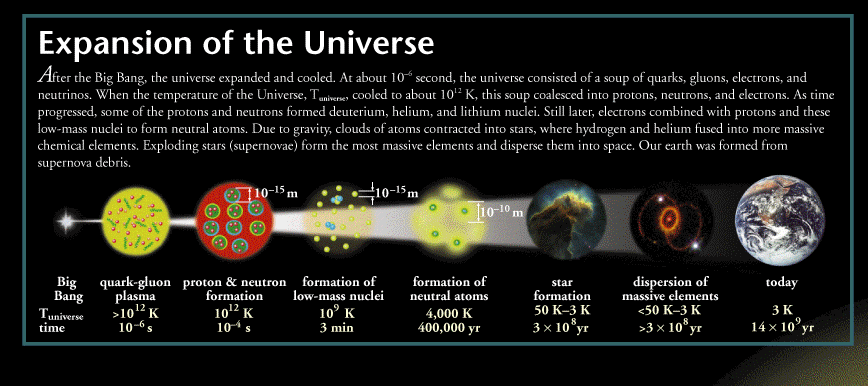
hist_univNo. God is another word for the intimate linkage between and among all things, from the smallest gluon to the largest star. God is neither a superparent nor a cosmic Santa Claus writing down your behaviors in the book of deeds; God is a metaphor for the sacred knowledge which permeates the perceivable, and the unperceivable, world.

Our deeds are, of course, written in the very real book of our life, so they have consequences, not only on our life as whole, but as they impact others and that same world which we all inhabit. You could also see God’s judgment as the manifestation of those consequences, in their positive and negative natures, not as a divine finger shaking or outright punishing, but as ripples from one instance of the sacred to the another.

 

In the Beginning

Winter                                                              Moon of the Long Nights

AlKabbalah last night. The first session of Mystical Hebrew Letters. Rabbi Jamie began teaching kabbalah at the Kabbalah Experience with this class several years ago. It moves from the broader conceptual fields of Soul and Space, the first two classes this year, to the particular examination of the Hebrew alphabet.
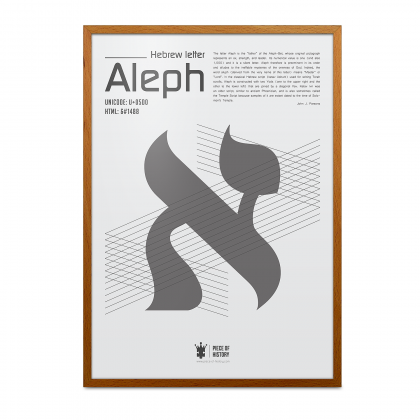
As with all the kabbalistic material, the subject matter gets complicated fast. We began with an overview of this ancient language. According to recent scholarship Rabbi Jamie says, it is the oldest alphabet in the world. Like most early languages, Chinese for example, it began as pictographs.

alephAleph, the first letter, was an ox-head. The word aleph means ox-head, or head of ox, also learning and chieftain. Prior to the use of Arabic numerals each Hebrew letter stood in for numbers with the letter aleph as number one. The word aleph means 1,000. Thus, aleph symbolizes the philosophical notion of the one and the many.
It is silent. Not sure why, but aleph and ayin, though used in the written language, are always silent. As silent and first in the alphabet, it also symbolizes the silence out of which came everything.

(next day) Stopped writing this yesterday when my need for sleep overcame my ability to write a coherent sentence.

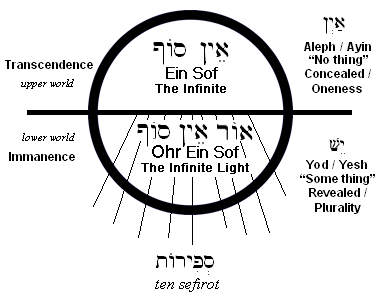
The big idea I took away from this class involved aleph and my reimagining/reconstructing emphasis on incarnation rather than transcendence. Jamie introduced the notion of the alphabet, the Hebrew alphabet, as a funnel flowing from aleph in the ein sof (unlimitedness), its silence standing for the space created when the ein sof contracted, the tzimtzum, and filled with ohr, the first light of creation which fractures and travels down through the tree of life with its 22 channels (connecting lines) to the tenth sephirot, or malchut/shekinah, which is this world. Its letter is tav, the 22nd and last letter.

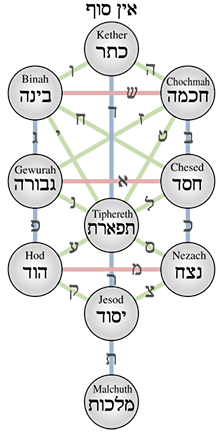
At first I thought, oh this emphasizes transcendence, the physical world developing in a top down fashion from a realm unconnected to it save by the thinnest of conceptual threads. Then Jamie began to introduce the location of the letters on the tree of life and aleph did not appear above the keter (the crown at the top of the tree of life), but on the parallel line of connection between chesed and gevurah, essentially the middle of the tree of life. Huh? How could this be?

These two images represent the two different ways of understanding this idea:

EinSof

This one shows the first representation of the funnel idea that came to me. It does in fact emphasize transcendence. But, when we remember (difficult to do when material is presented on paper) that the tree of life is three-dimensional and can be seen as a sphere, another possible image presents itself.

aleph

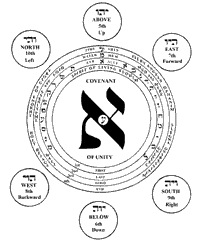
As the rabbi likes to say, Aha! The nub of creation, the contraction of the unlimited ein sof, the movement from the quantum world to the Einstenian/Newtonian this world, the shattering of the ur-ohr, the first light of creation, happens in the center of the sphere and radiates outward. Yes. The divine moves from within all to create, in an outward push, the shekinah, the divine manifested in created matter. This is big-bangy. The tzimtzum just proceeds the big bang which radiated outward from an unfathomably concentrated spot in the beforeness of whatever it was, the ein sof, to create literally everything we know.

This puts the sacred neither above nor below but within. In order to access sacred nature we do not need to cast a prayer upward toward the heavens or outward to a religious institution, but inward to the aleph in our own soul, to that silent spot in ourselves where resides our shard of the ohr, the first light.

Here is an image of the tree of life that shows the location of aleph between chesed and gevurah. Remember that the tree is three dimensional like the DNA helix.

tree_of_life2


Very. Stable. Genius. Yeah.

Winter                                                                   Moon of the Long Nights

bone brothBone broth still gently boiling on the stove. Its been there since yesterday afternoon at 5 pm. First time I’ve made this. At 8 or so this morning I’m going to start a beef stew in the slow cooker.  Beer is one ingredient so Kate bought a six pack of Dos Equis. Sacrificing for the cause.

Our very stable genius has just cavalierly unmoored the lives of 200,000 Salvadorans. That’s a small city of immigrants. Lack of empathy is a hallmark of this administration, necessary for gutting the future with one trillion dollars plus in tax cuts, pretending that climate change is a liberal conspiracy, trying to dump transgender military personnel over supposed medical costs, and elevating pedophiles and other sexual predators.

trump3In the debate over his mental illness I’m agnostic, agreeing with those who say he’s obviously dysfunctional, yet unwilling to ascribe his character flaws to a particular diagnosis. It does a disservice to all people with mental illness when such a man, a man whose moral compass has been rendered useless by the powerful magnets of fame and money, is seen to act as he does because of possible narcissism or whatever else others find in his public persona. They may play a role, yes, but there are still underlying values toward which this particular man gravitates, values inculcated by a racist father and a distant mother, values embraced by a hollow man needing to fill a vast internal vacuum.

Nixon and Trump, cancers of the U.S. political system.

Sad about Rigel. A sort of dark blanket over our lives right now. There’s a bit of hope that we’ll find something other than cancer, but it seems slim. We want to know her prognosis, how best to care for her right now. She’s a sweet, sweet dog.


This. That.

Winter                                                                          Moon of the Long Nights

The elliptical is gone. Sold back to Colorado Fitness. Two guys came in a Pence rental truck, picked it up and carried it down the stairs. Heavy, man. Its footprint is still here, outlined in dust.

Kep and Rigel
Kep and Rigel

Rigel’s liver values have continued to deteriorate. We’re taking her to a specialty diagnostic center for a liver biopsy. Possible liver cancer. She’s 8 going on 9, old in our family for a dog of her size. Makes me want to spend as much time as possible with her now. She’s still alert and responsive, the same dog, really, except for the recent habit of chewing up shoes, paper, boxes, hats. Might be something else. We’ll find out.

We’ve taken a cash infusion from last year, paid off our credit cards, plumped up by lots of Jon and grandkid related expenses, and transferred some more money into our savings. Feels good to start the new year debt free. We’re going back to the usual pattern of paying off the credit cards on the month. We strayed from this last year. Just too much going on and we let our attention wander.

inner childI’m still wrestling with schedules, Hebrew, novels, not in a groove and I don’t like that. Except. I read for much of Sunday, The Fifth Season, a fantasy series, very good. While I did that, my sensibility about what I might be doing began to shift. Not sure how, but I have an internal compass that eventually swings back to my true North whenever I get lost. That’s happening right now, though I don’t know where its headed quite yet.
Meanwhile we’re starved for snow and hoping some comes, a lot. We need it for moist forests with trees not dry like fatwood. Not much in the near term forecasts either. This is the arid West. And remains so.

A busy week ahead at Beth Evergreen. A presentation of stained glass art, the third kabbalah class, and another meeting of the MVP, mussar vaad practice group. Bagel table, too, on Saturday morning. More cooking.

Pay Attention

Winter                                                                         Moon of the Long Nights

Raris avis, a Thanksgiving capon

When Kate and I were first married, back in the early 1990’s, we lived on Edgcumbe Road in St. Paul. The house had a wonderful kitchen including an indoor grill with a rotisserie. I shopped at the Lund’s on Ford Parkway and cooked every afternoon, often watching Oprah as I did. I came to enjoy the regular work involved with making meals.

Cooking has a necessary mindful quality since temperatures, ingredients, points of adding this or that require attention. Knowing when a dish has finished cooking does, too. Over the last few weeks I’ve gone back to this daily, or almost daily, cooking and find I’m enjoying it even more. There’s a calm that settles over me when I start cooking. It’s familiar, creative.

I’ve begun experimenting in an odd way, for me. I follow recipes. Not always, but more than I used to. Thinking up ways to change a dish, to pair odd foods is fun, but right now I’m choosing to learn a wider variety of cooking techniques and that means following recipes. So, if it’s 4:30 p.m. MST, you can imagine me in the kitchen here on Shadow Mountain, a recipe propped against the wall, rattling pots and pans and wondering why I chose this recipe when I didn’t have any onions.

BTW: stopped watching Oprah a long, long time ago.

Seek? Yes. Claim to have found? No.

Winter                                                                  Moon of the Long Nights

It is not the seeking after God that divides but the claim to have found God and to have discovered the only proper way of obeying God and communing with God. M.M.K., Reconstructionist Prayer Book, page 125

each birth, always
each birth, always

Been thinking about religion. Again. Still. Always. Considering it from a different perspective this last week. I’ve said other times that I believe religion is the philosophy and poetry of the common person, a way to understand deep questions like: Why are we here? What is our purpose? What’s good behavior? Bad? Who am I? Who are we?

Religions are a language a group of people can use to have conversations about these questions, a set of ideas and concepts, history and tradition which give weight to possible answers. We are here to repair the world, to bear the burden of the other. A Jewish response to some of the questions. We are here to love one another as we love ourselves. One Christian answer. We are here to detach ourselves from the world, to float free of attachment and eventually find nirvana. One Buddhist answer. We are here to submit to the will of Allah. We are here as part of the natural world and best served when we align ourselves with it. We will head toward heaven or bardo or the endless wheel of reincarnation or the return of our elements from whence they came.

winter solstice4Inside the particular Jewish or Presbyterian or Unitarian or New Thought or Tibetan Buddhist or Hindu or Muslim community to which we belong we use this language and create a sense of belonging. As we use the language, part of which is ritual and dress, part of which is expected behaviors, we create a semi-permeable membrane, often not very permeable at all, for outsiders. To cross into our community they have to penetrate the language, learn the customs, adjust themselves to the patterns. The membrane works both ways, obscuring our vision as we look out from within our particular tradition. We see a world shaped by and often determined by the assumptions of ours.

This membrane tends to make dialogue across it difficult, sometimes impossible. My point here is that in the world there are many, many of these membrane covered communities. The very thing which makes them rich and wonderful to their participants makes them difficult to understand for outsiders. And, they can’t all have all the answers. Common sense says so.

Birth of Lord Krishna

Many of the new atheists (Dawkins, Harris, Hitchens) have taken these sort of observations and come out with ideological guns blazing, considering themselves in a High Noon battle with the forces of ignorance. I disagree.

Last night at Beth Evergreen, during the Shabbat service, I read through various pieces of commentary in the Reconstructionist Prayer Book. Mordecai Kaplan, the founder of the Reconstructionist Movement and a religious humanist, appears as M.M.K. In a derash, or homiletical interpretation of the Aleynu, the closing prayers for a service, Kaplan’s initials appear below this quote:

It is not the seeking after God that divides but the claim to have found God and to have discovered the only proper way of obeying God and communing with God. M.M.K., Reconstructionist Prayer Book, page 125

I think MMK and I could have been buddies.

Discussion at the Synagogue Tonight

Winter                                                                          Moon of the Long Nights

Reconstructionist Statement on Trump Announcement Recognizing Jerusalem as Capital

News

Jerusalem

The Reconstructionist Rabbinical College / Jewish Reconstructionist Communities and the Reconstructionist Rabbinical Association are concerned over the possible impacts of the timing and the unilateral manner of President Trump’s decision for the U.S. to formally recognize Jerusalem as Israel’s capital outside the framework of Israeli-Palestinian peace negotiations. In our movement we have long understood Jerusalem to be the capital of modern Israel, just as we have long understood the need for careful and constructive diplomacy by the U.S. when dealing with a place as utterly unique as Jerusalem, where deep religious, historical, and national claims overlap. For many years now we have also advocated for the day when a negotiated peace agreement ending the Israeli-Palestinian conflict would lead to the formal recognition of Jerusalem as Israel’s capital, not only by the U.S., but by nations all over the world. Many of us have envisioned that day as one in which the international community would even be celebrating the establishment of two capitals in different parts of the Holy City — one of Israel and one of Palestine — ushering in a new era of coexistence and mutual recognition. Our concern is that this abrupt disruption of the diplomatic status quo by the U.S. on this unusually sensitive and explosive issue may lead to dangerous unintended consequences, including renewed escalations of violence and terrorism.

Israelis are politically savvy and have long understood that the need for skillful diplomacy, and not the denial of the centrality of Jerusalem to Israelis, has been the rationale for the U.S.’s decades-long holding pattern on this particularly charged issue. We hope that today’s announcement will not ignite new rounds of violence or damage the ability of the U.S. to use its influence to support the renewal of Israeli-Palestinian and regional peace negotiations. In his remarks today, President Trump pledged to do everything in his power to pursue those goals, and we hope he will follow through vigorously and constructively.

As Jews, we are tied to Jerusalem historically, spiritually, and emotionally. Jerusalem is in our prayers and represents our people’s deepest yearnings for peace and redemption for all of humanity. We call on the president and American political leaders who care about the wellbeing of Israelis and Palestinians alike to focus their efforts on rebuilding trust, dialogue, and negotiations so that we can more speedily arrive at a time when Jerusalem will truly be a place of peace, reconciliation, and coexistence.


At The Feed Store

Winter                                                                 Moon of the Long Nights

Richie is a long time friend, from childhood…

“ALEXANDRIA — A couple of years before he retired from Delco Remy in 2006, Richard Howard bought the Alexandria Feed & Supply on Indiana 9.

On any given day, at any time between 10 a.m. and 2 p.m., several cars may be parked outside the building, giving the deceptive impression that a vigorous trade in pig, horse and chicken feeds is taking place behind its doors.

But the fact is the store has been closed for about three years.

Instead, the building is used for daily informal meet-ups of retirees who come to solve world problems, trade dirty jokes and reminisce about old cowboy shows.

“It’s become an adult day care center,” Howard said. “We’re not pillars of the community, I don’t think.”

The feed store is one of several places, including the Circle K store in Summitville and the McDonald’s in Alexandria where seniors — most of them men — find companionship once they leave behind the workplace where for decades most of their social interaction took place. With few options for seniors throughout the county, these communities are making their own.

At the Alexandria feed store, where the table is spread with a junk food feast of party peanuts, chips and butterscotch pie, the regulars hang out seven days a week, even on holidays.

The tradition started, Howard said, when he still sold feed.

“A lot of the guys would come up here. We’d have coffee and doughnuts,” the Alexandria native said. “If I sell the building, I’d have to go back home. I don’t know what I’m going to do.”

It’s the place where the regulars, like Stephen McPhearson and Frank Davis, come to keep up with local news, attracting the occasional visit from politicians looking to persuade them to swing votes their way.

“It gets pretty heated up here sometimes. We agree to disagree. It’s about half Republicans and half Democrats,” Howard said.

McPhearson is a 1996 retiree from Delco Remy.

“I can come in here and know everything that’s going on in Alex and everything going on in Frankton,” he said.”

Anderson Herald-Bulletin

Vintage

Winter                                                                            Moon of the Long Nights

milk man-canada-vancouver
milk man canada vancouver

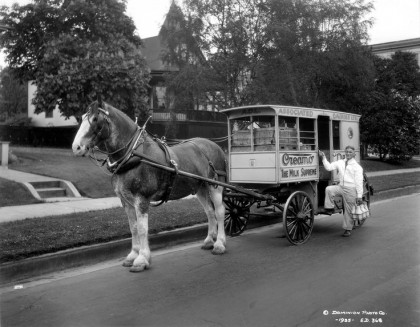
2018 needs to come to mind now if you still write checks. Remember checks? Charming pieces of paper with which old folks used to transfer money from their bank accounts to someone else’s? Dial phones. Black and white TV. Horse drawn milk delivery. Cars with fins. Poodle skirts and doo-wop.  Electric typewriters. (my personal obsession) Paper newspapers. Newspapers as delivery vehicles for the news.

Nostalgia? No. In most cases what we have now is an improvement, but it’s interesting to consider the cultural and technological distance between childhood and adulthood in any time period, I imagine. Might be an interesting academic discipline. How does the past look from an adult perspective? The gap between adult’s historical knowledge and their children’s immersion in their own time is always a source of entertainment at least.

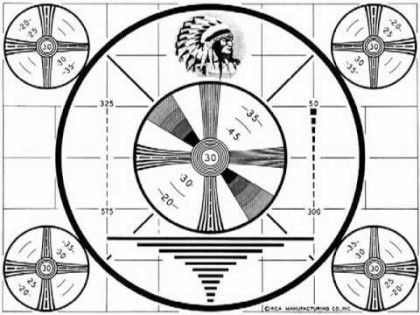
signoffMy grandmother called cars the machine. “Dad, would you get the machine and take the kids downtown?” We had Ray Carver whose horse drawn milk wagon survived into the late 1950’s. Television stations used to turn off for the night. Just had a conversation with some old friends about the sign off image with the Indian in an eagle feather headdress.

My childhood is vintage now and I have the images to prove it.