Category Archives: Bees

Bee Diary: Getting Ready for Extraction

Lughnasa                                                           Honey Moon

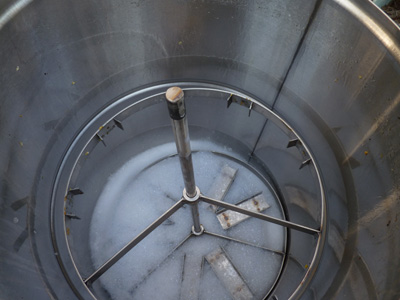
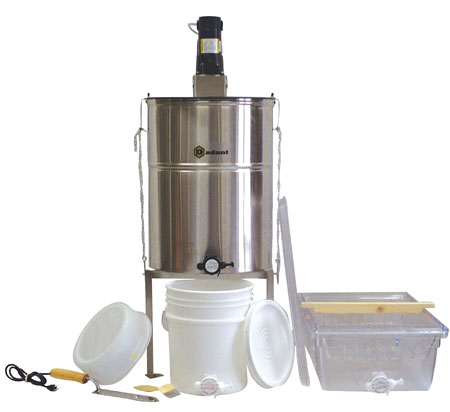
Everything has the dust washed off the extractor, the uncapping tub, the pail with the uncappingknifehoney gate, the three filters, the five gallon pails to hold the honey before bottling.  Kate has made cloth covers for the honey supers.  When I push the bees out with honey robber, I’ll put the supers on a pallet on a two-wheel dolly, then cover them so the bees don’t swarm back on the frames.
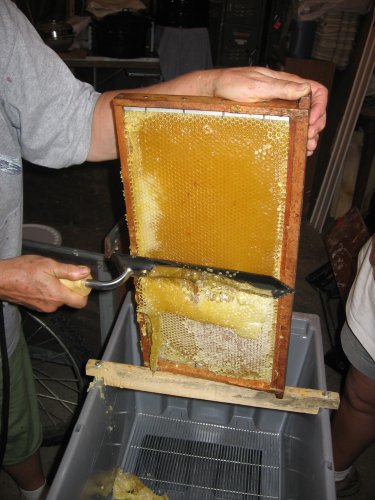
The kitchen will not look like itself for quite a while tomorrow.  Instead it will become our honey house with the extractor whirring, frames being uncapped with the hot knife, honey moving slowly through the filters, removing bee parts.  There is no way to extract honey without it making a mess.  The trick will be to have the mess end up on the plastic and the cardboard.

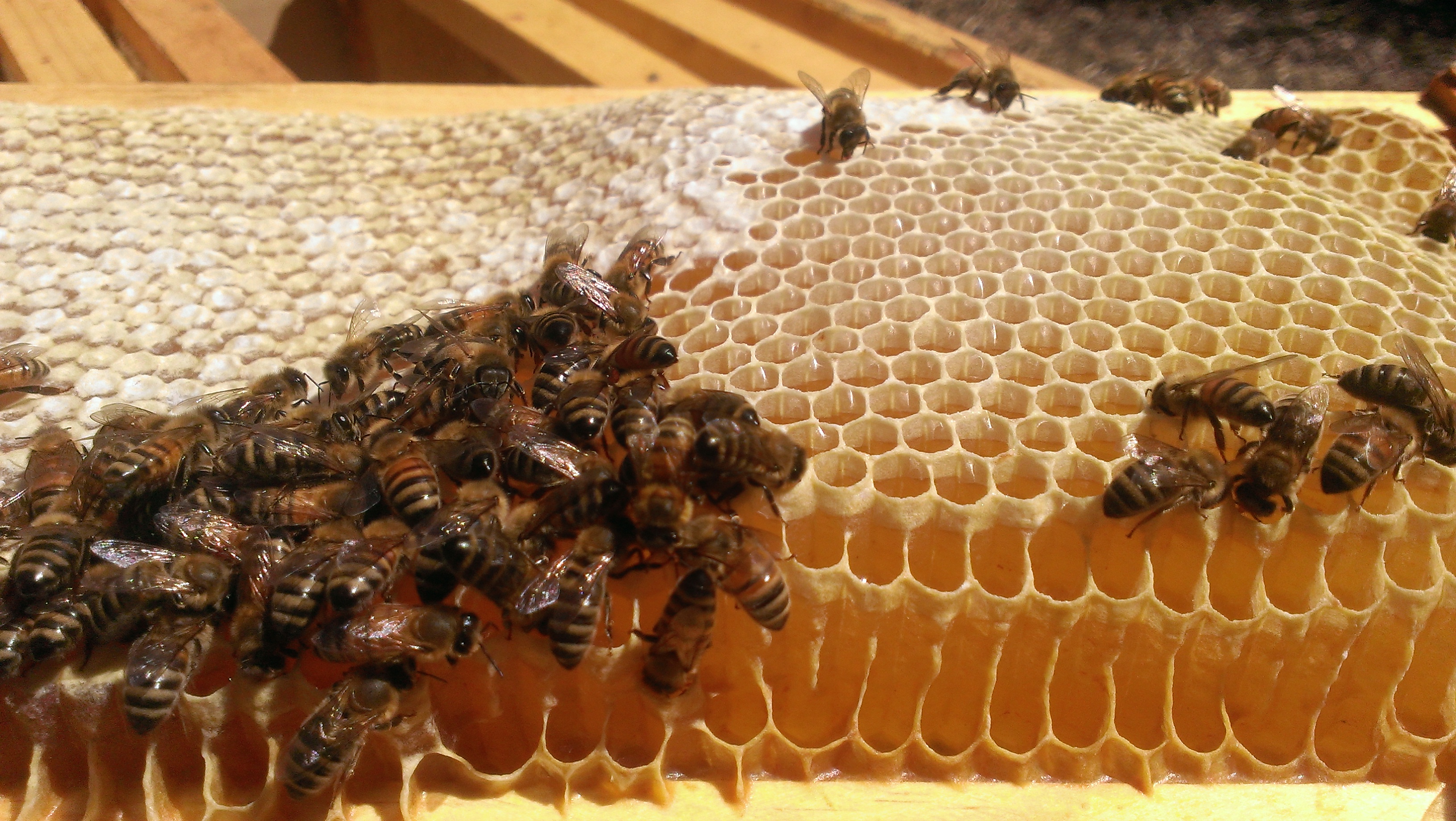
When we finish the extraction, we’ll still have honey in the uncapping tub since uncapping itself takes off some honey along with the cell’s white caps.  That honey has to separate out from the wax and that can take awhile.  The supers have to go back on the images (1)colony for cleaning.  The bees will clean them up, then they can be removed and stored for the winter.
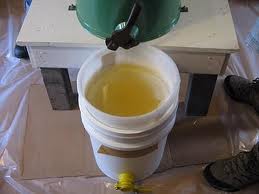
After we complete those steps, we’ll bottle honey using the five-gallon pail with the honey gate.  At some point later we’ll put on the Artemis honey labels.  Up to this point I’ve not learned how to work with the wax, but I plan to do that over the next few weeks.  I want to make candles.

Of course, the bee keeping doesn’t end with the honey extraction.  In fact, after I get the honey supers in the house, I still have to remove last weeks hopguard strips and put in this weeks, the final treatment.  This is for varroa mites.  Also, I’ll need to check, sometime in the next few weeks, the honey supply the colony has for the winter.  If it’s 400_Honey Extraction_0240inadequate, I’ll have to feed the colony to prepare them for winter.
There is yet more to do after that.  I have trees to cut down and brush to remove for the new bee yard.  Leveling out four colony bases and moving this colony back there will happen later in the fall or early winter.

My current plan is to have four colonies on a regular basis.    That means buying one more package next spring if this one overwinters and I can divide it.  In 2014 I would have three colonies, a parent, a divided colony and a package.  If I can maintain their health, then the parent colony will die, this year’s divide will divide in 2015 to form two colonies and the 2014 package will divide in 2015, getting me up to the four that I want to maintain.
 

Getting Ready

Lughnasa                                                              Honey Moon

We’re beginning to get ready for honey extraction on Wednesday.  Kate’s making cloth LW-Pwr-Extractor-covers for the honey supers today and tomorrow we’ll get all the extraction equipment out of the shed and into the kitchen.  There we will lay down cardboard and plastic, arrange the uncapping tub, the filters, the plastic 5 gallon pail with the honeygate and stabilize the extractor’s triangular metal stand on wood.  After setting up the extractor itself and getting a speed that doesn’t send it skittering over the kitchen floor, we’ll be ready for the next step on Wednesday.

On Wednesday, after a final reading of the refractometer on the uncapped honey, we’ll go ahead with all frames unless there is not enough capped honey.  If there isn’t, we’ll only extract from the capped frames and put uncapped frames back on and do them later.  The issue is the water content of the honey.  Honey has to have less than 18% water to be honey, otherwise it ferments.

More on the Wednesday process later.

The Family That Sprays Together

Lughnasa                                                               Honey Moon

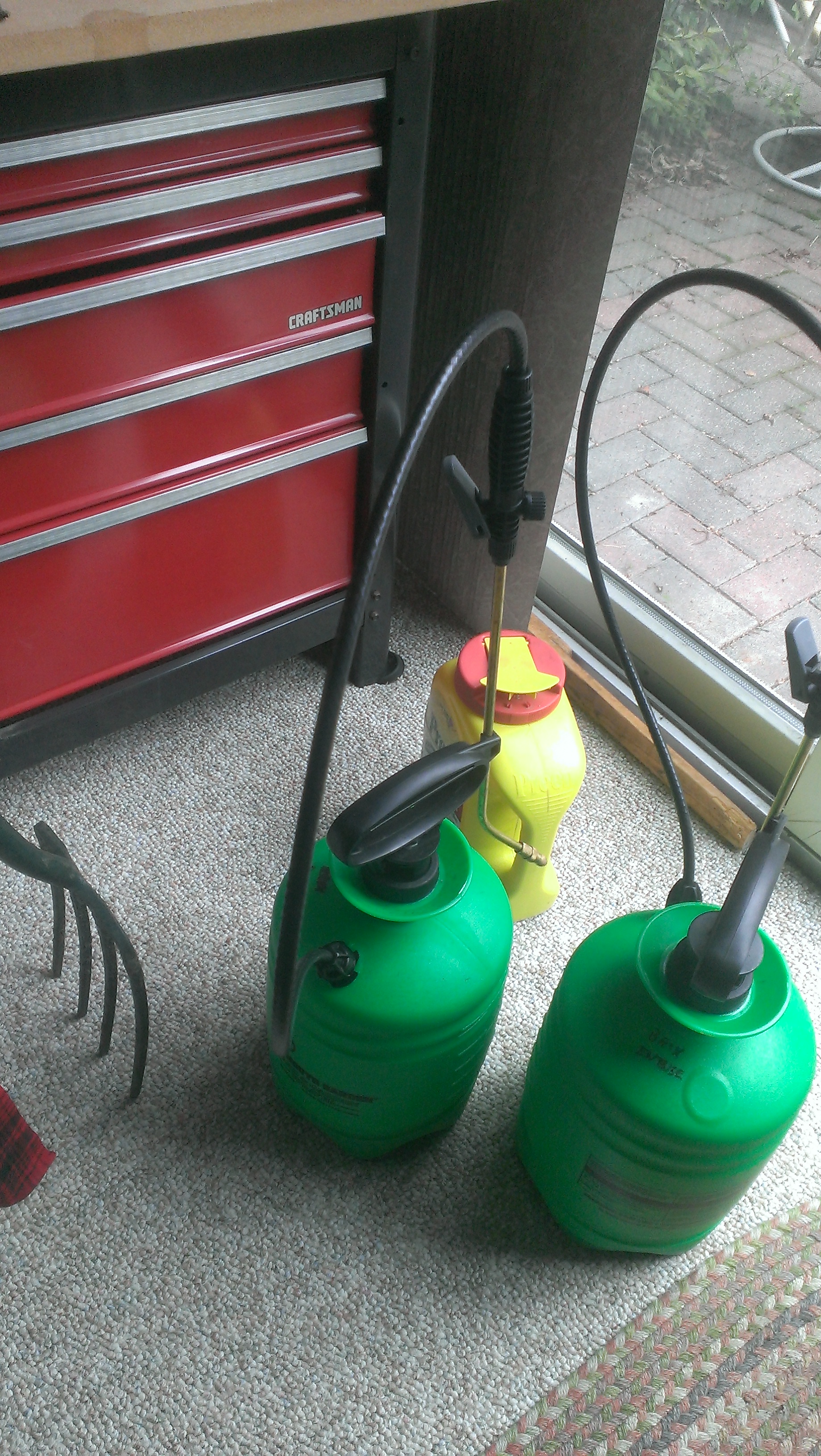
In what has become a Monday ritual I filled the green plastic sprayers with Qualify IMAG0762(vegetative) and Brix Blaster (reproductive) solutions and hit the garden well before 8 am.  There’s apparently something about plant physiology that makes between 4 am and 8 am the optimal time to spray.  The probability of me doing anything at 4 am is not high so I always run closer to 8.

After that I putzed around with Scrivener, trying to learn how to make the compiled version of Missing 3.1 look the way I want it to.  Compiling takes everything you have in a long document and gives it a uniform look and feel, chapter headings, font size, pagination, paragraph treatments.  It has a lot of parts and I don’t understand this aspect of the program as well I would like, but I finally got to a place I liked pretty well.

After printing out a single space version for Lonnie  Helgeson, I sent five pages to a copy editor for a sample rewrite.  He’s returned those pages already and I’ll review them tomorrow morning.


How Much Learning Can I Stand?

8/14/2013     Lughnasa                                                     Honey Moon

The upside is that, under all circumstances, I only have one more iteration of the hopguard, remove all honey supers task.  I hope that we can extract next Wednesday so I 400_Honey Extraction_0225will only have to remove the supers and then not replace them.  That would make the whole process easier.  The first two hopguard events left me, well, hopping and the bees buzzing.

I’ve decided I’m going to answer the Mod/Post-Mod question about Kant and then see how many I have to grade.  Writing answers to essay questions always clarified learning for me, so I’ll put the effort in on all 8 of them, just don’t know whether I want to spend the time grading.

P.S. written on 8/15.  In fact I’ve decided against answering the question.  I’m going to take the course as an audit.  I feel a little guilty about this because I know the way to integrate the material best is to write about it, but I’ve got too much else happening right now to do a good job.  There will be other courses and other chances to write.

Man Plans, Gravity Disposes

8/14/2013  Lughnasa                                                           Honey Moon

So.  It was going well.  The refractometer reported 19% water content in uncapped honey, too high and expected.  That was from the second honey super of six.  I had my plank IMAG0708across two upended trash cans that I used last time.  My ergonomics were better.  Lowering with my right arm.  All six supers, each with some weight now, maybe 5 total full or close to full were on the plank.  I got the hopguard strips out and had removed last week’s strips from the top hive box when I heard a noise.  Uh oh.

My temporary super holding plank had shifted and all six honey supers hit the ground.  Wow.  A lot of angry bees.  This is where I came in last week.  The difference this week?  I had a sweat band on so I could see out of both eyes and I had used the long beekeeper gloves with the sleeve that goes up to the shoulder of the suit.  Thank god.

The only stings I got this time were on my right ankle and I smoked them right away, dispersing the “sting again, right here!!!!” pheromones.  That left me free to contemplate the huge, sticky mess.  One thing at a time.  I decided I would finish the hopguard strips on the three hive boxes since I had to do it and I had begun.  So I did.

After the last hopguard strip went on, I moved over to the six tipped over supers.  Three I righted with a gloved handle on the top of the frames.  No problem.  Two supers I had to set aside and reinstall their frames one by one, turning them right side up as I did.  The last one though must have caught another super.  The super now sat at an angle.  That required a new one altogether.  Of which I have plenty. After grabbing that one from the garage and replacing the frames into it, I began lifting the supers back on to the stack.  Not easy because of their weight, but it got done.

Now, inside, I’m glad there’s only one more iteration of this process.  If I weren’t doing this mite treatment, I wouldn’t need to be doing all this lifting and moving, but I am, so I do.  Hopefully most of the honey will be capped next week, which means that it’s automatically below 18% since that’s when the bees cap it.  That will mean I can remove the supers for honey extraction and not have to put them back on.

Calibration

8/14/2013   Lughnasa                                                                                      Honey Moon

Cool weather.  Presents an interesting problem.    Honey has to have less than 18% water content to qualify as honey.  To measure this a refractometer is necessary.  I bought one.  It needs calibration; but, there’s a hitch today, the temperature.  The temperature has to be 68 degrees.  Won’t hit that until 11:00 am according to my weather websites.  I want to check the honey at 10.  On August 14th this is an issue?

I’m picking plums this morning, then I’ll do the refractometer test of the honey, after which I will, again, remove all six honey supers, remove the hopguard strips I placed last week and replace them with new ones.  My plan is better this week.  I have a desire to avoid the hassle of last week’s battle with an angry superorganism.  Aversive conditioning really does work.

Check you after it’s all over.

The Honey Moon

8/11/2013  Lughnasa                                                    Honey Moon

BTW:  I don’t change moon names mid-month but when I realized this was the honey extraction moon I decided to go ahead.  Honey Moon is too good to pass up.

Finished moving limbs in the prairie grass area this morning.  In matters related to trees I have experience.  I learned long ago that if you line up the limbs in the same direction and pull them all together so that their branching parts follow the cut ends, moving them is easy.  If you don’t do it that way, you’re in for a frustrating time.  Of course, chipping them is the usual practice, but I like building up brush piles for critters and I’ve done that as the default option for years.  Not to say I haven’t chipped.  I have, but only when the amount was considerable.  Wasn’t the case this morning.

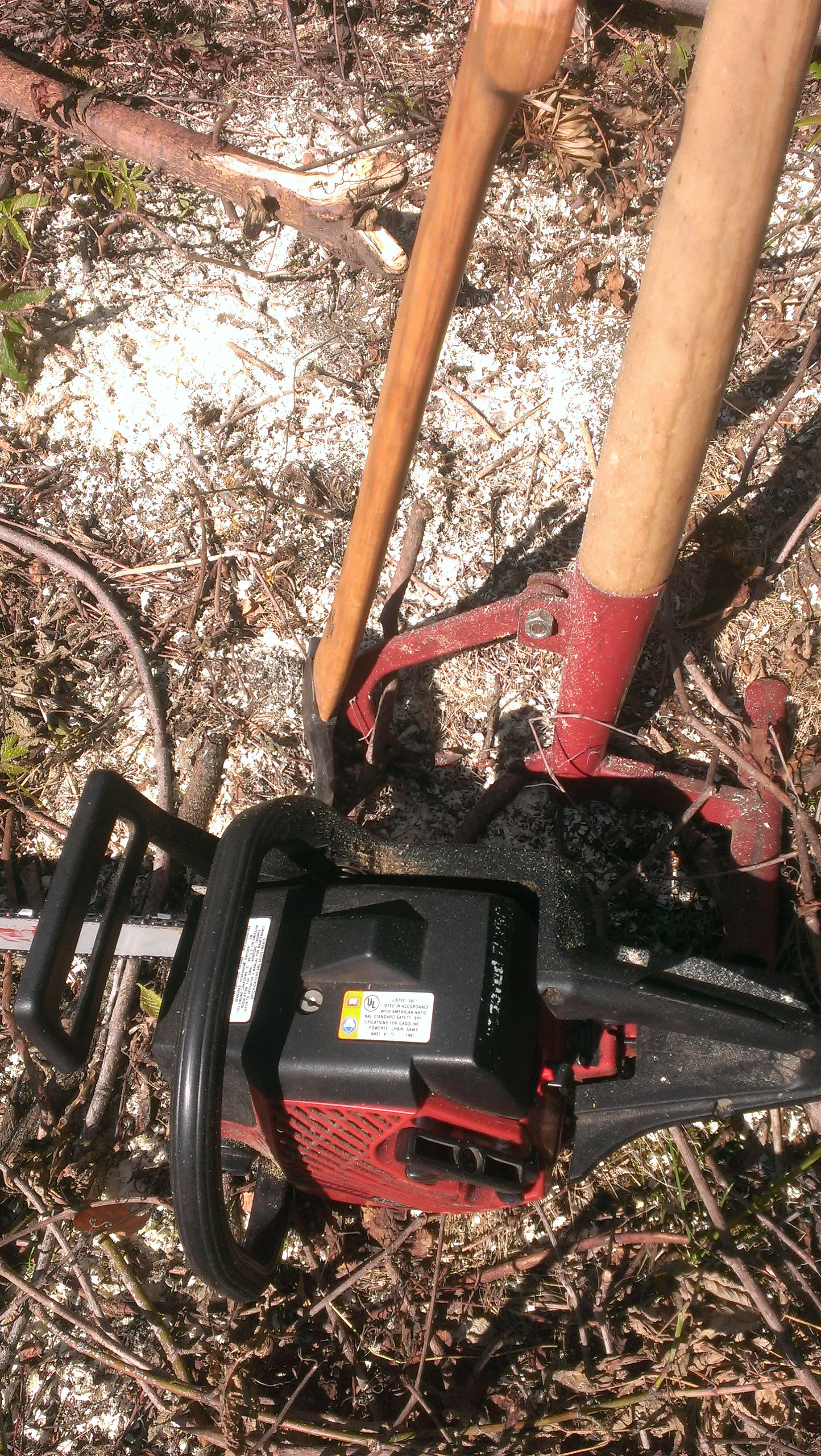
This project involved cutting down several ash trees and saplings that I had let grow up in the prairie grass area.  They had begun to shade the orchard and it was time for them to IMAG0746come down.  Past time, really.  I cut the trees down with the felling axe and limbed them with the limbing axe, but I used the chain saw to cut the trunks into logs.  The big pruners, 2 foot plus handles, allowed me to take out the amur maple saplings, too.  That area is now back to its original purpose, prairie grass and wild flowers.

Still plan to loaf today.  Sort of.  In my loafing I’m reading Madame Bovary and I finished the Communist Manifesto yesterday.  They’re both for my Modern/Post-Modern MOOC.  The guy who’s teaching it, Michael Roth, is the president of Wesleyan University and a scholar of French thought.  That makes the bias French thought, the touchstone he keeps coming back to in his examples and the source of several of the readings.  Though I took French in high school, I’ve not kept up with it and matters French have not figured significantly in my education, having a more English/German bias myself.  Gives this course a different feel for me and I like it.  But.  It’s not convincing me so far.

Extraction Plans

8/10/2013                         Lughnasa                                                 State Fair Moon

Honey extraction coming up on August 20/21.  We’re going to get ready on that Tuesday, IMAG0705which means cardboard on the kitchen floor and plastic all over, too.  It also means bolting our extractor stand to a piece of plywood with 2×4 lengths nailed to it for the stand’s braces, getting the uncapping tank set up and all the filters and bottling equipment cleaned out and ready for action.

On Wednesday I’ll begin by using honey robber to move the bees out of the honey super, one super at a time.  This involves putting a bit of a chemical on a felt backing contained in a super-sized wooden box and putting that box over the super.  This drives the bees down and allows me to get a bee free super off and onto a pallet I’ll have waiting on my truck dolly.  I’ll repeat this six times, covering the stack of supers each time I add a super to keep the bees away.

Once all six supers are off, I’ll wheel them into the garage and carry them, still covered, into the kitchen.  Kate will have the uncapping knife warmed up and will start uncapping.  When we have six frames uncapped, they’ll go in the extractor where they will spin as centrifugal force pulls the honey out of the comb.  This process continues until all frames, as many as 54, certainly 40, have the honey drained from them.  That’s when filtering and bottling begins.  A big process, lots of steps, but easier each time we’ve done it.  Practice makes lots of bottled honey.

After all this, of course, there’s selling it.  This is going to be a crop well beyond our needs so getting some cash out of it to defray the considerable money we’ve already sunk into bee-keeping makes sense.


Bee Diary: 8/7/2013

Lughnasa                                                                State Fair Moon

Oh.  My.  Just came back from a wrestling match with an angry superorganism.  Bill Schmidt noticed the height of my tower ‘a honey and wondered about wind knocking it over, but the height produces another kind of problem as well.  A happy problem in the end, but a sweat inducing, sting evoking problem in the here and now.

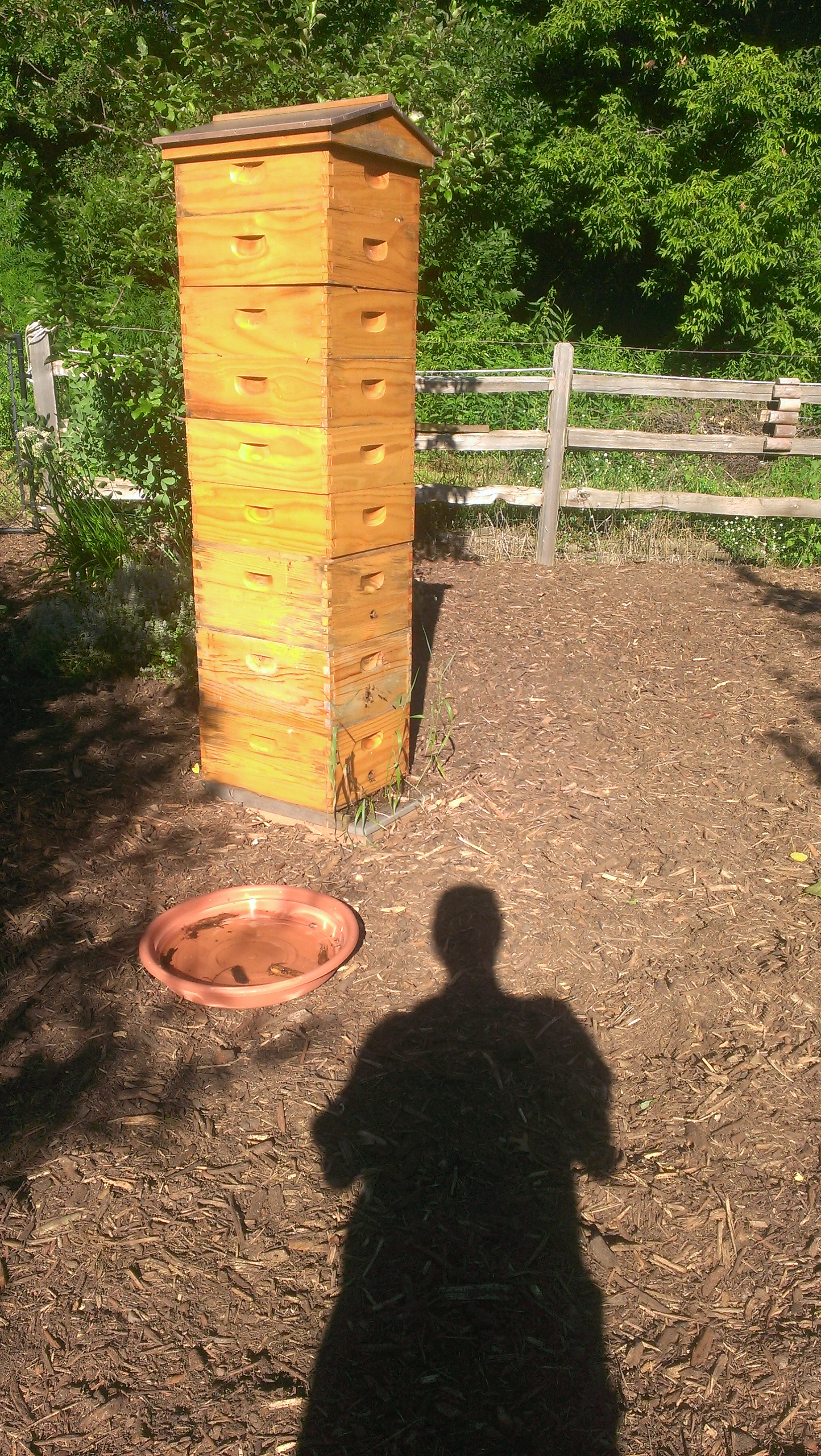
Out of 6 honey supers on top of the three hive boxes, four are full.  Honey, basically water, weighs more than 8.5 pounds per gallon.  Each of these full supers weighs in close to 50 pounds. Therein the happy and the sad of it.

The happy is 200 pounds of honey!  The sad is lifting 200 pounds of honey!  Plus some.

Here’s the deal.  The recommendation is to treat for mites and to do it now in August, with the honey supers on.  That means using a food grade miticide, one that won’t harm the honey in any way.  Which means less potent.  Which is good as far as I’m concerned.  The idea is that we rid the colony of mites in August, then the brood turns over after the nectar flow and produces mite free bees for overwintering.  Mites reduce the bees capacity to overwinter.  By a lot.

So.  O.K.  I decided yes. I’ll do that.  When I went to buy the one treatment and done product, miteaway, my dealer was out.  He had instead hopguard.  Hopguard requires two strips in each of three hiveboxes (the big ones on the bottom that hold the colony and its honey stores for the winter).  That’s one week’s treatment and the full treatment requires three weeks.

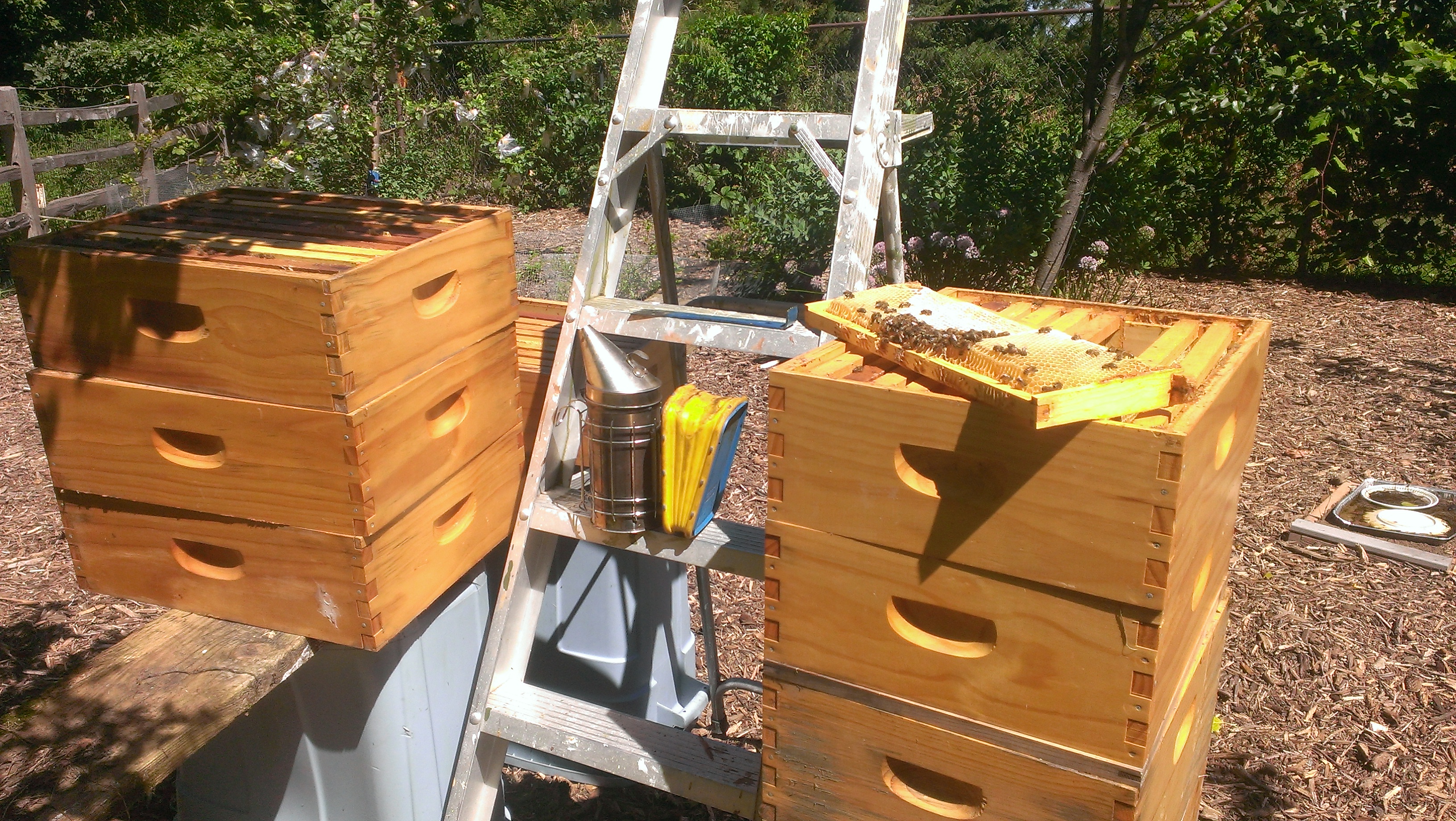
(taken today and the point of all this hooha)

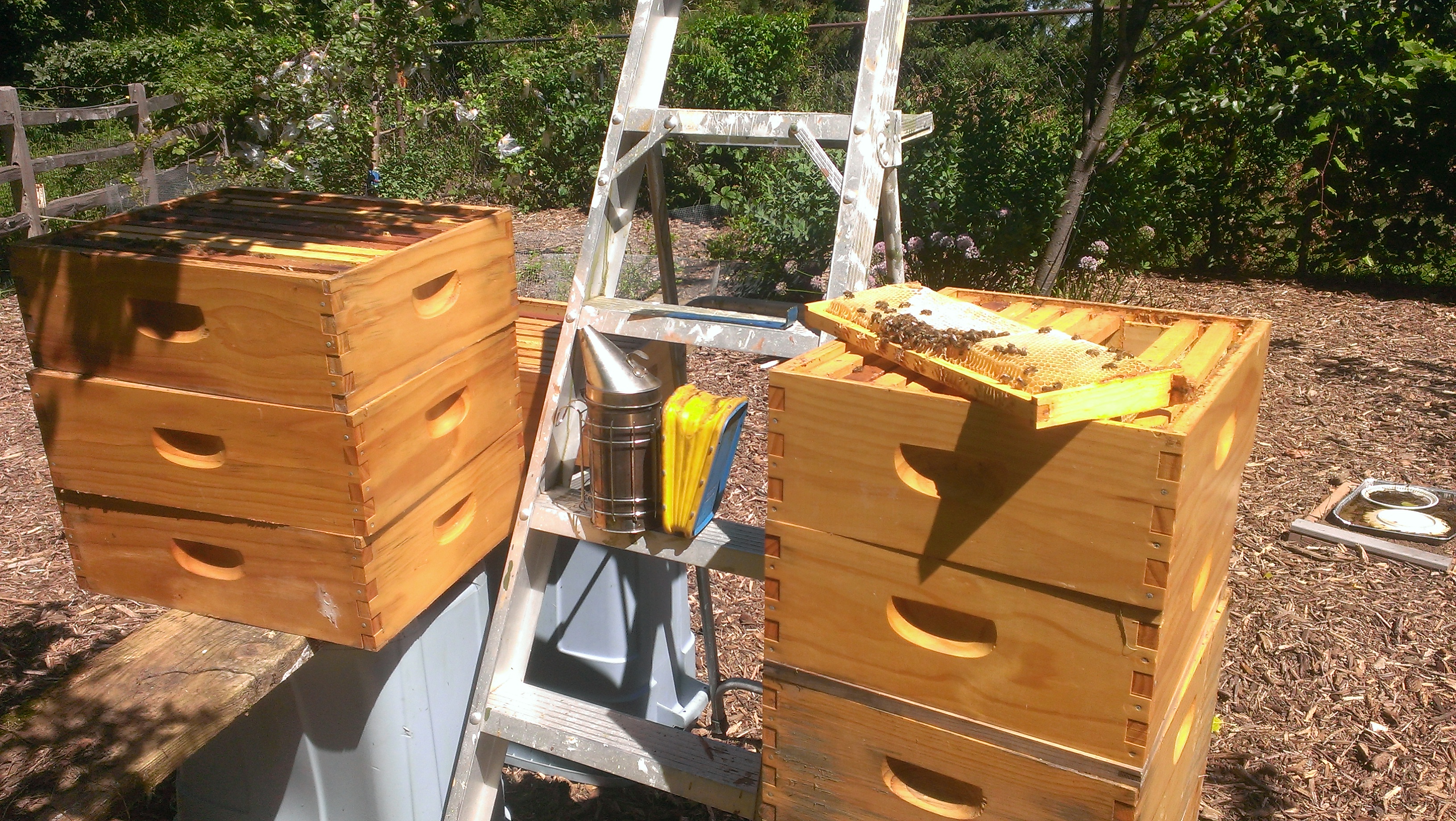
Now we get to the problem.  Each of those honey supers has to come off and sit somewhere while I put the hopguard strips in the hiveboxes.  So, that’s 200+ pounds off and set aside.  It also means moving two of the three hiveboxes off and back on.  They weigh substantially more than a full honey super.

Thanks to the Canadian leakage as Paul Douglas calls it the weather is about as good as it’s reasonable to expect:  70 degrees with a dewpoint of 50.  But.  By the time I finished schlepping honey supers the sweat had begun to run.  Down into my eyes.

Physically moving these boxes is right at or a bit more than I can do easily.  That’s ok, for the most part, but it does mean that I can’t make the slow, deliberate motions that keep the bees calm. So, by the time I got to the hiveboxes I couldn’t see out of one eye and had to squat and lift with my legs to budge them.  I’m not even going to mention the slippery hopguard strips that would not slide easily between the frames.

(an improvised super holding device.  also taken today)

Anyhow, I got all that done, got the honey supers back on and was feeling good.  Until I saw the queen excluder resting on the hiveboxes.  The queen excluder goes between the hiveboxes and the honey supers to prevent the queen from laying eggs in the supers.  Oh. My.  You can insert here words you use when you realize you have shot yourself in your own foot.

That’s right.  I now had to remove the supers a second time, put on the queen excluder and put them all back on again.  Well, that’s all done and finished until next Wednesday.  When I do it all over again.  Except, I hope, for that queen excluder part.