Category Archives: Great Wheel

It Forces Me Into the Present

60  bar steady 30.03 0mph NNW dew-pooint 54  sunrise 6:06  sunset 8:31  Lughnasa

First Quarter of the Corn Moon    moonrise 1219  moonset 2200

If you’ve ever wondered why I put all this weather and astronomical data first, good question.  The immediate answer is because I can.  My weather station gives me all the top line data with the exception of the Celtic calendar period, but I know those by heart now.  The moon names fascinate me so I have several lists of names from all the over world, and I choose one that feels right for the next month.  The lists that usually have the one I want are the Celtic, medieval English, and neo-Pagan, although I always feel a little strange with the last one because I don’t understand the roots.  The moonrise and moonset I got from a Naval Observatory website that creates a list for your location.

The secondary answer lies in weather history.  When I read back over my entries, I want to know what the conditions were like on the day in question.  Again, you ask, why?  Sometimes for gardening reasons.  Sometimes to jog my memory.  Sometimes just for fun.

The tertiary answer, though it may be the primary one, is this: it forces me into the present, right down to the temperature and barometric readings.  I like the reminder that this moment is this moment and no other.  Right now is right now.

Kate’s in Denver.  The dogs are asleep and the HD box has a so-so sci-fi movie on record so I can finish when and if I want.

A wonderful night and a good looking day tomorrow.  See you then.

Hoosier Bodhisattvas

79  bar steady 29.85 5mph NNW dew-point  67  sunrise 6:02 sunset 8:35  Lughnasa

Waxing Crescent of the Corn Moon

“What happens to a dream deferred? / Does it dry up / like a raisin in the sun?” – Langston Hughes

To continue the raisin metaphor the next line might include the fact that raisins are nutritious and can, with adequate moisture, grow plump once again.

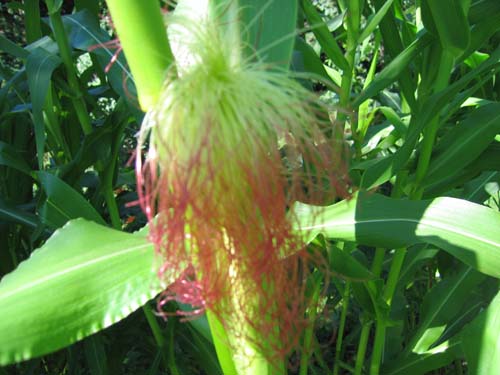
The corn tasseled out last week late and tiny ears of Country Gentlemen have begun to form.  The corn stalks soar an elegant, but seemingly fragile 7 to 8 feet above the garden bed.  Though there are only three rows and the rows extend only 8 feet or so in length, still it calls up all those corn fields of my youth, green jungles that flashed by as we drove on   crushed gravel roads, spreading a fine chalky dust behind us.  There was, in that time, a union between the maturity of the corn and our maturity, both green, filled with promise, but not yet ready for the harvest.  Corn, of course, has a shorter life span than most teenagers, but some of my Alexandria classmates were dead soon after our senior year, their maturation hastened by the fertilizer of war.

Though those afternoons and nights are long ago, 43 years at least, the marriage between my faith and the earth finds its true roots there.  The farms around home and the 4-H fair in late July gave the life of the land a prominence even to those of us who lived in town.  The sheds at the fair had rows of corn, tomatoes, beans, beets and cucumbers among many others, set out for the judges to assess.  Not the judgments, but the pride and the reality of these fruits imprinted on me those Madison County fields and the seasons through which they passed.

The family farm outside Morristown, which I visited and on which I stayed from time to time as a boy, had the same effect.  The corn shed with its slanted, open sides filled with the hard yellow ears of field corn had a mystery to me.  This shed found late fall and winter made one, the harvest stored for later use.  I loved the cool moisture of the concrete pools that held the milk pails until the milk truck came.  This was like a Celtic holy well, a place where the water burbled up from the ground, plentiful and free.  In the late summer the hay mow would have bale after bale of alfalfa hay, sweet and pleasant.

Below the hay mow the Holsteins would stand patiently waiting to be milked, their placid ways suggesting a Hoosier Bodhisattva.

Not far down the road, visible from the hill on which the Keaton family home stands even today, is Hancock Cemetery. There the harvest of generations of Keatons and Zikes lay, row by row, in family groups.  Not all that different from the hay mow in late summer.

Teasing Out the Pagan Lovesong

76  bar rises 29.89  0mph NE dew-point 67  sunrise 6:02 sunset 8:35  Lughnasa

Waxing Crescent of the Corn Moon

I saw the dentist today, oh boy.  He unscrewed a couple of fillings, refilled them, then closed what he insists on calling an “open contact.”  Does that sound like an oxymoron to you?  Does to me.  Dr. Mahler comes into my mouth unbidden, the occasion the retirement of the redoubtable Dr. Moghk, may he golf in peace.  Dr. Mahler is good, fast and communicative.  Sure of himself. Just what I want in a dentist.  No, seriously.  He’s a keeper.

The closing words of my last post have rung like a bell in my head since I wrote them:   This whole enterprise needs a rethink, a radical redo.  We have gotten thin and liberal, instead of profound and prophetic.

What to do? Part of the responsibility rests with me.  I have the task of articulating what I believe and have faith in right now.  This articulation must be clear and emotionally compelling.  And it is work I feel I can do, am ready to do.  Looks like I was off about ten years when I hoped for intellectual maturity in my early 50’s, it has come instead, in my early 60’s.  That’s all right.

The later maturity came because my individuation and maturation occurred more slowly than it might have thanks to alcohol and neurosis.  I regret the years I gave to anger, disappointment, drinking and smoking.  I regret the hurt I caused then and the overhang it left me.  Even so, I also know that regret is an emotion with no purpose, no forward motion, so I acknowledge it and set it to the side.  Today, the only time I have ever had and will ever have, is the day in which I take up this challenge, perhaps I could have ten years ago, but I didn’t.

Now it remains for me to tease out the pagan lovesong that courses through me when I  touch a lily or eat an onion grown in soil I have prepared.  There is an ancient language of love and awe for the natural world and for ourselves as part of and dependent on it.  This vocabulary of seasons, lunar changes, life’s stages, friendship and family has no nation, knows no creeds and depends on no books, yet it is as particular as the street on which you live and the air that you breathe.

This dream, what Thomas Berry called the Dream of the Earth, is a dream in the sense of the aboriginal dreamtime, it is a way of dreaming worlds into being and it is our great and primary gift as a species.  Like all gifts it can cause great good or great harm.   Over the next few years I will slip from time to time into the dreamtime and let you know what I find there.

Primal Eating

71  bar rises 29.87 0mph NE dew-point 58  sunrise 6:00  sunset 8:38 Lughnasa

New (Corn) Moon

A vegetarian meal  tonight.  Spaghetti squash, golden beets, cucumber tomato and onion salad and cooked whole onion.  Colorful and healthy.  All but the tomatoes were from our garden, including the garlic and cilantro sauteed in olive oil as a dressing for the squash.  After the OMG tomatoes the plants have settled into production with many fruits, but none mature right now.

I know some perhaps many of you who read this cook things straight out of your garden or meat from your stock, but I haven’t done it much.  Flowers and shade plants, shrubs and trees have occupied my time.  I love them and will always tend them but the vegetables now have my attention.

Primal eating happens when you go pluck five beets out of the earth, take them into the sink and wash them off, trim the leaves and roots away, then slice these hardy roots into smaller pieces, add tarragon and balsamic vinegar, some salt, cook and eat them.  The same tonight with the spaghetti squash, the cucumber, the onion, both in the salad and the one I cooked whole.   I knew these plants when they were tiny seeds, barely bigger than the lead in a pencil or when they were small potted specimens.  The onions and the garlic went into the ground as what they would become, only larger.  In each case though the same hands that harvested them prepared for eating.

10,000 years ago some hunters and gatherers first planted seeds and tended crops.  The effect on human culture still gathers momentum even today.  Nomadic life began to disappear for those people.  Settled villages sprang up around the fields.   The keeping of animals for food was more predictable than the hunt.  In both cases though our ancestors had to give up the moving from place to place depending on season and game patterns.  Our bodies, developed in the paleolithic to survive predators and hunt for prey, found themselves out of place.

They still do.  So, while gathering and cooking goes far back in our history, it does not go all the way back to that earlier phase of the moveable feast.  This fall, however, when Kate and I pick wild grapes that grow in our woods and turn them into jam we will travel back to those ancient times, the ancient trail of seeking food where it decides to be rather than where we care for it.

This meal tonight was a Lughnasa meal, a meal of first fruits, the harvest we do not plan to store either through drying or canning.  As a Lughnasa meal, it put us in contact with those early Celts whose gardens might spell the difference between survival and starvation.  We live in a wealthier time, but not in one any less dependent on the gifts of mother earth.

A Bell That Cannot Be Unrung

61  bar rises 29.87  0mph N dew-point 53  sunrise 5:59  sunset 8:39  Lughnasa

New (Corn) Moon

Outside tonight the sky has no moon.  This illustrates the paradoxical nature of light.  We think of light as illumination enabling us to see, but it has another, not often recognized property; it can obscure as well as reveal.   The night sky during the dark moon shines with stars, many invisible when the moon is brightest.  A cool night with a clear sky, a panoply of stars, ancient messages from faraway places gives a northern summer its true character.  Able to burn with heat in the daytime, the northern summer can cool down, remind us of the coming fall, just as Lughnasa, the Celtic first fruits holy day does.  A convergence of a new moon, Lughnasa and cooling temperatures make this a night made for myth.

The research for Heresy Moves West will probably end tomorrow.  I hope I can get at writing, too, but I doubt it.  Sunday.  This is a big task, one I set for myself, but I’d like to get a first draft done, so I can set it aside for awhile.  I have Stefan’s poems to edit and the Africa tour, too.  Not to mention a firepit to dig, hemerocallis iris and lilium to move.

A piece of this project troubles me.  Maybe troubles is not the right word, provokes, that could be it.  When Channing and the others split from the Standing Order Calvinist orthodoxy in New England, they started a cascade of controversy that has not ended.  Not long after the Unitarians had left the congregationalists behind, Emerson began writing his essays and giving his lectures.  With the strong push Transcendentalism got from Theodore Parker, there was soon a split over natural religion versus theistic religion.  The Civil War obscured this problem for the first half of the 1860’s, but it re-emerged as the Western issue as the more radical, Parkerite ministers began to dominate the Western Unitarian Conference.  This led to constant conflict with Eastern conservatives (used to denote those who wanted to retain Jesus as Christ, keeping Unitarianism’s original perception of itself as liberal Christianity).  The Free Religious Association and The Ethical Culture movement kept the Western issue alive in the east.  This split healed with a broad understanding of liberal religion, only to be sundered again in the 1920’s with the rise of humanism.  Humanism set aside theism for good in the interest of a scientific and humanistic approach to the ethical life.

Here’s the problem.  Conservatives predicted the gradual erosion of religious sentiment if there was not at least the glue of Jesus to hold the center.  Their predictions came true as the shift away from theism took its incremental, but, looking backward, inevitable progress toward an essentially secular movement focused on ethical living.  This leaves the field free for radical inquiry into the nature of the human experience.  A great, not small thing.

But, it can lose the faith that burns in the heart, that seeks the reality next to or beyond this reality; it can lose it in the same kind of scientistic move that linguistic analysis made, that Richard Dawkins and Sam Harris make.  It is, though, a bell that cannot be unrung, so we must seek this faith that burns in the heart elsewhere than in tradition.  Good.  Emerson thought so, too.  The question is, where?

Investigating this question will occupy some time, perhaps the next few years.

When I went out to check the drying onions, I found one with a bit of a soft spot.  I brought it inside to cut up for a salad for lunch.  Cut open I put my fingers on the white flesh.  It was very warm, almost hot.  That drying would take place inside the onion had not occurred to me.

Radical Expectations

86  bar falls 29.66 3mph N  dew-point 59  sunrise 5:56 sunset 8:42 Summer

Waning Crescent of the Thunder Moon

Lughnasa, August 1st, comes on a new moon night.  This means the first harvest festival of the Celtic year (it ends just before the last harvest festival on October 31st, Samhain.) will coincide with the dark moon.  In some pagan systems the new moon, the dark moon, is a time for introspection, for reflection.  It is a time to consider your life, to meditate and consider new beginnings.  This convergence of Lughnasa and the new moon may make for an interesting holiday.  Look to the Great Wheel posting on August 1st for some thoughts and a description of our celebration in the garden here at home.

Tonight is the second Sierra Club political committee meeting.  More endorsement work and consideration of targets for the up coming election.  I can’t talk about the details, but the political work makes a certain part of me thrum.

Speaking of cycles and elections the fall campaign has begun already.  Obama visited Europe and the Middle East.  McCain visited a German restaurant.   No kidding.  Look it up.  While my broad political sympathies lie with the Obama camp, my particular politics seem distant from the tug and pull of rhetoric which focuses on tax cuts and forcing people to buy medical insurance.  Where are the poor?  The disadvantaged?  The environment does seem to have traction in this race, part of the reason I decided to go with the Sierra Club work, but even there the radical, cut to the true bottom of an issue and deal with that, hears only faint echoes of itself.

Of course, expecting radical solutions from a political/economic system devoted to moderate policy initiatives, policy initiatives often vetted by the very industries and political interests targeted by them, remains, as it always has, an exercise in futility.  I know that.  I see it.  I feel it in my gut.

Which begs the question, why work within it?  Unlike those long ago days of movement politics drugs sex and rock and roll I sense no significant political minority roused.  The environmental advocates, who, if any, should be advancing with some power right now, seem fragmented.  In a moment without a vanguard and in a moment without a popular, even if disorganized, front clambering for change the politics of most use happen within the messy gears of our quasi-democratic process.

Even Though It’s Still July

71  bar steady 29.87  0mph ENE dew-point 62  Summer, wonderful

Full Thunder Moon

The color:  deep red, pale yellow, pink, mauve, orange, red, virgin white, flame pink with a burnt orange throat,white with a pink throat.  Scents ethereal as they are ephemeral.  The true lilies and the day lilies are in bloom.  A chaos of color.

The true lilies have a bloom architecture clean, sweeping, grand.  They have colors with hues so intense they can make the heart dance.  These are the regnant plants of this garden and this is their time.

Here’s the problem with putting stuff in writing:

“We will also finish creation of a fire-pit, family gathering area begun last fall.  These will be finished by the August date of my meeting.”  from my Woolly project notes.

Kate dug this up yesterday and reminded me of this commitment.  Sigh.  The one aspect of gardening that seems always to drain from consciousness is the July slump.  Not much gardening gets done by me in this month.  It’s too hot, too many bugs and I’ve usually worked way more than I intended in May and June.

In July I begin to need indoor time, book time and writing time.  By August things have become marginally cooler, I’ve satisfied the reading itch though probably not the writing and the bugs become tolerable.  August and September, sometimes in to mid-October can be intense gardening, too.

All this means I sometimes (always) project more completion than I will realize.   Even so, I want to finish the fire-pit, family gathering area, too.  I have not told Kate that I intend to rent the stump grinder this Wednesday, but I do.  That will clear out the roots I found lacing the fire pit hole last fall as I dug.  After some weeding, moving some sand and rock and cutting up a few logs for seats around the fire, the fire pit will be done by August 18th.  That’s the date of my Woolly meeting and Kate’s 64th birthday.

Maybe I’ll go out there right now and start pulling weeds.  Even though it’s still July.

Writing Makes Its Own Space

66  bar steady 29.79  3mph NNW dew-point 63  Summer night, rainy day

Full Thunder Moon

We had rain and storm, tornado warning and tornado watch.  A full thunder moon day.  The rain poured down, drenching the lily blooms, forming small rivers on the wide leaves of the acorn squash.  While I read the first chapter of the book on the Western Unitarian Conference, the rain drained from the sky and onto the azalea, the begonia, the several amarylis and a bed full of hosta.  Reading a good book while it rains or snows pleases me, makes me feel at home, in place.

Kate harvested beans tonight, a few onions, too.  I used the onions with some beets I bought at Festival, delicious.  We also had a few early sugar snap peas and wax beans.  Some fish.  Some pasta with pesto made from hydroponic basil.  An evening meal.

Kate works this weekend, as she does every other weekend.  Ten days in a row, a long stretch, but she likes the four days off it gives her.  We pretend she’s retired on those days.

The Minnesota UU history piece has begun to take shape, get bones.  When there is a subject matter to master before I write, it usually takes me a while before I get a gestalt, a feel for the whole.  Once I have that I know where I need more information, or that I do not.  At that point I can sit down and write, usually in one setting.  A few days later, after its cold, I go back, reread and edit, revise.  Then I’ll put it away until I need to present it.

This one has been a bit unusual in that history requires a certain precision and accuracy with details, chronological sequence, names and places.  This means the material that I use to illustrate and make my points must get reordered to fit my needs, yet remain accurate and true.   It’s part of what I love about this kind of work.

When I have this kind of work, it pushes out everything else.  The writing work makes its own space in my life, creates openings and time for itself.  Just like this blog.  It happens each day, two to three times a day and often I do not recall having written here.  The breadcrumbs, though, are there, laid down in words and postings.

A Deere John Article

66  bar rises 29.91 0mph N dew-point 56  Summer night, cooler

Full Thunder Moon

I went out tonight for a bit of moon viewing.  I’ve always thought a moon-watching deck would make a nice addition to the property.   We don’t have one so I stood in the driveway, watching the moon while Lady, the brittany next door, howled at me (instead of the moon).

This moon rides low in the sky, just below the tree tops, so I had to walk almost to the end of our driveway until I could see it free and clear of the treeline.  It is a polished coin of a moon, bright and sparkling in the sky, a moonstone on jeweler’s velvet.  A night out well rewarded.

From tonight’s Washington Post

Deere John: It’s Been Good Knowing You
Lawn Behemoths Are Going Out to Pasture “The riding lawn mower has long been a barometer of the American dream, been a symbol of having arrived in the suburban middle class. It says, “I have so much lawn to mow, I need to sit down.”

It says, I’ve made it, I’ve escaped that funky old rowhouse neighborhood with the asbestos siding and yards like dirt-scabs. My land, my spread, not enough to plow, but way too much to mow the old-fashioned way. It says, I’m Jefferson’s dream of the yeoman farmer. It says, I’m rich enough to not only raise a worthless crop, but to pay money for the privilege. It says, I’m a boy with a boy’s rightful toys; a real American man.

Or that’s what it said back when city dwellers would gather around the riding mowers at the old Hechinger north of Capitol Hill, and dream the dream.

Now it’s saying something else. It may be a measure of the forces lined up against us. The riding mower seems to be on the wrong end of every headline. If economic news — from gas prices to shrinking nest eggs — is like the magnifying glass focused by an 8-year-old to fry a bug with sunlight, riding mowers are the bug.

The news: The riding mower industry “is deeply troubled by the decline in housing starts,” says Kris Kiser, spokesman for the Outdoor Power Equipment Institute in Alexandria. “New home construction is a good barometer for us. But you add foreclosures, decline in housing starts and the decline in housing sales, and you have the trifecta.””

Dehn’s 4 Seasons, the lawn appliance store where we bought our chain saw, our riding mower, our snow blower and super charged weed whacker closed up shop and didn’t alert us at all.  I drove by there one day a few weeks ago and the place was empty.  Capitalism’s creative destruction is at it again.

Imagine Your Soul Traveling on a Lambent Beam

69  bar rises 29.85  0mph NE dew-point 68  Summer night with a full moon, steamy beautiful

Full Thunder Moon

Five of us sit down every 4 to 5 weeks or so and play sheepshead.  This is a game, as I’ve said before, peculiar to eastern Wisconsin and there among the German community where it is also known as schotskopf.  Sheepshead is the thin glue that gives us an excuse to sit together, laugh and be amused at the spectacle of ourselves.

As I grow older, it is these close gatherings of friends that provide the social cohesion I need.  My needs may be less than most, but they are not non-existent.  These men, all save me variously Catholic, from not anymore to still engaged in the work, have wry, knowing attitudes toward life, attentive to the ridiculous and the tender.  I am more when I return than when I left.

And something to be said for the moon.  A perfect circle, silvered white and suspended in the sky with stars and planets gathered round.  On the nights of the full moon the dark opens its arms to secret pacts, whispered love and the breath of Diana, huntress and defender of the forest.

Take a moment and step outside, stand under the Full Thunder Moon and let it shine on you.  Imagine your soul traveling on a lambent beam to the moon and back, gazing down toward the spinning blue globe as you come home.  This dance of the planets and their satellites around the greater gravity of Sol creates and destroys.  Shiva Nataraja.

Amen.