Category Archives: US History

Obey

Fall                                                                                      Falling Leaves Moon


Students in Jefferson County, Colorado and Hong Kong reacted strongly against authoritarian regimes that would limit the teaching of history and studies focused on the homeland. This is no accident. Children and teens are acutely aware of the BS factor in adult pronouncements. They learn some of that at home no doubt, matching parents words with their deeds, but school authorities often say one thing and do another. Kids always notice. Sometimes, like reasonable human beings, they dismiss it, probably saying something like, adults will be adults, but sometimes they notice a danger to their future, perhaps even to the adult’s future.

Especially when governments, the schoolboard in the instance of Jefferson County and Beijing in the instance of Hong Kong, try to shape teaching to conform to their own ends. In Jefferson County the schoolboard wanted a more “patriotic” curriculum that emphasized the values of free enterprise and loyalty. They also wanted a curriculum that downplayed the role of protest and other civil disobedience in the shaping of American history. In Hong Kong the movement led by Joshua Wong wanted public decision making in who would be chief executive of Hong Kong. They also opposed a moral and national educational program* that had critics among Hong Kong teachers, just like Jefferson County.

Children know that their birthright is a world in which they have a voice, in which their decisions and choices matter, in which the information on which they make those choices is as unbiased as possible. In particular they oppose bias by so called “authorities.” Why? Because children instinctively know that authority shapes reality for its own purposes.

As we grow older, we become that authority. If we are wise and can remember our own youth, we will listen to the voice of the young when they say, “I’m calling bullshit on that.”


*”The “China Model National Conditions Teaching Manual”, published by the National Education Services Centre under government fundings, was found to be biased towards the Communist Party of China and the so-called “China model“. The teaching manual called the Communist Party an “advanced, selfless and united ruling group” (進步、無私與團結的執政集團), while denouncing Democratic and Republican Parties of the United States as a “fierce inter-party rivalry [that] makes the people suffer”” analysis by teachers, from Wikipedia

Love it or leave it

Lughnasa                                                                          College Moon

Cool nights. I’m enjoying these. A great advantage of mountain living is that most nights are cool nights. Looking forward to that. Also, realized that after we move Coming Down the Mountain will take on a new meaning in our life.

The push this week is getting things ready to make efficient use of the SortTossPack folks. A major emphasis will be sorting art, objet d’arts, souvenirs, all that stuff that hangs around because it got set down long ago and never moved. This is the love it or leave it sort.

Which reminds me of a conversation with Tom Crane at the War Memorial during the Woolly Meeting last week.  Pondering the weirdness around patriotism, the notion that the only patriots were veterans and flag wavers. I said, yes, and recalled the 60’s when the love it or leave it bumper stickers pretended to sort out the patriotic, worthy of citizenship folks from those of us with long hair and in opposition to the Vietnam War.

Love of country does not equate to love of government and pride in all its decisions. Nor does it equate to love of the economic system that sorts folks into the 1% and the 99%. Love of country has many roots and more than one flower.

With a son in the military I appreciate the dedication and sacrifice those who serve in the armed forces make, even in peace time. That some in the country want to remember and honor those who serve seems like a natural impulse to me. Most nations have needed warriors over the millennia and they are often the difference between freedom and servitude.

But, the warriors in our country serve at the discretion and for the policies of our elected officials. This means that the work they do passes through the sausage works of politics before it comes to marching orders. Not all wars (most wars?) are just. Thus, it is not reasonable to conflate opposition to war, or to a particular war, with opposition to the military per se.

The love I feel for my nation has three main sources: the people as a collective, the nobility of our experiment and the vast diversity of the land itself. Though we become separated by distance, by values, by history, by future potential each person in our nation is my fellow citizen, a person whose rights and responsibilities I respect.

This great experiment, whether a people with roots in other lands can flourish as one country, is a noble one because it represents in microcosm the world. The fact that our history has many regional, ethnic, even religious conflicts does not take away from the experiment, rather it underwrites it. Can we live with and grow together in spite of the depth of our differences? That a nation can persist, can become great under such circumstances is hopeful.

Finally, this land that is our land. The oceans and their shores. The rivers and lakes. Old mountains like the Appalachians and young vibrant mountains like the Rockies. Vast areas of level fertile soil in a humid climate. Even vaster areas of thin, rocky soil in arid climates. The forests and the wildlife, the farms and the ranches. The wild places and the domesticated. It is a wonder and a full lifetime, even two full lifetimes would not be enough to explore it.

It is this combination of people, political purpose and powerful geography that makes me love where I was born and where I will die. The good old U.S.A.


A Man, A Monument

Lughnasa                                                            College Moon

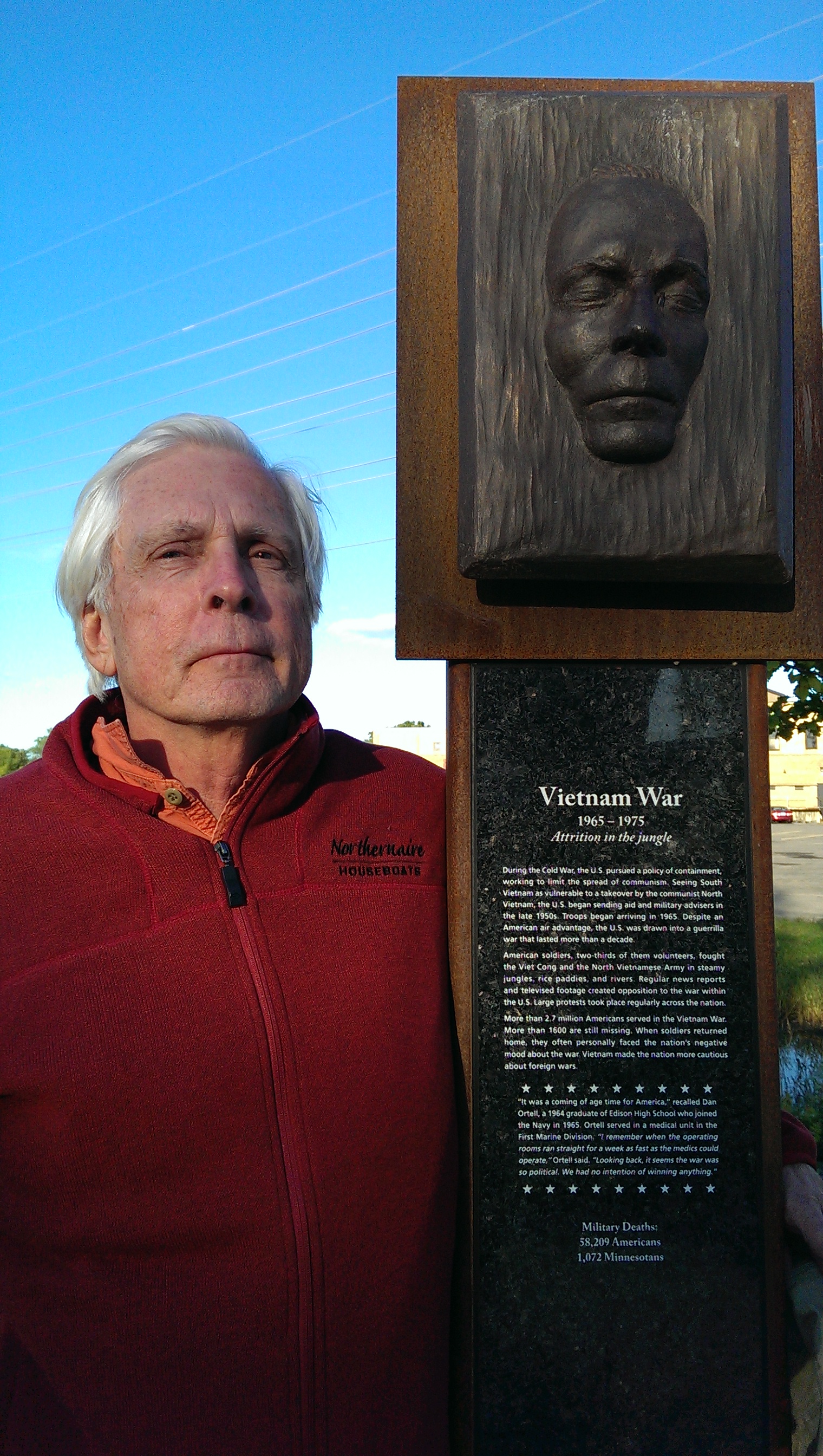
IMAG0657Third Monday of the month. It’s been the Woolly meeting night for years, over 25. Bill Schmidt suggested we visit a memorial related to war, a memorial in a neighborhood park in northeast Minneapolis, right on the Mississippi behind the old Grain Belt Brewery and its wonderful castles of yellow brick. The memorial is in an odd, very out of the way location, almost as if its hidden. And it is a monument to the effect one man can have on history.

That one man is Woolly Mark Odegard, a Vietnam War Veteran, who became part of this project and as part of it shaped its content in important ways. When the group gathered to consider it began, all the veterans wanted to honor the war and their service. This is after all the public script about how to notice veterans. We honor the historical event, the war, and their participation in the war. But Mark knew there was more beneath the public script.

When probed, the veterans admitted that war was ugly, painful and often confusing. Mark said the monument should show that side of war, too. He got this element added by interviewing veterans from various wars and putting their quotes on marble stelae along with historical facts about the war. Commenting on the Spanish-American War one man said, when the fighting against the Filipino’s began he realized the war “was about greed.” Unusual and telling language at a war memorial.

Each stelae is a slab of black granite with text acid etched into it and a face above it IMAG0661bronzed from living subjects, when possible veterans from the wars memorialized. Mark suggested that the monument start with the Dakota war in 1862 since that was the first war with Minnesotans serving. To particularize it further Mark suggested that the stelae have the number of Americans who died and the number of Minnesotans.

(Mark next to the Vietnam War stelae topped by his face in bronze.)

This monument will be in place for a long, long time and Mark’s effort to personalize war through the words of veterans will bring an element of realism to a too often romanticized human endeavor.


Cities built on Vesuvius

Lughnasa                                                                          College Moon

War is a terrible act. It marshals the forces and treasure and precious lives of foes into a bloody knuckle, don’t stop till the last soldier is down fog. Intentions, plans and often nations disappear in that fog and sometimes never re-emerge. Yet Barak Obama, the get-us-out of Iraq and Afghanistan president, is about to have his Woodrow Wilson moment.

My wife is a pacifist, my son a manager of war planes in battle. I’m an anti-Vietnam war era foreign policy realist who recognizes the anarchy existing at the level of nation-states. The always combustible atmosphere of geo-politics is even more flammable in the Middle East where oil and playing with matches has become the third millennial Great Game.

Add to that a world-defining struggle between Enlightenment rationalists and those who inhabit the caves which still project a dead God’s shadow (see post below) and we may be living during a world historical turning point. The irony, of course, is huge. We fight those inflamed by their commitment to a desert storm god not only because they harass us with bombings and public beheadings, but because their god’s realm includes the very fuel we need to continue poisoning the climate in which we all have to live.

This is a struggle between the god-drunk and those who live the dangerous life in which “knowledge (has) finally (stretched) out her hand for that which belongs to her: she means to rule and possess, and you with her!” We are out-numbered and out-flanked as the Chinese dragon grows stronger every day. What could possibly be more dangerous than this life? And, if we follow Nietzsche, “the most fruitful and enjoyable.”

As this blog says in its tagline, Welcome to the journey.


Unasked Questions

Lughnasa                                                                   College Moon

A project, perhaps the smooth beast rising from the deeps, keeps coming at me, jostling me, prodding me to imagine it into being. I’m not ready to go all the way there yet so let me set down a few bars, perhaps really only a jumble of notes not yet ordered by staff and clef.

1. American art. Here would be American works that found their muse in the West as it came to be in the minds of a young country. Here the work of the Hudson River School, the Ash-can School, Wyeth, Homer and Hopper, even Ed Ruscha, artists whose work clawed away at the truth underneath the bones of American life and culture. Warhol and Pollock and Rothko, too. Morris Louis. Photographers like Anself Adams and Walker Evans and Diane Arbus and Cindy Sherman and Edward Weston. Seeking the American through our art.

2. American music: jazz, Copland, Gershwin, Ives. Seeking the American in our music. Seeking the sounds that issue from the various rivers that make us an ocean.

3. American thinkers like the American Renaissance, like Dewey and James, Wills and Veblen, DuBois and Douglas. What is our manner of thought, our direction? Our ideas that tear away at the fabric of this country, peaking behind it, looking for its connective tissue.

4. American literature: Melville, Emerson, Hawthorne, Twain, Poe, Lovecraft, not just the luminaries here, but the dark lights, too. Probing, seeking for the through line from the first immigrants to the most recent, how they wove their lives together. Sinclair Lewis, Sherwood Anderson, Theodore Dreiser.

Poets yes, of course. Whitman, Silliman, Dickinson, Moore, Oliver, Berry, White, Collins…a long, long line of persons using words as scalpels to flense the fat off the American soul and leave it bloody, but bared

These are the source material, the Americanness. And yes, I need more women and yes, I need more variety, but this is a long project, perhaps the last project, one focused on who we say, show, play that we are. Theater is not there in the list. Neither is invention. Nor war. Nor democracy. Nor politicians. Nor sport. Probably should be.

This is too nebulous, too diffuse, too broad. In danger of being too shallow, too thin on the ground to matter. Maybe so. Or, maybe it’s just a search for the roots of my Self, its American roots. Not sure yet, like I said.

That Other Brutal Atrocity

Lughnasa                                                                    College Moon

On the other brutal atrocity. America’s death row. The release of the two brothers in North Carolina, after 30 years on death row, only adds to the growing list of miscarriages discovered before the fact of execution: 146 since 1973. Death Penalty Information Project. The same source of information found ten cases in the same time period where there were grave doubts about the executed person’s guilt.

While the barbarity of severing a living man’s head with a hunting knife is self-evident, frying someone on an electric chair, poisoning them with cyanide, hanging them so their neck breaks, shooting them with rifles or that mockery of medical procedures, lethal injection on a Naugahyde cross is on the same continuum, not a “more humane” method, just a different method.

It’s important to see the log in our own eye as well as the log in that of ISIS. We do not come to them with clean hands or pure hearts. We too are compromised and fall short of the glory that could be the human race. This is not to point to a particular solution for either one, but simply to call out the truth.

Positive Signs

Summer                                                             Most Heat Moon

Some positive signs. News about climate change has gone from whether to when, how much and what do we do. Though this is a fight that will require joint effort beyond anything I’ve seen short of a war, the U.S. can lead if it finds the will. A change in the public opinion atmosphere, in this case, may lead to a change in the less gaseous atmosphere.

Another. News reports have begun to notice inner city America. Again. Urban poverty became prevalent long before climate change arose. Roman and Chinese cities in ancient times already grappled with its problems. Over the course of my life urban issues have had their cycles, reaching a zenith during the Presidency of Lyndon Johnson and his Great Cities programs.

Today’s Star-Tribune has an article that grazes the issue written by Chicago Tribune conservative Steve Chapman who quotes Ta-Nehisi Coates of the Atlantic.  This link to the Atlantic collects several of Coates’ fine essays on urban America, particularly urban black America with a focus on Chicago. He’s making a case for reparations, that is, some form of restitution for all those effected by chattel slavery. Well worth reading.

Cities and their issues were the focus of my professional and political life. It’s heartening to me to see these matters beginning to take up space in various media. The amount of human heartache and the egregious loss of raw talent occasioned through urban poverty is stupefying.

May both climate change and urban poverty see more of our combined attention over the next few decades. They both need it. (Another bit on the intractability of urban poverty later.)

On the Run

Summer                                                                   Most Heat Moon

Started a new book last night, On the Run, by Alice Goffman, a recently graduated sociologist Ph.D.  Her father was Erving Goffman, also a sociologist. You may be familiar with his work on social interactions. For example, in a work on human interaction he observed that the amount of space people need when conversing while standing differs by culture.

On the Run recounts Alice’s 7 years of living in a poor black neighborhood of Philadelphia, but recounts it from a sociological perspective. I’ll write more about this as I get into it, but I wanted to note two things I’ve learned already. Things that disturb me quite a bit.

First, in the introduction she cites devastating statistics about the incarceration of black males. This one really got me. 60% of black males who don’t finish high school end up in jail. 60%!

Second, she remarks on a coincidence that’s been staring us in the face for a long, long time, but is even more devastating. The rise of tough-against-crime legislation and the war on drugs-both of which are primary drivers in what one sociologist calls “mass incarceration”-began in the 1970’s. This is the period just after the passage in 1964 of the Civil Rights Act and the victories of the civil rights movement. Think about those two things together. They should give you pause.

More later.

Never Again

Summer                                                              Most Heat Moon

Patriot. Or not? If patriotism is a libertarian in a tri-foil hat, Revolutionary musket slung over her shoulder and ready to hunt elephants, then I’m not one. If patriotism is a flag-waving, bible-thumping, climate change denier, then I’m not one. If patriotism is a Love or Leave It bumper sticker and an NRA decal on the back window, then I’m not one.

If patriotism is a swell in the heart when, on returning from a trip abroad, a customs officer says, “Welcome home.”, then, yes, I’m a patriot. If patriotism is a love of this land in all its geographic and geological diversity, then I’m a patriot. If patriotism is a belief in equality, not only before the law, but within society, then I’m a patriot. If patriotism is a belief in the shared journey of those who live in this nation, then I’m a patriot.

I am a patriot and I claim this day as a celebration of my nation, one committed to justice, to fairness, to equality, to brotherhood and sisterhood among all peoples. We cannot allow the nativists and the bigots and the chauvinists and the jingoists to be the only ones who love this country and stand up and say so. After the 60’s, I said never again would be that true. Never again.

American?

Summer                                                                Most Heat Moon

As the fourth of July spreads around us like Adirondack chairs scattered on a vast green lawn and the coming night brings the promise of fireworks, Andover has that casual, up at the lake feel. Motorcyclists went by on Harley’s earlier, flags whipping behind them. Here and there bicyclists go for a daytime ride. It’s America.

Octavio Paz tried to find the Mexican identity in his “Labyrinth of Solitude.”  The land we now call Mexico was already inhabited by complex civilizations like the Mexica and the Maya as well as numerous smaller groups of indigenous peoples. In Oaxaca state alone there are 250 languages. When the conquistadors came, they began a process of suppression and assimilation that, in Paz’s view, obscured and/or erased indigenous identity and conquistador identity alike. Given that the stock of both had given way in the mix, what was a Mexican? Who was a Mexican?

In the United States the process has been different. The land was bigger, the native population smaller and the clash between native and colonist much more about suppression than assimilation. Too, continuing waves of immigration, including the importation of enslaved Africans, caused assimilation to occur more among groups of immigrants, rather than between colonists and indigenous peoples. The numbers of immigrants, as well as the size of the United States, led, also, to large enough immigrant communities where assimilation could be staved off for a long time, and perhaps avoided altogether, at least in the Mexican sense.

So, we now have a country not based so much on the melting of one group into another, Mexico is a much better instance of the so-called melting pot, but of different peoples from many lands living under the same political and legal roof. In Chinatowns throughout the country thousands of American citizens, maybe millions, live their daily life speaking Mandarin or Cantonese, working in Chinese restaurants, retail establishments and in general conducting their lives within a cultural context more Chinese than Western. Yet they are Americans as much as I am. The same with the Hmong. African-Americans, though stripped away from their original cultures long ago, have created a strong sub-culture of their own and many if not most of them live within it totally. Yet, they too are as American as I am.

Then there is the strong stream, ironically, of Latin immigrants, most from Mexico, who not only live their lives here speaking Spanish, shopping in bodegas, celebrating quinceaneras and attending Mass or visiting botanicas, but have begun to assimilate us, reshaping certain cities toward a more Latinized culture. This is a process that will continue. Up here in white, Scandinavian and German Minnesota, all of this can seem quaint, even a touch exotic, but Minnesota too is being transformed, now by waves of immigrants from the Sudan, Ethiopia and Eritrea.  Thousands of these Africans, not enslaved, never enslaved, come here with their culture’s intact, but when they raise their hand and pledge allegiance to the United States of America, at that point they, too, are as American as I am.

We are unusual in our commitment to integrating many races, many ethnic origins, many religious beliefs under one flag. Even though there are certainly countries with more internal diversity than we have, India for example, we are the one country committed to making ourselves a nation of others. Even though we go through waves of nativism-badly mistaken as we are all boat people except for the natives-we do take in people in large numbers and often they are as Emma Lazarus wrote:

“…your tired, your poor,
Your huddled masses yearning to breathe free,
The wretched refuse of your teeming shore.
Send these, the homeless, tempest-tost to me…”

I’m not a flag-waver, not hardly, but I have come to appreciate the unique and precious nature of this experiment we call the U.S.A. I’m proud to be an American.