Beltane Mountain Moon
Kim Stanley Robinson: Red, Blue, Green Mars meet the proposal.

Beltane Mountain Moon
Kim Stanley Robinson: Red, Blue, Green Mars meet the proposal.
Beltane Mountain Moon

On Sunday I reached some sort of odd apotheosis, presenting a series of video lectures on the Dead Sea Scrolls at Beth Evergreen. In the audience of 20, larger than I had expected, were 4 people from Idaho Springs and Georgetown, Christians invited by a biblical scholar who is a member of Beth Evergreen. That meant that in answering some of their questions, even haltingly because I don’t know the field very well, I, still an ordained Presbyterian clergy, represented a Jewish perspective to Christians on subject matter that altered both faith traditions. Weird.
It could have been better. Two weeks ago I checked out the A/V setup I would use. Though I had a DVD, my laptop, a Lenovo has no DVD player. Not a problem because I could stream the lectures off the Great Courses’ website. The link to the synagogue’s wifi was fine, as was the hdmi link to the projector set in the ceiling. Rabbi Jamie and I fussed around with the sound board, unfamiliar to me, linking the computer to it. We did get the sound to work and I thought I had it down. Turns out I missed a key move on powering up the sound board.
Kate and I got to Beth Evergreen at 1:15 since she had agreed to handle the food (which she did in typical splendid fashion) and I wanted to have time for tables and for making sure my setup would deliver. With some satisfaction I soon had the lecture displayed on the screen. But. No sound. Hmmm. I have plenty of time, that’s why I came early.
After looking carefully at the soundboard, being sure it connected to the hdmi feed, a few people began to show up. Uh oh. I really had to get this to work. Finding the power buttons, I got the sound board to light up, but still no sound at the screen. It’s been a long time since I got sweaty palms, but I did on Sunday. Folks kept coming. I kept having no sound. It was ten till 2, the start time, and being an unreconstructed Northern European the thought of starting late literally made me sweat.
 I had to call Alan Rubin, a new Beth Evergreen friend, who is the A/V sage. He said he was sitting by his pool enjoying the weather. It was a blue sky, white cloud, warm but not hot, Colorado day. After some false starts, Alan isolated the problem, I poked a button and, right at 2, the sound. Whew.
 However. All this meant I had not had time to arrange the tables for folks to take notes, so they sat in chairs looking up at the screen. I also had not given sufficient thought to the pedagogy of the afternoon. How would we interact? What questions might prompt discussion? The fact that everyone faced front rather than seeing each other across a table made getting a conversation started difficult. Though I don’t think the audience cared, I’d hoped for a more interactive event and I didn’t facilitate that.
This was the first of what we hope to be many more online type offerings by the adult education committee, so I’ll get a chance to get better at it.
Sunday’s session anticipated a May 20th trip to the Denver Museum of Nature and Science for a tour of the Dead Sea Scroll exhibit currently there. Russ Arnold, Rabbi Jamie’s brother and professor of religion at Regis University, Denver, will lead the tour.
Beltane Mountain Moon
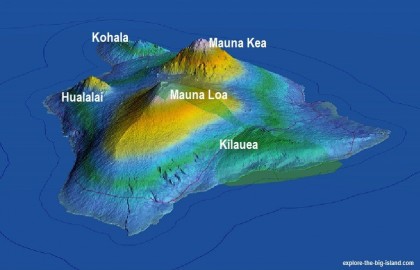
Volcanoes of the Big Island
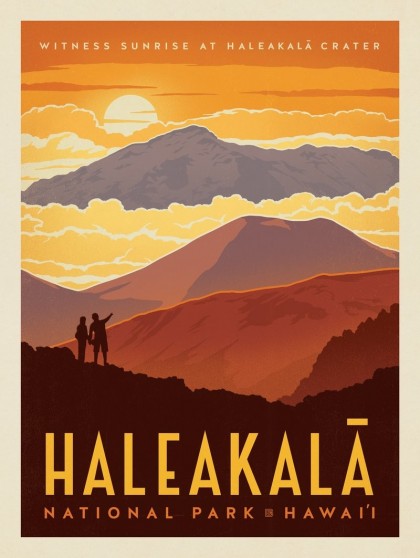 In the month of the Mountain Moon Kilauea has reminded me that my interest in mountains precedes the Rockies. My first mountain driving experience was Haleakala on Maui. I learned there that you don’t have to brake going up, take your foot off the accelerator and the mountain takes care of you.
Haleakala means house of the sun and on one of our trips to Maui I did the tourist thing of seeing the sunrise on Haleakala. As we rode in the small van around 4 a.m., the skies were cloudy, rushing across the island, allowing the full moon to become visible, then blocking it out. Even though we were on Maui, a tropical paradise, the early morning temperatures on Haleakala’s summit, 10,023 feet, were cold and windy. Black Mountain, visible from my window here in the loft, is 10,731 feet.
 Hawai’i put vulcanology on my oh this fascinates me list. On a visit to the big island, Hawai’i, we drove the Highway east out of Kona, traversing first Hualalai, which sits just above Kona, then Mauna Loa, the long volcano, and finally, climbing up the eastern flank of Mauna Loa we went past Kilauea. We did not go in that day, driving on to Hilo town. On our way back, later that evening, we drove along the southern flank of Mauna Loa again, the air scented by gardenias and jasmine.
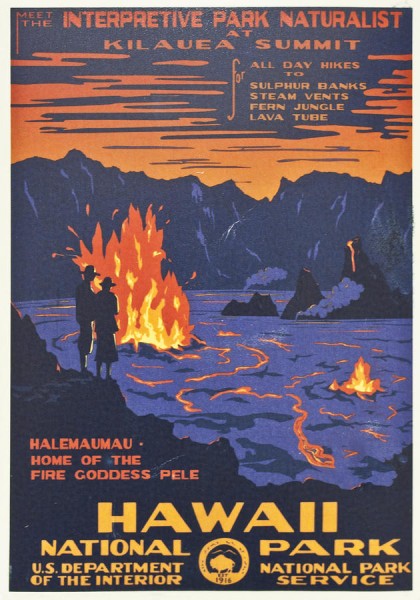
In 1999 we visited the Big Island again, this time staying in Volcanoes National Park at Volcano House. We were there for two weeks. Learning the language of volcanoes was easy there: fumaroles, vents, calderas, pahoehoe, ropy undulating lava, and aa, fragmented sharp blocky lava, lava tubes, magma, magma chambers, and the home of Pele, Halemaʻumaʻu Crater. (see poster above)
Hiking a long path around the summit, walking on lava flows where the Pu’u O’o vent added to the land mass of the Big Island, exploring inside now drained lava tubs with ferns growing from the ceilings and reading about volcanoes gave me both an experiential and intellectual immersion. I’ve followed Kilauea off and on since then and the news coming out of the Big Island has me riveted.
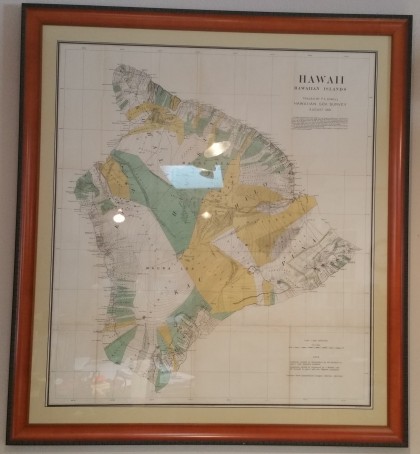 Maps. Kate bought me this wonderful vintage map of the Big Island. It now hangs in a prominent position here in the loft, reminding me of many adventures including our stay at Volcano House. Kilauea is in the yellow portion of the map that extends south to the Pacific and butts up against the large swath of green in the middle. The new eruptions are in the eastern, white segment that extends to the north from the point where Kilauea meets the Pacific. This is Kilauea’s eastern rift zone*. People building there knew about the rift zone, but hoped it wouldn’t affect them, much like we hope our location in the Wildlife Urban Interface, WUI, won’t result in our home burning down. Mother Nature gives no passes for human hopes however. She decides when and where things happen, according to her own laws.
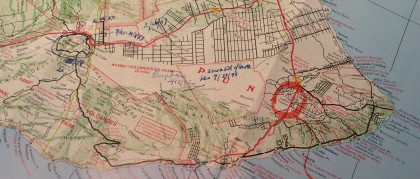 Over years of travel I have purchased maps and annotated them. I did this especially in Hawai’i where we visited often while Kate practiced. It is a popular location for continuing medical education. Each time we visited I would mark where we had gone, the date, sometimes a brief note though the longer explanations were in my notebooks. We spent time on Maui, Hawai’i, and Kaua’i, enjoying all of them in turn. Each has their particular charms.
The section of my Big Island map above shows the eastern rift zone area with our 1999 visit marked by the black circle in the upper left and the current eruptions in the Leilani estates circled in orange. The Lo’ihi seamount, the latest island of the Hawai’ian archipelago forming beneath the sea, is just south of the shoreline shown here. It’s the volcano that is most directly over the hotspot** which has formed the whole archipelago.
 In 1999 I stood on the rim of Halemaʻumaʻu Crater. Next to me were empty bottles of gin and rum, sprays of flowers, especially red ginger and bird of paradise, a lei of gardenias. These were left by native Hawai’ians who came here to worship Pele, the goddess of fire, of volcanoes, of creativity. This is, according to Hawai’ian theology, Pele’s current home though I imagine she will be moving in the next few thousand years to Lo’ihi.
Rudolf Otto, the German religious philosopher who wrote about the nature of the holy, said it combines two elements: awe and the mysterium tremendum et fascinans***. Gazing down over the rim, looking 150 to 200 feet to the crater’s floor, awe came bubbling up at me. In 1999 Pele’s home had no active, visible lava, but just knowing that the magma existed below a thin crust of cooled lava was enough. There is a large lava lake in the crater now.
Otto could have written these words to describe my feeling: “overpoweringness, majesty, might, sense of one’s own nothingness in contrast to its power.”
Wordsworth, too, in the World Is Too Much With Us:
“I’d rather be
A Pagan suckled in a creed outworn;
So might I, standing on this pleasant lea,
Have glimpses that would make me less forlorn;
Have sight of Proteus rising from the sea;
Or hear old Triton blow his wreathèd horn.”
The lava on Kilauea is about 2,200 degrees Fahrenheit. Various magma chambers up to six miles below the surface feed the lava flows into Halemaʻumaʻu Crater, formerly fed (up until this last week) Pu’u O’o and now feed the fissures breaking through the eastern rift zone 21 miles from the Kilauea caldera. Here is the raw power of our wild universe visible in its most primal form, kin to the winds of a hurricane, the awful speed of a tornado, the waters of a tsunami, flooding rivers, avalanches, wildfire, orogeny. Nothing subtle at all in these forces; we ignore them at risk to ourselves and those we love.
I need no book, no prayer, no revelation of another. Here is the great wild, the generative power of the tao laid out for all to see. Stand in a sanctuary and feel no more divinity than in their presence. Visit St. Peter’s or the Temple Mount or the Wailing Wall or Angkor or the Great Medicine Wheel and know no more of the sacred, the holy than when the heat of the lava brushes your delicate skin. Pele’s touch.
*Rift zones are areas where the volcano is rifting or splitting apart. The rock in a rift zone has many cracks and is relatively weak, and thus it is easiest for magma to make its way to the surface through these rift zones.
**Hot spots are places within the mantle where rocks melt to generate magma. The presence of a hot spot is inferred by anomalous volcanism (i.e. not at a plate boundary), such as the Hawaiian volcanoes within the Pacific Plate. The Hawaiian hot spot has been active at least 70 million years, producing a volcanic chain that extends 3,750 miles (6,000 km) across the northwest Pacific Ocean. Hot spots also develop beneath continents. The Yellowstone hot spot has been active at least 15 million years, producing a chain of calderas and volcanic features along the Snake River Plain that extends 400 miles (650 km) westward from northwest Wyoming to the Idaho-Oregon border.
*** Rudolf Otto and the numinous
“Mysterium tremendum et fascinans” (fearful and fascinating mystery):
Beltane Mountain Moon

The fan is in the bedroom, ready for summer. May seem like a minor achievement, but I spoke with Alpha Electric about doing this during the can we ever get the generator installed fiasco. A long time ago. Done.
And, for the hmmmm factor. Turns out Mason, the electrician came here from White Bear Lake, Minnesota. The plumber who will come when we call came from the area around Nowthen, just a few miles from our home in Andover. And, Ted of All Trades, the handyman, before he moved here, lived in Ames, Iowa, right across I-35 from Nevada where Kate grew up. The only longtime Coloradan that we use regularly is Ken of Boiler Medics. He is Latino.
Not sure what the deal is with the other trades people we’ve tried to use up here though an ad in the 285 advertiser reveals a lot. I don’t recall the service but its first two key messages in the ad, in bold print, were we return phone calls and show up on time. Those two attributes alone differentiate them from most of the folks we’ve tried to work with.
Beltane Mountain Moon

Kate got two good reports yesterday. Her surgeon, David Schneider, said, “If we see this kind of progress at this point, you’re going to have a splendid result.” He looked at the x-ray and also said, “You had such great cortical thickness. I was surprised by that.” He says the nicest things. Later in the day, at p.t., her physical therapist said she has great range of motion. All of this underscores the effort she’s putting in at home and augurs for a return to quilting and sewing with a pain-free right shoulder.
 I’m having a bit of a pinch me moment. I contacted an electrician to install a fan in the bedroom. He not only called me back; he said he could be here today. Well. O.K. He’s the ex-son in law of Herme and the only one Herme would consider selling his business to. Herme did some work for us a couple of years ago and was great. I believe I’ve found an electrician I can count on.
Made shepherd’s pie last night. A straight forward and tasty recipe.
Spring Mountain Moon
In hopeful news for us a big spring snowstorm is on the way, perhaps 16-24 inches over Friday and Saturday. I know, I know, those of you reading this closer to the Atlantic and sea level can only groan at the thought of yet more snow and cold, but we’ve had a very dry winter. Let it come.
Next Wednesday morning, April 25th, will be a red letter day here on Shadow Mountain. Not a red flag day, but a red letter day. That will be when Best Buy delivers and installs our new dishwasher and takes away forever the Samsung lemon. Like the upcoming winter storm it cannot happen soon enough.
Kate’s feeling much better. A combination of things. Some weight gain, the beginning of physical therapy, returning to her diclofenac for arthritis pain, better nausea management. I told her last night that it was as if she was poking her head above the clouds for the first time in well over a year. A long siege. May the healing continue.
A quiet day today, get some laundry done, some cooking, hair and beard trim by Jackie, get ready for Ted of All Trades second visit. Call an electrician to wire a fixture in the bedroom for a ceiling fan. Around the house stuff.
Spring New Shoulder Moon

Good conversation yesterday with friend Bill Schmidt. He turned 81 on Friday, a birthday call. He’s deeply involved in a business, UFaceme, (picture above), writing code, doing statistical analysis, using pitch decks to secure investors. May we all be as vital at his age.
My phone call with him took place at the Final Approach, the food court at the cell phone lot for Denver International Airport, while I waited for SeoAh’s text. She flew in from Atlanta yesterday to stay with us until Thursday. Her English has improved significantly and we chatted easily on the way back from the airport.

Been wondering for a while why I’m so damned exhausted. Caretaking seems to demand far more of my psyche than my body. The various chores I do, by themselves, are not physically onerous. Washing dishes. Not hard. Doing the laundry. Not hard. Running the vacuum, picking up. Not hard. Grocery shopping. Not hard. Taking Kate to medical appointments, handling the tasks with her that being one-handed makes difficult. Not hard. Feeding and managing the dogs. Not hard. The sum of them all? Makes me, as evening approaches, short of emotional reserve and wanting to flop in a chair. Why?
 Well, a reason occurred to me. Decision fatigue.* This involves the affective cost of constantly making decisions. The theory suggests that we have a limited amount of attention and choice-making each day. Sleep restores it, but as we make decisions our decision making ability depletes, often quite rapidly, leaving us emotionally drained and less than crisp in whatever we’re doing.
How does this apply to caretaking? All those not hard things each require a certain level of attention and decision making. Do I wash the dishes now or do I wait until after supper? How much laundry soap do I use? Which setting on the machine? Is it time to vacuum again? Does this stuff need to get put away? Where does it go? Why isn’t Rigel eating? What can I do to help her? What’s on the grocery list? Do I need to get gas? You get the idea.
Though none of these things individually are hard, many of them are ones that Kate takes care of in the normal division of labor in our relationship. That means I don’t have settled, habitual ways of handling them that bypass decision making. Over time I would gain those, figure out a way to include all of them in my day without having to find the detergent, measure it, wonder how long the cycle takes. But for now each of them requires a flood of mini-decisions, each of which drains energy.
Just writing about this makes me want to find a chair, flip on the TV and zone out for a while.
*decision fatigue refers to the deteriorating quality of decisions made by an individual after a long session of decision making.[1][2] It is now understood as one of the causes of irrational trade-offs in decision making.[2] For instance, judges in court have been shown to make less favorable decisions later in the day than early in the day. wikipedia
Spring New Shoulder Moon
Visit to Lisa, our primary care doc. Kate’s post-op. Biggest issue is weight loss. Contributing factors: nausea, lack of exercise, Sjogren’s, especially a sore mouth sensitive to sharp food and spicy food. Good news, shoulder pain seems gone. Which was a big reason for the surgery in the first place. Lisa showed us pictures of her Izzy, a labradoodle puppy. Very cute.
After that we went to Plato’s Closet, a second hand clothing store. I’m still dressing my Colorado persona. Bought several flannel plaids, ten, I think, for less than the price of one new one. Good brands, too. I was gonna ask the help if Plato’s Closet was a play on Plato’s Cave, but decided against it since it seemed unlikely any I encountered had ever heard of Plato.
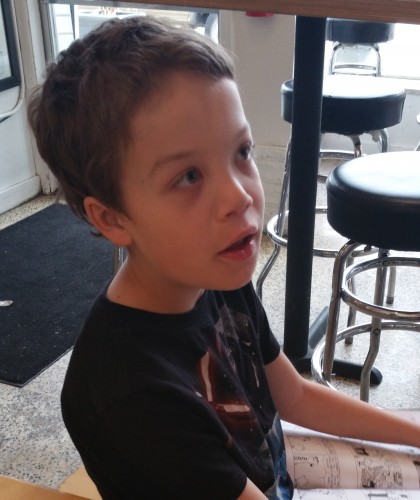
 We drove on into Denver, Colfax Avenue (sort of like Lake Street in the Twin Cities). To GB Fish and Chips. Their motto is “In Cod We Trust.” This is one of Ruth’s favorite spots and yesterday was her 12th birthday. We had a nice visit with her and her phone. Gabe was there, too, out of the hospital after septicemia, but still on IV antibiotics. He looked a bit exhausted.
Earlier in the day Rick came out from 1 Stop Appliance. The A team at last. He figured out what’s wrong with it. The main computer board and a computer board for the inverter were both shorted out. Significant since they were just installed Wednesday of last week and Monday of this week.

Rick noticed water splashes along piping near them, then showed me corrosion both on our old main board, which he had brought, and the new ones. Problem. Since to look at a dishwasher it must be pulled out, that means it’s disconnected from the water and electricity. You can’t run it and look for leaks so it’s necessary to use secondary data.
He took pictures, muttered. Then he told me Samsung might condemn it. Sad. Now we’re condemning dishwashers. What’s next? Sofas? Toasters? Shoes? I hope they do condemn it. It’s nothing more than an expensive drying rack right now. If they do, they either buy it back from us or give us a new one. Either one is ok at this point.
Ironically, I found this article just now from the Atlantic on April 3rd:
Doing Dishes Is the Worst This is now an empirically proven fact. Dishwashing causes more relationship distress than any other household task.
Spring New Shoulder Moon
 “I’m a doer.” Kate said this yesterday. Yes, she is. So much so that we often referred to her as the energizer bunny. Jon’s divorce, Sjogren’s and arthritis has made doing difficult, often downright painful. The combination put her in a tough place psychologically; but, it feels now, for the first time in a year plus, that she’s going to push through it. As Winston Churchill said, “If you’re going through Hell, keep on going.”
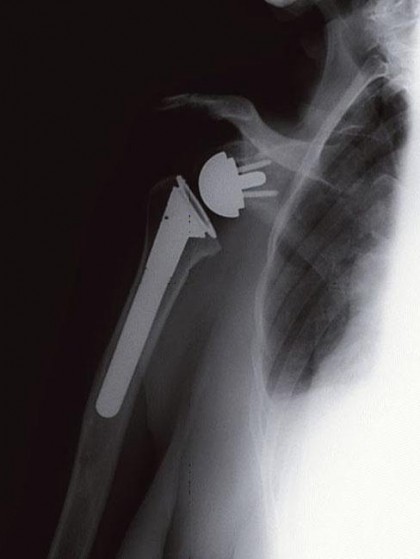 We had her first post-op appointment yesterday and got to see an x-ray of the new appliance. This isn’t hers, but it’s an accurate representation of what we saw. As this image shows, the ball of the shoulder is now where the socket used to be and the socket where the ball used to be. This reverse total shoulder uses different muscles to power the arm, the deltoid in the main. It also reduces pain more for certain patients though I’m not sure why.
Seeing the screws, poking out from the ball, seemed strange to me, but it underscores orthopedics as the carpentry of medicine. Sawbones. The multiple uses of the inclined plane. Thanks, Archimedes.
These surgeries, joint replacement, aren’t perfect, but they’re way better than doing nothing. My knee, for example, is not the knee I had when I was 40, but it is pain free and I can work out without contorting myself. I can’t stand for long periods of time, but I can stand without pain. Kate has two artificial hips and now an artificial shoulder. Pain reduction is a primary benefit of all these procedures and it’s usually pain that leads to them in the first place.
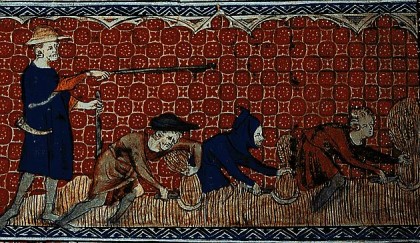 We often talk about folks for whom physical labor is key to their job: trades people, movers, utility workers, lumberjacks, mechanics, farmers, even physicians. Prior to joint replacement as an option, they had to suffer through the pain or stop working. Imagine what it was like on the frontier to have debilitating hip pain, a shoulder that would no longer move above a right angle, a knee that buckled under pressure. Or, in the middle ages, for peasants. Soldiers. Domestic servants.
 It’s likely, for example, that Kate’s years of lifting babies and young children led directly to the arthritis that ruined her right shoulder. That’s the Schneider hypothesis since the sort of dysfunction her shoulder displayed is most common in women.
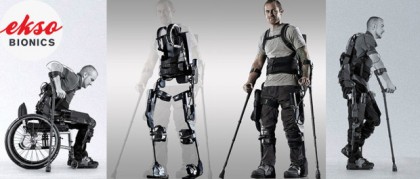
These are life extending surgeries, making it possible to live, rather than exist. I imagine that soon bionics will be more generally available and will complement this sort of procedure, perhaps making up for atrophied muscles which are a common sequelae of joint problems. All this is part of the glass half full view of the future.
