Category Archives: Memories

Week II Post-Surgery

Summer                                                                   Recovery Moon

Week II post surgery. My energy improves daily though I’m not back to full stamina. The surgical stigmata, six wounds where the robot’s arms pierced my skin, are healing nicely. It no longer hurts to lie down on them. An unpleasant, but anticipated side effect of the surgery, temporary incontinence, seems to be clearing up much more rapidly than I’d imagined it would. And, most importantly, I’m presumptively cancer free, the only question being possible microscopic metastases. I test for that in early September.

The tomorrow wall has crumbled. I can now see into the future again. Yesterday I made Amtrak reservations for my 50th high school reunion in September. The overnight California Zephyr runs from Denver to Chicago and then a short ride on the Cardinal to Lafayette, Indiana where I’ll pick up a rental car and drive the rest of the way. I do it this way because the Cardinal gets into Indianapolis after midnight and this allows me a good night’s sleep, plus I can gradually re-enter Hoosier space driving familiar highways back to Alexandria.
camp chesterfield2
The Trail of Religion

Again this time, as I did for the 45th, I plan to stay at Camp Chesterfield, a Christian Spiritualist center. It’s a quirky, old, interesting place. And, it’s cheap.

The loft is ready for its second round of construction, more shelves, then more shelving. I’ve abandoned my attempt to get the books properly organized as I shelve them because I need to clear space for more shelves. I can sort and organize as much as I want come fall.

My psyche has not caught up to my body’s healing pace. Though the tomorrow wall has fallen, I still find my days somewhat chaotic, not sure what to do, then what to do next. We’ve had a continuing drip, drip, drip of other matters: cracked tooth, dying boiler, Kate’s very painful back that contribute. All those seem to be moving toward resolution. I’ve even found a plumber for the generator install, a niggling thing still hanging on.

I’ll find my psyche back to its usual eagerness over the next week or two. I look forward to it.

Again, gratitude to all of you who sent notes over the cancer season. It matters.


Summer Haze

Beltane                                                        New (Healing) Moon

photo by sister Mary

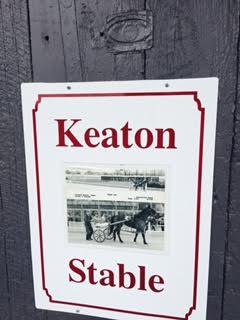
Summer as a boy meant trips to Morristown, Indiana to visit grandma and grandpa Keaton, Aunt Virginia and Uncle Riley, and their kids Diane, Richard and Kristen. Charlie Keaton, my grandfather, pictured in a post below, was a horse trader. He made his money, as I understand it, by driving around in his car, listening to the stock reports from Indianapolis, and buying up cattle and other livestock, then selling them for a better price in the stockyards.

He loved horses, was a railbird at Churchill Downs and owned his own harness horses which he kept on the farm about three or four miles outside of Morristown. He lived in town in a big house. Set on a corner lot it had a wraparound porch, large trees that shaded it, so it was always cool, even in the humid southern Indiana heat.

Uncle Riley continued the harness racing tradition after my grandfather died. Richard picked it up from Uncle Riley.

Morristown, more than Alexandria, where I grew up,  is a place where I have roots. Even though Mom and Dad’s graves are in Alexandria, it feels like a temporary place, someplace I was for awhile before moving on to my real life. Morristown, on the other hand, has that summer morning haze off the river feeling, a place where my people lived and where they still live.

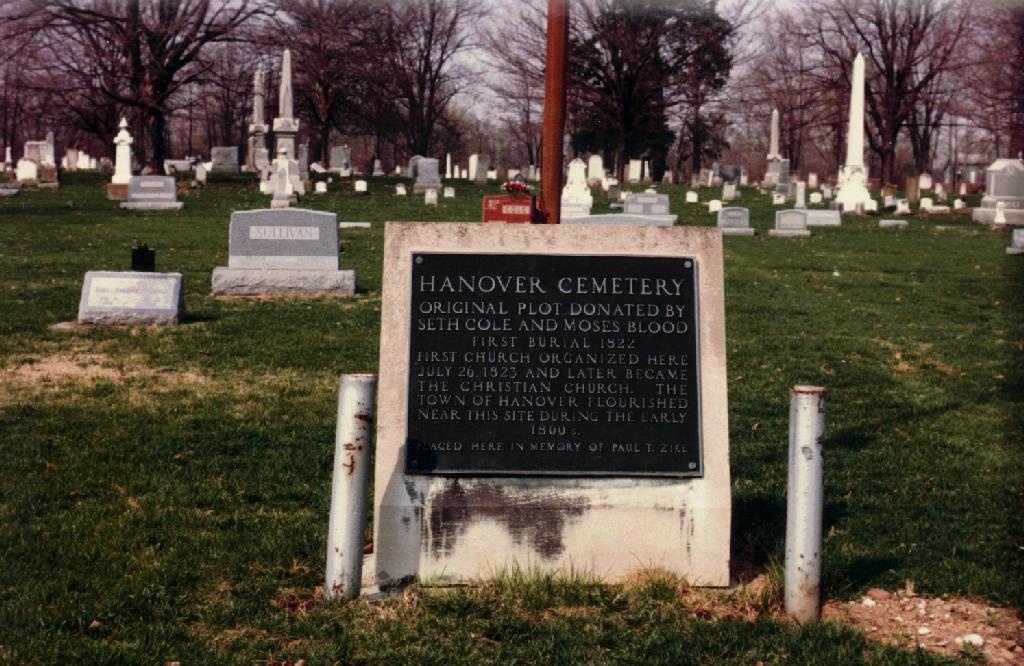
hanover cemeteryNowhere is this more evident than in Hanover Cemetery where the first row of grave markers are Keatons and near them are Zikes. Charlie and Mabel are there. Uncle Riley and Aunt Virginia. Aunt Barbara. Uncle Paul and Aunt Gertrude. Aunt Mary. And many more.

The farm, the one that grandpa won on a wager at the horse track, is just around the bend and up a slight rise from the cemetery. Keaton farmland runs in back of the cemetery and to the north of it.

What positive feelings I have about Indiana come from this small town, Grandpa’s big house, the farm and this cemetery. They represent, they are, for me the spot where family and place have the most coincidence.

Knausgaard

Beltane                                             Closing Moon

Reading Karl Ove Knausgaard’s, My Struggle: Volume I. This book hits me as his memories call up my memories. His father memories call to mind my own, distant father, somehow unknown and unknowable. As he sat at the kitchen table, ruler and fat pencil in hand, mocking up an ad for the Times-Tribune’s Thursday edition, the big one which made us paperboys groan as they weighted down our green canvas bags, I would watch him, wonder why a man of his intelligence would spend time doing this.

His mind (Knausgaard’s) roves around ideas and art and writing in ways I recognize, having traveled many of the paths on which he walks. He wonders about his visceral reaction to art, why one painting moves him and another doesn’t, why so many of the ones that do come from a time before the 20th century. He plays with epistemology, speculating on how confident we can be about knowing the world; it is there, as David Hume said when he kicked the rock and said, “I refute it thus,” referring to Bishop Berkeley’s world of perceptions only, yet the world is not so easily known, forming itself from colors, for example, that represent not what color something is, but exactly the color it isn’t.

And, too, he is Norwegian. So he describes the inner workings of a Scandinavian mind and a culture that references lutefisk, fjords, cold and snow in the way a Hawai’ian might mention taro, palm trees and the hula.

My Struggle is not for everyone. It is personal, microscopic, intimate, plotless, meandering. If you need a narrative that hangs together in the usual way, this is not it though there is a continuity, a sort of modest stream of consciousness, more like blocks of consciousness, that do connect one with the other.

Recommended.

From the Archives, Ten Years Ago

Sunday                                     5/29/05

Ought 5.  40 years after high school ended.  High school seems so long ago.  Minneapolis and St. Paul, Hubbard County, Lindstrom, Appleton, Connersville, Crawfordsville, and Muncie.  So many places, so much life frittered away.  Yet I feel content.  Odd, isn’t it?

I’ve spent lifetimes as a drunk, as an administrator, as a scholar and a drifter.  As a lover, and a fearer, an advocate and a hermit.  From this vantage point I think of two things:  John Desteian’s remark that it is a tragedy I had no students, and Kate’s comment last week about myEducation of a Docent having the virtue of being “existential”, by which she meant rooted now, rather than in a future ambition.  I don’t know whether to evaluate these notions as critical, pejorative or as statements of fact.  Perhaps they are both.

This is my 58th Memorial Day and I feel at ease.  Not because I have accomplished much, though I feel I’ve met the criteria of having won not just one but several “victories for  humanity.”  “Be ashamed to die until you have won some victory for humanity.” – Horace Mann  I know the end point of this Pilgrimage, though not its epilogue. Perhaps I will not be at ease tomorrow, things change, but today I am calm.

Summer’s Gateway

Beltane                                                                  Closing Moon

Beltane marks the start of the growing season and the Celtic summer on May 1st. Meteorological summer doesn’t start until June 1. The summer solstice isn’t until June 20th/21st. Even so, we have just passed through our cultural gate to the summer season: Memorial Day and the Indy 500.

Yesterday bike riders began to show up in greater numbers, a fact that encouraged a lot of barking here on Shadow Mountain. There goes another one. Woof. And another one. Woof. The doggy equivalent of OMG.

Decoration Day, as it was called when I was a kid, was also the end of the school year. 12 years in the Alexandria, Indiana school system left me deeply imprinted with its meaning. First, we had the last day of school. The student’s equivalent of OMG. Then, we had the Decoration Day parade which ended at the cemeteries on Highway 9. After that, bliss.

Each year since, even today, the day after Memorial Day feels different. Lighter. My heart fills up with possible small adventures: hikes, road trips, movies, long evenings outside with friends. Too, U.S. history becomes more important to me, so I often pick up a Civil War book or something about slavery. This year I imagine they will be about the West.

So, let’s go play!


Peek-A-Boo

Imbolc                             Black Mountain Moon

Reading in the New York Review of Books about FBI surveillance of the anti-war movement. There was paranoia about the Feds all the time, with new folks coming under suspicion. The times were rich with focus, focus that made sense and focus that did not. The two were sometimes hard to separate.

Anyhow, the article reminded me of the funniest instance of FBI surveillance in which I personally participated. Back in ’72 or ’73 a bunch of us conceived the idea of a human chain around the Federal Building in St. Paul. There may have been a court case then, I don’t recall, but we showed up bright and early, joined hands and made a circle around the building. OK, almost the whole building. We didn’t have enough to close off the loading docks.

Anyhow, the Kellog Square apartments were under construction across the street from the Federal Building. They were mostly complete, several stories of apartments with glass windows facing the street. All of the apartments, up, I don’t know 20 floors, were empty. No curtains on the windows. No furniture. No renters yet.

Except. About six stories up, one unit had curtains. And, peeking between the curtains were cameras. The lenses were visible to the naked eye. Once we noticed them we waved, of course.

Very subtle of the FBI to hide behind curtains. In the only apartment that had them.

Oh, those were the days.

Validation

Imbolc                                                      Black Mountain Moon

Validation comes at odd points, often years later. In this Atlantic article, the Miracle of Minneapolis, the author, with the aid of Myron Orfield, links the Twin Cities’ blend of more abundant affordable housing and wealth to regional government. Somewhat valid.

Here’s the valid part: “While many large American cities concentrated their low-income housing in certain districts or neighborhoods during the 20th century, sometimes blocking poor residents from the best available jobs, Minnesota passed a law in 1976 requiring all local governments to plan for their fair share of affordable housing.” op cit

The invalid part is this. Even with these kind of laws on the books there are powerful forces that still work against the development of affordable housing. The NIMBY movement can marshal usually white middle and upper-middle class folks against multi-family housing. In Andover, for example, the city council time and again denied applications to build multi-family housing, denials premised in large part on the number of police calls to the two instances of multi-family housing (excluding senior citizen housing). This dynamic plays itself out in wealthy neighborhoods and suburbs across the Twin Cities.

Here in the Denver metro area another force, the market, stands in the way of affordable housing. Rents are high and single family homes are in short supply as well as increasingly unaffordable for new home buyers. This dynamic pushes against the development of affordable housing because normal development is so profitable.

Although some action has been taken in Minnesota and a few other states, the minimum wage is another barrier to affordable housing. Even affordable housing has to be paid for and often folks in the low wage sector: convenience stores, walmart employees, waitresses and bar-tenders, grocery store clerks and baggers, retail workers simply don’t earn enough to afford even reduced cost housing.


Here’s the validation. Back in the 1970’s and early 1980’s I was part of a Twin-Cities wide movement of neighborhood activists who advocated for and built affordable housing. We did this through the creation of Community Development Corporations (CDC’s), neighborhood level organizing and in-depth participation in city political races as well as city council deliberations. Most of the affordable housing in Minneapolis and St. Paul-I can’t speak to the suburbs-would not have been built without this committed core of ground level workers, activists and  community developers alike.

(I chaired the West Bank CDC during its most expansive phase of building in the late 1970’s. See pic.)

On the West Bank, where we built 500 units of affordable housing during my time there, we also pressed this movement further by organizing worker-owned co-operative businesses. We were trying to deal with the wage side of the affordable housing equation as well as reducing the cost of housing to begin with.

These were exciting and productive times with different city and state level initiatives being pushed forward by different groups. This all tailed off in the 1980’s.

“In the 1970s and early ’80s, we built 70 percent of our subsidized units in the wealthiest white districts,” Myron Orfield said. “The metro’s affordable-housing plan was one of the best in the country.”

The region’s commitment to dispersing affordable housing throughout the metro area has since diminished.” op cit

This decline exactly parallels the rise of Reagan and the subsequent gathering storm of the Moral Majority followed by the Teaparty movement and the war on terror. The way to achieve and maintain gains for the poorest of our citizens are known and replicable. They do require political will at several different levels of our society and this current society has broken faith with the idea of communal responsibility. This is the great evil of our time, worse than wars or Ebola or terrorism because the cost in damaged lives is so much greater.

A 50 Year Old Habit

Winter                                                                                                  Settling Moon II

Yesterday, after some bookcase assembling, I got an attack of the Sundays. This is a torpor that hits after noon on the seventh day of the week, perhaps only for those of us of a certain age. Our parents took us to church followed by a restaurant meal or a big home-cooked meal. The effect was like a weekly Thanksgiving dinner, a slowing as the body took in more calories than it usually had to absorb.

So I read Moon, the book I mentioned a couple of posts back, then watched some TV. Not vigorous, more calmed and quieted by a habit created well over 50 years ago.

Today has seen the book cases assembled as far as I can take them until I find more shelves. So I’ve started the really fun part, the organizing of my library. The bookshelf next to the computer will contain ancient history, Latin, mythology, material focused on the world of classical antiquity and its predecessors. Another large section I’m filling up now contains books related to art. These will stand next to a broad section on the United States with literature, history, religion, anything that helps fill out the current gestalt of our nation.

Right now that’s as far as I’ve gotten, but other sections will emerge as I move more books.

Winter                                                     Settling Moon

The boiler gurgles behind me. A slight ringing in the ears tells me I’m not done adjusting to the altitude. If I step outside, I’ll no longer see bare tree limbs, shrubs and the remains of last year’s perennials. Instead there will be the thin fingers of pine trees pointing up toward a clear, dark sky. The land beneath them has little undergrowth up here though about 600 feet below there are meadows with grasses and thin leaved shrubs.

Settling in has a lot of components. Yes, of course, there are the details, the net of the ordinary. It slips over us and we are unaware, caught in it and wriggling only folds it tighter around our day.

There is, too, letting go of there while trying to live here. That was made easier by the leave takings we both had. We left having said real and good good-byes.

There is the subtle and longer term process of developing new memories, Colorado memories. Making Colorado memories seems harder when caught in the mesh of car registrations, insurance to buy and bathrooms to clean. I say seems because it is often in those acts that the first memories begin to take root.

The clerks at the Colorado License Bureau laughing about the Omaha steaks Kate and I had planned for New Year’s Eve. “Don’t be surprised if a van pulls up. We know your address.” Driving home from Jon and Jen’s in rush hour traffic and, as a result, going slow enough to take in the Beirut Restaurant, the Corvette only car dealer, the modernist houses on Monaco Avenue. Taking our business meeting to DW’s 285 Cafe which had a large group eating breakfast, at least two of whom were clearly drunk.

Settling in, then. Underway.

Trailhead: Ancientrails, 2005

Winter                                                    Settling Moon

Ten years ago last November I visited Singapore, Bangkok and Siem Reap. My sister and I spent a fascinating morning at the American Club in Singapore watching the election returns over bacon, eggs, pancakes, grits. Bush II won the election, kicking off my Southeast Asian odyssey with a tragedy of historic consequence.

(Had the thought yesterday that the Bush clan is the Duck Dynasty of American politics. Still seems like a good one.)

After Singapore, I spent a couple of days in Bangkok, then flew to Siem Reap, Cambodia, the jumping off spot for visiting Angkor. Angkor was a revelation to me. An ancient Hindu culture, the Khmer, built temples, each erected by a god-king, over a huge area. Unfortunately, I’d left my blood pressure medications back in Bangkok, so, instead of lingering for the last days of my trip in Siem Reap, I had to return to Bangkok.

While there, running across the street to dodge the infamous Bangkok traffic, my right foot fell into sewer obscured by the nighttime darkness. Severed my Achilles tendon as I ran forward, wincing in pain.

In February of 2005 I underwent surgery for repair of the Achilles. Recovery required two months off the leg, so I decided to start a blog. Ancientrails was the result. Ancientrails began on February 1st, 2005, less than a month from now.

Over the course of this eleventh year of Ancientrails, I plan to revisit matters that interested me on some of the days during those ten years.

Here’s a bit of post from January 3rd, 2007:

“Back to Docent class today.  Ann Isaacson gave a masterful lecture on a difficult subject, the decorative arts.   She has a grasp of technique and detail in these matters that is impressive.

It was good to see the class again.  It provides two essentials for a long life:  learning in a new subject, and new friends.  I still feel lucky to have this chance and look forward to touring and further art  history research.

On another artistic note I headed over to Northern Prairie Tileworks  to see about the cost of using hand made tiles for  our fireplace surround.  Kate and I saw these guys at the Arts & Crafts Expo at the State Fair grounds last fall.

Roger and another man who worked there were helpful.  It looks like we can afford this one accent piece and I’m glad.”