Holiseason now looks back a month to October 31st and still forward to January 6th, Epiphany. Over a month of the season lies ahead. Advent, Hanukkah, Posada, Winter Solstice, Christmas Eve and Christmas. That odd week at the end of the year, then New Year’s: 2015.
2015 will bring not only our first full year in Colorado, but my 50th high school reunion. Remember not being able to imagine how old you’d have to be to have a 50th high school reunion? Now I know.
I’ll go by train, as I have in the past, though this time from the Denver Union Station east not from St. Paul’s Union Depot south. The Denver train is the California Zephyr and runs daily between San Francisco and Chicago. On the Empire Builder the service was pretty good, by Amtrak standards (a low bar, I admit), and I don’t know about the Zephyr. Whatever it is, it beats air travel for me.
A piece on social justice I’ve been writing , a presentation for Groveland U-U on December 14th, has been harder than usual. Usually such presentations form over a period of time, I write them, present them and forget them. This has been my pattern for the 22 years of occasional presentations there.
Two key elements have made this one more difficult. It will be my last, probably my last such presentation anywhere and certainly my last to Groveland. And, it was originally to be reflections of my years of social justice work, mostly in the Twin Cities.
When I tried to do a summing up, a sort of lessons learned, failures and successes as examples, it came out wooden. Too focused on me, too summary, not really coherent. Then, I thought, ah. What is it that creates a need in some of us to work for social justice, to attempt to move the levers of power in such a way that they benefit others?
That one felt too psychologized, too small.
What I ended up writing is no valedictory speech. It’s neither summing up nor psychologizing. It is, rather, about choice, about existentialist living.
It finishes with this:
We’ll end with another instance, perhaps a change that will come into your life as it already has in mine. Grandchildren.
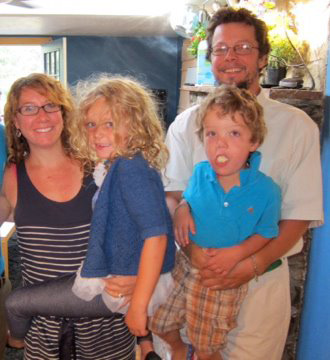
I don’t want to say that grandchildren are at the center of my life because they’re not, though they’re pretty damned important. I do want to say that being with our grandchildren, Ruth and Gabe, 8 and 6, gives me a clear focus on the future, that is, the world in which Ruth and Gabe will grow up, in which they will have children and in which they will grow old.
I know, as you probably do, that it will be a much warmer world and one with more erratic weather and changed food production systems. It will be a world in which the current gap between the 99% and the 1% will get wider. Just taking these two instances, as I look at Ruth and Gabe and, at the same time, at that future, those gazes will inform the political choices I make now. Perhaps that’s true for you, too.
Out to Keys for our weekly business meeting. Kate gets decaf, having been up since 5:15 with the dogs. I get caff, having gotten up at 7:00. We go over the weekly numbers, our financial situation and the calendar. Talk about the move while silverware clinks against ceramics and Pam, our waitress in a sequined red t-shirt with Disney characters and her name outlined in the shiny stuff, fills our cups with a two-fisted maneuver, a pot of decaf and one of regular.
Across from us sat a couple, cute trollish in type, older with white hair, jowls. Her with a scowl and him with Coke bottle thick black glasses. They didn’t talk.
Back home after that where we went over our lists of things to do. Mine included deploying the bagster, a final check of closets, sheds, drawers, cabinets, packing the downstairs bath and remaining art. Kate had on hers checks to the painters and the stager among other things.
Downstairs I wrote a second version of my presentation for Groveland on December 14th. It’s title and theme now comes from a short work by Kierkegaard, Purity of heart is to will one thing. A complete refocus.
Here is an interesting conundrum. Should I let my Colorado self emerge out of the casual interactions inherent in moving to a new location: talking to mechanics, visiting the grocery store, dining at the 285 cafe? Or, should I try to shape it, finding like minded folks through obvious clusterings such Sierra Club, the Denver Art Museum, the Democratic party? Sure, it will be a bit of both, I know, but where I should place my emphasis?
As I have been discussing the move, I’ve emphasized the loss of the Woollies, my docent friends, the sheepshead guys and the thick web of history here after 40 plus years. One straight line of thinking is to investigate the sociology of Denver for nodes of persons whom I might meet with similar tastes and interests. That’s why I’ve mentioned politics and the Sierra Club as likely sources for new friends.
And yet. Another part of me, reinforced by some reading in Kierkegaard and an article by a professor on why he has left politics behind (politics or productivity in his mind), have given me pause. Not to mention the onrushing reality of the move. No, I don’t have to make a decision soon, or ever for that matter, but I want to.
Why? Because I don’t want to create a sticky fly trap for my self. I don’t want to make commitments in order to meet people that will result in my needing to pull back later. Right now I’m thinking that politics, though a strong and thrumming wire wound throughout my life, is just such a fly trap. As would be volunteering at one of the museums. Long drives. Winter weather. I dropped both Sierra Club and the MIA for those reasons and, to underscore the professor’s logic, to enable my productivity.
A Colorado, a mountain, a western, a grandpop self will come into being if I live my life, flowing from here to there as events take me. I want the productivity that I find so dependent on having my own time and my own space. Guess that’s my answer for right now.
A holiday morning. This one with no pans clanking, oven sending out aromas. Not even the Macy’s parade. I never did connect our HD Comcast service. The HD delivers the basic cable channels we pay for to keep down the cost of the broadband. No Rosebowl later in the day either.
Dining this afternoon at the Capital Grille. Our last Thanksgiving here and we’re sharing it with Anne, Kate’s sister. A cold day, appropriate for the final major holiday of our Minnesota lives.
Holiseason hits its full stride with Thanksgiving. After this the holidays keep coming, up to and through Epiphany on January 6th. So many of them focus on getting. The twin oxen of capitalism and marketing, goaded as they pull the treasure carts of mercantilism, strain to drag us off center in our lives. That’s why Thanksgiving and its focus on gratitude is so important for us right now.
But. Black Friday. Bleeding into Thanksgiving evening. Bah. Humbug. Marley’s ghost drags his chains around in delight.
As the lights go up, the songs come on the radio, I love the focus on illumination. Enlightenment, you might say, is the reason for the season.
And yet. I find myself, to quote Robert Frost, “one acquainted with the night.” This is the season of darkness, the approach to the longest night of the year. The dark is fertile, a place of creativity and the nurturing of life before it emerges into the day. Here in Andover and also on Black Mountain Drive the night brings with it silence, a quiet similar to holiday mornings, like the one around me now. I love the blackness and the light. Blessed be.
Took my weather station apart today and cleaned it up. There’s another Davis weather station not very far from our new house and it posts on Weatherunderground as Black Mtn/Shadow Mtn. Once I get mine setup I’m going to go back to posting my weather, too. I moved the display panel away from my broadband hookup into a room where I only use wi-fi here and could no longer post.
The study is done for now. So is the garden study. It was the one with all the files. Tomorrow I’m going to head into the closet under the stairs and the built-in cabinets down here in the basement. That will represent the last of the packing until December 15th or so, moving week. Then, all the computer stuff, all the monitors, this tower, keyboards, mice, cables, power surge strips. Into boxes. Another box for desk supplies, Latin books, remaining stuff.
Next week I plan to go through all of the manuals we have and organize them. I’m also going to work on information about the house itself (where the gfi’s are, filters, that sort of thing) and put together a handbook for the various gardens and the orchard. The new folks will do whatever they want of course, that’s how transfer of property rights work, but I want them to know how and why we did what we did.
There will be a bit in there, too, about cohabitation with the pileated woodpeckers, great horned owl, the moles and the voles and the mice. Those land beavers and whistle pigs. The occasional snapping turtle, small green frogs, salamanders, newts and garter snakes. The odd opossum and raccoon, of course, as well. Chipmunks, squirrels, turkeys and deer. Crows and nuthatches. Chickadees. Hummingbirds. The whole blooming buzzing menagerie.
Holiseason has begun to gain strength. Thanksgiving preparations are underway in millions of households across the country. Tickets have been bought; cars checked; phone calls and e-mails made. America’s festival of gratitude has a lot of momentum. Yes, the earliest Thanksgiving (at least the one projected back into the founding history of the English colonies) has a negative image. Perhaps deservedly so, I don’t know the history well enough.
Since Abraham Lincoln made Thanksgiving a national holiday though, the family focused day has united Americans of diverse backgrounds and religious orientations in a secular celebration of extended family and friendship. Whatever form of Thanksgiving works for you, it is a day to remember the blessings we each have in our lives. No matter how great or how small they may be.
Of course, there is the dark pall of Black Friday, a habit so twisted in its mercantile logic that Best Buy tried to come out the good guy by saying that they were letting their employees go home to sleep. Not many sales, the spokesperson said, were made late at night anyhow.
Ursula Le Guin gave a wonderful speech at the national book awards last night. I heard it on NPR today. She made several striking points and I’m embedding her speech in the next post, but she took a cut at capitalism that sunk the knife in deep. We live, she said, in capitalism. Its power seems inescapable. So, she went on, did the divine right of kings.
Whatever your plans I hope they include gratitude for the gift of life and for the wonder of this earth on which we live. What a privilege it is to be alive now.
Fall is in its last days. Samain comes on Friday. The seasons of the year that speak most directly to my soul arrive back to back. Samain, then Winter. Guess that tells you what it’s like to live inside my skin.
The sky today glowered over the landscape, a November sky ahead of its month. It felt like a homecoming to me.
A long while back I chose to identify the period from Samain to Epiphany, as holiseason. It’s a whole season of special holidays, moments and weather. They are distinct, yes, from Diwali to Kwanzaa, Posada to Hanukkah, Christmas to the Winter Solstice, Thanksgiving to New Years, Samain to Epiphany, but their proximity, their charged valence in their particular cultures adds up not in simple sums, but in layered complexity.
Put, for example, Samain’s celebration of the thinning of the veil between this world and the Otherworld in dialogue with the holiday of gratitude and family we call Thanksgiving. To do so reminds me of a small object in the art of the Americas collection at the Minneapolis Institute of Arts, the Nayarit house.
This is a tomb object, excavated from a ninety foot deep shaft grave made by the Nayarit culture of what is now western Mexico. We have little firm information about this object but we can infer from its presence in a tomb that it might convey something about life and death.
It contains groups of people, probably relatives of the deceased, eating and drinking with each other. As groups of kids investigate this ceramic object made between 300 BCE and 400 ACE, they usually conclude that the group above is living and the group below the ancestors. The key thing they also note is that they are eating and drinking together.
Of course this brings up the Mexican celebration known as the day of the dead, also a holiday in holiseason. It could be seen as the living generation celebrating Thanksgiving with each other, yet intimately connected to their ancestors, who carry on their own celebration, one we acknowledge at Samain. Or, one we might acknowledge at Samain if we took seriously the Celtic imagery of the veil between the worlds grown thin, a very similar idea to the one celebrated throughout Latin America, but especially in Mexico as the Day of the Dead.
The most mythic and sacred period of the year approaches. I’m excited about it.
At the Walker. Shocked out of my move fixation, gladly so. What I hoped for. A major exhibition covering years when art turned over on itself and the Walker made its reputation as a nationally significant contemporary art space, Art Expanded, 1958–1978, challenges boring old representational painting, stiff granite sculpture, and anything else considered traditional or usual at the time.
It got me immediately into careful looking, following disinhibited artists as they struggled to use a radical new freedom, going with them to places absurd and funny. An example of the latter is a small notation for a happening: Turn the radio on, turn it off at the first sound. This zeitgeist was mine as a young adult, traditional sexual mores, traditional career paths, traditional power structures, traditional decorum was all suspect and suspect in such a way that the burden of proving itself useful to the human project lay on tradition.
The Walker is an osmotic membrane, the world of art pushes at its curators and they try to let through only the most innovative, most balls against the wall, most beautiful, most lyrical of the very new. It is an antidote to burying myself in the minutiae of moving. So easy to do. Artists trying to replace sculpture with three video screens, two larger and one smaller between them, stacked vertically, with strings like those of a bass arranged in front of the screens and a stool behind for the screenist to use while playing push me away from the taskiness of the move and back into the realm of, “Oh! What’s this?” A place I consider my natural habitat.
So it did not surprise me when I sat down to eat lunch that my mind strayed to a mind-full meal. It went like this. I had a fruit salad and a grilled cheese and bacon sandwich. Fork into grape. Huh. Roots captured water, distributed it up a vine and into the developing fruit, swelling this taut case until it was full. The leaves captured solar energy and created carbohydrates. Sweet. Wine. Kate and I at the KSNJ dinner on Kate’s 70th. Mogen David. A melon. Kate makes melon salads every summer, puts them in a long plastic container and we eat them throughout the week. Pineapple chunk. A happy worker makes good fruit. The Dole plantation philosophy on Lanai, now abandoned to the techno-baron Larry Eliot and his desire to create a sustainable, profitable community. Strawberry. California’s Central Valley. Drought. The precious water contained in this strawberry might have come from last year’s snow pack in the Rocky Mountains. Then, the bread. I don’t eat bread anymore, but half a grilled cheese sounded so good. I went ahead. Diabetes. Why do the things I like a lot turn out to be bad for me? Days of grilled cheese and Campbell’s tomato soup. An Alexandria, Indiana gourmet lunch.
Now this is not mindful in the way of savoring the grape as a tight oval, bursting with juice, breaking the skin with sharp front teeth and feeling the first squirt of liquid on the tongue sort of mindful. No, this is a mind-full lunch in which I allowed free association to guide and slow my eating. The blueberries. Those Augusts on the North Shore wandering through burned over or clear cut forests, gathering wild berries, eating as many as I picked. The blueberries we have outside in our orchard. That sort of mind-full.
A primary text in my rethinking, reimagining my faith is Becoming Native to This Place by Wes Jackson of the Land Institute. It’s not the content of the book-though it has useful material about new ways of agriculture-but the gerund phrase it has as its title.
Becoming native. What an idea. The very notion of native is that you can’t be native unless you’re born to it. So what can this mean, becoming native? In my understanding it’s about a process, a careful listening and seeing. Casey Reams, a soil scientist, was notable for saying, “See what you’re looking at.” So often we don’t.
We will never be native to a place where we were not born, but we might enter a state of grace with the land, a “becoming native” state, an ongoing increased intimacy and sense of co-creation. When Kate and I landed here in Andover 20 years ago, I was far from what I understood then as my native turf, the streets and inner city neighborhoods of Minneapolis and St. Paul. But, as I wrote here a few days ago, I’ve actually spent most of my life in small and medium sized towns of the midwest, 47 of 67 years. So, I became native, or entered into a state of becoming native to the city.
Becoming native is not achievable from the couch or from books or from yearning. It begins when, as the New Testament says of Jesus’ disciples, you shake the dust off your sandals and finally leave the other place behind. Whatever it is. Becoming native begins when you commit, often unconsciously, to the new place.
After 19 years in Indiana, where I was raised; I lived in Wisconsin for a year, Appleton, and never felt like I landed. By the time 20 years of residency in Minneapolis/St. Paul came and went, its streets were my streets, its future my future. Becoming native happened gradually and unconsciously.
Here in Andover, where I initially felt out of place (a cliche I use deliberately here), becoming native followed a somewhat more conscious path. We decided to put landscaping work into the mortgage and added terrain features such as boulder walls, a tiered perennial garden and several plantings of trees and perennial flowers and shrubs. Initially, the gardening work was bulbs and annuals, almost exclusively in the tiered bulbs above our brick patio.
There were though, several black locust trees in a grove about 40 feet off our back deck. That area, sort of a backyard, had weeds and these trees. Black locust is a dense wood and one often used for fence posts in the 19th and early 20th century. They also have thick, wicked thorns. It was the work of a couple of years, with chain-saw and step-son, before those trees were gone and the stumps had been ground away.
After the bulbs and the annuals, the felling of the black locust grove, attended by sweat and days of heavy labor, including sessions with a rented industrial quality wood-chipper, began to reel me into this place. The soil and manual labor, outdoors work, gave me an intimacy with the grounds I’d never had anyplace else.
Add in the dogs of those years, the planting of this garden and that, the eventual creation of the raised beds, the orchard, the fire-pit and we began to become one with the land here. The bees provided a collegial work force from the insect world.
The house hosted birthday parties, holiday meals, meetings with the Woolly Mammoths, the Sierra Club and parties for Paul Wellstone’s first campaign. Over time this land became home.
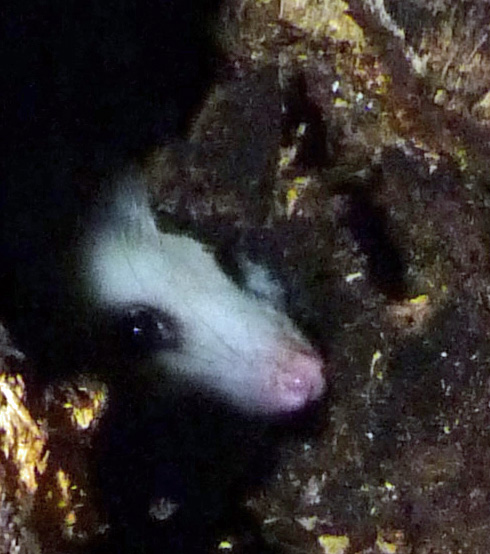
Then, becoming native to this place could truly begin. I would mark the moment of crossing the threshold late one fall night, perhaps in November when I heard a scratching outside the study window. Turning off the light in the room I moved closer to the window and looked out at a bird feeder then set up nearby. There, scratching among the fallen seeds was an adult opossum. This was the first opossum I had ever seen live outside of a zoo. He came back several nights, then disappeared, perhaps eaten, perhaps gone into hibernation.
In thinking about the possibility of hibernation I began to see this property in a new way. According to the Minnesota Extension Service and the DNR, there were likely thousands of animals: chipmunks, voles, opossums among them hibernating here in our woods. An image, a vision really, of our land with many, many lives lying below ground or in tree hollows came to me.
It was that vision that awoke me to the fact that we shared this property with so many others. It was not our property anymore than it was theirs. We were cohabitants. And not only with animals. The jack-in-pulpit, the columbine, the wild grape and wild cucumber, virginia creeper, the lilies and the iris, the tulips and the daffodils, the garlic and the asparagus, they all rested here over the winter waiting springs touch to come out into the sun.
An anthropocentric notion of ownership, amplified by deeds and by the very process we go through now, selling this property, creates an illusion of our habitation here as the only significant one. Many people would, without much thought, identify humans as the only inhabitant of the land. And it is not so.
Here there are whistle pigs, raccoons, squirrels, chipmunks, voles, the occasional wandering muskrat and rat, salamanders great and small, newts, garter snakes, toads and frogs, snapping turtles at certain seasons, pileated woodpeckers, great horned owls, crows and geese. There are millions, probably billions, of microscopic flora and fauna that keep our soil vital and nourishing for the larger plants that live within it.
This is a hectare of land, 2.5 acres. It has oak, ash, poplar, ironwood, elm, cedar, buckthorn (grrr), snowberry, river birch, maple, pine and spruce. There are many native and many domesticated plants and six domesticated animals, four dogs and two humans.
Once this umwelt settled into my conscious and unconscious awareness I knew I was becoming native to this place. I will never be as native to it as the generations of rabbits that have lived and died here. Nor will I be as native as any of the other animals or the native flora. Perhaps I have become as native here as the daffodils in our gardens and the lilies, both flowers that thrive on this land just as Kate and I have.
And now we are selling. What does that mean? Really? A certain sum of money, often transferred from one mortgage bank to another, changes hands. Legal documents get signed. Keys handed over. On some day we see our goods loaded onto a truck, we get in our Rav4 and pull out of the driveway never to return. But our cohabitants will remain, snugged into their tree cavity, their underground burrow, their nests beneath the shed. The major natural character of this place will remain largely intact. Sales are about humans, mostly, unless new “owners” abuse their trust.
We will, I think, go through a process of denativizing in which we gradually let go of the sensibilities shaped by these woods, these plants, these animals, these cohabitants. Even if we visit someday, just to see how the old place is getting on, we will return not as natives but as travelers, historical tourists.
We will, I hope, be becoming native to a new place, one with hard rock and high peaks, faraway vistas and remarkable spring snows. But it will not be easy. We will have to earn our place there, just as we have here. Frankly, it’s the part of this journey that most excites me. Yes, the grandchildren. Of course. Yes, Jon and Jen and Barb. Of course. But as to my life and its daily turn, becoming native to the Rocky Mountains is the big joy ahead of me.