Category Archives: Translating Metamorphoses

Sprinting

Winter                                                             Seed Catalog Moon

Huh.  “90, no more like 95%, right.”  Greg said this during my sight reading this morning.  “You’ve jumped several levels since our last session.” I’d felt it over the last few weeks of translating, a more than gradual emergence of learning, not like moving up a plateau, more like sprinting past a plateau or two.  This is an overnight sensation it’s taken me four years to reach.  I’m grateful for it.

(ok.  I don’t actually know what this guy’s saying.  Anybody else?  Probably something scatological but it’s a cool graphic.  It could be, note the necking.)

I feel accomplished.  I can actually see a Charles Ellis translation of Ovid’s masterwork, the Metamorphoses, coming into existence. Wow. Give me the geezer high five folks.  It’s happenin’.

My next goal is to increase my speed.  I’d like to get to 12-15 verses an hour with the goal of doing around a 100 verses a week.  At that rate I could translate the typical Book, there are 15, in around two months to two and a half months.  The translation would not be polished, of course, but I’d be laying pipe at a credible rate.  Add in polishing and I could maybe finish in four years, perhaps a little more or a little less.  Probably less since presumably my facility would grow as I worked.
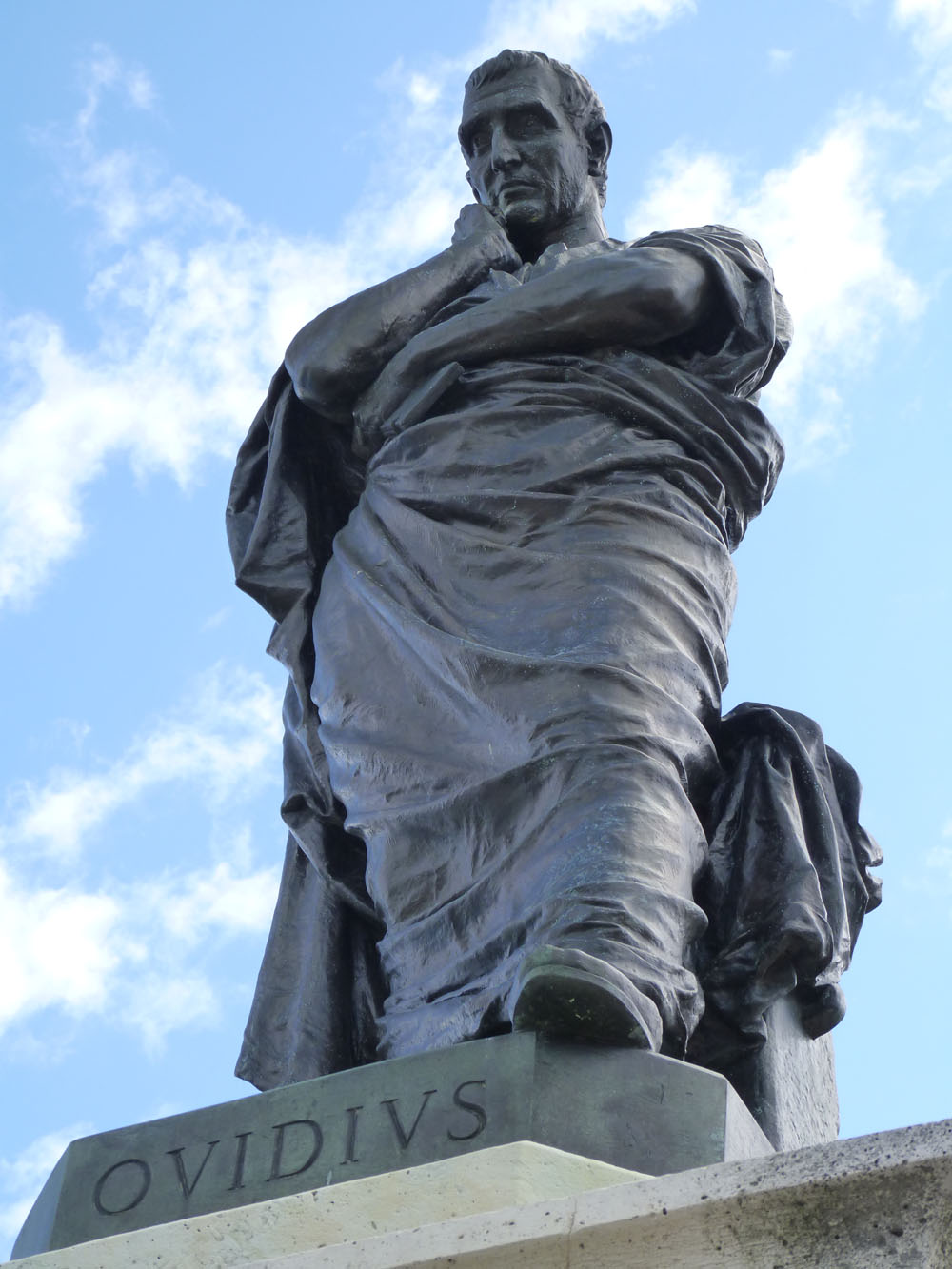
4 Years In

Winter                                                               Seed Catalog Moon

The Latin this morning.  Going over my translations, preparing for sight reading with Greg.  This means reading the Latin aloud, in the order in which I translate it, then translating.  Even with a word’s meaning written over it and the declensions and conjugations indicated below them (annotated by me), this is still a challenge, even after preparation.

(This is a fresco inspired by the passages I translated today.  Lycaon’s servant brings a platter of human meat to Jupiter.  This is the affront for which Jupiter will transform Lycaon into a wolf.)

Preparation essentially means going over the passages I’ll translate with Greg and translating them in my head, checking the translation I get with the translation I’ve written down earlier.  Because I’m translating faster now, we get through much less in a session than I translate, so I’m on verse 300 of Book I, but Greg and I are at verse 216.  This means I’m working with him on material I’ve translated often several weeks ago.  Verse 216, for example, is post-Thanksgiving work.  As a result, reconstructing my thinking then is sometimes difficult.

Today, though, for the first time, I found stuff I struggled with in that post-Thanksgiving translating coming more easily as I went back through it for review.  More easily is not the same as easily, but I’m getting better faster now.

Focused

Winter                                                           Seed Catalog Moon

Made a concerted push and finished Climate Change, Week 2, today.   Always surprised at how concentrated mental effort exhausts me.

A bit of Latin today.  It was interesting, so I’ll post it here. Ovid describes the state of the countryside in Lycaon’s kingdom after the flood:

This occupies the high ground, a hooked ship sits

294  And draws its oars here, where not long ago a farmer plowed,

295  Above the fields or sails over the top of buried villas,

296  This ship on the surface catches fish in elm-trees.


This apres deluge piece from the Metamorphoses reminded me of a story I followed with fascination as a high school student.  The Army Corps of Engineers put a dam on the Salamonie River and submerged Monument City (pic) and two other towns.  The Corps bought the towns in 1965 and moved everyone out, including, which intrigued me at the time, all the cemeteries.

In this case you can literally catch fish in the elm-trees.  There was a dark glamour to the whole project. These towns flooded regularly and the dam sought to end the problem of rising waters in the area by covering them with water so that hooked ships might draw their oars there.

Kate’s sister Anne has been here the last couple of days sewing.  She’s got a couple of days off from the jail in Shakopee.

Grrr

Winter                                                                      Seed Catalog Moon

My Latin skills have begun to increase.  I can almost see myself learning.  Most of the time for the last four years it’s been slog, slog, slog, slog, insight.  Repeat.  Now something has begun to happen, like that learning has begun to snowball, building on itself.  Which, I guess, is what’s happening.  It’s weird, but fun.

(pic:  Ta Dah)

Microsoft, I’d forgotten how much you used to frustrate me.  Now that I no longer work as much in Word my animus toward Microsoft had softened, but getting Missing back from Robert Klein reminded me.  I can’t open the damned file.  I’ve had this problem ever since I “upgraded” to Word 2013.  It has some protective mechanism that is very suspicious of outside documents.  I’ve unlocked most of them, but so far this one, one I really care about, won’t open.  Grrrr.

Still, I’ve looked at some of Robert’s work and he’s very thorough and helpful.  I can’t utilize his work to its full capacity until I can get the document into Word however.  That’s where I can manipulate the editing and see exactly what he meant.  Grrrr.  Again.

One step closer to finishing up the final draft.  Might get it done before Denver.  If I can open it in the first place.

The Weekend

Winter                                                           Seed Catalog Moon

Got caught up with the Climate Change MOOC, part of the process involved getting my head turned toward scientific reading, following graphs and numbers and equations. I’m past the first really brain busting part and the flow of the reading went much better this morning.  Another challenge to, as Hercule Poirot would say, “the leetle gray cells.”

Spent some time with an easier task, translating more of the Metamorphoses.  In these verses Neptune rides the waters, urging them on as they flood the earth, then strikes the ground with his trident and creates earthquakes.  Poseidon, earth-shaker, as Homer knew him.  This was an earlier human generated, outsider mediated, apocalypse.  Climate change is our very own.

The Great Wheel blog continues to take shape, a bit here, a bit there.  Changes, tweaks, but growing.


A Log Entry

Winter                                                                       Seed Catalog Moon

Warmer today.  We reached 2.  Not so cold tonight, only -5 right now.

More Latin.  Jupiter is drowning the world.

More Loki’s Children.  I’ve finished the first scene.  A big revelation is set up.

A solid workout.  Time with Kate.  Another good day.

Into the Next Year

Winter              New (Seed Catalog) Moon

The new year has begun, or as I thought about it in light of a post below, the next year has begun (Happy Next Year!).  It finds me following trails laid down in other times.

In the morning I went through, for the second or third time, parts of the Lycaon story that I have previously translated.  The goal now is to sight read the passage, translating with minimal helps.  Right now I have to write a definition over the word, perhaps a grammatical note, but the way to get fast is to read Latin as I read English.  That’s a long way off, but I can see the horizon line of that skill.  When I reach that point, I’ll be able to do serious scholarly work as well as learn great stories.

In the afternoon I picked up Loki’s Children, itching to get my fingers on the keyboard, putting some pages behind me.  Got waylaid looking up material about Thor, who is a very interesting god, probably the most loved god in Norse antiquity and mainly a giant-slayer, though he had a sideline in the inadvertent killing of dwarfs.  He killed Alvis, for example, by asking him questions until the sun rose and the light of dawn turned Alvis to stone. Alvis wanted to marry Thrud, Thor’s daughter.  Thrud, not exactly an elegant name, is it?  Maybe it sounds better in Old Norse.


The research turned out to be very useful, allowing me a thread I can use for building a strong throughline in Loki’s Children.  Sorry, but that part’s top secret.


2014 Intentions

Winter                                                         New (Seed Catalog) Moon
Having presented a prod toward humility and non-attachment here are some of my intentions and hopes for the New Year:

1.  A healthy and joyful family (including the dogs)

2. Sell Missing

3. Have substantial work done on Loki’s Children

4. Translate at least book one and two of Ovid’s Metamorphoses

5. Have a productive garden and orchard, beautiful flowers

6. Host a Beltane and a Samhain bonfire to open and close the growing season

7. Establish a new beeyard and have a decent honey harvest

8. Have a new and consistent way to include art in my life

9. Consider a new blog focused solely on the Great Wheel and the Great Work

10. Feed the autodidact with a few more MOOCs

Off the Plateau

Samhain                                                             Winter Moon

Greg says I’m working now at the level of an undergraduate who has finished school. Still a long ways to go.  He also said he was very pleased with my progress.  Nice to hear. I’ve been studying Latin for 4 years now and have become accustomed to the plateau, slog, plateau, slog nature of the work.

Recently it felt like I’d been slogging, not able to lift myself up to the next level.  Then, Greg pushed me to try a new method.  I did and I’m now working faster and more precisely.  Even so, the closer I get, the more the smaller details stick up, stub my toe.  That is, what used to be approximation, close but ok, now has to turn into literal Latin, then idiomatic English.

Somewhere ahead of me is trust.  A point where I can trust my own work without a need to consult Greg.  At least not very often.  That’s more years yet ahead.

Here’s what I would like to achieve with this work:  1.  My own translation of 606Metamorphoses and the resultant embedding of its stories in my memory.  2.  A commentary for certain parts.  3.  The renewal of interest in Ovid at the elementary, middle school, high school and introductory college level.

These are, I know, ambitious goals, but they nest together, one reinforcing the other. Number 3 represents my belief that these stories in their original form are so good that they can easily compete with graphic novels, movies and simplifications.  Hey, who wouldn’t like a good story like Pentheus where a mother literally tears her son apart?

A Bit of Divine Pragmatism

Samhain                                                                     Winter Moon

Another 6 lines of the Lycaon story.  Sort of.  Lycaon’s story per se ends with the piece I published the other day.  It continues, however, as Ovid recounts how the enraged Jupiter goes from transforming Lycaon into a wolf to plans for a deluge, a wiping out of humans. The other gods are mostly okay with this except they do ask, “who will carry incense onto our altars?”  A bit of divine pragmatism.

Must of been eating my Latin wheaties because the translation is coming faster and faster now, the results of my work most often squaring with the Loeb English translation.  That’s not to say they match but I understand how Miller got his translation and how mine differs in a way that makes sense.  The Loeb’s purpose, as I understand it, is to offer a close to literal reading of the Latin, though once you learn the Latin it’s clear how far from the Latin even the literal readings are.  This is not criticism; rather, it shows the gap between languages and how bridging those gaps is a quirky business, yielding all manner of contraptions from elegant trussed spans to rickety ropes.

This is what I got into it for, yeah these many years ago.  After studying the Bible, written in Hebrew and Greek, you learn the need for careful attention to this work, exegesis.  I never mastered either Hebrew or Greek, but I really wanted to experience the world behind the Wizard’s curtain of the translator.

As a vehicle for that journey, I chose the Metamorphoses because it is the reference text for the entry of Greek and Roman mythology into the Western stream of the humanities. This way I ground myself in mythology while satisfying a more abstract desire.  It’s working.