Category Archives: Art and Culture

Standing on the Shoulders of Giants

Beltane                                                                         Summer Moon

Got to thinking about the standing on the shoulders of giants meme. It’s a great contribution of Isaac Newton, a quotable polymath and giant like last century’s Albert Einstein. The more I thought about it though the less satisfied I was with it.  [Blind Orion Searching for the Rising Sun (Poussin, 1658)]

It introduces a necessary humility to any advancement in human thought, emphasizing the debt owed to the past. But. It seems to me a forest works better.

The giants of the past remain just that. The General Shermans, the Methuselahs of the forest, but they protect the growth of new, younger saplings and smaller giants who grow up among them. They are nourished from the same soil, in the case of Newton and Einstein, western civilization, and they don’t disappear under a long chain of legs and heads and shoulders, but remain in their place, already tall, eternal and the guarantors of the forest itself.

Too, I can easily imagine my own journeys into these groves, wandering among woodlands growing since the days of classical Athens, old kingdom Egypt, republican Rome, the Renaissance. And consider Newton. Perhaps the mythical apple tree of his life might have been the Islamic scientist Averroes.

This ancestral forest lies just beyond the edge of this material reality, its sylvan nature dependent no longer on the laws of physics but on the memories of the future. We are its caretakers, responsible for its continued health.


Phone Latin

Beltane                                                                        Summer Moon

Greg and I have done phone Latin for over four years.  We just finished another go and he found the verses I found difficult challenging, too. That makes me feel ok. Like life, if I have a partner in my confusion, I’m fine. Then we can work on it together. And, if we don’t achieve clarity, we’re still together. Just confused together.

It is a weird thing to contemplate, this long term relationship, now in its fifth year during which Greg and I have seen each other twice, once when I met him at the UU church in Wayzata and a second time when he and Anna, his significant other, came to Kate’s retirement party at the MIA.

Conducting all these sessions over the phone has an anachronistic feel, yet for the study of a language, it has worked just fine. We have the internet in common, using Perseus as an interlocutor for definitions and usage. We met weekly for the first two and a half years, then we went to every two weeks, the schedule we follow now, though even that gets spread out some due to our mutual schedules.

This fall, the long term project can get underway at last.

Right now I’m working on the story of Apollo and Daphne, which Antonio del Pollaiolo has rendered here with Daphne beginning to sprout what will become the leaves of the laurel tree. Ironically, the laurel becomes the symbol of male athletic dominance.


How others see us

Beltane                                                             Summer Moon

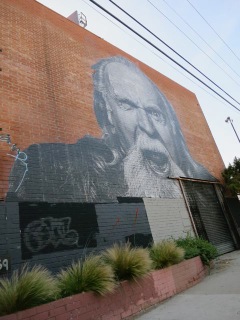
This from docent friend Allison:

I especially liked this wall art that I saw on a random building on a random street on a random day in LA.  The guy reminds me of Charlie…and that 
makes me smile.

 Charlie

Media Diet

Beltane                                                            Emergence Moon

My media diet. A while back, maybe 5 years or so, I heard an NPR piece on the concept of a daily media diet. It’s simple. What do you read, listen to, watch during the course of an average day? Yes, it probably changes from one day to the next, but it’s also got some bones that stay in place most days. Since the question of information sources came up at the Woolly meeting-not everyone gets their news from or trusts the NYT for example-I decided to raise this media diet issue again.

Your media diet is important because it is your intellectual nourishment. What you take in through various media may be grouped: information, news, education, entertainment. In terms of informing ourselves we all need a balanced diet, but research shows that instead we have narrowed our range of inputs, often tailoring them to our preconceived views. This is dangerous and, like a varied diet is good for the body, so is a varied media stream good for the intellect.

I’ll show you mine if you’ll show me yours. I’m going to put down my media diet in as much detail as I can muster. If you have the time and inclination, I’d love to see yours.

Daily:  Minneapolis Star-Tribune print, New York Times online, Star-Tribune online, Wired online.

Magazines(print): New York Review of Books, The Economist, Wired, Dwell, AARP, Funny Times, National Geographic*


Most days: online e-mail subscriptions Foreign Policy Situation Report, Big Think, Brain Pickings, DeLancey Place, Beacon, Gizmag, Chronicle of Higher Education, Scientific American, Tablet, PCMag, Trendland, Nieman Lab, Economic Policy Institute, Think Progress, various other Foreign Policy.* Poem-a-day.

Most days:  Accuweather, NOAA, MPR Updraft and Paul Douglas weather online.

Websites:  Cool Tools, Perseus (Latin text of Ovid), various political websites, Metropolitan Museum of Art, Walker Art Museum, MIA (and others less often like War on the Rocks, Small Wars Journal, USAF Journal, Internet Movie Data Base, Netflix, Rotten Tomatoes, Slate

Museums: The Walker, the MIA, rarely the Russian Museum, the Science Museum, the Minnesota Historical Society

Radio: MPR News, Classical and KBEM Jazz (only when driving and not often then anymore)

Music: little during the average day except as above

Television: Kate and I watch a couple of shows on Huluplus. I might pick up one more plus whatever I have on while I exercise.

Books: I may look at several books during the course of an average day. These days many of them relate to Latin, Ovid, the Metamorphoses and translation. I’m also reading material on emergence, the Arabian Nights and Colorado.

Usually I read one book for leisure at a time until finished. Right now I’m reading a Brian Sanderson fantasy novel. This kind of reading usually happens later in the evening.

*Both the subscription e-mails and magazine subscriptions can overwhelm me and my time. It’s a balancing act to get useful information while being able to maintain forward motion of projects like writing and translating and gardening.

You might have plays, concerts, dance performances, clubs to add to your list. We do occasionally get out to these, but much less often than when we lived in the city.
 

Taking the Past to Anchor the Present

Beltane                                                                    Emergence Moon

Ah, an irony. Bringing myself into the now is as simple as clicking on Perseus, opening up Book I of the Metamorphoses and starting to translate. There is no room for the past or the future (except of course the reality of the past present in Ovid’s Latin, thus the irony) when I have to consider the muddy earth, heated by the sun in the high heavens, bringing forth countless forms, some from before the flood, but also some new monsters. This is ancient science which understand the moist earth as a creative force.

(Eugene Delacroix, Apollos slays the python, 1851, Musée du Louvre, Paris, France)

As long I stay with the act of translation, I’m in the moment. That tether, established by the hour or so spent with four verses, continues to anchor me even after I’m done.

Now, considering the move is not enough to draw me away from the present once my tether has been fixed. In the moment I can identify tasks related to the move that I can handle now. And do them with no propulsion into the future. Ah.

Crowded

Beltane                                                                    Emergence Moon

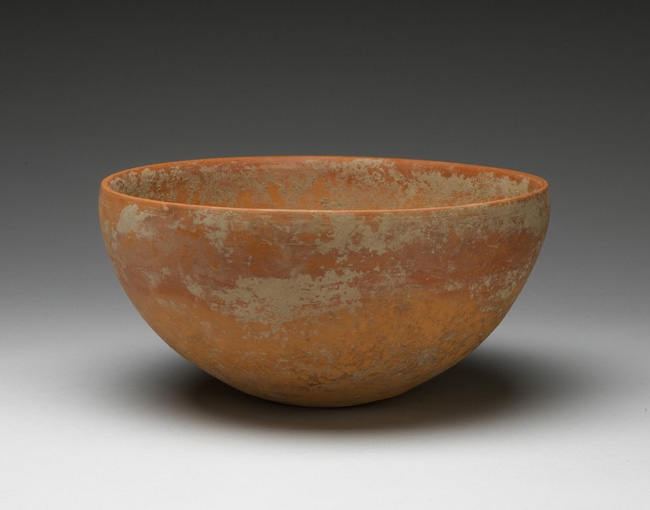
After meeting Becky yesterday at the MIA, I left. I had planned to stay a bit, wander in the bowl650galleries, visit old friends. But an unremembered aversion pushed me out the door. The place was packed. Lots of school kids and lots of Friends of the MIA for the Friends’ lecture.

Back in the now long ago and halcyon days when continuing education was rich in content and held on Mondays, the museum closed to visitors, going in for continuing education had the flavor of a monastic retreat. There would be an hour plus of wonderful thinking about art, followed by private contemplation in quiet galleries.

An understandable desire to get numbers through the doors has made visiting museums during high traffic times a much different experience. This is edutainment. Minds young and old soaking up the kind of information and experience that enriches their lives. That’s a big positive. But for those of us who visit the museum for a one on one moment with Song dynasty ceramics or Baroque masterpieces like Poussin’s Germanicus, not so much.


To Hell and Back

Beltane                                                              Emergence

Dancers. Kinesthetic wonders. The James Sewell ballet troupe are lithe, strong, fluid. Many of the things they did with their bodies revealed possibilities I had not kenned. Several a male dancer with take a female dancer on his back, then they would move, him bent over slightly, her resting on his back with no holds on either part, just weight and angle keeping her in place. Or, deadlifts of a prone woman on the floor to hip height. The Inferno was 70  minutes long and the number of calories expended by the troupe would keep me thin for a couple of months, maybe longer.

Then there was the audacity of it. The level of creative challenge in taking a solid, 800 year old literary masterpiece and interpreting it in an essentially silent, physical medium is immense. This was a brave work. The score and the dancers took on us on a journey through the Inferno, going lower and lower, down the New York Subway into the infernal regions. The Sewell inferno is set, loosely, in New York City.

This story of damnation and mid-life crisis is timeless and the Sewell Ballet has done it well. Worth seeing.


Calming

Beltane                                                              Emergence Moon

The first wave of emotions has passed. I feel present now. Those onions and leeks which I did not plant yesterday will go in on Monday and Tuesday instead, along with some fertilizer for the daffodils. Big life decisions take a while to incorporate and this one is not done with me, I know. But for today, it is.

Kate and I are going into the Cowles Center to see the Inferno danced by the James Sewell Ballet. Several years ago, when the writing stalled, I spent a year reading the classics, among them Dante’s Divine Comedy. This is one of the masterworks of western civilization, especially its depiction of Dante and Virgil’s journey through the Inferno. I did read on, finishing the trilogy with the Purgatorio and the Paradiso. It’s ironic, and I’m hardly original in observing this, that the Inferno is what has held reader’s attentions the most over the years. Damnation interests us more than redemption.


The Monthly

Beltane                                                                    Emergence Moon

A sickle Emergence Moon has risen in the west, just behind a tall poplar. Above it is Jupiter. A month plus a little ago, March 27th, I was on the road out of Holbrook, Arizona at 4 am. The mesa country was cold and the night was deep. Up in the sky hung a crescent of the Hare Moon and in its cusp was Venus.

(Spring Scattering Stars, Edwin Blashfield,1927)

Crescent moons are among the signal aesthetic gifts of the universe, especially when combined with a bright planet, especially Venus or Jupiter. The heart that cannot be moved by a black sky, a silver sliver of moon and cradled within its arms a fellow traveler, is a heart that has lost its wonder. I recall thinking as I drove on I-40 that morning last March that much of the beauty of southwest Native art came from clear views just like the one I was seeing.

It’s not hard to imagine those early ancestors of ours, on their trek out of Africa, looking up in wonder at the very same sight.

1001

Spring                                                                        Bee Hiving Moon

Usually I would do Latin in the afternoon after the nap since I spent the morning on the America Votes meeting, but instead today I began to nose around in another favorite locale of mine, the 1001 Nights.  I’ve read two different translations of the tales of Scheherazade, both entertaining, but I’ve learned through two new books in my library, “Stranger Magic”by Maria Warner and “The Arabian Nights-A Companion,” by Robert Irwin, that both of the translations have significant flaws.

So I found two new translations, one with only 271 tales but the other, with an introduction by Irwin himself, that is three volumes long.  When I finish up with Malcolm X, I intend to get back into the Arabian Nights.  Between Ovid and the Arabian Nights the tales are endless and well told. There’s something profound in the types of stories a culture folds into itself, makes significant through reception. The same is true, I suppose, of individuals. I’ve had djinn and Dionysus running around in my head since high school.

Then there’s that whole matter of the biblical stories, too.  The narrative lenses through which we come to understand our lives and the lives of others.  Those three: Bible, Metamorphoses and the Arabian Nights are more key to me than most of the greats of Western literature, perhaps with the exception of Kafka and Hesse.  The other work that stands with these in my own inner world is the Chinese classic, Romance of the Three Kingdoms.

This is the way my life goes lured by political change, entranced by stories of the divine and the magical, enfolded in the life of plants and dogs, wrapped up in the world of art. There are worse ways to live.