Category Archives: Art and Culture

Rock, then Roll

Fall                                                                  Fallowturn Moon

The way it goes.  Life rumbles along, eggs getting bought and eaten, trash taken out, kisses given, strangers greeted.  Then, a day like today rolls around.

Kate took me into the MIA today so I could attend the first of a day symposium on the Qin dynasty and matters related to its art.  Three great lectures in the morning, another after lunch and a couple of so so ones following Jenny So, the after lunch lecturer.

Concepts, objects, new history all shoved in as fast as a willing brain could absorb it.  And I was willing.  Eager, even.  However the bin gets full, develops what miners call an over burden and the mind says, no more, please not now.

So into the car with Kate to head out to France avenue for a memorial service for Regina Schmidt, Bill Schmidt’s wife.  Woollys and sheepshead folks in the same space.  Bill greeting people with his gracious dignity, pictures and videos going as is the new trend.

Then the service with songs and poems and testimony, a wonderful heartfelt poem by Bill.

All the while wrestling with Kate’s news that Gertie had taken a post-op turn for the worse, feverish and limp.  Kate took her to the vet, they cut off the bandage and she’d developed an infection.  Wind, Water, Wound is the post-op mantra for possibilities of infection.

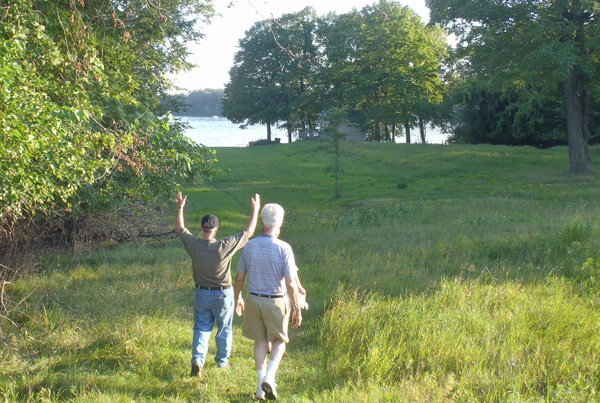
(Bill and I on Big Island in Lake Minnetonka)

She got a second anti-biotic and Kate brought her home.  She thought about calling me and asking if I could find a ride home to Andover.

So we left after the service, got a bulb syringe to encourage her to drink and some fancy wet dogfood.  She’d not eaten nor drunk water.  Both obvious concerns.

When we got home, she ate all the fancy wet food and, after I syringed several tablespoons of water through her teeth, she drank all on her own.  Her eyes are alert though her temp is still high.  We’ll see, but my guess is she’s turning this thing around.

China Rising

Fall                                                                    Fallowturn Moon

Walk through with Yang Liu today for the Terra Cotta warrior exhibition.  Using the terra cotta term to shorthand this exhibition does it a significant disservice.  Yang Liu visited many provincial museums as well as the museums associated with Qin Shi Huang Di’s tomb complex.  He chose objects from 16 different museums in all, the bulk of them intended to the story of the rise of the Qin.

That means including Spring and Autumn period bronze ritual vessels and bells, plus a sword (looks more like a dagger to me) made of iron!  This same sword has a pure gold hilt done in sinuous rectangular shapes, dragon motif, and inlaid with turquoise.  The Qin began to emerge during the Spring and Autumn period, 770-476 BC, grew strong during the warring states period, 476-221 BC, then, for a brief but centrally important 15 years, unified China and invented many of the marks of empire that would follow:  standardization of weights, currency, script, chariot axle widths, a pyramidal style government with the emperor at the top and a bureaucracy to support it.

The story this exhibit tells is of a region at war with itself, splintering into multiple states, each vying with the other for land, resources, power.  It is a long period because it runs from 770 BC to 207 BC, but it is a critical, perhaps the critical period for understanding the rise of China, many of its concepts still intact even in today’s People’s Republic.

Warring States

Fall                                                                         Fallowturn Moon

Today begins the journey to Shaanxi, the province of the Qin state as it emerged during the Eastern Zhou dynasty, a peripheral state on the frontier.  In the lecture today I learned that there is some debate on the origin of the Qin state.  Did it emerge from the barbarians to the west?  Or, did it have, at least in its ruling family, linkage with the east coast?

Yang Liu, Curator of Chinese Art and Head of Asian Art Department, acknowledged this debate, then said, “Why is it important?”  The problem is this.  The Qin unified China and Qin Shi Huang Di is a national hero.  Dynastic China as we come to know it after the Qin has its roots in many of the reforms of Qin Shi Huang Di.  What would it mean if that founding state was not, after all, Chinese?

This show is going to be a big deal, a very big deal.  Schools have already booked nearly all the available slots between now and the show’s end.  The museum has asked docents to sign up for additional tours.

What Yang Liu wants to do is place the tomb, its guardians and other wonderful burial objects like life size water birds and half-size bronze chariots, in the context of the rise of the Qin state during the Eastern Zhou in the Spring and Autumn period, then its emergence as a powerful state during the Warring States Period.  Only then can this massive tomb complex, of which the warriors are, after all, only a small part, be understood in its full historical significance.

Over the next few days I’ll post research I’ve located and things I learn at the Qin dynasty symposium over the weekend.

Old Timey

Fall                                                                      Fallowturn Moon


Pierre Cécile Puvis de Chavannes French, 1824-1898.  Sacred Grove, Beloved of the Arts and Muses  Art Institute of Chicago

Moving on in our mythology class to Hesiod and his Theogony, the Birth of the Gods.  This is a very different epic poem from Homers though no less beloved in antiquity.  Hesiod’s a beginnings and genealogies sort of guy over against Homer’s narrative genius.  By our narrative saturated standards the two don’t stand comparison, but in the past Hesiod’s poem was seen as inhabiting an equal but different place.

I think it’s like Genesis compared to the gospels, a grand narrative of beginnings, including the first people and the first important sacred events over against the story of a well loved figure whose life had a distinct arc.

It’s interesting to me since I’m at the same time preparing to tour the Terra Cotta Warriors exhibit at the MIA.  This has me tucked into Asian antiquity, the Chinese branch, especially the Warring States Period, 475-221 BC and the immediately subsequent Qin dynasty, 221-207 BC.  The Greek material from Homer and Hesiod is in 700-800 BC range, so deeper back in the Western story, yet it’s all well before the Christian era.

One of the things that really fascinates me at the moment is the cultural continuity in China from the early Shang dynasty in 1600 BC to the present laid over against the more fragmented but equally old Western cultural tradition.  In material I study there seems to be a bias that the cultural continuity of Chinese civilization produces a superior civilization. I’m not sure at all that that’s true and I’m also not sure that there is less cultural continuity here in the West.

Another day on this controversial point.

Saturday

Fall                                                                        Fallowturn Moon

A cold morning has given way to a beautiful fall day.  Clear, bright.  Still colored leaves on trees and bushes.

We had our business meeting this morning.  I’ve spent most of the afternoon on my Mythology course and revising Missing.  Listened to two interesting lectures, one on Odysseus’ scar and one on Penelope’s dream.

image: “Ulysses Recognized by Euryclea,” Eustave Boulanger, 1849. Ecole nationale supérieure des Beaux-arts, Paris


How Raven Became Black

Fall                                                              Harvest Moon

Another brilliant blue day, with slashes of orange and red, sky filled with high white clouds. These northern fall days expand the mind, let it reach out beyond the horizon, taking the breadth and height of it all into the soul, the inner life growing proportionally.  No problem with this season growing longer.

Lights out at the MIA this morning.   I wasn’t there, but apparently security gates came wheeling down in the galleries and the place went dark for an hour or two.  Very dark in certain areas.  I imagine the Japanese galleries and the Pacific Islands and the Islamic and maybe Southeast Asia would pitch black.  They have no window light.  None.  Wonder which images came to life?

Our afternoon tour got delayed because the kids were at the Children’s Theatre, attached physically to the museum, and it went dark, too, delaying their show.  This was a big group, 153 kids altogether.

Since I’m taking a class on mythology, it’s worth recounting here a frequent occurrence at one of my favorite objects:  the Transformation Mask by Kwakwaka’wakw sculptor Richard Hunt. (both pictures from the MIA website)  I tell a story about Raven, who had white feathers, then met Gray Eagle’s daughter, fell in love and visited her father’s dwelling.  Raven finds the sun, the moon, the stars, water and fire inside Gray Eagle’s lodge, steals all of these things and gives them to the people who have been living in darkness.  In spreading fire he carries a brand in his beak and his feathers are burnt.  That’s how Raven became black.

I tell this story as it is and leave it.  Most of the time, some kid asked, “Is it real?”  In return I ask, “What do you think?”  Usually kids accept the story as “real.”  I don’t press this interpretation, but I happen to agree with them.  It’s true because it explains the birth of the Raven clan and its totemic animal.  In this sense, too, it is real.  As real it gets.

MIA Tension

Fall                                                                    Harvest Moon

It’s a tough time to be institutionally arty.  Of course, the rarer times are when it’s not tough, but this is one of the tough times.  Declining investment income, donor fatigue, changing audiences, sometimes diminishing audiences.  Orchestras make the news, not for their wonderful sound, but for the latest lockout.  MOMA opens on Monday to bring in more revenue.

(art news)

This means, too, that life inside these institutions, as I said in a previous blog, is under tension.  The Minneapolis Institute of Arts is no outlier.  We’ve had new strategic plans, restructuring, bold new revenue plans and changes in special exhibitions.  We’ve also had, and it’s reflected in a current upcoming dustup, organizational spasms revealed in attempts to discipline volunteers.

No, we’re not talking about Jerry Sandusky or Boy Scout or Roman Catholic kind of issues.  No, these are much worse.  Bullying, badgering, pushy e-mails.  I know.  Pretty scary, right!  Then there’s that pesky issue of evidence, which in this case seems unavailable, contained in secret personnel files.  How J. Edgar Hooverish.

The pushes and pulls inside these necessary organizations have begun to create bulges and cracks, silliness, paranoia.

This particular incident to which I refer has also revealed a process in which there is no appeal and where the body most likely to advocate for the docent was told it had no say.  This is all very peculiar, hamfisted and seems designed to create a furor.  Just why that would be desirable, I don’t know, but I think it’s gonna happen anyhow.

Granted, these are difficult times, but creating more problems on top of them doesn’t seem wise.

The Curatorial Burden

Fall                                                                         Harvest Moon

Markers of having come from a different time, a time faraway, in another century, another millennium: sadness at the thought of Museum, Inc. servicing customers.  This is part of the DNA (get it?), the dynamic something or other, that will transform the MIA into a ship able to sail into the waters of the future.  Having led my share of strategic planning sessions, I know well the fervor and excitement that comes from bracing the winds of change, throwing up the collars for a good dose of reality, navigating dangerous waters all the time watching out for shoals.  The cliche police need to patrol these documents.  Come on.

(picture from

When Kate left Allina for retirement, she was so happy to go.  Why?  Because the practice of medicine had gone, in her career, from a profession focused on patients to an organization focused on management by objective.

In the Atlantic online magazine there is an article about the failure of liberal arts colleges.  That failure the author defines as not teaching entrepreneurship. We’re still stuck, he says, back in the 60’s and 70’s when a college degree meant something.  Now history majors are out of work.  We need, he says, history majors who can be entrepreneurs.

Yes, I admit it.  I bought into the liberal arts idea, that pursuing the intellectual path most interesting to you, most worthy of your passion was what higher education was about.  Still buy it.

Here’s the problem.  Museums, especially art museums, do have a higher calling.  These fragile vessels care for the world’s cultural patrimony/matrimony.  That calling, the curatorial burden we might call it, carries our mutual story forward and ensures that the next generation and the next and the next can pick up the narrative, weave it into their own lives.  That they can react to it and to our reactions.  That they can use it as shoulders to stand own when they take up the paint brush, the chisel, the hunk of clay.


This is not a business proposition.  This is a human responsibility, like caring for a family.  Does the family require money?  Of course.  Does money define the organizational structure of a family?  Do we want Family, Inc?  Maybe if your name is Corleone, otherwise probably not.

Medicine is not about numbers of patients seen by the hour.  No, medicine is about the practiced eye, the trained mind, the relationship between one human and another.  Does the practice of medicine require money?  Of course.  Should that mean medicine needs to take on a corporate structure?  Of course not.  When money begins to define the purpose of an organization, that organization has become a business, an Inc.  Fine for making shoes, cereal, cars, widgets.  Not fine for art or medicine or families.

The liberal arts education, whether at college or university, has the same responsibility as the art museum.  It inserts its students into the grand narrative of human history.  As humans we share so much with the humans of the past.  We make the same mistakes, for example.  We wonder about the same imponderable questions.  We struggle to express ourselves through literature, art, music.

Does any of this deny the need for an economy, a place of trade and commerce?  No.  Not at all.  But when the Medici’s made their money what did they do with it?  When the robber barons got their millions what did they do with it?  What’s Bill Gates doing now?  They approach the arts, questions of justice, questions of human suffering.

It is the liberal arts and the arts themselves that frame the questions, have the deep pool of answers, know the roads that lead away from civilization and those that lead toward it.  We can’t abandon these treasures because the business cycle has a predictable rough patch.  We can’t change healing and learning and creation into business models because it’s not their essence.  We will learn this now or later.  History teaches these lessons over and over.
 

Art in Life

Lugnasa                                                                    Garlic Planting Moon

As I continue to think about the MIA and my writing process, one aspect looms very large to me.  How would I continue to have art in my life in as significant a way, though without the time and subject strictures of the docent year?

Several ideas have occurred to me.  Which ones might work?  Too soon to know.  And, there is the important question of whether they will match the docent experience in both quality of learning and quantity of time with art.

Here the ones I’ve come up with so far:

1.  Walker/MIA  art blog

2.  Put up my own exhibitions using images from the internet.  The gallery setting on wordpress would work well, though my tumblr account would, too.

3.  Develop a reading program in art history.  I’m especially interested right now in contemporary artists theoretical approach to their work.

4. Make a commitment to look at art in new venues:  other museums in the Twin Cities, museums in other cities, books, internet resources, especially the Google Art Project.

Pre-Raphaelites: Victorian Art and Design, 1848-1900  (National Gallery, D.C.)
February 17–May 19, 2013

The first major survey of the art of the Pre-Raphaelites to be shown in the United States features some 130 paintings, sculptures, works on paper, and decorative art objects.

I’m sure other ideas will emerge.  If you have any, let me know.

The Friday So Far

Lugnasa                                                              Garlic Planting Moon

Latin morning.  Greg, my tutor, says he sees a lot of progress.  I can feel it, too.  He wants me to start reading Vergil now, at least a sentence or two a session.  I’m now translating with fewer and fewer mistakes, often where I’m confused, so is Greg.  He still gets me out of tight places and we wonder about the tougher ones together.  It’s more collegial.

(Philemon and Baucis)

Kate and I went up to Isanti to the Creamery for lunch and then down to Greenbarn to pick up some composted manure, sweet corn, cucumbers and, ironically, tomatoes.  I want to make a double batch of tomato/leek soup this weekend and we don’t have enough ripe tomatoes right now.  I’m gonna do more pot pies and make some chicken noodle soup as well.  All for the freezer.

As you might able to tell, my mood has lifted, I’m back in the with it range.  A lot of the lift came from talking it out with a Kate a week or so ago.  She’s a great listener and my love.  The combination is a good one for healing.