Category Archives: Great Work

A Coarse Spirituality

Lughnasa                                                                   Harvest Moon

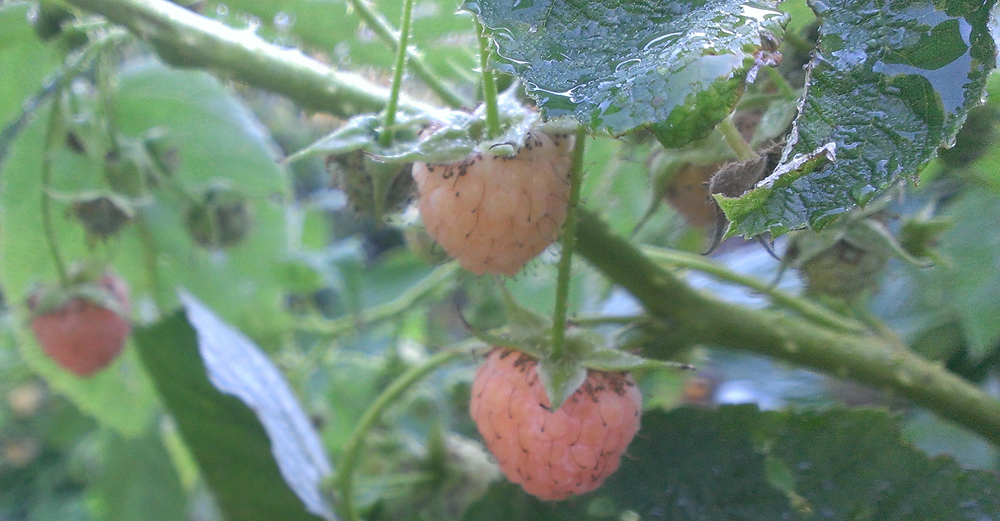
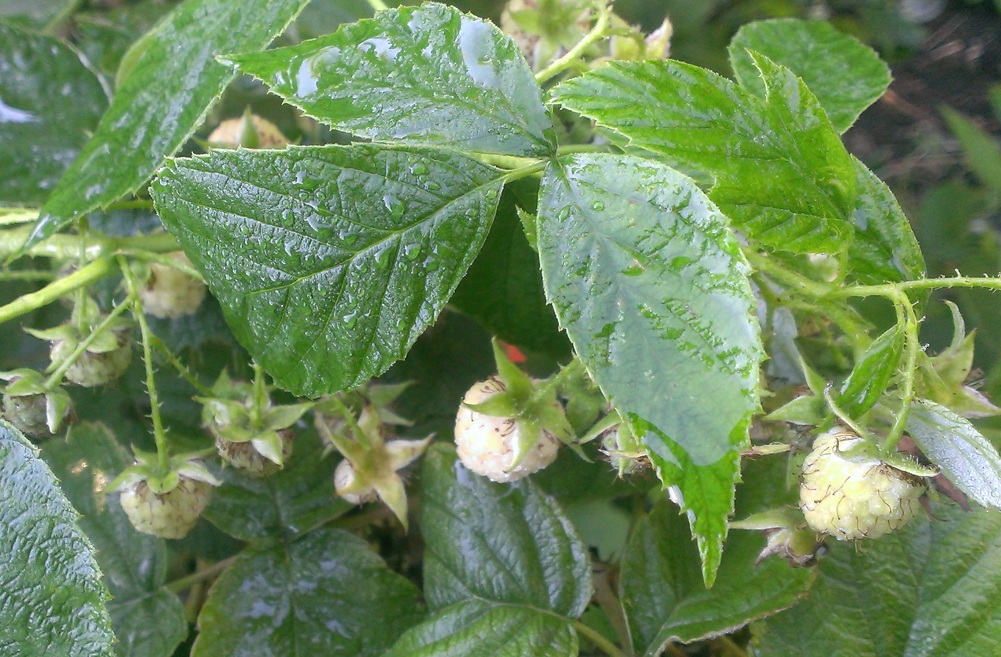
Yesterday in the midst of wet raspberry canes, plucking fruit from thorny yet fragile IMAG0955cropped1000branches, the spirituality of the moment grasped me.  The canes stuck to my sweatshirt sleeve; the water soaked into my jeans.  This was the real in all its obstinate presence.

Last February Kate and I did some winter pruning and I cut last year’s canes down to the ground.  We were late getting this done, but the timing was alright.  Now, eight months later, those same plants had burst up, some over my head and drooping with golden and red-purple berries.

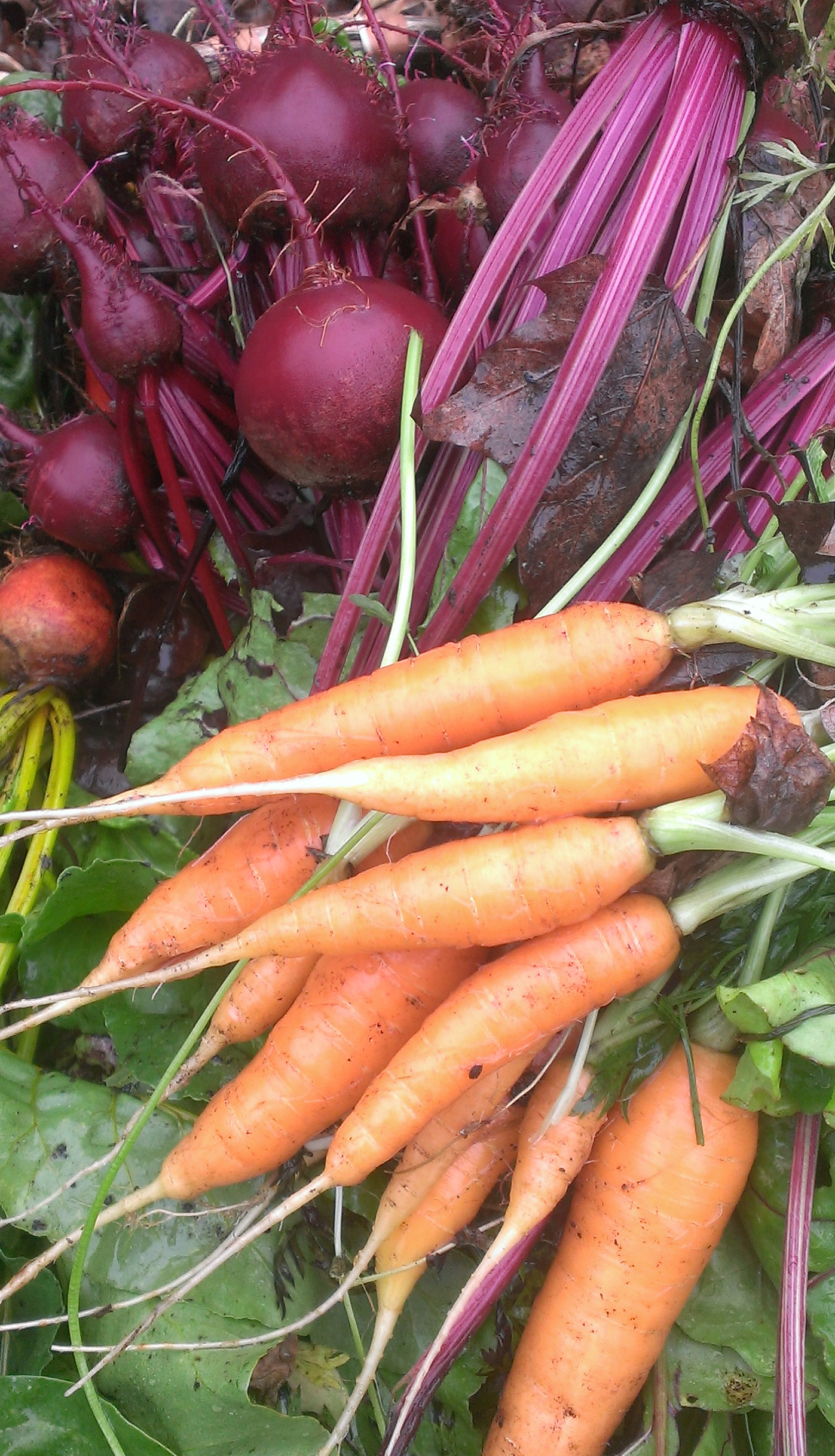
The garden, the orchard, the bees each reward us: tomatoes, carrots, onions, apples, cherries, pears, honey.  A virtuous circle, we care for the soil and the plants and the trees and the hives, they in turn offer something we can eat.  Eat.  Think of that.  This is the true and definitive instance of transubstantiation.   Eat this cherry and remember me.  Eat this IMAG0956cropped1000carrot; it becomes me.  It becomes me to eat this carrot.  The soil and the plants here give of themselves that I may not perish.

Thus, to be among them, feeling them pluck at me, rain water dripping off them onto me is a coarse prayer, a baptism by holy water made clean and pure in the clouds then delivered unto us by the morning rain.

Amen.

Jelly Fish. They’re Back! And After 550 Million Years, Returning to Prominence

Lughnasa                                                          Harvest Moon

Here’s an ecological problem I’ll bet you’ve not heard about unless you’ve traveled by Linblad ships recently.  Maybe not even then.  Read the whole review, well worth it, at New York Review of Books.

(Box Jelly, aka, the most poisonous creature on the planet.)

“From the Arctic to the equator and on to the Antarctic, jellyfish plagues (or blooms, as they’re technically known) are on the increase. Even sober scientists are now talking of the jellification of the oceans. And the term is more than a mere turn of phrase. Off southern Africa, jellyfish have become so abundant that they have formed a sort of curtain of death, “a stingy-slimy killing field,” as Gershwin puts it, that covers over 30,000 square miles.”

quote from:  Stung! On Jellyfish Blooms and the Future of the Ocean
by Lisa-ann Gershwin, with a foreword by Sylvia Earle
University of Chicago Press, 424 pp., $27.50

Herbicides

Lughnasa                                                                     Harvest Moon

I use herbicides sparingly, for problems I can’t eliminate by hand.  Those problems include an invasion of rhizomatous creeping charlie, poison ivy and the stumps of felled trees.  The creeping charlie (no relation) was a mistake on my part.  I didn’t recognize it and advised Kate not to pull it when it could have been controlled.  Somehow it got over a large section of ground.  I sprayed it this morning.

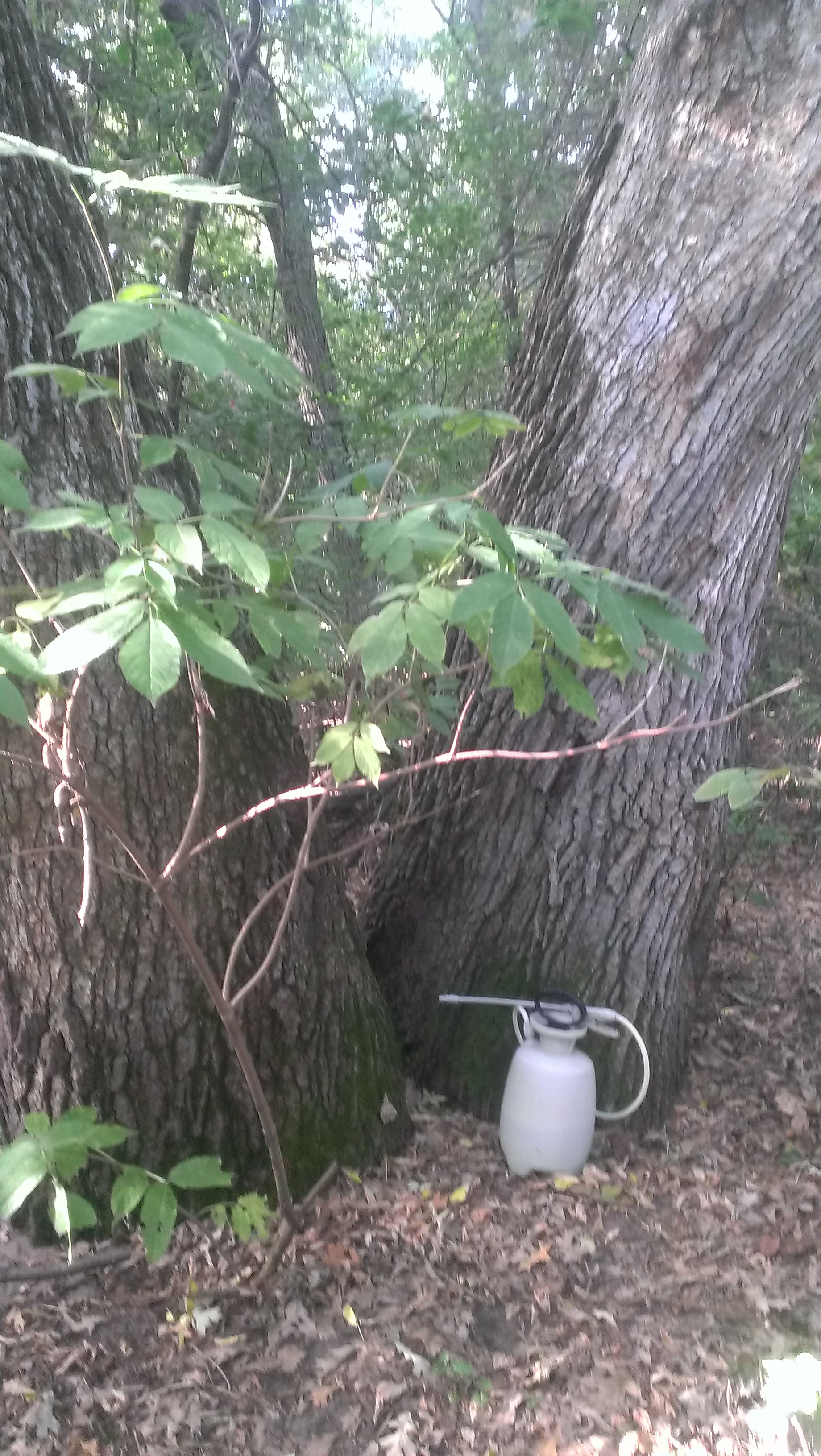
Poison ivy.   My earliest adventures with industrial strength herbicides (triclopyr) began soon after IMAG0944our purchase of this property.   Doing research I discovered Rhus radicans likes the ground around oaks.  We have lots of oaks in our woods.

My first efforts with roundup (glyphosate) had no effect.  Ha, ha.  Like rain water to me.

The first time I used triclopyr, as brush-be-gone, a dilute solution sold for ornery shrubs and could-be-tried as adult weeds, failed, too.  Back to the research.  Ah.  The best time to spray them is in the fall when the plant stores energy in its roots for the coming winter season.

(Gog and Magog)

Today (it’s fall, you may notice) I sprayed the creeping charlie because of this information.  I also went hunting poison ivy. I’ve been after it off and on for 15 years.  This year I had trouble finding any.  A good sign.  The ones I did find I coated leaves and stems.  The word on triclopyr is that it vanishes after three months in the soil.  You don’t want to use it around things you want because it’s effective.

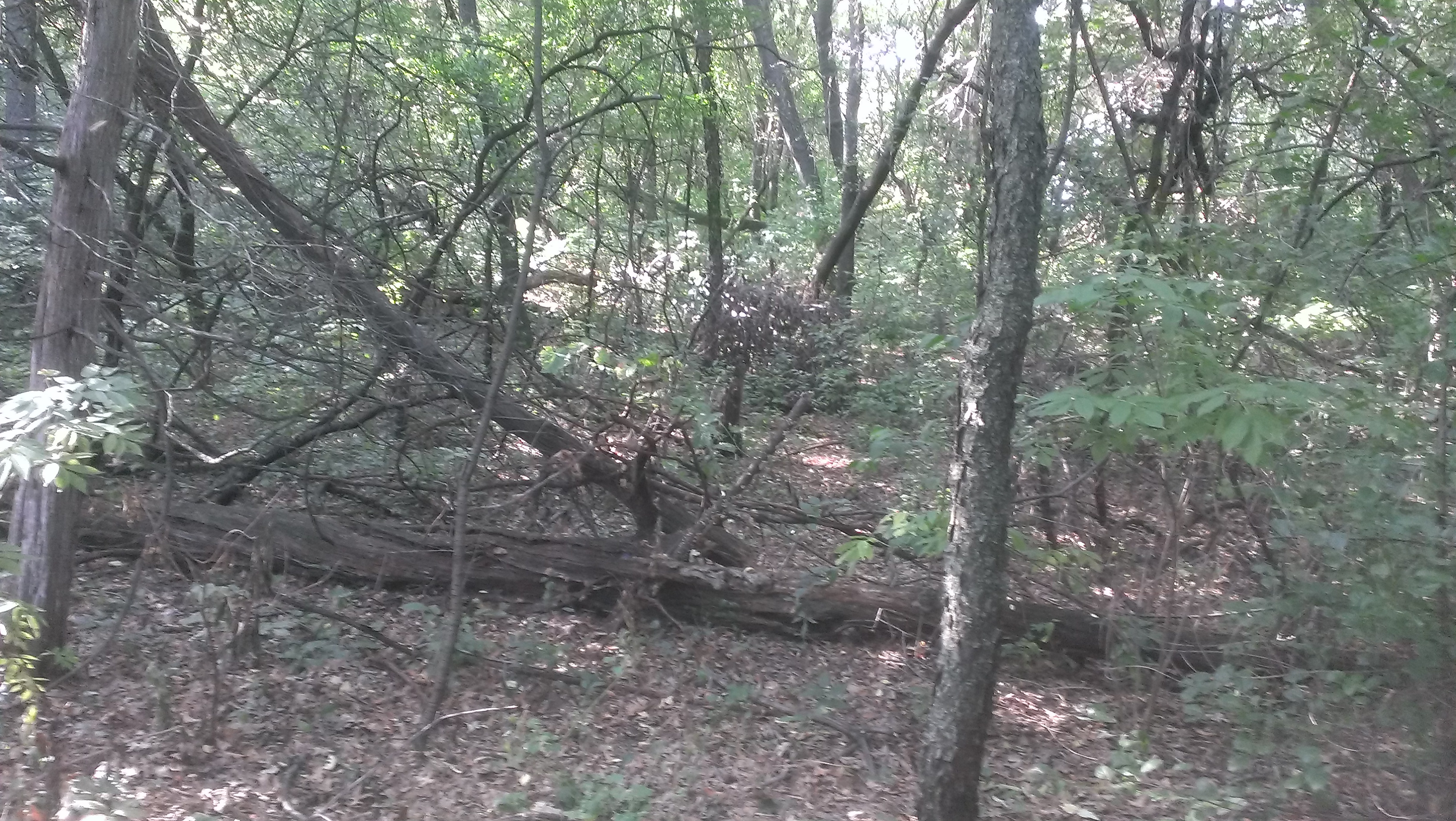
Last I’ll use it on stumps.  The problem with stumps, especially ash and black locust is IMAG0949that the tree immediately sends up new treelets to replace the missing one.  Unless you grind the stumps, which I no longer do, you’ll have a clump of new trees instead of an eliminated old one.  I don’t cut down many trees, but when I do it means I have a specific purpose in mind:  more sun for a growing area, more space for the bees, an area for our fire pit.  New trees are not part of the plan.  Using a paint brush to coat the stumps with triclopyr, a less dilute version than brush-be-gone, solves the problem.

(in our woods near the big oaks, Gog and Magog)

In all cases I use integrated pest management to reduce and/or eliminate the need for pesticides.  I use hand removal, physical barriers like landscape cloth and careful selection of plants to reduce the need for herbicides.  I don’t like using them, but in some cases I’ve not been able to come up with other solutions.

Soil Test

Lughnasa                                                                     Harvest Moon

Soil tests create the information base for deciding on what products and what amount of soil testthem to use next year.  Fall is the best time to do them since the broadcast fertilizer can be laid down before winter.

I used a clean trowel, a plastic bucket and my knees.  To do a soil sample involves a clean cut into the soil of six inches, then a small slice of that cut, top to bottom, into the bucket. This process repeats several times in different areas, then you blend the soil and take 1.5 cups of it and put it in a plastic bag.  I did this twice, once for the vegetable garden and once for the orchard.

A soil test sheet, provided by International Ag Labs, takes down garden size and what kind of testing you want done.  That all gets mailed to lab in Farmington and a while later, a recommendation comes back with very specific amounts and products.

My dealer, Luke Lemmer in Plato, Minnesota, will compile the broadcast according to the labs recommendations and will also supply the other products.  The soil test goes in today.

Midwest Grimoires

Lughnasa                                                                  Honey Moon

Finished spraying.  As the crops come in, the amount of spray needed diminishes.  Today I really only needed the reproductive spray because the remaining vegetables are mostly in that category:  tomatoes, ground cherries, egg plants, cucumbers, peppers, carrots. Granted there are a few beets, some chard and the leeks yet to harvest but they seem substantial already.  They also benefit from the showtime, nutrient drenches and the enthuse that I will spray on Saturday morning.

Kate roasted the broccoli and froze it.  She’s also making pickles today, cucumber and onion.  She’s in back to the land, earth mother mode and has been for several weeks.  She consults her canning, pickling, drying, freezing books like grimoires from calico clad wise women of the rural Midwest.  And does likewise, tweaking the recipes when she wants.

The Everyday Wonderful

Lughnasa                                                                    Honey Moon

The environmental community has a new addition, Arthur Levi Neilsen, born today.  8.5 pounds, 21.5 inches to Greg Neilsen and Margaret Levin.  Margaret is the executive director of the Northstar Chapter of the Sierra Club.  Congratulations to Greg and Margaret!

Grocery shopping today for the first time in a long time.  Kate’s been handling that for a while, seeking deals quite successfully and saving us money.

It’s been a domestic week for team Olson-Ellis with the honey extracted and partially bottled, excess books taken to Half-Price books and sold and multiple cans of paint and other hazardous waste accumulated over many years taken to the Anoka County hazardous waste pickup.

Now kicking back and enjoying the slow ride toward misplaced heat.  The heat has, however, made rendering the wax from our cappings a breeze.  We have a tupperware container full of bright yellow, clear, wonderful smelling wax.  A treat.


Medicating Mother Nature

Lughnasa                                                                         Honey Moon

Quiet has fallen here, though the temperature has not.  9 pm in late August and the temp outside is 75, the dewpoint 65.  And we’re heading into a week of high dewpoints and temps above 90, Friday right now comes in at 96.  This is the time when we start to cool down, head toward fall, this year, no.  As Paul Douglas, local meteorologist said in a recent column, “Mother nature needs to be medicated.”

As things calm down and drift back toward normal, I’ll look at the edits the copy editor made on my sample pages.  He charges $20 an hour and estimates 50 hours for the book, so that’s $1,000.  That’s a lot, yes, but to put the final polish on the manuscript before it goes to agents and publishers, probably worth it.  But I have to believe he’ll deliver.  That’s why I want to check the edits carefully.

After the nap today, I began to feel rested again.  The bee vacation has begun to recede though I did spend some time today looking at candle making videos.  The candle mold I purchased makes 8 tapers.  I also bought 100 feet of wick, so I’m ready to go as soon as the wax rendering is complete.

A Co-op

Lughnasa                                                       Honey Moon

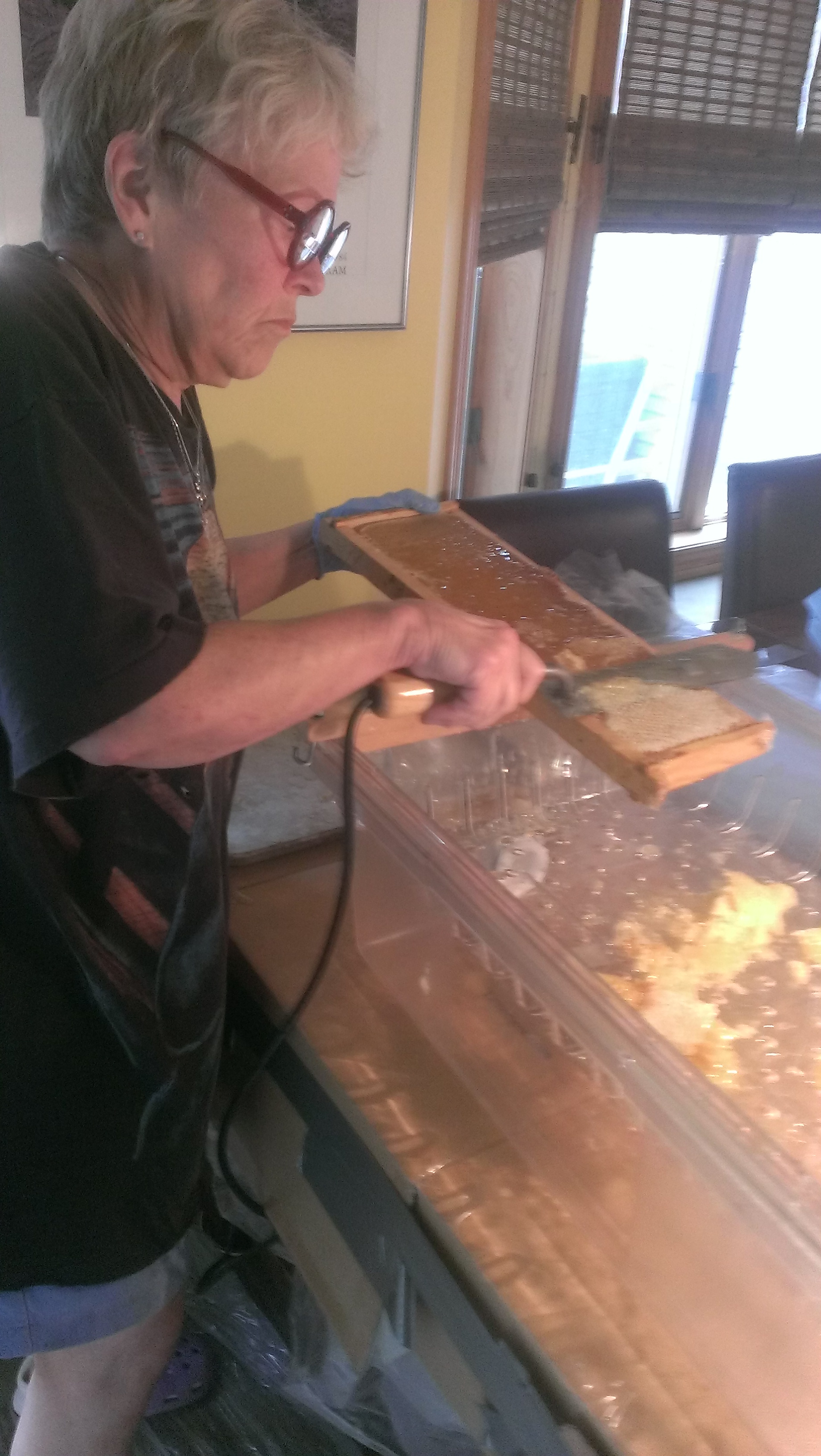
On a few occasions yesterday bees who had not left the supers buzzed about the kitchen as the extractor whirred and Kate ran the capping knife over the frames.  Each time I encouraged these bees to exit through an opened door and in all but five cases they found the way out.  In those others we caught them in plastic containers and freed them.  Two died, one caught in the door and one I don’t know why.  These bees are our partners in Artemis Hives and deserve respect and kind treatment.  Even if they don’t always show me the same.

It’s a repeated observation, but it’s unusual enough that I’ll make it again.  Kate and I share this property with a whole host of other animals who make their home here.  Chipmunks are the most visible mammals, but we also have gophers, rabbits, opossum, raccoons, squirrels, woodchucks, mice, voles and I have seen at least one marten though I realize he was far from his range.  I mentioned the other day snapping turtles transiting our woods, but we have other amphibians like frogs of least two kinds and toads.  Snakes, salamanders, and skinks live here too.  Many birds are at least here occasionally:  great-horned owls, crows, pileated woodpeckers, red-headed woodpeckers, chickadees, cardinals, blue jays, rose-breasted nuthatches and wild turkeys.  Deer and coyote come through our land from time to time, though it’s been awhile since I’ve seen deer.

This list doesn’t include other very important organisms in the top six inches of the soil and the other plants, from perennial flowers to vegetables.  Our woods has many oak, ash (so far), elm, ironwood, cedar, black locust, poplar and, of course, buckthorn.

It is so easy to imagine that we own the land, but it just isn’t true.  We have a temporary use permit, a years long pass to erect a human dwelling on already inhabited premises.  This permit comes from other humans who might want to do the same; it’s a rule of exclusion, keeping other humans away, but it has no effect on these other tenants.  They come and go as they will, choosing their homes in the ages honored way of finding a good nest site, an excellent burrow, a place to raise young under the shelter of a shed.

All we humans can do is enhance or destroy those options.  We don’t create them, maintain them or put them up for rent.  They are the last and true commons, that portion of the earth still used as it was long ago before the scourge of private property.  We only imagine we own it.


Visiting the North

Lughnasa                                                         Honey Moon

The full Honey Moon has an amber cast tonight, appropriate for our work tomorrow and Wednesday.  Driving back from Wayzata it hung high in the sky, clouds passing before it.  It was warm, 80 degrees when I left the retreat center and the Woolly meeting there.

Tom showed a DVD from his trip to Svalbard.  It was a stark but beautiful land and sea and ice scape populated with curious polar bears, blubbery walrus and ring seals.  The ring seals only show up on this DVD as the meal of a large male bear.  The video of a polar bear suckling her cub was, according to a Swedish polar bear researcher, unique.  He’d never seen it before and, interestingly, said he never expected to see it again.

There was, too, the story of ocean open months earlier than normal, of the pack ice decline separating the polar bears from their main, almost exclusive food source, the ring seals and the staggering potential of upsetting the theromhaline cycle if Greenland melts. This could shut down the Gulf Stream with a cascade of unknown effects.

We went on from there to discuss superstitions and masculinity.  I had a sense that the conversation about masculinity per se, oddly a subject only lightly discussed among the Woollies over the years, might hold more for us at some other point.

It was, as always, good.


Prairie on my Mind

Lughnasa                                                              Honey Moon

I have an itch that I’ve waited now some twenty years to scratch and it may be about to happen.  When we moved in, I wanted to nix the lawn and sow prairie grass instead.  Now Kate is open to replacing most of our lawn with prairie grass and perhaps some new tree plantings as well.  I say open because she’s agreed to think about it.

We already have two large swatches of prairie on either side of our lawn, our compromise as we did the initial landscaping.  This notion came to me again while I walked in the eastern side of prairie grass and realized how at home and comfortable it felt: insects buzzing around, wildflowers blooming, a few trees popping up, milkweed ready to burst its pods.