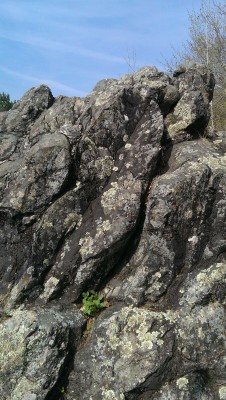
Long ago native to this place

Beltane                                                                               Beltane Moon

Up early today. Too early. 3:00 am. Sigh. Still, got blogging done, e-mails sent and my high intensity workout in before leaving for my first Native Plant Master class in Morrison’s Mt. Falcon Park.

On the way I got gas at Conoco rather than the Loaf and Jug (Rumi, Omar?). I did that because I wanted a breakfast burrito from the best breakfast place in town according to reviews. But when I pulled up, the best breakfast place in town was gone. Not there. Vanished. Disoriented me for a bit, even though it was a food wagon. Not sure where it went, but I found it disconcerting to have an entire business, one I’d seen frequently since we moved here, disappear. Not to mention that I wanted breakfast and now no longer had time to stop elsewhere.

The dewpoint/temperature convergence coupled with lots of moisture in the air gave the mountains long tendrils of fog slipping through the pines and white crowns like so many of my friends. Atypical. The effect is very schwarzwald. This could be Bavaria.

In Morrison I turned off 285 North, which heads into Denver, and onto Colorado 8. It goes into Morrison, passing by the Fort, the adobe restaurant I mentioned some time back. Just a mile or two past the turnoff for Mt. Falcon Park where I was headed is the well known Red Rocks Amphitheater.

These Coloradans are a hearty group. Every one came with a backpack, obviously used before, rain gear, hiking boots and some had water repellent, zippered pants over their regular pants. One young woman, recently moved here from North Carolina, had bananas, clementines and granola bars stuck in several mesh pockets.

I say hearty because we each dutifully consulted our Colorado Flora field guide, our plant identification list and the Native Plant Master guide for Mt. Falcon Park (these last two distributed this morning as course material) in the constant and, at times hard, rain. It rained as we investigated a pretty five-petaled plant whose flowers change color after pollination. It rained while we investigated the shrub with trumpet shaped flowers that stood next to it. It poured down rain as we used Colorado Flora to narrow down the two species of cypress that stood next to each other.

Further along the trail, yes, it rained, we found a vetch, one of two species of the pea family we looked at. Vetch takes up selenium from the soil and concentrates the mineral in its stalk and leaves. Horses and cows get the blind staggers from the selenium so, though a native, it’s an unwelcome plant in pastures. Plants that take up soil minerals and concentrate them in their stalk and leaves have created a new discipline, geo-botany. Geo-botany uses plant analysis to find places where toxic minerals are present in the soil.

Did I mention it rained? All the time, from moderately hard to pelting. Not a usual Colorado problem. This is an anomalous May, though May is usually wet. So I’m told.

We had a recently retired geologist in our class. We stopped among shrubs and short trees for a snack. He noted that was a geologically important spot. The Fountain formation, red sandstone and crumbly red shale, the same formation that makes up the Red Rock amphitheater,  gave way to the granitic rock of the true Rocky Mountains only 5 or 6 feet away. “This means we go,” Tom said, “from 250 million year old sandstone to billion year old rock.” To the east the sandstone, remnant of a much earlier mountain range, covers the same billion year old rock exposed during the Laramide orogeny, the mountain building episode that formed the Rockies.

Since Kate had a pacemaker appointment, I had to leave early. I was not unhappy though I look forward to the next class. May it be dry. Of course, then it might be hot.


Beltane                                                             Beltane Moon

Hmmm.

“Snow for the northern and central mountains is looking like a sure-bet, and with that the National Weather Service has issued a Winter Storm Watch which goes into effect Saturday afternoon and continues through Saturday night. Heavy snow at elevations >8,500 feet for the northern and central mountains will add up to 10 to 20″ by Sunday morning. If your plans take you into the mountains Saturday afternoon, please plan for winter driving conditions.”  weather5280

Minnesota Gneiss

Beltane                                                                Beltane Moon

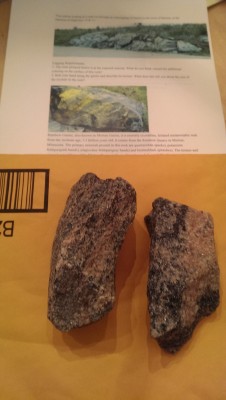
IMAG1496There’s history, pre-history, then there’s a really, really long time ago. Friend Tom Crane sent these two chunks of Morton gneiss.* I think he wanted me to have a marker stone for the oldest rock in the U.S. Thanks, Tom. They’ve gone on the rock wall before the Ely greenstone** we collected last week.

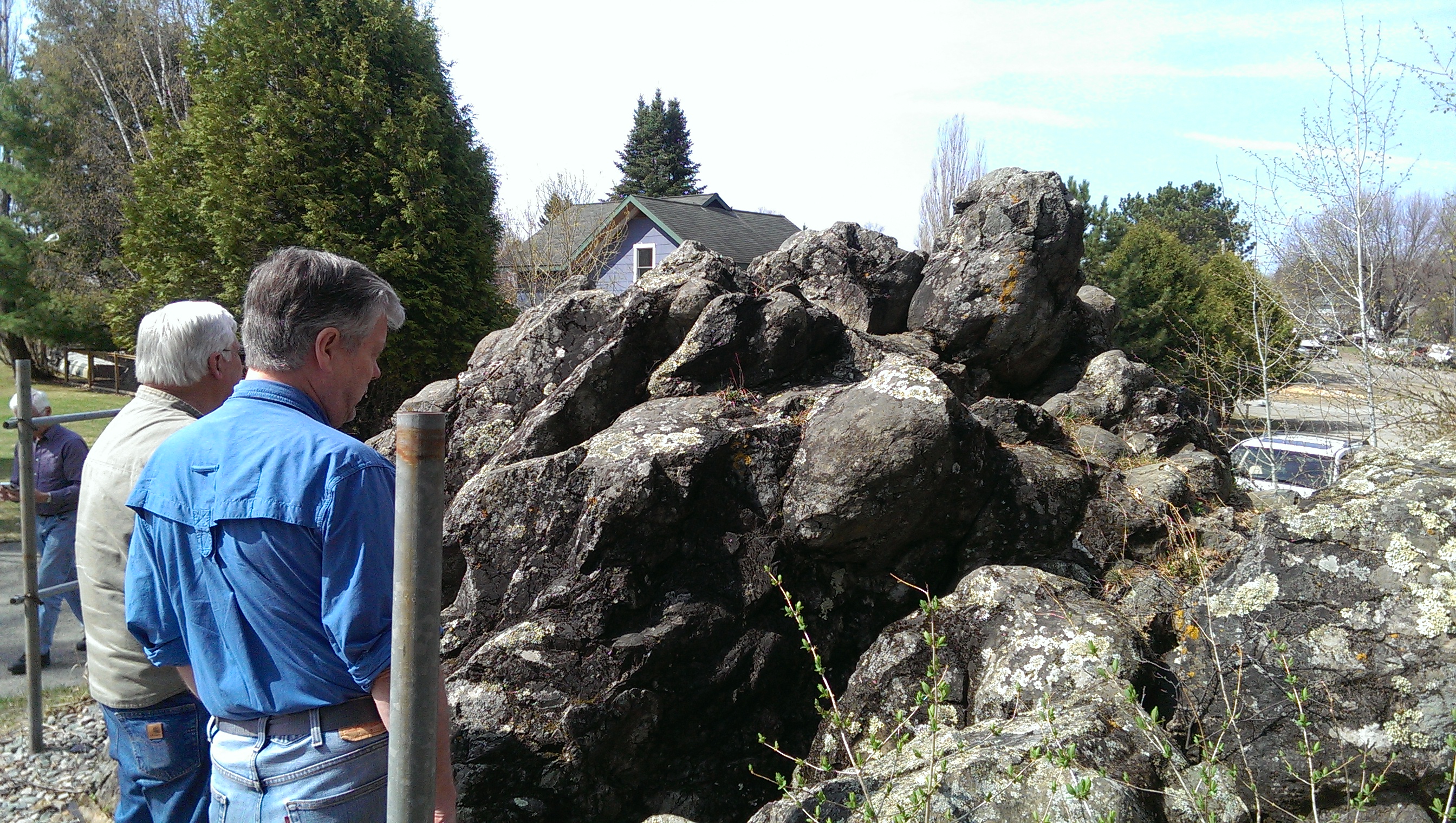
We visited the Ely greenstone outflow in Ely together last Sunday after the Woolly retreat.

The ability to touch this hardened time is a remarkable opportunity. The past is always with us.

Our body is the Morton gneiss of our deep past. It carries in itself memories of formative events we have long forgotten. There is a debate about the continuity of the self, one side seeing it as a narrative stitched together to explain our existence, but non-essential. The other side, my side, sees the self as a current manifestation of all the moments that have shaped us, plus an ineffable emergent quality that makes us more than the sum of our parts.

The dense, hard bones of mother earth support the efflorescence that is the biosphere. This living, breathing outer layer is, likewise, an emergent property. It is not, said another way, predictable from the original constituent elements of planet formation. Thus, the entirety of earth’s vital children evidence the earth’s own selfhood.

This is not the gaia hypothesis which sees the earth as an interdependent system of systems. It is, rather, an attempt to position the evolution of our planet from Hadean times, the earliest period of earth’s formation, as a mystery, yet one with known parts.

The mystery is that these parts formed at all from the detritus of the big bang. The mystery only deepens as evolution proceeds and creates a wanderer that follows a repetitive path. As geologic changes shaped the early continents and reshaped them, another, profoundly deeper mystery occurred. Somehow, life. From inert gneiss and greenstone and all the other truly ancient bones, came a quickening in the vast waters that covered most of the surface.

In my opinion the revealed self of this particular cosmic location manifests in this most peculiar change, one in which the earth begins to move, root, swim, run, think. I am not trying to anthropomorphize the earth. It doesn’t need it. It is as it has become, a thing sui generis, unique in our solar system, maybe in our galaxy. Who knows?

Old Mammoths stare at 2.7 billion year old rock formation, Ely Greenstone

*”Archean crystalline basement rocks are exposed at several places along the Minnesota River valley in south-central Minnesota. These rocks are mostly gneisses of various compositions along with other igneous and metamorphic rocks.

Left: exposure of mafic gneiss at Granite Falls beside the Minnesota River. Right: closeup view of pegmatite vein within the gneiss at Granite Falls.

Among these ancient rocks, the Morton and Montevideo gneisses are the oldest whole-rock continental crust in the United States. Many attempts to date these rocks using various radiometric techniques have yielded an age ~3.5 billion years old (Goldich, Hedge and Stern 1970; Bickford Wooden and Bauer 2009).”   Morton gneiss

pillow rock (lava extruded under water) Ely greenstone, Ely, Minnesota


**”The lakes of the BWCA were carved from Precambrian bedrock of the Canadian Shield by advances of ice sheets during a succession of ice ages during the past two million years. Many varieties of this ancient bedrock are exposed, including granite, basalt, greenstone, gneiss, as well as metamorphic rocks derived from Precambrian volcanic and sedimentary rocks. Greenstone located near Ely, Minnesota is up to 2.7 billion years old. The size and shape of most lakes in the BWCA are dictated by the bedrock, due to the ability of glacial ice to erode softer and weaker rocks more easily, creating depressions later filled with water.”  canoetrip.com