Imbolc Valentine Moon
Well. That happened. The 70’s.
I remember that decade as a time where great rock went to die and when the movement began to decline. The reaction against the cultural revolution, hippies and back to the land and free sex and rock and roll and feminism and black power, began to gain momentum. Last year, on November 8th, we saw the culmination of that fulmination. And, it’s ugly.
I’ve asked myself many times in the intervening years whether the 60’s were a mistake, a wrong turn, excess turned into a political rationale. There is no easy answer. Yes, excesses were common, drugs and sex in particular. Some of them though pushed us past the traditional barriers erected by our parents and the people in power. Those excesses allowed us to fight a weighty establishment which had sat on freedom for women, for blacks, even for soldiers caught in a miserable foreign policy, for decades and in some cases centuries.
Today we have the revenge of the cis-gender, straight, white, males and their allies. Shunted aside in the rush for liberty from traditional sexual and racial mores, these folks heard a man who claimed to understand their situation. To them, making America great again meant a return to a time of unconscious and unearned privilege, a time when they had good jobs and could support their families.
As I’ve written here before, how you define is how you solve. These folks see globalization and line-jumping as the primary source of their woes. Not that simple. Automation turns out to be the culprit. We’re manufacturing more than ever before; we’re just doing it with many fewer employees. Shaming corporations into leaving plants here will not do the trick, neither will tariffs on imports. We need a complete rethink of work, of the social safety net, of our common obligations to each other.
If we consider the 60’s as the thesis and the 50 years or so since then as the antithesis, we may now be moving toward the synthesis. That, I hope, is what the next decade or so will bring. I’d love to see the new culture arising from this dialectical struggle, so I hope it begins to take shape before I die.





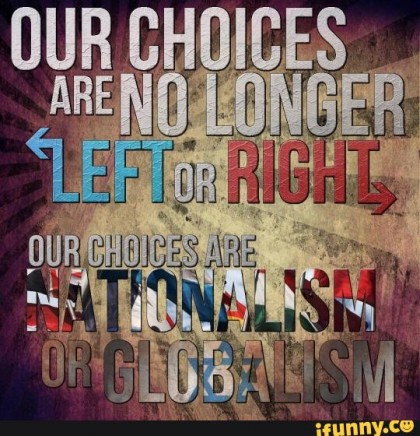 First, the main struggle right now, in both Europe and here, is between globalists, people like me, and blood and soil nationalists, like Trump’s America First. It’s not an either/or, of course, but most of us tend to lean toward one end of a continuum, more concerned about home or more concerned about the world as a whole.
 The bleakness is the lack of good-paying jobs for those with less education. The punishment comes from seeing others getting in line ahead of you for the American Dream. This line-jumping (Hochschild’s analysis), as it is perceived by white working class folks, has been created by the left’s very successful focus on identity politics: women’s rights, LGBT rights, civil rights. Put these two together, the bleakness and the punishment, and it’s no wonder we have a reactionary revolt underway, just look at your Facebook feed for proof.
 Fourth, after reading Hochschild’s book, I’m no longer convinced that a focus on economic policies will adequately address the working class movement toward nationalism. I say this because
  Woke thinking about the subtitle to the book Strangers in Their Own Land: Anger and Mourning on the Right. I realized I knew this one from personal experience.