Honoring the Aspen, Tree #1

Beltane and the Shadow Mountain Moon

This is the first entry in my honoring the Tree mussar practice. I will post these as I do them.

My kavanah, my intention, is to enhance my capacity for honoring all things, all Earthlings. Including humans. In this honoring means paying attention, close and uninterrupted attention. Seeing the other for what they exhibit, to imbibe their uniqueness and their interconnectedness. This uniqueness has many names: Buddah nature, soul, highest potential, essence, wholeness, image of God. In seeing the sacred reality of this Aspen I am in turn seeing my own sacredness in the process of seeing the Aspen.
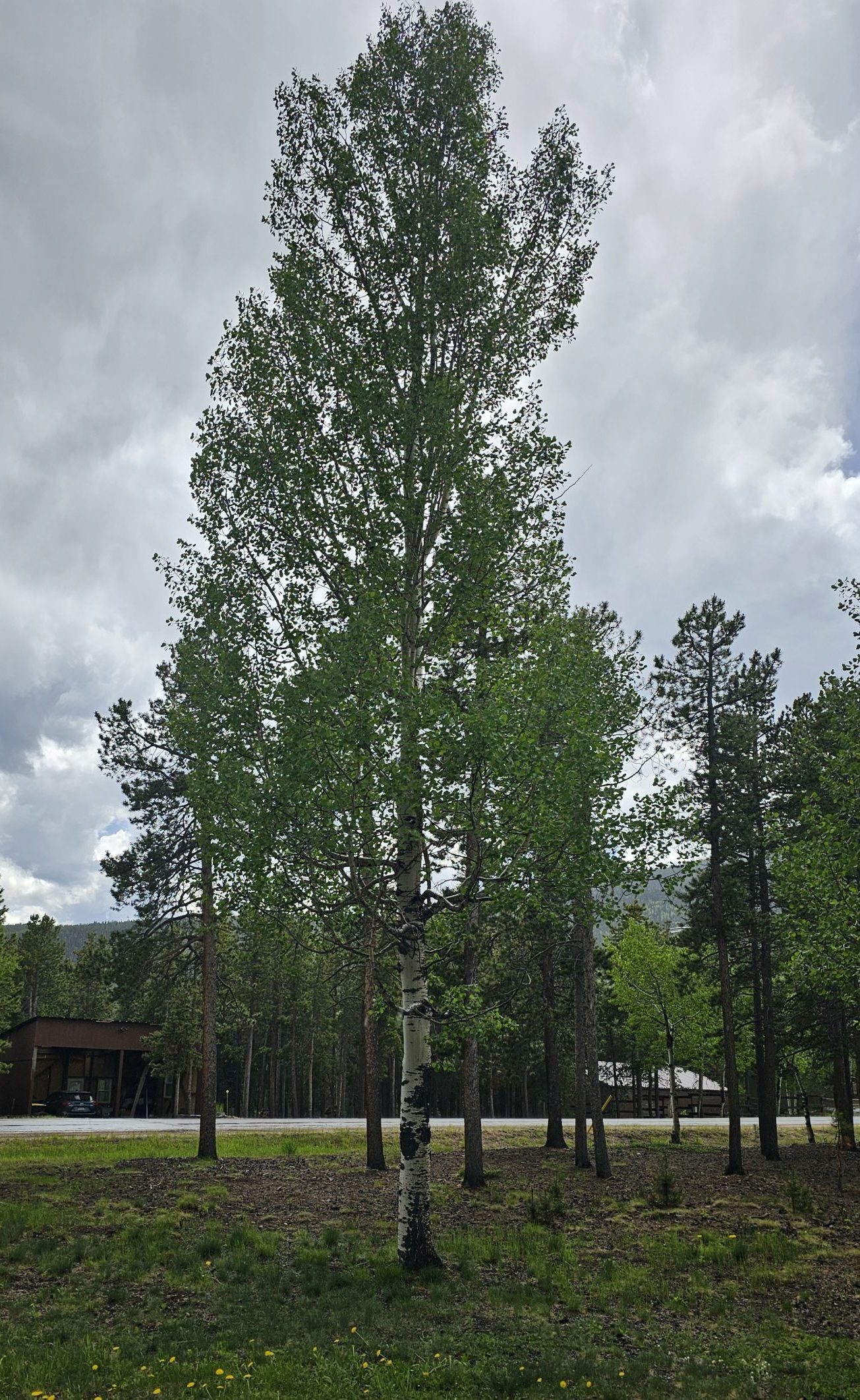
 

When we first moved here on the Winter Solstice of 2014, this Aspen had no leaves. Tiny shoots of its clones were hidden beneath the Snow cover. But they were there.

Nine and a half years later I went out today, out front since this Tree is in the front. As I walked up to it, I noticed its Trunk’s variation between a smooth gray Bark and a wrinkled black Bark. As if the Tree could not make up its mind. I’m curious now as to the purpose of the two different types of Bark. A Spider and an Ant crawled over both smooth and rough, unconcerned.

My hand found the change in textures though they seemed more graduated with touch. The smooth Bark had some grippiness to it and also contained small raised bumps of the rougher black Bark. When I walked around the Tree, I noticed at its base a large scar, black Bark that looked like a Fire scar. Doesn’t make sense to me, but it’s a distinctive feature of this Tree and a reminder that its journey has not always been easy.

Looking straight up the Trunk toward the Leader reaching for the Sky the Bark got smoother and smoother as it went up and the Trunk got smaller. Could it be that a certain girt stretches the smooth Bark far enough that it separates and allows the rougher Bark to form? If so, why?

The most striking feature of this tree for me, on this sunny Colorado Mountain morning, danced on the ends of short stems, quaking this way and that. Throwing shadows on the Leaves behind them, then fluttering out of the way. Leaves in groups of five opened and closed each others access to Great Sol’s brilliance.

The interplay of light and shadow these Leaves put on would make a great Calder sculpture. The shifting moving Leaves were beautiful. As beautiful as any work of art in a museum.

While being beautiful, they also perform Mother Earth’s true miracle, light-eating. Turning photons into sugars. The sine qua non for all complex life on this planet.
Rebels

Beltane and the Bar Mitzvah Moon

Friday gratefuls: Shabbat. Bar mitzvah decisions. Regaining confidence. Purpose. Shekinah. Trees. Great Wheel. Great work. Rabbi Jamie. Zornberg. Mordecai Kaplan. Mah Tovu. Mussar. Luke and his passion. Leo. A long immersion in matters Jewish. Alan and First Watch. Diane and the Sea Lions of Fisherman’s Wharf. Mark and Bangkok. Familiar turf for him.

Sparks of Joy and Awe: Mordecai Kaplan

One brief shining: We sat there around his circular table, his library wall filled with texts in Hebrew as well as English, Rabbi Jamie and me, he showed me the Haggadah by Mordecai Kaplan, this one got him excommunicated, oh, my attention piqued, I’ve got to have one I said because I love stories of rebellion and its consequences.


Finished reading all 2,000 plus pages of Romance of the Three Kingdoms. A significant classic of Chinese literature. And a good read. Took a while. One takeaway from it. Rebels are the bad guys. The guys who support the Emperor are the good guys. This was an important learning for me since we Americans valorize the rebel, the American revolutionary. Our country was born in rebellion whereas China’s civilization honors it long, continuous history.

The mandate of heaven takes the place of the rebel. So long as an Emperor could claim the mandate of heaven*, he could rule. But, if he lost the mandate of heaven**, it became the people’s responsibility to overthrow him and usher in a new dynasty. Even in this case though the rebel served the new dynasty to be born from the old one. No experimentation in political form.

I admire Mordecai Kaplan and his willingness to follow his own thinking, to de-supernaturalize Judaism and to demote tradition from decider of all questions to a factor with a vote but not a veto. I love the expectation of debate, of doubt, of honoring the other’s perspective. Kaplan and my kind would not fare well in Chinese culture. Either under the old dynastic pattern or under the very similar Chinese Communist Party. Rule from the top down is the Chinese way.


Just a moment: A bit about the Caitlin Clark story. Yes, she’s a whitebread Midwesterner playing in a state, Indiana, that has not been celebrated for its moves towards racial justice. Yes, she’s touted as the next big thing that will push the WNBA higher up in the world of professional sports. And, most important, yes, the media has portrayed her first games as a pro with the breathless and hyperbolic ideas that often accompany writing about a new sports superstar.

She’s getting knocked around, shoved, posted hard. Many of those playing her like hockey enforcers are black. So villainous? Right? How dare they play hard against the white savior of their sport? Isn’t that self-defeating for women’s basketball as a whole?

No. The opposite is true. Were Caitlin given kid glove treatment she would never have the chance to mature into a true star. This hazing, some no doubt with malice, shows she’ll get no special favors on the court. That her game has to take over at a high level or she’ll remain a journeywoman player.

Should intentional fouls be called? Of course. There’s no excuse for casual violence in any sport. Well, ok, MMA. Otherwise, let everybody play their game.


*…the Mandate of Heaven was that although a ruler was given great power, he also had a moral obligation to use it for the good of his people. If a ruler did not do this, then his state would suffer terrible disasters and he would lose the right to govern.  World History Encyclopedia

**The sign that the mandate had been lost would be made evident by all kinds of calamities including natural ones: earthquakes, storms, solar eclipses, floods, drought, famine and plague. Other signs could be a more personal evidence from the emperor’s own behavior: cruelty, corruption, military defeat and incompetence. These were all interpreted as signs of the displeasure of heaven. To rise in rebellion when these signs occurred was justified. ChinaSage