Taller than its neighbors at Elk Meadow Park, Tree #3

Beltane and the Bar Mitzvah Moon

Occurred to me today that I can honor any tree I want. Doesn’t have to be in my yard though I imagine the bulk of them will be.

Today I had a blood draw in Evergreen so I drove up Stagecoach Road to one of the many trailheads for Elk Meadows Park. Got out of the car and walked over to the main path. On the left side of the main path was a stand of Lodgepole Pines. Though the elevation was only 7,700 feet they seemed to be doing fine.

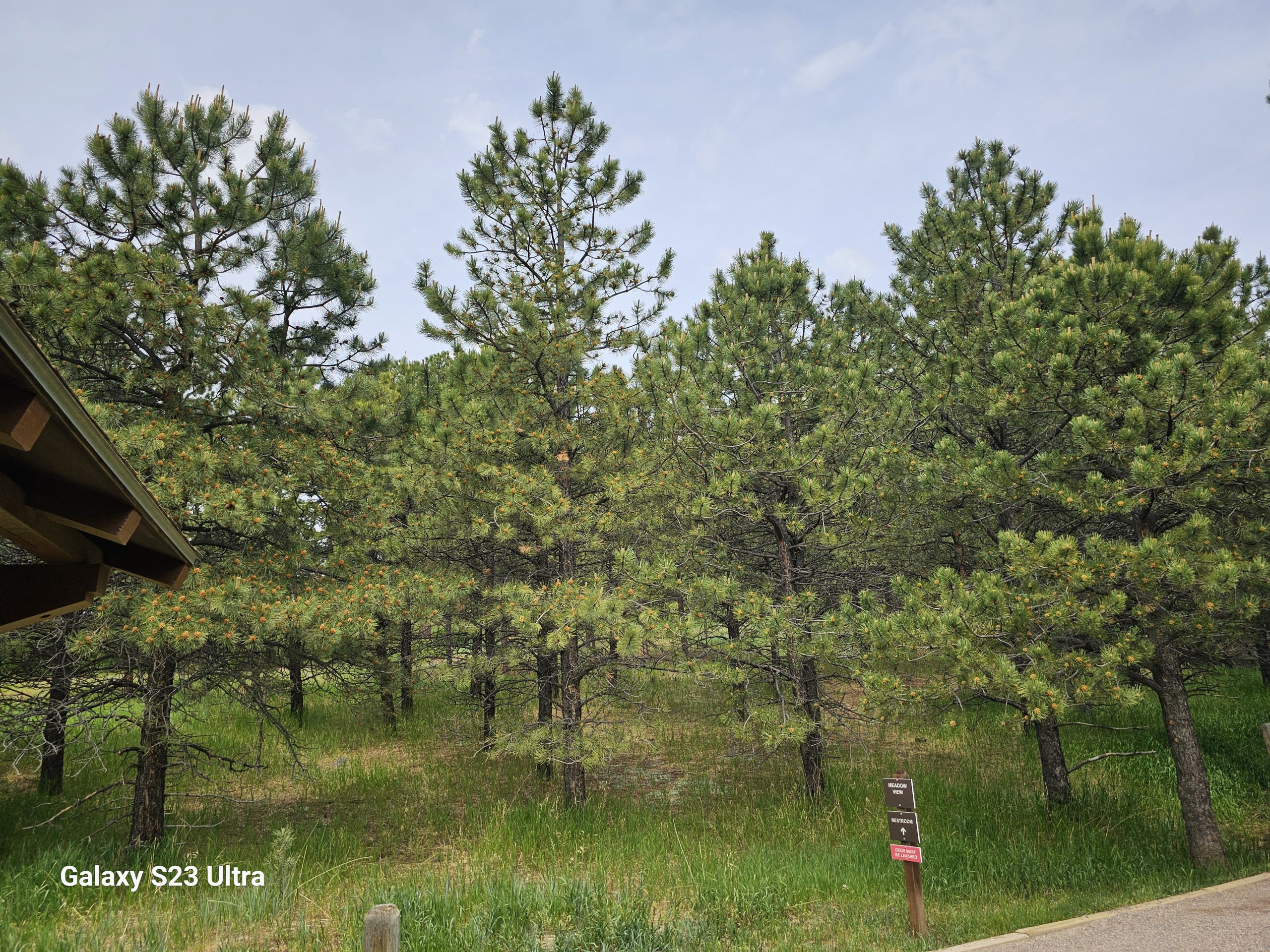
Probably influenced by reading Wild Trees I chose the tallest of those in the grove for my honoring.
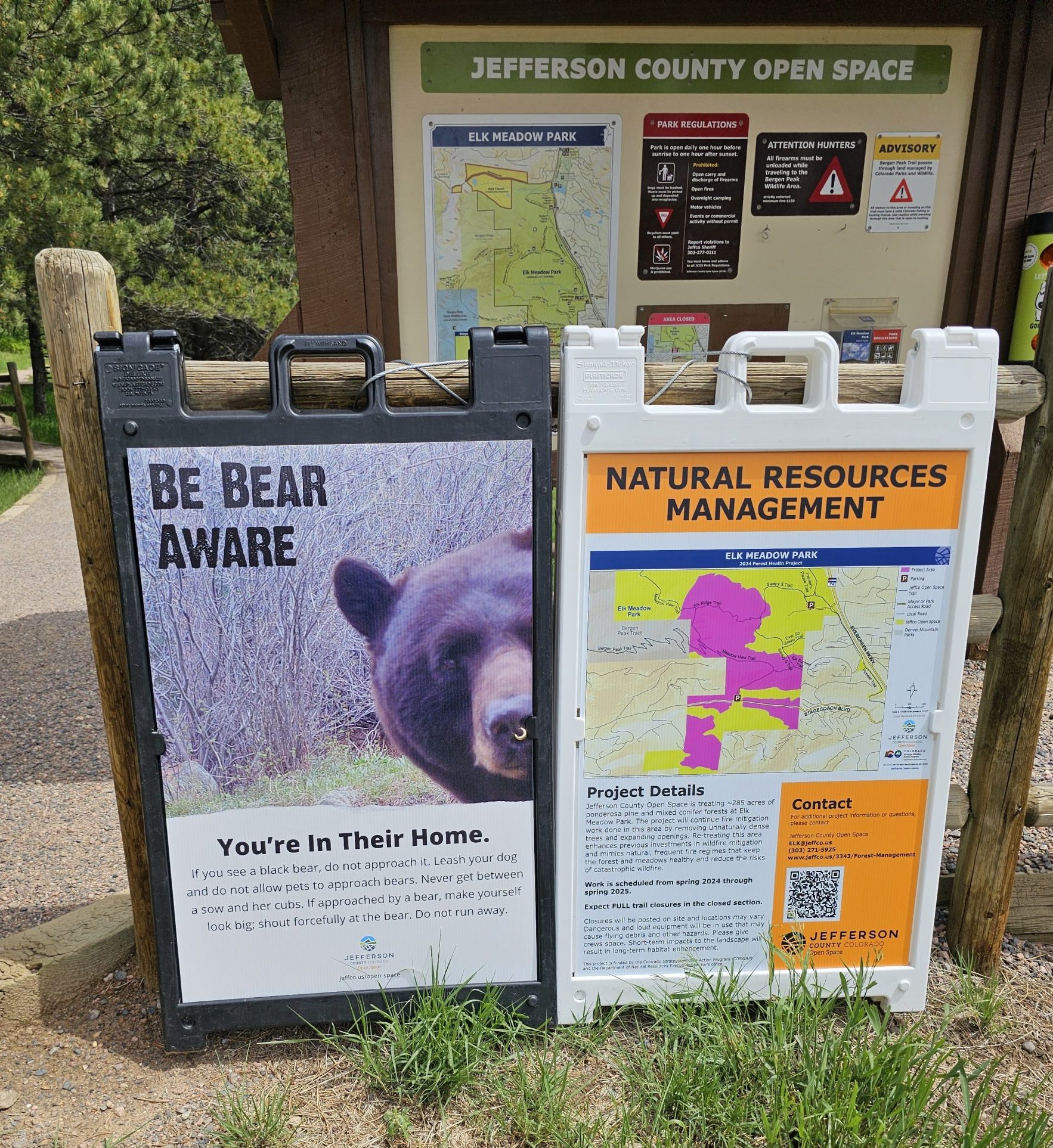
A sense of the Park
The tallest in this shot

This Tree grows in a small Grove on a slightly sloped area. A Colorado Forestry website says Lodgepoles prefer a slight slope and this Tree has found one. Like my Lodgepole Companion most of their Branches push out from the Trunk toward the Southeast. Also like my Companion this tall Lodgepole has almost no branches toward the Northwest.

Its lower Branches contained fewer male sex organs than my Companion, but shared this characteristic with its neighbors. Further up they began to proliferate. About two thirds of the way up a row of Branches had female Strobilus that were taller and fuzzier than the others. Don’t know what that means, but some of Tree #3’s neighbors had the same pattern.

The softer, yellowish pine cones are the male organs. The more erect one in the middle is female which will transform over time into serotinous cones. Serotinous cones have heavy pitch sealing the precious seeds inside. Only the heat of a Forest Fire will cause the pitch to melt and allow the seeds to disperse onto the scorched earth.

When you live in the Mountains, it is so easy to drive past the Trees, seeing them only as a barrier to accessing the slope of the Mountainside. Or, to see them and think they’re all alike. If you’ve seen one Lodgepole, you’ve seen them all. They do share many characteristics. Altitude and soil preferences. Monoecious reproduction. A thin bark. A susceptibility to Fire, especially Fires that advance from Crown to Crown. The hardest for smoke jumpers and hotshots to control.

Yet they are all different. All unique individuals expressing their full potential in that one spot where they grow, adapting their Branching strategies to the microclimate of other Trees, position on a Mountain, shelter or not from Storms, the nutrient value of the Soil.
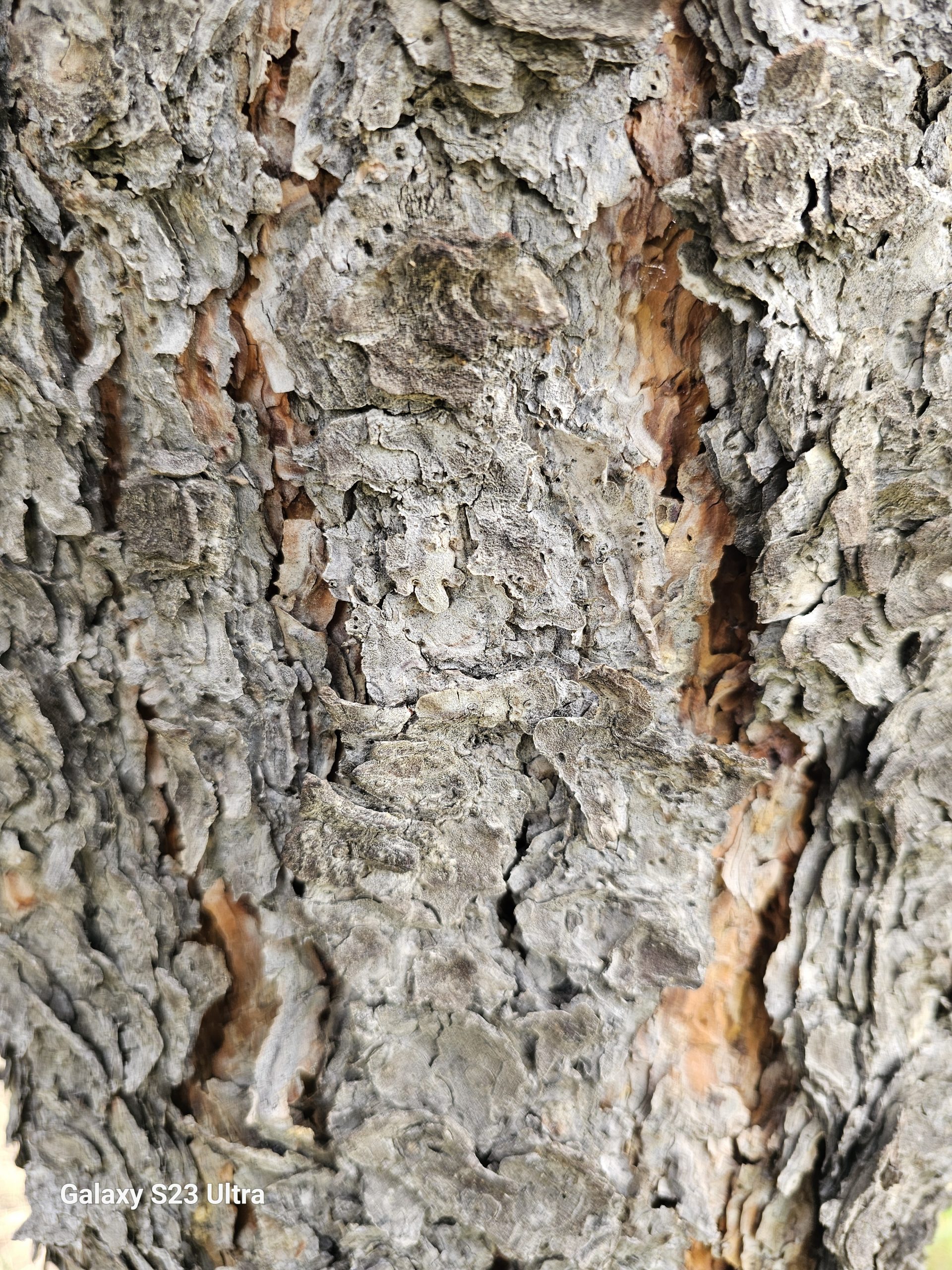
The bark of Tree #3


What was/what is/what will be

Beltane and the Bar Mitzvah Moon

Monday gratefuls: Bar Mitzvah in two days. Paul and Tom coming. Ruth and Gabe. The gold Mogen David, shield of David, from BJ. Writing my D’var Torah. Interpretation of my Torah portion. See below. My Lodgepole Companion eating from Great Sol’s buffet of light. Rain yesterday. A cool night. The Rockies. The Appalachians. The Sierra Nevada. The Sawtooths. Kilauea. Mt. Etna. Yellowstone. Krakatoa. Mauna Loa. Mauna Kea. Haleakala. Magma. Lava. The living Earth.

Sparks of Joy and Awe: Altitude and depth

One brief shining: Rough bark on the Lodgepoles, no running your hand over it appreciating the surface as on the Aspen, the Lodgepole grips your skin, makes it sticky with resin; no smooth bark at the top either, it’s rough all the way up to the Lead, so I placed my palm on it feeling its ridges and wide spots, its less welcoming configuration, wondering why Trees make the Barks that they do.


Wanted to share the first draft of my d’var Torah.

My bar mitzvah Torah portion:

Exodus 19:25-20:1-2

19:25 So Moses went down to the people and said [this] to them.

20:1 God spoke all these words, saying:

20: 2 I יהוה am your God who brought you out of the land of Egypt, the house of bondage:


God self identifies here with the word, יהוה. Yud Heh Vav Heh. YHWH. Rabbi Lawrence Kushner writes: “…in truth these letters are unutterable. Not because of the holiness they evoke, but because they are all vowels and you cannot pronounce all the vowels at once without risking respiratory injury. The word is the sound of breathing. The holiest name in the world, the name of the creator, is the sound of your own breathing.”

Another turn on the sense of this God name that shows up thousands of times in the Torah is that it is a verb. That God is a verb, not a thing, not an entity. We might consider this as a translation: what was/what is/what will be. God evolves from the past into our present moment and on with us into the future.

We can turn back now to the Shema: Shema Yisrael.  יהוה eloheynu. יהוה echad.  A translation with this definition of יהוה : Listen, God-wrestler. What was/what is/what will be is our God. What was/what is/what will be is one. (Pause)

Martin Buber famously suggested that there are two kinds of relationship: I-It and I-Thou. “The I-It relationship is one based on detachment from others…in which one uses another as an object. In contrast, in an I-Thou relationship, each person fully and equally turns toward the other with openness and ethical engagement. This kind of relationship is characterized by dialogue and by “total presentness.”[i]

Returning to the Shema and we God-wrestlers. What was/what is/what will be is one. An I-It relationship imagines we can detach a person, a Tree, a Mountain, an ocean from the one that we know as what was/what is/what will be. Alfred North Whitehead called this a fallacy of misplaced concreteness. It is a violation of the interconnectedness we proclaim every time we say the Shema.

Rabbi Rami Shapiro calls the move from I-It to I-Thou a change from narrow mind to spacious mind.[ii] In narrow mind we foreclose on possibility, limit our understanding. Most dangerous of all, we deny the interconnected reality of the One.

Here’s an example of narrow mind. A commentary on the American Dream, especially in the West: “Propelled by our ambition to remake ourselves, we careen past one another, oblivious to the fact that we’re following a pattern as old as our country.”[iii] 

(Pause)

Mizrahim. Egypt. Or, the narrow place. Or, the place of bondage. It is godly to move from the narrow mind, the narrow place in our psyche, to the spacious reality of our true bond, our literal oneness with all that becomes and is becoming.


We can now understand, I believe, Rabbi Rami Shapiro’s reframing of this first commandment:

“I יהוה am your God who brought you out of the land of Egypt, the house of bondage”

as a kavannah, an intention:

  1. “Spirituality is a source of liberation. Aware of the suffering caused by enslavement to things and ideas, I set my intention to free myself from all addictions and compulsive behaviors, both material and spiritual.”[iv]

This is teshuva as Shapiro defines it, returning to the whole you, the one  made in the image of what was/what is/what will be, and knowing all of you lives embedded in a glorious reality always evolving and becoming something new.


[i] Lucy Fishbein on Sefaria

[ii] p. 80, Judaism Without Tribalism, 2022, Monk Press

[iii] NYT article about Ted Kaczynski

[iv] p. 129, op cit