Category Archives: Bees

Moving From the Theoretical to the Concrete

Lughnasa                                            Waxing Back to School Moon

Kate has had a nasty cold since Monday and I can feel it trying to claw its way up my esophagus, making my throat scratchy.  My hope is that the recent two time bout I had with some bug in July, then August has revved up my immune system.  With rest I can pound this sucker down before it takes hold.

Starting back on Latin today.  I took part of July, all of August and the last couple of weeks off with the bees and the vegetables and the orchard.  Thought I’d get work done on Ovid, review, but in fact I got very little done.  An old student habit of mine, if it’s not pressing, it’s not getting done.  I’m looking forward to the weekly sessions, building toward enough confidence to tackle Ovid and others on my own.  It’s a project, like the bees, that keeps the gears turning, not giving them a chance to rest.  Best that way.

A few years back it was the MIA docent training.  Then the move into permaculture and vegetables and fruit.  That one’s still underway as I learn the complicated dance of seasons, cultivars, pests, harvest and storage.  The MIA training, for that matter, only gives you enough legs to get into the books and files yourself, training you to look and think about art, but each tour demands specific self-education on the objects and the purpose of that tour.

(Minoan Gold Bee pendant from Crete, circa 2000 BC)

Part of my impatience with the seminary experience is that I’ve moved so deeply into more concrete endeavors.  Art has the object as an anchor, then its history and context.  Latin has words, grammar and literature as well as Roman history.  Vegetables and fruit have real plants, particular plants with needs and products.  The bees have the bees themselves, the colonies, woodenware, hive management, pest control, honey extraction.  This is, probably, the world I was meant to inhabit, but philosophy and the church lead onto another ancientrail, that of the abstract and faraway rather than the particular and the near.  It’s not that I don’t have an affection, even a passion for the theoretical, I do, but I find my life more calm, less stressful when I work with art, with potatoes and garlic, with conjugations and declensions.

I now have almost three decades of life devoted to the theoretical, the abstract and the political so I bring those skills and that learning to my present engagement with the mundane, but I no longer want to live in those worlds.  They are gardens others can tend better than I can.

Integrated Pest Management

Lughnasa                                Waxing Back to School Moon

It’s been a wet, cool few days.  The Apiguard I picked up last night only works above 60 degrees and 70 is better.  It recommends chemical resistant gloves.  I’m using this on two colonies, the parent and the divide.  I tested the divide and its high, putting the colonies winter survival at risk, though I did not test the parent since the divide began with a hive box full of parent colony bees, it seems reasonable to assume it has a high mite count, too.  I don’t like using the medication, but the UofM, which shares my bias toward Integrated Pest Management and leans against treating recommends it.  I did count my mites, too, so I know the divide has a high mite count.  The package colony, which had only 1 mite all together, I will not treat.

The fumigilin-B treats nosema.  In this case the only way to reliably test requires a 400+ microscope, an expensive counter and a bunch of dead bees beat up in a mortar and pestle.  The U, again, recommends treatment this year in particular so I’m following their advice.  Nosema and varroa mites are two of the culprits in colony collapse disorder and often combine to cause the winter loss of a colony.

Integrated pest management for mites and nosema includes using Minnesota hygienic queens, which I have done, and can include use of a drone frame which attracts mites because drones take longer to pupate.  When the drone frame has capped brood cells, the beekeeper removes and freezes it, killing the mites and the drones.  This reduces the overall mite load.

Integrated Pest Management (IPM) has been around for a while.  It’s sort of a middle ground between all organic and contemporary agriculture/horticulture/apiculture techniques.  The idea is to put any chemical treatments as last resorts, utilizing first techniques that either directly mimic nature or are supportive to it.  In gardening, for example, companion planting qualifies.  So does crop rotation.  So does soil improvement.  So does hand picking insects and pruning out diseased branches or plants.  Another involves acknowledging that some level of disease and infestation is a normal part of the natural world.  The problem comes when the level begins to interfere with the plant or animals productive ability or its ability to, say, survive a Minnesota winter in our case.

In apiculture it involves, in addition to what I’ve already mentioned, culling 20% or so of your woodenware as it reaches 5 years of age.  This reduces nosema because the nosema organism lays down spores that can last as long as 75 years.  Another technique involves making sure your colonies have adequate food supplies for the winter.  A colony that struggles for food in early spring has much higher susceptibility to disease.

I use IPM in our perennial flower beds, our vegetable garden and now in the Artemis Hives.  I’ve not started in the orchard yet because fruit trees are still a mystery to me.  Gotta resolve that over the winter.

Jax

Lughnasa                                     Waxing Back to School Moon

After a nap, I headed out again, the second of three busy days.  This time I went to Jax, a return to the 1950’s with dark wood paneling, a lovely buffet table and Jean-Marie’s jax-matchbookmilestone birthday.  Happy Birthday, Jean-Marie matchbooks, the whole Jax touch.  I met Jean-Marie’s daughters and spent a good bit of time chatting with her oldest who until recently was a graduate student under Marla Spivak, the bee goddess of the UofM.  She and Jim of Nature’s Nectar, whom I saw later, convinced me to try and keep my old parent colony.

The elegance of the Jax setting made for a dignified tone.  Other docents came in and I spoke with Joannie Platz, Toni de Lafour, Marilyn Smith and a few others.  I saw Allison as I left.  She has a very fashionable red knee brace.

A long drive out to Stillwater to Nature’s Nectar to pick up Apiguard, Fumigilin-B, shims, hive stands and corks.  Jim’s a knowledgeable guy and easy to talk to.  He gave me some good advice about the parent colony.  He requeens every year, so the need to eliminate the old parent colony is not so high.  With tests and assays I should be able to keep on top of the mites and other diseases, too.

The drive back from Stillwater was in pouring rain; the first time I’ve driven in really heavy rain this year.  Back home now and dry.

Tomorrow is the docent lunch at noon, then the UTS event at 6:00 PM.

Busy, Busy

Lughnasa                                  Waxing Back to School Moon

Whew.  The new queen came today in a perforated UPS box, complete with a court of five worker bees.  After spraying them with sugar water, I took them out to the honey queen-bee-mdhouse where I pushed in the cork at the end of her wooden home, inserted a marshmallow (tiny) into it firmly, then opened the divide, took off the honey filled top hive box and inserted the queen in the middle of the second box.  This is called a slow release.  The queen and her workers eat away the marshmallow from one side, workers in the hive from the other.  Over the time this process takes, so the theory goes, the new queen becomes less threatening to the workers, who then allow her to come out and become their new monarch.  If it doesn’t work, they kill her.  I won’t check for another week.
With the queen in her new castle (hopefully), the grocery store was next on my list since Kate has a cold and she likes my chicken noodle soup when she’s sick.  While I made the chicken noodle soup, I also cooked lunch.  After we ate lunch, Kate went back to rest and I went outside and picked yet another several cups of raspberries.  Our bushes have been prolific this year.  The chicken noodle soup had our carrots, onion and garlic.

When the raspberries were inside, I worked downstairs answering e-mails while I waited for the soup to finish cooking so I could add the egg noodles and the peas.  At the end of that.  Nap.

After the nap I had to sort out a vote on legislative priorities for the Sierra Club and respond to a few more e-mails.  This took me up to the time to leave for the Minnesota Hobby Bee Keepers Meeting at the University of Minnesota.  The man who runs nature’s nectary, Jim, was there with a refractometer to measure moisture levels in honey.  Our capped honey was 16.9%, a little thick and the uncapped honey was 18.3%.  Since honey is anything below 18.6%, both of our batches were fine.

Home again where Kate and I ate some soup, watched a little TV, put the dogs to bed and then headed there ourselves.

Bee Diary: Supplemental

Lughnasa                            Waning Artemis Moon

The varroa mite count is in and my bees had–1.  That’s one mite for the sample of some 225 bees.  I didn’t get the optimal 300, see the business about the bees not volunteering for freezing to death, but finding only 1 mite makes me feel pretty comfortable.  Wednesday I’ll check the divide and see  how it’s doing mite wise.

I’ll have to become more facile with this procedure since I need it to do at least twice a year, more if the counts begin to go high.

We had a thunderstorm that knocked out the power and turned on our generator earlier tonight.  My computers were not unplugged, but they seem to have survived.

Waning Day

Lughnasa                     Waning Artemis Moon

The evening of a fine day is a silk garment laid on to welcome the night.  It caresses, soothes.  It wraps itself around the shoulders and extends a brief embrace as light fades and the stars come out.  It is, as my ancestors knew, a sacred time.

These days of September are the evening of the growing season, a transition to the colder, fallow season of late fall and early winter.  I’m glad they’re here.

As with each day, each week, each month of the growing season there are tasks appropriate to the time.  Here are a few of the ones we have left:

Garden

  • put a riser on the irrigation head nearest the deck
  • put composted manure and/or compost on the raised beds
  • Weed  perennials
  • harvest potatoes, beets, greens, tomatoes
  • save seeds:  tomatoes
  • plant bulbs
  • plant garlic
  • transplant:  gooseberries, hosta, bugbane
  • black plastic and mulch along truck path

Bees

  • sample for varroe mites and nosema
  • check honey and pollen supply
  • feed if necessary
  • in november prepare for winter

Sitting Back

Lughnasa                                       Waning  Artemis Moon

The big push on honey extraction, preceded by the push to mulch the orchard and the vegetable garden, has left both Kate and me happy the weather has soured.  She sews, now in the room right above my study, and I tap tap tap away following this lead and that down the cyber rabbit hole.

After reading Romance of the Three Kingdoms and Blind Descent, I’ve veered off into fiction, a sort of relief has taken my reading and I’ve plowed through 2 1/2 novels this last week +.  None of it so far is noteworthy, just pleasant diversions.

Worked this last week on a project for the office of Learning and Innovation at the Museum.  It involved responding to a new exhibition of heads and masks to be installed in the hallway in front of the antiquities galleries.  It’s part of the Art Remix concept.  Thinking in this way, finding connections between the new installation and other parts of the museum, stimulated me, shot off a spark or two.

Bee Diary: Honey Extraction, Photos

Lughnasa                                           Waning Artemis Moon

By Kate’s calculation we have 4.875 gallons of honey.  Not bad.  In terms of, say, filling up your car, 4.8 gallons doesn’t sound like much, but in terms of filling up canning jars filled with honey, it’s a lot.  The following photos will give you an idea of how the day went.

400_honey-extraction_0225

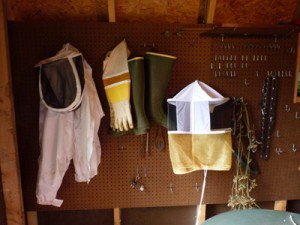
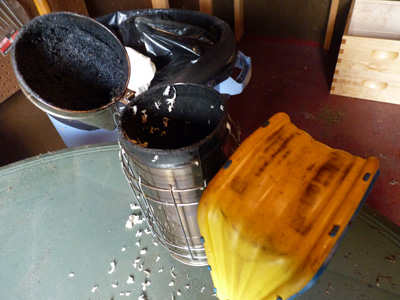
The gear.  I wore the white suit and the gloves for the extraction because it protects me better when the bees get defensive.

400_honey-extraction_0226

Each time I have tried to work in the hives without this essential tool, the smoker, I’ve gotten stung.  Every time.

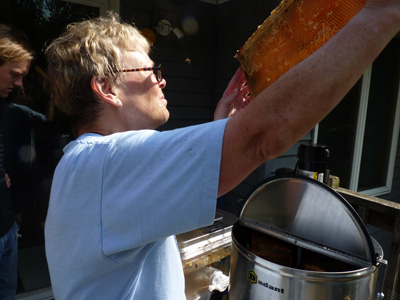
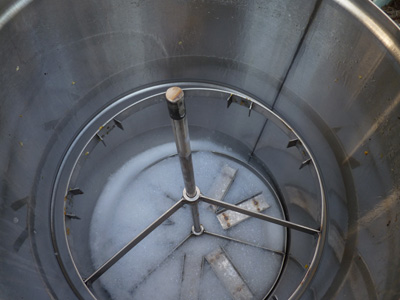
400_honey-extraction_02391Doing the extraction. The frames with honey go in the extractor, lid up.  Then they whir around and centrifugal empties them of their honey while leaving the honey comb intact.  That means next year’s bees won’t have to waste energy building comb.  They can go straight to honey production.
400_honey-extraction_0240

Afterward, my fastidious wife (as she referred to herself), hit the extractor with soap and water.

400_honey-extraction_0248

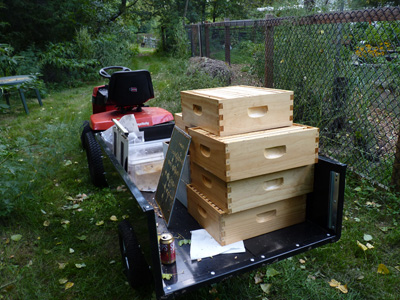
The lawn tractor got a workout today.  Here I’ve loaded it with honey supers that now have empty frames.  They go back on the hives for a couple of weeks so the bees will clean them out before storage for winter.

400_honey-extraction_0244

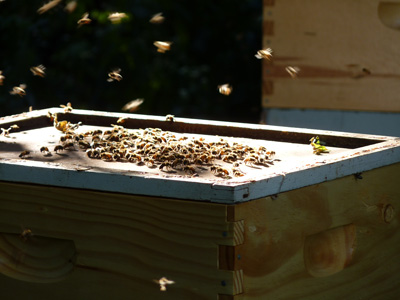
The bees on the parent colony just before I put back on the recently spun out frames.  BTW:  Kate made all the wooden ware you see here.  I think it’s beautiful.

Bee Diary: Honey Extraction, Day 2

Lughnasa                                       Waning Artemis Moon

Artemis Hives have given up their surplus honey, all under the Artemis moon.  We started this morning with Kate putting a plastic drop cloth down on the deck while I went out to the colonies to see what was still there.  The divide had, as I expected, nothing.  That means, oddly enough, that they will need to be fed over the next few weeks before winter sets in.  The parent colony, the big dog as far as honey production, produced a good bit.  Two full supers plus maybe half of a third.  We’re well over three gallons now, probably closer to five.  I’ll get an exact count soon.

Honey extraction has its straightforward side.  Take the full frames, stick them long side up in the honey extractor and turn it on.  If there is a significant amount of 400_honey-extraction_0239capping, there is an additional step, uncapping.  Kate did this chore with the electric uncapping knife.  We had at least one extractor run with 80% or more capped.  This honey was darker.  We can bottle it right out of the extractor after filtering.

(Kate inspecting a frame to see if the honey has been extracted.)

The rest had less to no capping.  That honey has a higher moisture content and, as I said yesterday, has to be heated to kill the yeast and thereby avoid fermentation.  The taste difference is insignificant to my palate.

When we spun out the first six frames, all went well.  We emptied the extractor, took the honey in and Kate heated it.  By the time I brought the next two supers full of honey frames, however, the bees had found us.  It took a bit longer because we were further from the hive than the honey house (at least the building I’d intended to serve as a honey house.), but they found us.  After that, all sticky, sweet operations had numerous bees in attendance.  They were not aggressive, but they made the process a bit more nerve racking.

Once again the heat caused sweat to cascade over my eyebrows and into my eyes, inside the bee suit where the eyes cannot be reached by hand.  I wore the bee suit because the bees are more defensive during honey removal.  Makes sense.  But that damned bee suit amps up the humidity and heat.  Not fun.

We now have half-pint, pint and quart jars filled with an amber liquid, a sweet product made, collected and bottled right here at Artemis Hives.

Bee Diary: Honey in the Jar

Lughnasa                                    Waning Artemis Moon

The waning Artemis moon has a golden hue tonight, honey colored, as it sits on the northeastern horizon.  A band of clouds created two dark lines, parallel to each other and about a third of the way down.  It looked like a view of the moon from an ukiyo-e print.

We have bottled our first honey.  Those four frames from the package colony, not even full frames at that, yielded almost a full gallon of honey.  We strained it through a coarse, medium and fine filter and put it into half pint jars for the most part.  It looks beautiful and very satisfying.  Artemis Hives has begun to produce.  I think I’ll tip a half-pint out in the woods to honor the namesake goddess.

Tomorrow I’ll work first on the divide, since I know it has very little honey in the supers.  It plugged up the third hive box with honey back in late May, early June.  After that I’ll move to the parent colony.  The parent colonies produce the most honey because they are vigorous and are not storing honey for the next year.  It will be interesting to see how much we get from the parent colony since next year, if everything goes well, we’ll have two parent colonies and two divides.  Four colonies should produce plenty of honey for our own use and to give as gifts.

It’s going to be hot with dewpoints in mid-70s.  That’s good for working with the honey because it flows well when the temperatures are high; that’s bad for working with the bees because I have to wear a veil at least.

We bolted the honey extractor to the deck instead of using the honey house.  Did that for a couple of reasons.  First, it’s much further from the colonies and second, it’s much closer to the kitchen.  Also, the mess, and it is a messy process, can be contained with drop cloths.