Category Archives: Bees

Garden Theme for 2010: Consolidation

Imbolc                                       Waxing Wild Moon

At this time of year gardeners begin to develop x-ray vision, seeing through the snow, ice and frozen  soil and imaging the greening.  Those of us who rely on memory more than paper try to envision what we’ve got in the ground, sort of the botanical base line.  Perennial flowers and plants, which make up the bulk of our terraced gardens, have an established presence.  We add in some annuals as the spirit moves, sometimes we divide existing plants like hosta, hemerocallis, iris, Siberian iris, liguria, bug bane, dicentra, aster.  Once in a while we plant new bulbs.  None last fall, for example, but that gardensenscence09probably means some this fall.
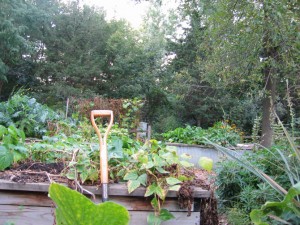
(pic:  where we left off last fall)

This part of the garden requires work, but not as much as the vegetables and the orchard.  I count it is a known quantity.

The permaculture additions, of which we have made several over the last three years, are still new to us, requiring attention and learning.  This year, I’ve decided, will be a consolidation year.  Nothing new, making what we have work as well as we can.  That means planting vegetables in two categories:  kitchen garden for eating throughout the summer and early fall and vegetables for storage over the winter:  potatoes, garlic, parsnip, carrots, greens, squash  those kind of things.

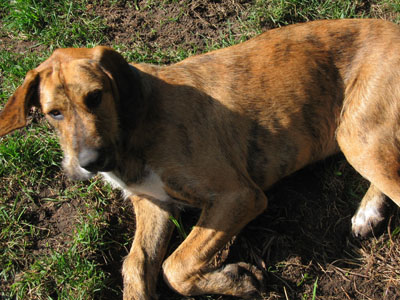
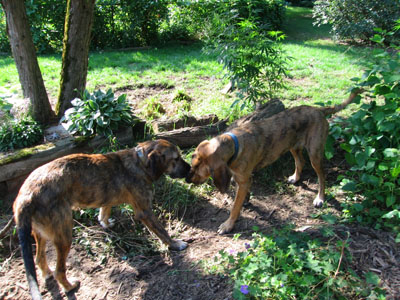
There is a good bit of work to be done repairing Rigel and Vega’s late fall destruction.  That won’t be repeated because we have a small fortune in fencing around the vegetables and the orchard, but I lost heart last fall and didn’t get the netaphim repaired and earth moved back into place.  That awaits in the spring.

In mid-March I have the bee-keeping class and this year I have the same consolidation idea for the bees.  Establishing the hives as permanent parts of our property.

We do have a couple of smaller non-garden projects that need to get done.  I dug the fire-pit two years ago, but with all the fun of the puppy’s last summer never got back around to it.  It needs finishing.  I also want to turn the former machine shed into a honey house, a place to store bee stuff and to process the honey.  Of course, we actually have to produce some first.
Rigel Redux

Fall                                            Waxing Blood Moon

After reviewing the stats for ancientrails, I learned something old.  During the time when Rigel and her sidekick Vega staged their break-outs readership went up.  My assumption is that conflict drove the rise.  Can man outsmart dog?

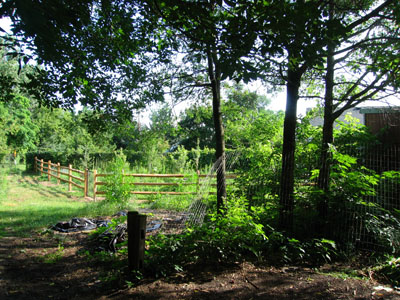
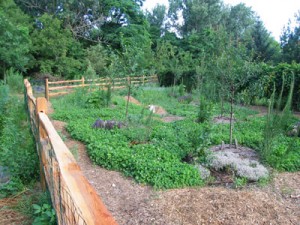
Chapter 14 or so.  Vega and Rigel have not escaped the yard since the electric fence went up with the one exception I orchardfence709mentioned where Rigel opened the truck gate.  There is, though, a follow-on.  While gnashing my teeth  about the escapes and to allow Vega and Rigel some outside time, I reversed field and put them inside the fence we put up to keep them out of the orchard.  Did you follow that?
This  only lasted for a few days while Kate and I gathered our strength and solved the larger problem, then we let them back out into the larger backyard.  Now, however, Rigel yearns for those days in the orchard.  So what does she do?  Yes.  She climbs into the orchard.  Do you hear those teeth again?  Right now I don’t know how she does it.

On another front.  The bees.  Mark Nordeen graciously set me in bee-keeping this spring with the loan of a bee suit as well as hive boxes and supers (for the honey).  He came over frequently at first, then gradually let me handle the bees on my own.  We are, however, in the fall and I need to make the bees comfortable for winter.

Since bees are warm climate critters, not even native to our shores, winters alone can kill an entire hive.  As  you can imagine, our winter puts a good deal of stress on a hive.  That stress plus some disease and pesticides contributes to Colony Collapse Disorder.

Elise, Kate’s colleague and Mark’s wife, got a new horse, an heirloom breed and a black mare.  While putting the horse in a trainer (Elise rides dressage.), the horse kicked Elise on the chin, threw her fifteen feet and knocked her out.  The kick separated skin from bone around and below her jawline.  She’s better, but still suffering head-aches and neck pain.  As you might imagine.

Anyhow that means the bees and I are on our own on this getting ready for winter deal.  A learning experience for me.

Fall Clean-up

Fall                                         Waxing Blood Moon

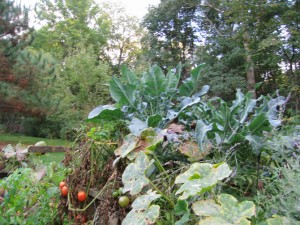
Out in the garden this morning taking down plants that have finished their labors.  Large cruciform vegetable plants grew from the seeds I started inside, but they never developed any fruits.  They’re in the compost now.  All the tomato vines save one have come down.  The last tomato harvest went inside today, too.  A few straggling yellow and orange tomatoes and a cluster of green tomatoes for a last fried green tomatoes.

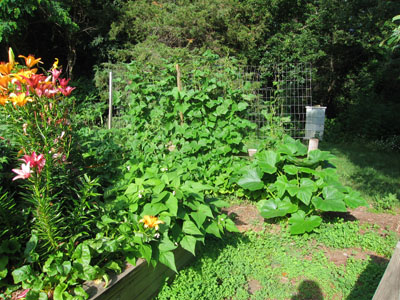
A new crop of lettuce, beets and beans are well underway, lending an air of spring to the dying garden.  While examiningdieback091 carrots I have in the ground awaiting the frost, I discovered golden raspberries large as my thumb.  A real treat at this late stage in the year.  They await the vanilla ice cream I’m going to buy when I go to the grocery store.
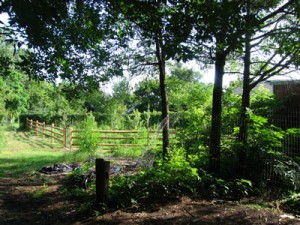
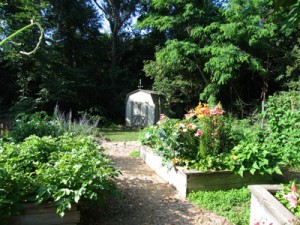
The 49 degree weather made doing these choirs a pleasure.  Odd as it may seem, I like the fall clean-up part of gardening as well as I do any other part, perhaps a little bit more.  Most of these plants I started as seeds in February, March or April and they have matured under my care, borne their fruits and run through their life cycle.  From some of them I have collected seeds to plant for next year.  The clean up then represents a completion that goes one step beyond the harvest.  It honors these living entities by caring for their spent forms in the most full way possible:  helping them return their remaining nutrients back to the soil.  I want no less for myself.

Got a new toaster and a new ladder in the mail yesterday from Amazon.  Boy, shopping has changed.  I rarely go to a big box store anymore, once in a while to Best Buy to check out DVD’s or for some computer accessory.  I still go to hardware stores and grocery stores, the things you need weekly or right now or fresh, but everything else I buy online.

The bee guy, Mark Nordeen, had to cancel again today.  His wife, Kate’s colleague, got kicked in the head by her brand new black mare.  E.R. and a concussion later she’s home off work.  Guess I’m gonna have to figure out how to over winter my bees all by myself.

Water and Politics

Lughnasa                             Waning Harvest Moon

Kate took her ailing sewing machine up to St. Cloud.  She bought it there.  On the way home she brought maid-rites, a taste of Iowa burger.  Maid-rites have a crumbly hamburger instead of a patty, a little bit like sloppy joes without barbecue sauce.  Kate had not been far from home for several days with this illness.  She’s on the mend now.

The new plantings, shrubs and trees, need water these next few weeks, before it gets cold.  Their roots will uncurl and extend into the soil, go deeper and wider.  By next spring they should need no extra care.  That’s part of the idea behind permaculture, a maintenance free or low maintenance landscape.  Permaculture achieves this in several ways.  Plant guilds, plants that complement each other planted together, and plants native to the eco-system are two primary strategies for achieving this goal.  Productive plants, aided by plant guilds, and native to the region make them naturally disease resistant and adapted to the particular moisture and soil requirements of your site.

Even so, they still need to get established, just like all those college freshmen throughout the land, uprooted from home and having to become part of a new place.

All this meant really long hoses since we have now begun to plant beyond the range our irrigation system.  Since these plants won’t require additional water in the future, it doesn’t make sense to provide new irrigation.

A few limbs and one tree also had to come down to make sure some of the new plants thrive.

I checked the bees today, too.  Still little honey.  I’ve provided the hive and the bees have worked all season, so I’m not unhappy.  Even so, I hope next year I can get some honey.  Don’t know right now what I need to do differently, if anything.

A good part of the afternoon I’ve spent reading Politics In Minnesota weekly reports, a subscription service focused on the ins and outs of Minnesota politics, especially at the state level.  On Monday I’ll attend a Minnesota Environmental Partnership meeting that will try to assess the political context for environmental issues at the legislature next year.  I’m reading ahead.  The context is critical when considering electoral and legislative politics.  Not so much when pushing issue campaigns, at least not in the early stages.  To win, though, requires sensitivity to the political context in which the issue must be resolved.

Pain and Work

Lughnasa                         Waxing Harvest Moon

Kate came home early from work.  Not working, not pulling her load is hard for her to bear, psychically much harder to bear than the physical pain.  She goes to work when she is in pain, partly because that’s how doctors have been socialized, but also partly because she wants to do her share, or pick up another person’s, if necessary.

This is not a fun way to live her last full year of work.  My hope is that we can find a way, with the help, perhaps, of the two surgeons and the PM&R doc.  She is, as a co-worker told her, a strong woman.

Just watched the Secret Life of Bees.  A fine movie, feelings popping out all over the place and at unexpected moments.  “Just send out love to the bees,” Queen Latifah’s character says.  Yeah.

I’m Not There

Lughnasa                               Waning Green Corn Moon

Once again a movie arrived late in the pick-up zone.  I’m Not There, the movie about Bob Dylan, was on view here at the Seven Oaks Family Theatre.  It took a while for the dizzying shifts and the multiple actors to make sense, but they did at last.  Cate Blanchett amazed me, as she often does.  She is one of the finest actors working right now.  I found Christian Bale’s performance less compelling, but good, too.  Richard Gere made an interesting Billy the Kid and the young black kid, Marcus Carl Franklin, in a difficult role, performed with great skill.   Heath Ledger and Ben Whishaw, who played an enigmatic, trenchant Dylan giving an interview, also appeared.  I’d give it 3.5 stars.  But you saw it years ago, I suppose.

There was a 7.1 magnitude earthquake in the Izu islands about 100 miles from Tokyo.  It shook buildings in Japan’s capital city, but there was no tsunami.

The bees have been busy, but there is little  honey in either of the supers.  I checked the top hive box and there is comb honey there.  Some of the frames had a long dark streak through the honey cells.  It didn’t look right, but I really don’t know.  I need some help.  I did taste the honey and it was delicious.

Becoming Native To This Place

Summer                        Waxing Green Corn Moon

westorchard709

The next meeting of the Woolly Mammoths will be here in Andover.  That means it’s theme and subject matter time.  The theme will be, Becoming Native to this Place, the title of a book by Wes Jackson of the Land Institute.  The subject matter will focus on the gardens, permaculture and the local food (slow food) movement.

At the Seed Savers Exchange conference held two weekends ago in Decorah, Iowa a commercial grower told of his change to the local foods idea.  A grower of greenhouse foods for various distributors who took his foods far from northern Iowa, he recounted attending a meeting sponsored by folks whose agenda was local foods.  They showed that, due to commodity based agriculture, northern Iowa was a net importer of food.  That astounded him.  He switched his focus then to growing vegetables for local consumers, working on niche markets like institutions, restaurants and grocery stores in the northern Iowa area.

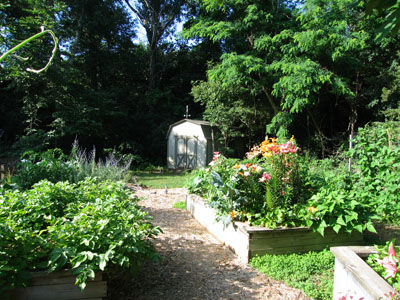
He didn’t mention Michael Pollan by name but the subject matter was similar to Pollan’s recent work, In Defense of Food.  The Woollys have read the Omnivore’s Dilemma and the Botany of Desire.  We’ve also looked at the notion of Homecoming and the Great Work by Thomas Berry.  This August meeting, only 17 days after Lughnasa, the first fruits festival of the Celtic calendar, will celebrate the Woolly’s interests in home, food and continuity.    southgarden709400

Continuity?  Yes.  The Woollys have a 20+ year record of perseverance with each other and, by implication, an interest in this place we have  chosen to call home for those same number of years.

To the Woollys who read this:

Please choose one of the books or websites indicated and take a look.  While looking pick out two things:  what surprised you?  what would you like to know more about?   If you want, also look for something that seems off or misguided to you.

In the Garden

Summer                        New Moon

A.T. used the chainsaw this morning.  He cut out a mulberry tree growing in an unwanted (eastern) location.  A.T. feels manly after he uses the chainsaw.

Kate and A.T. harvested peas, greens, beets and turnips, too.  A.T. planted beans as a cover crop among the onions, where the garlic came out.  A.T. plans a much larger garlic crop for next year.  He has 9 or so large bulbs set aside for planting and set in an order for several new varieties.  At the SSE (Seed Saver’s Exchange) conference over the weekend a speaker suggested planting the garlic earlier, even in August.  A.T. asked SSE if he could get his garlic earlier than the September 7-9 ship date.  Nope.  Not to  worry, he’ll plant his own in mid-August and check the crops against each other next June.

This whole gardening process now begins to blur the line between horticulture and agriculture.  With crops meant for immediate consumption, but others for storage:  potatoes, turnips, carrots, squash, beans, garlic, onions, greens and peas, plus the eventual fruit yields, our garden has become a substantial part of our lives.  Substantial in the transubstantiation notion loved by Catholics.  We eat of the body of our garden and our orchard and in our bodies it becomes use, transfigured from plant to human.  A sacred event.  Substantial in the way it requires the use of our bodies to realize its harvest.  Substantial in the political sense since it cuts down trips by car, makes our place better than we found it and keeps us close to our mother.

The bees have added another dimension.  An interdependent, co-creative collaborative effort.

Vega. Again. Bees and Permaculture.

Summer                           Waning Summer Moon

Vega the wonder dog continues to amaze us.  While I worked on the air conditioning earlier today, she picked up the small box I had to reserve the screws removed from the cowling.  I heard the screws clinking as she walked away.  When I got to the box, she had set it down and not a single screw had gone missing.  She continued to help me during the whole process.

Also earlier Kona, a whippet who opens doors, opened the back door and let everybody inside.  When Kate came out of her shower, Vega had sprawled out on our bed.

After I put the whippets to bed, Vega and Rigel come out in to the living room for a bit of human time.  Vega promptly hops up on the couch, rolls over on her back and relaxes her legs over the edge.  Then she goes to sleep.

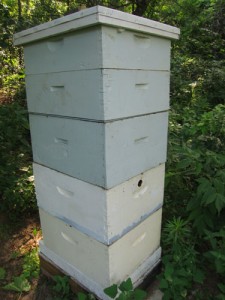
The hive stands pretty tall now with its two honey supers and the queen excluder.  hivebody500

I’ve been very lucky to have Mark Nordeen as a mentor in the bee-keeping.  He’s gotten me through the rough spots for beginners:  equipment which he let me use, hiving the package of bees, how to examine frames and what to look for, when to put on the honey supers and when to use a queen excluder.   All of this stuff would be easy to stumble over in even the first few years and Mark has walked me through it.

The bees have added another element to the permaculture work Kate and I have begun.  The bees live and work in our garden just as we do.  They have a stake in a healthy garden just as we do.  Working with bees feels very collaborative; we are two species working and living together, sharing our needs and our specialized skills.

We have two apples coming along in our orchard as well as blueberries and currants.  I also found a huckleberry today, a plant I have never grown before.  The garden has begun its arc toward full productivity.

Now we have an orchard filled with fruit trees and plant guilds to support the trees, bushes that bear berries, even a hazelnut.  The orchard complements our expanded vegetable garden.  The playhouse Jon put together for us will go with the finished firepit (someday) as a family outdoor recreation area.  This is all part of the permaculture idea, having various zones of the landscape for specific purposes and each zone located optimally for its needs.