Category Archives: Our Land and Home

Embrace Weedy Backyards and Undeveloped Lots

Imbolc      Waning Wild Moon

This is an opinion piece by Senator Ellen Anderson.  I reprint it in full here because she addresses a critical problem for the Great Work.  Almost.

Here’s what I mean.  In referring to the work of the Lessard Council she defends metro area expenditures because, as she puts it, the DNR has used scientific principles to determine that the Metro area has 255,000 acres of undeveloped land with high ecological significance. (italics mine)  She does this to defend these acres from those who would claim that there is “no habitat” to protect in the metro area.  OK, so far.

The problem is this.  In her genuflection to science and its degrees of high ecological significance she misses the urban forests, the front yards and backyards, the parks and boulevards, even the land most often neglected, the land beneath streets, highways, buildings, houses, railroad tracks and industry.  It is as if these portions either do not exist, or, because they do not meet the definition of high ecological significance that they are somehow less worthy.

Yes, I know she makes this argument for a particular pot of money aimed at vanishing wilderness and  other areas important to science and again, I say, that’s ok as far it goes, but it leaves us with the notion that these other lands, the lands of low ecological significance according to scientific criteria, are less than, underwhelming.

In fact, if the Great Work is to succeed, then we must embrace our weedy backyards and the undeveloped lot, our over-grassed lawns and our worn-out parks.  We must find ways to love them and treasure them as they are all Mother Earth.  In some ways this is a greater calling than struggling over the remaining areas of high ecological significance.  Why?  Because these humble patches of earth are where most of us meet our mother day-to-day.   Because it is often these humble patches of earth that are the most degraded and in need of our care.  Because it is these humble patches of earth, close to the bulk of the population that can be transformed into local food sources and beautiful flower and native plant gardens.

Senator Ellen Anderson’s piece:

“As one of the Senate members of the Lessard Outdoor Heritage Council, I have been impressed by the dedication and hours put in by all of the council’s members in the last few months. We are trying to come up with a good plan to protect, restore and enhance our natural resources, as we promised the voters who approved the Clean Water, Land and Legacy amendment in November.

Many legislators have expressed concern that the preliminary list of proposals is light on metro-area projects, well under 10 percent of the dollars and a very small portion of total acreage. Traditionally, the Legislature values statewide balance: Dollars spent should serve all Minnesotans, not just some. I agree with this principle. But if our primary concern is protecting natural resources and habitat, there are other critical reasons the constitutional legacy funds should not all be spent in greater Minnesota.

I’ve heard many people say there’s “no habitat in the metro area.” Not true. The state Department of Natural Resources used scientific principles to determine that the seven-county metro region still has over 255,000 acres of undeveloped natural land with high ecological significance. This is 15 percent of the region. Sixty-eight percent (174,139 acres) of these remaining natural lands is not permanently protected as regional park, wildlife refuge or natural area, or by other public designation.

To put this amount of land in perspective, one of the projects the council approved (and which I support) is the acquisition, by easement, of 187,000 acres of forestland in the area around the Mississippi River headwaters, for more than $40 million.

Clearly there is land of significant ecological value all around the state, and such land should be protected for future generations. The Statewide Conservation and Preservation plan recognizes that and should guide our decisions with the best science from University of Minnesota experts.”
http://www.startribune.com/opinion/commentary/41234342.html?elr=KArksc8P:Pc:U0ckkD:aEyKUiD3aPc:_Yyc:aUU

After the Service

Imbolc            Waning Moon of Winds

To follow up on the morning jitters.  At the end of my American Identity sermon I received an unusual and rare compliment: everyone clapped.  I took time on the way in to center myself and become part of the beautiful day underway.  As I got more centered, I remembered that I had never served and never intended to serve as a parish clergy.

Why?  Because my views occupy one end of a spectrum, the far left edge.  In the Presbyterian community they perceived me as a prophet, so much so that when I left back in 1990, the Presbytery bought a large print of a Jewish prophet and gave it to me in a nice frame.  Oh, yeah.  That was my place.

I recall a 1972 sermon at Brooklyn Center United Methodist Church on July 4th.  After I got done calling the congregation to patriotic resistance to the war, I went back to stand by the door and shake hands.  The congregation split like the Red Sea and went everywhere but where I was.  I’m that guy.

This sermon has a radical message to and it received resistance today, but in a much gentler and more dialogical way than that one 37 years ago.  I’ve learned some and this community of people knows me well, so we can disagree and still remain friends.

As Popeye used to say, I y’am what I y’am.

With Apologies to Canada and Mexico

Imbolc            Waning Moon of Winds

I edited and revised American Identity today.  It needed a paragraph indicating what I believe to be similarities between the ante-bellum USA and our current era.  National identity was weak during the ante-bellum period and is weak now.

In ante-bellum America the Unitarians William Ellery Channing and Ralph Waldo Emerson made a strong push for American letters.  On the one hand they wanted a break with the European dominance of American literature, painting and scholarship; but more, they wanted American letters, literature rooted in the American experience, painting using American themes and flowing from the genius of American talent and scholarship trained in the new nation and carried out by American academics.

American identity is weak now for several reasons.  Increasing Mexican immigration has raised a potent challenge to the Anglo-Protestant traditional US culture.  We are now a multiethnic, multiracial society, but our identity has only made tentative steps to say what that means.  We lost a prime enemy in the USSR and now have no one over against whom to identify ourselves.  Since the 1960’s there has been an erosion of trust in the basic institutions of our society:  business, government, the church, education.  Each of these challenges the old ethnic, racial and Anglo-Protestant consensus that underwrote US identity through the 1950’s.

Like the ante-bellum USA this is a time for a new American letters, a new American literature, a new American painting and sculpture and music, a new American poetry and a new American scholarship, one that reflects the multiethnic, multiracial society we have become.

Listen to the Rhythm

Imbolc            Full Moon of Winds

We’ve had snow all afternoon and into the evening.  Don’t know how much we got, but it’s not the 6-8″ predicted.  Still, the landscape looks nicer.

I’ve got a rhythm going.  Breakfast, write one and a half to two hours, study, lunch, nap, collate research and write, workout, supper, watch some tv, read, come downstairs and do a little more writing.  Sometimes, like Monday, I write all day until I finish a project’s first draft.  This is a good rhythm.  I am productive, creative and learning.

Kate and I have the re-fi bug.  She’s done the research, the hard part of meeting with the mortgage bankers–pawns of the stupid rich.  Now we have to pick a package at an interest rate below 5% and go through the hurdles of appraisals, credit checks, underwriting and closing.  It will help our monthly nut in a big way.

Tomorrow or Thursday I’ll edit American Identity, remembering to add in the impact of national identity (it changes our political behaviors and the policies we support) and perhaps a teaser about geographic components.

A full moon, snow coming down and darkness all round.  And to all a good night.

I Love the Midwest

Imbolc      Waxing Moon of Winds

Finished the Asmat tour and a visual thinking strategies (VTS) tour for 3rd graders.  I give them tomorrow morning.

Put together the legislative update for the Sierra Club blog and a morning entry for the Star-Trib.  Soon, it will be nap time.

This afternoon and over the weekend I’ll dig back into the American Identity piece for the 15th. It’s been fallow since Monday, but it has not disappeared from my consciousness.  I’m leaning now toward a definite geographic hook, an addition to the more usual psycho-political work I’ve read in Huntington and some of the other essays.  I’m not sure yet whether I consider it an equivalent to those notions or whether it is a more important category.

Here’s what I mean.  The notion of a nation is abstract, in the instance of a nation as geographically large as the USA, it can become even more abstract.  My hunch is that, as all politics are local, so are all experiences of national identity.  In other words, my experience of my land, my hometown, my home state or region is, both of necessity and emotional depth, the basic ingredient of my affection for my native land.

That is not to say that This land is my land, from California to the New York Island doesn’t also inform my national identity.  I feel the Rockies and hollers of Appalachia, the rain forests of Washington State and the glaciers of Montana have a place in my sense of national identity, some of them in spite of my never having visited them.  They recede in importance for me, however, when I compare them to acre after acre of corn and wheat.  They do not have the emotional resonance for me the Great Lakes have, especially Huron, Michigan and Superior.  My life has been lived in the towns and cities of the Midwest and I love the Midwest.  When I think of my US identity, I think first of the Midwest.

More on this to come.

Survey: Americans give cold shoulder to thought of moving to Twin Cities

Survey: Americans give cold shoulder to thought of moving to Twin Cities

Last update: January 30, 2009 – 5:08 PM
While “We Like It Here” has become a badge of honor of sorts for inhabitants of the Twin Cities area, a national survey by a respected research firm has found that Americans elsewhere have little interest in moving to the land of the wind-chill factor.

The Pew Research Center released results Thursday of its survey of where Americans would most like and not like to live.

The Top 10 were all in the South or the West, led by Denver. Next were San Diego, Seattle, Orlando, Tampa, San Francisco, Phoenix, Portland, Sacramento and San Antonio.

The Twin Cities area landed 26th in the 30-city metropolis heap, followed by Kansas City, Cincinnati, Cleveland and Detroit.

http://www.startribune.com/local/38697482.html?elr=KArksLckD8EQDUoaEyqyP4O:DW3ckUiD3aPc:_Yyc:aUycaEacyU

They really don’t know what they miss by not living here.  A convinced and happy immigrant.  Me and the Norwegians, eh, Ole?

Hey! You! Help Me Write My Piece On American Identity

I’d appreciate any comments on the notion of American identity:  what is it?  who has it?  should all Americans have it?  Do all Americans have it?  What is the American sine qua non?  Can we survive as a nation if we don’t have a shared national identity?  If not, why not?  If so, how would that work?

Use the comments section.  I’d love to know what you think.

An Existential Cry?

-8  falls 30.32  SW0 wchill-8 Winter

First Quarter of the Wolf Moon

The Great Horned Owl who lives in our woods calls tonight, right now as I write.  Whether he, or she, speaks to a lost love or wayward children I do not know.  On a night this cold it could be the existential cry of the world, proclaiming the season at its depths.  I often imagine this owl whose wingspan extends longer than my body and whose talons can lift a small dog or a young child with ease; I imagine this owl perched on a top limb of our tallest poplar.  The gaze of this fierce predator, the apex predator of our woods, rakes the Wolf Moon, perhaps blinded by the light, but looking just the same.  Because, like us, the moon attracts the eye.

The Vikings lost to the Eagles.  I don’t feel as let down as I have when the Vikings have lost other playoff games.  Not sure why.  Maybe because they did not come into this game a prohibitive favorite, then give it away.  Perhaps because they played with heart and made some young team mistakes.  I don’t know.  But I’ll watch again.  Peculiar, eh?

Writing Homecomer took up the writing juice today.  Little left over for this blog.  I’ll let it sit a day or two, then read it with a red pen in hand. Go back to the computer and revise it.  Then let it be.

Now, back to The Given Day by Dennis Lehane.  If you have not read it, and enjoy period pieces with rich characters and real historical drama as I do, then you’ll find this a treat.

And A Happy…

7oaks250.jpg9  bar steep fall 30.12  ENE9  windchill 9   Winter

Waxing Crescent of the Wolf Moon

Friend and cyberwizard Bill Schimdt reminded me of a wonderful show the sky put on tonight to celebrate the New Year.  The moon with Venus in its arms.  This is the waxing Wolf Moon, a sliver facing up toward the east with Venus just above and centered over it.  The moon has an immediate tug on my memories, often creating a flood tide of associations from Islam to nursery rhymes to Neil Armstrong and Jules Verne.  It also fires my love of the night, creating a light in the darkness, a light that does not cause the darkness to flee, but makes it more accessible.  And they say lunacy is a bad thing.

This new year’s I plan to celebrate in dreamland.  My new habit of a 10:30 bedtime is too fragile to wreck watching Dick Clark’s face-lift as the ball descends in Time Square.  Windy and -1 there.  Ouch.

The new year comes this time with genuine opportunity for change, change that matters.  I plan to be part of it and hope you do, too.

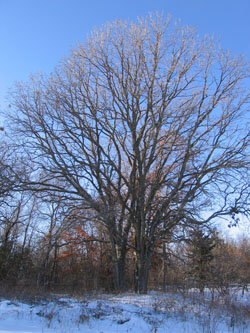
Sometimes I refer to our property as 7 oaks.  This is a photograph of those seven oaks, white and red.  They grow on a small hill, visible from where I write. They are a grove, a fine companion in all seasons.

-30-  until 2009

Do Ya’ Live in Minnesota?

Forwarded to me by a fellow Woolly Mammoth, Tom Crane.

Jeff Foxworthy on Minnesota

If you consider it a sport to gather your food by drilling through 18 inches of ice and sitting there all day hoping that the food will swim by,
You might live in Minnesota.
If you’re proud that your state makes the national news 96 nights each year because International Falls is the coldest spot in the nation,
You might live in Minnesota.
If you have ever refused to buy something because it’s “too spendy,”
You might live in Minnesota.
If your local Dairy Queen is closed from November through March,
You might live in Minnesota.
If someone in a store offers you assistance, and they don’t work there,
You might live in Minnesota.
If your dad’s suntan stops at a line curving around the middle of his forehead,
You might live in Minnesota.
If you have worn shorts and a parka at the same time,
You might live in Minnesota.
If your town has an equal number of bars and churches,
You might live in Minnesota.
If you know how to say …Wayzata…
Mahtomedi…Cloquet…Edina…and Shakopee,
You might live in Minnesota.
If you think that ketchup is a little too spicy,
You might live in Minnesota.
If vacation means going “up north” for the weekend,
You might live in Minnesota.
You measure distance in hours,
You might live in Minnesota.
You know several people who have hit deer more than once,
You might live in Minnesota.
You often switch from “Heat” to “A/C” in the same day and back again,
You might live in Minnesota.
You can drive 65 mph through 2 feet of snow
During a raging blizzard without flinching,
You might live in Minnesota.
You see people wearing hunting clothes at social events,
You might live in Minnesota.
You install security lights on your house and garage and leave both unlocked,
You might live in Minnesota.
You think of the major food groups as beer, fish, and venison,
You might live in Minnesota.
You carry jumper cables in your car, and your girlfriend knows how to use them,
You might live in Minnesota.
There are 7 empty cars running in the parking lot at Mill’s Fleet Farm at any given time,
You might live in Minnesota.
You design your kid’s Halloween costume to fit over a snowsuit,
You might live in Minnesota.
Driving is better in the winter because the potholes are filled with snow,
You might live in Minnesota.
You know all 4 seasons: almost winter, winter, still winter, and of course, road construction,
You might live in Minnesota.
You can identify a southern or eastern accent,
You might live in Minnesota.
Your idea of creative landscaping is a plastic deer next to your blue spruce,
You might live in Minnesota.
If “Down South” to you means Iowa,
You might live in Minnesota.
You know “a brat” is something you eat,
You might live in Minnesota.
You find -10 degrees “a little chilly”,
You might live in Minnesota.