Category Archives: Faith and Spirituality

On Seeking Happiness

 74  bar steady 29.94 ompn SE dew-point 62  sunrise 6:17  sunset  8:16  Lughnasa

Full Corn Moon

“Men who seek happiness are like drunkards who can never find their house but are sure that they have one.” – Voltaire

In Los Angeles Story, Steve Martin has one of the great opening moments in cinema.  He drives into a planned community, tie undone and looking exhausted after a long work day.  In his hand the garage remote points at house after house, all the same, on and on and on, all gray, all with the same front porch, the same roofline, the same front yard and driveway.

Contrary to the positive psychology movement I agree with Voltaire that happiness, if it comes, arrives in moments and as the adjunct of other activity, never as a realized objective.  Happiness as a pursuit has a futile, desparate air, intimating that life without it has less, is less.  I don’t believe that.  Think of Viktor Frankl, creater of logotherapy, who maintained a sense of purpose while in the concentration camps.  Or, Anne Frank, hidden, yet living.  Imagine those times in your life when happiness has eluded you, were those times less worthwhile than those when happiness came easily?

To seek happiness demeans the reality and integrity of the total human experience.  If it comes, let it come.  If it does not, we live on anyway.

Outside work today so I need to get going.  See you soon.

Athletic Pinnacles, All On A Friday Night

69  bar steady  29.96  0mph NE  dew-point 64  sunrise 6:17  sunset 8:17  Lughnasa

Full Corn Moon

The Japanese have tea parties.  They sit on special decks built for one purpose.  Their artists have perfected its illustration.  The moon.  Moon viewing.  We have the same moon, but our utilitarian perceptual field notes the brightness.  Or, the sentimental connections of blue moons or harvest moons or over the moon, but we do not honor the moon sui generis.  If you have time the next night or two, take a moment, maybe more.  Look at this silvered neighbor, our closest ally, a chunk of earth separated now from home by 250,000 miles.  Full moons and crescent moons spark the fire in my heart, wonder.

I watched three Olympic events tonight and each one in its way affected me.  The Romanian woman, Constantina Tomescu-Dita, ran away from the field at the ten mile mark.  She ran away, ran away, ran away home in an inspiring individual effort.  At 38 she was the second oldest contestant in the field.  I got caught up in her bravery, her grit and finally her perseverance.  When she ran into the bird’s nest stadium, I cheered along with everyone else.

Michael Phelp’s 8th gold medal.  It was no gimme with a strong Australian team and a scrappy Japanese team right on the heels of the US, but Jason Lezk swam another anchor lap with great energy.  He’s 32.  Do you see a theme here?  Dana Torres, US silver medalist in the 50 metre dash (swim), is 41.  Phelp’s is in his prime and has done something no other Olympic athlete has ever done.  8 gold medals.  In one Olympic.  Some say it may never be done again.  Maybe not.  Maybe so.  What ever happens, nothing will ever detract from the disciplined, humble swimmer from Maryland.

Ussain Bolt ran a 9.69 100 metre dash.  He did it with ease and elegance.  He, on the other hand, is 21.  This was his first Olympics. He was so far ahead of the field that he thumped his chest and opened his arms palm up to the crowd–while he headed toward the finish line, speeding up.

3 riveting athletic feats.  Makes you proud to be a human being.

Corn Mother

82  bar falls 30.06 2mph N dew-point 65  sunrise 6:16  sunset8:17 Lughnasa

Full Corn Moon

This comes from wise woman Susan Weed and her website.

Her presentation of Lammas (Lughnasa) and especially her explanation of the link to the Eleusinian mysteries gives me chills.  Why?  Because I have corn growing in the garden right now.  Lughnasa is in essence a celebration, as I said in my post on the Great Wheel page, of the neolithic revolution, a celebration then, of wise women, since most archaeologists agree that women began the practice of horticulture.  It is also, and this is what gives me chills, a celebration of the corn that grows now here in Andover in 2008.  As the neo-pagans say, Blessed be.
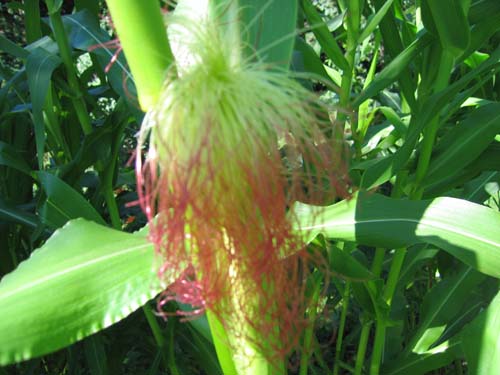
                     punksilk2.jpg

Lammas, or “Loaf Mass,” is the Feast of the First Harvest, the Feast of Bread. This Holy Day honors the women who created agriculture and bred the crops we cultivate, especially the grains, or corn. In the British Isles, celebrants make corn dollies from the last of the newly-harvested wheat. The corn dolly holds the energy of the grain Goddess and, when placed above the door or the mantle, will bring good luck to the household all year.

When we think of corn, we think of succulent cobs of crisp, sweet, buttery yellow or white kernels: immature Zea mays, Indian corn. You know, corn. As in sweet corn, popcorn, blue corn, decorative corn, corn bread and corn chowder. Corn!

But, did you ever wonder why it’s corn? “Korn” is an old Greek word for “grain.” Wheat and oats, barley and even rice, are korn. This usage is preserved in the song “John Barleycorn must die.” When Europeans crossed the Atlantic and were introduced to the beautiful grain the Native Americans grew, they, of course, called it “corn.” And nowadays we think of corn as only that, but corn is Kore (pronounced “core-a”), the Great Mother of us all.

Her name, in its many forms — Ker, Car, Q’re, Kher, Kirn, Kern, Ceres, Core, Kore, Kaur, Kauri, Kali — is the oldest of all Goddess names. From it we derive the English words corn, kernel, carnal, core, and cardiac. “Kern” is Ancient Greek for “sacred womb-vase in which grain is reborn.”

The Goddess of Grain is the mother of civilization, of cultivation, of endless fertility and fecundity. To the Romans she was Ceres, whose name becomes “cereal.” To the Greeks, she was Kore, the daughter, and Demeter (de/dea/goddess, meter/mater/mother) as well. To the peoples of the Americas, she is Corn Mother, she-who-gave-herself-that-the-People-may-live. She is one of the three sister crops: corn, beans and squash. In the British Isles she was celebrated almost to the present day as “Cerealia, the source of all food.”

Honoring grain as the staff of our life dates at least as far back as Ancient Greece. Nearly four thousand years ago, the Eleusinian mysteries, which were regarded as ancient mysteries even then, centered on the sacred corn and the story of Demeter and her daughter Kore or Persephone. Initiates, after many days of ceremony, were at last shown the great mystery: an ear of Korn. Korn dies and is reborn, traditionally after being buried for three days. Corn and grain are magic. The one becomes many. That which dies is reborn.
Dark Energy

67  bar rises 30.17  0mph NNE dew-point 58  sunrises 6:15  sunset 8:19

Whole Corn Moon

“We are reformers in spring and summer; in autumn and winter, we stand by the old; reformers in the morning, conservers at night.” – Ralph Waldo Emerson

One of the beauties of Emerson is his immersion in the rhythms of the natural world.   Any farmer, any gardener, even any denizen of the farmer’s markets has a visceral sense of the way human activity changes with the seasons, at least in temperate latitudes.  Once the growing season begins, and for a bit before it does, our attention begins to move outside.  At first we watch temperatures, frost dates and the warming of the soil.  Then, we begin to watch for plant emergence, the ephemerals.  Once spring is in full gear with last frost date past, the growing season begins in earnest.  This means we are outside, working.  In this work we express, as Emerson subtly suggests,  our confidence as changers of the world.  We plant corn here and corn grows.  We plant tulips there and color blossoms.

Then, when the all the plants save the ancient firs and pines have begun to die back and the vegetables have given their harvest, we turn back toward the inside, reading and crafts and puttering in the workshop perhaps, or focusing on our work for pay.  As the nights grow longer, as they do even now, we light our fires and gather in our modern caves, lights on against the dark.

Still, I part company with Emerson a bit at the end of this quote.  The night, as it grows longer and deeper, heading toward the winter solstice, the heart of mid-winter, encourages creativity.  The metaphor of the day goes from verdant field to fecund womb.  As we slow, pull in our senses and live more in our interior, seeds planted long ago begin to sprout.  The novel we muttered about while weeding the tomatoes begins to demand a place in our lives.  The child we wondered about in the spring begins to insist, pushing us toward family.  The painting influenced by the play of light on brown and withering plants takes on shape and color.

Hecate. Persephone. Jesus in the tomb.  Osiris scattered among the reeds.  The rebel angel in Pandemonium.  The shadow within our own psyche.  All these are night time, dark energy forces.  Their energy often sublimates when the external world draws us; but when winter or melancholy strikes,  they can draft upward, burst out into full awareness and with their explosive power drive us either toward self-destruction or acts of creation.

Why Does Gardening Inspire Us?

65  bar steady  29.78  0mph E  dew-point 64  sunrise 6:11  sunset 8:24  Lughnasa

Waxing Gibbous Corn Moon  moonrise 1816  moonset  0130

Rain all night.  After a night of moisture the air is cool and the garden looks replenished.  The lily bubils I set out in their soil plugs yesterday got a good drenching.  Forgot to mention yesterday that I also planted a stem with the bubils on it, apparently this was the old method of regeneration.  It makes sense because it’s what the plant intends.  After die back the stem and its bubils would fall to the ground and sprout from there.

While looking at the tomatoes yesterday, I had a realization, one you’ve probably made already.  When the tomato fruits are not ripe, they blend in with the bushy plant and its leaves.  Once they are ripe, that is, ready for distribution by hungry critters, they turn red.  Then, they stand out against the green.  Mother nature reverses the human traffic light, for her green means stop and red means go.

When I set aside a book review to purchase the book The Brother Gardeners, it made me think about gardening from a different perspective.  That is, why does gardening inspire us, over and over again?  We do not write books of a philosophical bent about agriculture, at least not many.  I can’t recall any, but there must be some.  So why does gardening get so much ink; it is an act usually irrelevant to economic fortunes.

Here’s one answer.  Gardening is a unique experience for each one who engages it.  The topography of your land, its winter and summer extremes, annual rainfall, the microclimates, the amount of work you put in to the soil, your ability to match plants with all these variables, the time you can devote, all these factors plus many more make certain that even the person gardening next door has a different experience than you do.

Within that unique experience though, there is a universal moment, an archetypal moment.  Each time we provide support and care to a plant, any plant, we relive a defining event in all human history, the neo-lithic revolution.  Somewhere, around 10,000 years ago or so, somebody, probably a woman, noticed that plants grew from seeds.  Little by little this led to tending the first gardens, a bulwark against the vagaries of hunting and gathering.

This changed the world.

Gardening, too, remains the most common activity, perhaps after parenting, that gives us the sense of co-creation with the forces of life.  In each unique experience, from tending African Violets in a windowsill to tomato plants and corn outside, we have to live on plant time.  We wait for the seeds to sprout.  We wait for the leaves to grow.  We wait for the blooms.  We wait for the fruits to set.  We wait for the fruit to mature.  Though we can, and do, fiddle with these factors most of us allow the plant to lead us.

In this cycle, as old as plant life itself, older than the animals, is the paradigm for our own lives.  Thus, when we weed or harvest, prune or feed we know ourselves part of the vitality of mother earth.  That’s key, we know ourselves as part, not the whole, not the most important part, only a part.

Colma, California City of the Dead

69  bar falls 29.80 1mh SSE dew-point 53  sunrise 6:11 sunset 8:25  Lughnasa

Waxing Gibbous Corn Moon    moonrise 1816  moonset  0130

Finished Alive in Necropolis. A fascinating book, part ghost story, part coming of age story, part police procedural set in Colma, California.  Colma, California is not just anywhere; it is where San Francisco chose to bury its dead.  There are way more dead people in Colma’s 17 cemeteries, 1.5 million, than citizens, 1, 280.   This one I read almost straight through.  It kept what John Gardner calls the fictive dream alive.

Feels good to have read the last two nights rather than watch TV.  I might let it become a habit.  I love fiction, write fiction.  That’s not to say I don’t pick up non-fiction, in fact, I do.  Quite a bit.  Some folks I know rarely read fiction.  I rarely read non-fiction books through in the same way I do novels.  I tend to treat them as resources, reading them more in the manner of college reading.  I seek the big ideas, the general arc of the argument.  Sometimes, I’ll finish them, but rarely.

Kate is home, the night is pleasant.  The kids are healthy, the grandkids, too.  And the dogs.  The gardens productive and the flowers are beautiful.  A good now.

The Earth, a Sacred Place

79  bar falls 29.96  0mph NE  dew-point 56  sunrise 6:10 sunset 8:25  Lughnasa

Waxing Gibbous Corn Moon

I got this off the Permaculture listserv.

“(I find this is a good reminder to recite every morning.)
Diadra

A Prayer for Gaia by Rose Mary O’Malley

As I breathe in your air, eat your fruits and drink your water, let me be sustained and nourished so that I may serve.

As I use your resources for clothes, shelter and warmth, let me be strengthened so that I may give back more than I have taken.

As I drink in the beauty of your oceans, flowers, blue sky and stars, let me be so filled with beauty that I will bring only love and joy to your inhabitants.

As I am nourished, taught and loved by your inhabitants, let me so filled with love and knowledge that I joyfully work to assure a fair distribution of your treasures.”

It is an example what I believe to be true, that is, many many people consider the earth a sacred place and have the intention of reverence and worship toward her.  The whole neo-pagan movement with its mix and match invocation of Europe’s ancient pantheons and perhaps some Egyptian influence does not reflect the rootedness of this sentiment in American soil. (That is, the American manifestation of it.  I believe this is a global phenomenon.) It is also not the case that the Native American reverence for the earth is other than a salutary reminder since their experience is so different from that of us boat people.

We need a way of following the seasons that respects our American experience of this vast and wonderful land.  We need a way of honoring mother earth that borrows, yes, from other cultures, but does not presume to make their ways our ways.  We need, as Emerson said, a religion of revelation to us, not the history of theirs.   And that revelation comes from two sources:  our experience of the outer world–this land, its peoples and our experience of other peoples and other lands; and, our experience of our inner world and its own universe, added to our resonance with the outer world.

This is the pagan lovesong that I hear in the hearts of so many people, one that needs articulation and expansion.  This is like Brian Swimme’s work, too.

This faith, this reverence and worship of the earth, as in Ms. O’Malley’s prayer, is an ur-faith, or a proto-faith, a faith that comes prior to others,  a faith whose acceptance does not contradict the Mulism or the Buddhist, the Taoist or the Christian, but complements, supplements them.  For some, like me, it is an adequate faith, enough to sustain me on my journey and as I contemplate the life after this one, or others, it is not enough, but one that needs some salvation instrument or some philosophical cleanser.  That’s all right.

Remember The Sabbath Day And Keep It Holy

76  bar steady 29.97  0mph NEE dew-point 58  sunrise 6:10 sunset 8:25  Lughnasa

Waxing Gibbous Corn Moon    moonrise 1633 moonset 0040

Strange how I have to relearn, sometimes again and again, simple home truths.  A day of rest is good for the soul.  The Jews knew it.  The traditional Christian community knew it.  It may be a Western contribution to humanity.  I’ll have to check, but I don’t think the Asian communities have a similar notion.  Yes, they have festivals and holidays, that’s for sure shared, but the notion of a weekly day of rest?  I don’t know.  Those of you who read from Southeast Asia, what do you know?

Anyhow, I woke up today recharged and ready to go.  This in spite of my lingering doubts yesterday.  Remember the Sabbath Day and keep it holy.  Quite a while back I got interested in the idea of sacred time, my commitment to the Celtic calendar is an example.  I also observe a week long retreat at the end of each year thanks to the Mayan concept that the last five days of the year are best left alone in terms of work.

I took from the Spanish cultures, especially Colombia and Mexico, the siesta.  A nap a day continues to be a cornerstone of how I live daily.

The religious communities with whom I shared a vocation for a time convinced me of the value of regular retreats.  The retreats and the Sabbath day have been honored more in the breach than the observance, but I believe that is about to change.  Our body needs sleep, perchance to dream, and, it turns out, our mind does, too.  Recent research shows that the mind sifts, weighs, analyzes and interprets the days events while we sleep.  I suspect the same thing occurs when we take a regular caesura from the usual rhythms of our week and our year.

Please note I’m not talking about vacations here.  Those exist for a different reason, I believe.  Vacations allow us to vacate the norm and experience another world.  They are more for fun and for education seen as fun.

The holy rhythms of which I write here are different.  They focus on the spirit, the care and maintenance of our soul.  Our doubts about such a metaphysically evanescent idea may have contributed to our immersion in and the stickiness for us of the material, outer world.

Well, time to put this regathered energy to work.  See you on the flipside.

How I Work

76  bar falls 30.01  0mph SW dew-point 58  sunrise 6:06 sunset 8:30  Lughnasa

First Quarter of the Corn Moon  moonrise 1326  moonset 2226

“More Americans are likely to suffer kidney stones in the coming years as a result of global warming, according to researchers at the University of Texas.”  Agence France-Presse, July 2008

N.B. All these quotes about global warming come from this website:  The Warmlist.  Here’s the webmasters explanation:

“This site is devoted to the monitoring of the misleading numbers that rain down on us via the media. Whether they are generated by Single Issue Fanatics (SIFs), politicians, bureaucrats, quasi-scientists (junk, pseudo- or just bad), such numbers swamp the media, generating unnecessary alarm and panic. They are seized upon by media, hungry for eye-catching stories. There is a growing band of people whose livelihoods depend on creating and maintaining panic. There are also some who are trying to keep numbers away from your notice and others who hope that you will not  make comparisons. Their stock in trade is the gratuitous lie. The aim here is to nail just a few of them.”

So, don’t say I didn’t fess up.  The Star-Tribune turned me onto this site.

Shifted focus. Gonna work on that firepit.  I decided Kate can help me transplant day lilies when she gets home and I’ll still have time to transplant the iris.  I get on a task and sometimes don’t lift my headup to check whether it makes sense.  Heresy Moves West is an example.

The research alone would take a good bit of time, I knew that.  That meant I could not hope to research and write it in the week prior to September 14th.  Knowing that I began to develop this knot in my to do lobe.  It began to insist, get it done.  Get it done now.  Right now.  This even though the date was 8 weeks away at the time.  Anyhow, I finally opened up and let the lobe have its way.

Once begun, research and writing, at least for me, need to be one fluid motion, the research followed by the writing.  In my case this is because as I research various ways of slicing and dicing the information comes to me throughout. At night before I go to sleep the data often floats up and demands consideration.   Sometimes I make note of these patterns, sometimes not.  Often I don’t because I want the order and interpretation fungible to the last possible moment.

Why?  In between the research and the writing there is a creative time in which the data and the various arrangements of it begin to pull other information, other paradigms out of my memory.  This process can change the data’s relevance.  Let me give you an example.

At first I imagined a straight chronological presentation.  The Unitarians began at such and such a place at such and such a time.  The westward expansion of the US began in this time period.  It rolled out according to these stages, in this place at this time and another place at another time until the whole shebang ended up encountering Minnesota. This came to me first because historical movement often seems cleanest presented in chronological order.

Soon though, as the pieces began to swirl, it became clear to me that the historical progression would have to start earlier, then even earlier.  I wrote about this a while back, my need for context.  When I realized there were big ideas at play here, the order of things changed again.  Then it was a history of ideas approach that made more sense, capturing the development of the peculiar notion of religious freedom in the US.  As that became clear, a second important dynamic rose to the top, the rolling dialectic between orthodoxy and heterodoxy.

To highlight the ancient character of this dynamic I decided to find its beginnings in the Abrahamic tradition with Abram’s call away from polytheism to allegiance to YHWH.

Both of these decisions meant that the data in the presentation would have to show how the westward movement of heresy (the rolling dialectic of orthodoxy and heterodoxy in Unitarian history) advanced thanks to the first amendment and how it continued the long arc of dogma challenged by new thought.  This lead to the realization that the westward expansion of heresy intensified in the  atmosphere of freedom and pioneer energy found on the frontier.  So, when we end up in Minnesota, the presentations show how religious freedom and the rolling dialectic not only manifest themselves here, but in fact gain strength and intensity.

Finally, that lead to a desire to push the dialectic one step further, beyond the bland everything’s in bounds soup of current day Unitarian-Universalism to the articulation of a new heterodoxy, one opposed to the dogma of one size fits all faith-lite.  This piece is the unwritten one at this point.

It Forces Me Into the Present

60  bar steady 30.03 0mph NNW dew-pooint 54  sunrise 6:06  sunset 8:31  Lughnasa

First Quarter of the Corn Moon    moonrise 1219  moonset 2200

If you’ve ever wondered why I put all this weather and astronomical data first, good question.  The immediate answer is because I can.  My weather station gives me all the top line data with the exception of the Celtic calendar period, but I know those by heart now.  The moon names fascinate me so I have several lists of names from all the over world, and I choose one that feels right for the next month.  The lists that usually have the one I want are the Celtic, medieval English, and neo-Pagan, although I always feel a little strange with the last one because I don’t understand the roots.  The moonrise and moonset I got from a Naval Observatory website that creates a list for your location.

The secondary answer lies in weather history.  When I read back over my entries, I want to know what the conditions were like on the day in question.  Again, you ask, why?  Sometimes for gardening reasons.  Sometimes to jog my memory.  Sometimes just for fun.

The tertiary answer, though it may be the primary one, is this: it forces me into the present, right down to the temperature and barometric readings.  I like the reminder that this moment is this moment and no other.  Right now is right now.

Kate’s in Denver.  The dogs are asleep and the HD box has a so-so sci-fi movie on record so I can finish when and if I want.

A wonderful night and a good looking day tomorrow.  See you then.