Category Archives: Faith and Spirituality

Self-Care for Future Corpses

Samhain                                                                         Thanksgiving Moon

Eat right, exercise, die anyway. I loved this refrigerator magnet and I love this short article by Sallie Tisdale. Especially for us third phasers. No fear, as the bumper stickers say.

Sallie Jiko Tisdale @ Tricycle.com

Sallie Jiko Tisdale is a Tricycle contributing editor and a lay teacher at Dharma Rain Zen Center in Portland, Oregon. She has authored several books and many essays.

Holiseason

Samhain                                                                  Moon of the First Snow


Holiseason. Begins on October 31st with Samhain and runs through January 6th, the Feast of Epiphany. This is a time when temperate latitude, northern hemisphere locations go through the darkest months of the year, punctuated with snow and cold. In times before refrigeration, electric lights, central heating, grocery stores this was a time when family and livestock could die. That’s why it begins on a holiday when the veil between the worlds thins.

Over the course of this time comes Thanksgiving, food and family at the center, many holidays of light, brave gestures against the seeming victory of darkness, the Winter Solstice, Saturnalia, New Years and the feast of the epiphany: Hanukkah, Posada, Advent, Deepavali, Christmas, the Winter Solstice, Saturnalia, New Years, Kwanza, the feast of the Three Kings. Special music, distinctive decorations, gift giving, meals with family and friends, times for reflection on the meaning of life and the nature of reality are the norm during Holiseason.


It is, for me, a joyful time. I love the moments of connection, the songs and stories raised in the air, the colorful installations on homes and businesses, the food, but most of all I like the quiet time, time to consider the light and dark in my own life. I love the way humanity, all over the globe, has taken special care for each other in times that were once literally dangerous, risky. I will surf holiseason again this year, riding the pulsing waves of human delight.

Happy New Year!

Samhain                                                                   Moon of the First Snow

The Celts began the New Year at the end of the harvest season celebrated on October 31st. In the old Celtic calendar there were only two seasons: summer and winter and today marked summer’s end or Samhain, the end of the growing season. So for the ancient Celts the year began in the fallow season, the season of senescence and death.

As I’ve watched the run up to Halloween this year, I’ve been struck by its emphasis on horror, scares and fear. As a direct, but altered version of Samhain, Halloween emphasizes certain aspects of the original holiday, for example the thinning of the veil between this world and the Otherworld, the land of faery and the dead.

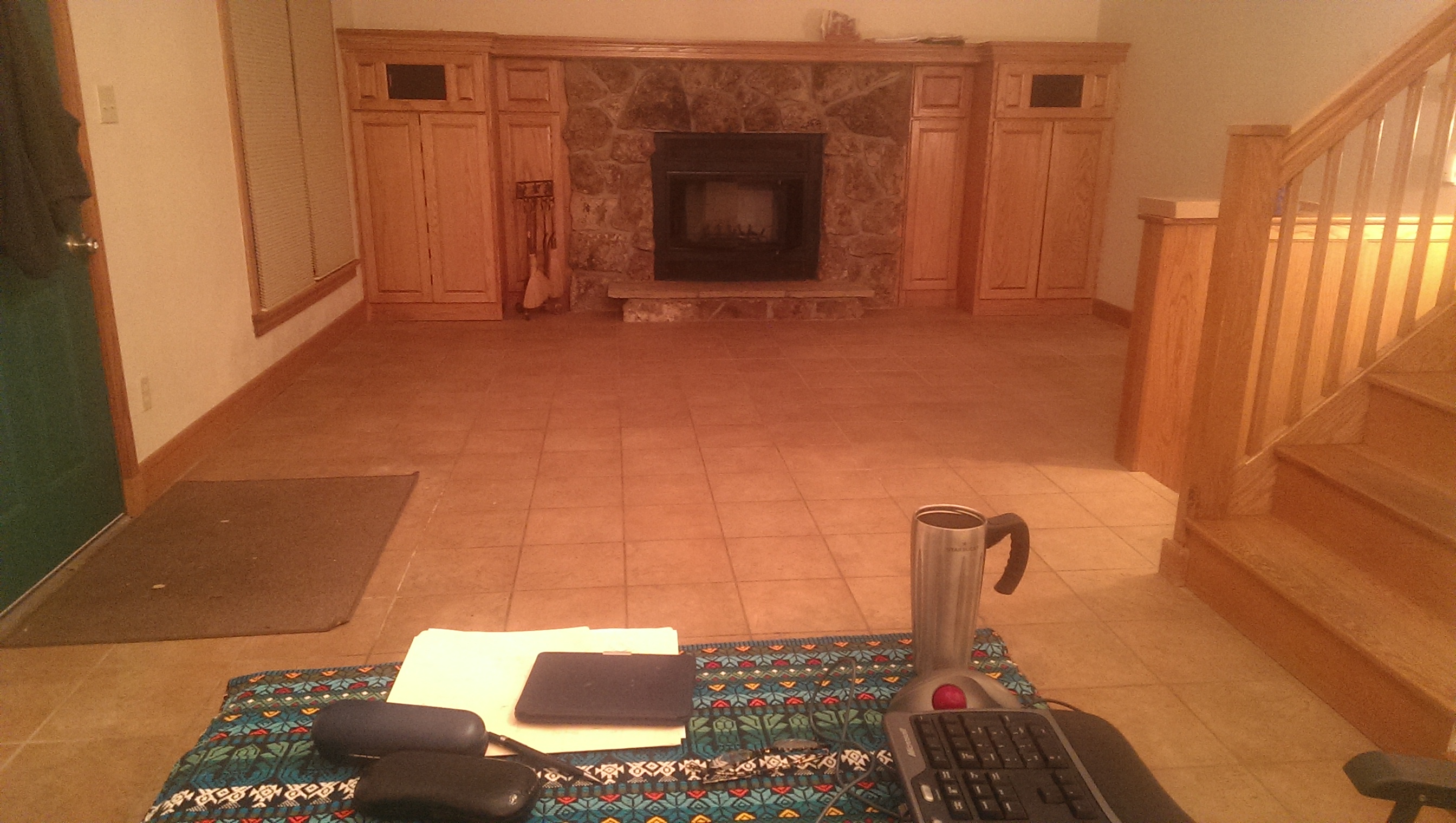
This year Kate and I celebrate the thinning of the veil between Minnesota and Colorado. Exactly a year ago today we closed on Black Mountain Drive. That closing brought Minnesota and Colorado so close to each other they could touch. For us.

Three mule deer bucks were in the back that morning, eating grass. I approached them slowly and they let me get very close, watching me with round brown eyes, attentive but not nervous. They were the spirit of Shadow Mountain welcoming us home, a trinity of mountain dwellers.

Black Mountain Drive is a Great Wheel home. We closed on October 31st, Samhain, and moved in on December 20th, the Winter Solstice, the day that Samhain ends. The holiday of the longest night, Winter’s Solstice, is my favorite holiday of the year, so to close on Samhain, the New Year, and to move in on my favorite  holiday gives our home a special frisson. It occupies a space not only on the physical Shadow Mountain but on spirit Shadow Mountain, too.

IMAG0773Our home participates not only in the massive rockness of the mountain, but in the essence of the Rocky Mountains, their wild majesty, their sudden emergence from the Great Plains, their uncivilized character. These mountains are home to elk, mule deer, fox, bear, squirrels, pika, mountain lions, human beings, dogs, cats, lodgepole and ponderosa pines, Colorado blue spruce, fast running streams, waterfalls, quiet ponds and small lakes.

It is a Samhain home and a Solstice home, forever for us, infused with the old energies of these two seasons. Our years within it begin on the Celtic new year and grow deep with the long night, the two poles of our start here.

So this year we celebrate both home and holiday. Blessed be.

Not Even Gone

Mabon                                                                     Moon of the First Snow

It is so beautiful here around 5 a.m. when the sky is clear, which is most mornings. The stars leap out of the sky, reminders of the power they had when the only light pollution was an evening’s campfire. Orion stands high in the south, moving toward Black Mountain. The Big Dipper disappears behind the roof of the garage in the east, but the pointer stars are visible, showing the way to true north. Cassiopeia, that unhappy queen, extends her jagged W, a slash of stars.

Time travel has been with us since the first human looked up in wonder at the stars. What we see unaided and what we can see with telescopes comes to us from the distant, distant past. So distant that the miles come in units of time. Perhaps, in a way, our lives are like the heavens, still shining after long years, even after death, radiating out from our small sector of space-time to the far away future.

So you might go out and look at the stars and consider the bright lights in your life, still strong and beautiful, wonderful. And remember that someday, you too will shine for others. Not gone, not even absent.

On Dying Luminously

Mabon                                                                              New Moon of the First Snow

Friend Tom Crane wrote this morning:  “Third phase (or whatever the hell it is we are in) is stereotyped as winding down, dealing with fewer issues (because they have all been dealt with already) and generally a slowing down.  Now that we are all really fully into whatever this is it seems to me there is a good bit of the opposite of that energy.  We are dealing with really significant stuff (body and health related, for instance) that never came to us when we were younger and more vital.  There is more change per square minute that we have ever seen before in spite of the stability of key relationships and situations.  And yet it is curious that we seem to be demonstrating greater capability than ever before as we navigate all this with the experience and wisdom(?) gained through decades of experimentation with who we are.”

The third phase notion is my attempt to decouple this period of life from the concept of retirement, an idea that this period of life defines itself as not-doing something. Winding down, dealing with fewer issues, slowing down featured prominently in the finish line model of retirement. We were done with the workaday world, no more 9-5. No longer the buzzing, blooming world of business with its implacable demands. Now we could kick back, put our feet up, pop a PBR and watch football without guilt. Or go fishing. Or golfing. Or quilt. Or spend more time with the grandkids.

And, when work finished up followed by four or five years of leisure, then disability or death, that model, retirement, the time of not-working, probably made sense. That is, it described life post-work for the bulk of retirees.

Lengthening lifespans have caused not-working to become inadequate for understanding life after the second phase of family building and career. In fact for some who enter the third phase they may not have given up their career, though family building is likely behind them. Still, even those still active in work often now see work as much less central, much less definitive for their identity.

If you agree to any degree with this: “I believe that the true norm of the third phase is to wander, to become like a planet to your Self, pulled by the gravitational attractions of its values and its directions. Now is the time, if you have not availed yourself of it earlier, to listen to the voices of your own heart, your own dreams, your own ancientrail.”, then, this time, call it the third phase or aging (though I’ve always found this an odd term since by definition we begin aging at birth) or old age, is qualitatively different from what has gone before.

It no longer focuses on getting somewhere, accomplishing something (though we may get somewhere and things may well be accomplished), but on the journey of your uniqueness. In this way we can arrive at the paradox, the apparent contradiction that Tom identifies: “…there is a good bit of the opposite of that energy.  We are dealing with really significant stuff (body and health related, for instance) that never came to us when we were younger and more vital…There is more change per square minute that we have ever seen before in spite of the stability of key relationships and situations.”

Once we have made or not made our family, stumbled on or victoriously walked the path of work/career, then the shift can be made to a time of self-understanding, self-expression. Perhaps the second phase could be characterized as a “we” phase and the third the “I” phase, in this sense the third phase and the first have much in common. In none of the phases do we exist solely in a we mode or solely in an I mode. I refer to a matter of emphasis, one dictated not so much by personal desire or even cultural norms, but by matters of biology.

How so? In the first phase we are young, inexperienced, naive to the world. As we grow and our bodies change, the emphasis is necessarily on personal learning: socialization, athleticism, school curriculum or skill set development. At some point in our twenties, early or late depending on the amount of schooling undertaken, the idea of family begins to take hold for most of us. This reflects a maturation of the body and an acquiescence to the species imperative for propagation. Work and/or career follows from the learning of the first phase and becomes, again for most of us, intricately entwined with family.

We are not eternal though. The body begins a decline, at first gradual, then more pronounced. At some point the children are launched, either into the workforce or into higher education then the workforce, and our own work/career reaches a peak. Sometime after we begin to contemplate a time when neither work nor family building will be central to our lives. Yes, family will still be important, probably, and even work might continue in some fashion, but neither will be at the center of our lives anymore.

What will be at the center? Individuation. The final process of personal development. Does this mean a collapse of the we and an ascendance of the I? Not at all. Your individuation may well carry you more deeply into the world. Or, it may not. It may carry you into the study, the sewing room, the world of rocks and minerals, even the development of a brand new way of human interaction. Wherever it carries you, if you are true to the defining character of the third phase, that it ends in death, you will become more of who you really are. Because, you see, it is, finally, only you that dies.

So, then, the paradox. When we are at our most authentic, are most keen to explore and liberate our gifts, the body is well into its senescence. So, the signals of mortality come fast and often: cancer, arthritis, glaucoma, weakening, imbalance at the same time the Self, the integration of body/mind, is at its most flourishing.

Though it doesn’t have to make sense, since this is a biological process and has its own timing, it does make sense to me that our most fully evolved person can be the one who faces the physical challenges of aging. By now, hopefully, we have learned of our finitude and understand biological deterioration. What a gift it is to see our frailties for what they are, accidents of our biology, and not determinative of our Self, its worth. In this way our best Self confronts the dangers and agonies that would have terrified, perhaps frozen, our younger Selves, and sees in them not the hand of a cruel fate, but the working out of a truth known since birth. We are mortal.

But, we can die as the flaming aspen does, a brilliant luminosity apparent just before the winter sets in.
Quadfecta

Mabon                                                                       Elk Rut Moon

September has seen me accomplish a rare third phase quadfecta. First I drove to Indiana for my 50th high school reunion. After my return I had three appointments: internist, audiologist and urologist. The internist ordered x-rays and gave me my first ever diagnosis of arthritis. The audiologist told me what I already knew, deaf in the left ear and not hearing well out of the right. The urologist told me I was nominally cancer free.

This morning I picked up and am now wearing my new hearing aid. That’s right. Aid. Just one. So far my voice sounds gravely and I’m hearing the computer keyboard clack. No real revelations so far.

So, in less than three weeks cancer vanquished, hearing aid, arthritis and my 50th high school reunion. That’s roaring around the corner into the third phase, pedal to the metal.

Neither the First nor the Last

Mabon                                                                               Elk Rut Moon


The bloody supermoon. Saw it last night over Conifer Mountain with Kate. We stood at the end of the driveway, she in tie-dyed t-shirt and a small Hawaiian quilt for a skirt and me trying to make sure I didn’t fall in the ditch. It was, after all, dark. It reminded me of a frigid Minnesota night, a January of long ago, with the Woolly Mammoths at Villa Maria in Frontenac. We went outside to see the lunar eclipse. The air temperature was well below zero, maybe 15 0r 20, and we stood, in the dark, marveling.

When I checked Facebook this morning, I saw many cell-phone shots of the super, bloody moon. They all proved that cell-phones are not a good choice for photographing lunar anything. Too far away. They also proved the old lover’s promise, we’ll be looking at the same moon.

As any reader of this blog can attest, I start with the same two things every post: the Celtic season on the Great Wheel and the current moon. The spiral nature of time is caught by the different seasons of the Celtic year, seasons which recur, and the always changing, yet always the same phases of the moon. This focus helps me stay in context with the natural world, in it and of it.

It also reminds me of a crucial fact. This life will end in death, but death is not the end. It is, like the recurring Celtic seasons and the phases of the moon, a moment in the spiral passage of the human species from yesterday to tomorrow. I am neither the first nor the last, but rather part of a widening gyre that is the cumulative experience of what it means to be human. I contribute my part, then make way for others, just as the blood moon departs to make way for countless more phases.


Self-ish

Mabon                                                                     Elk Rut Moon


I’ve had false dawns on this recent journey, thinking the time was right to get back to writing, to Latin, to dreaming, to acting. A flywheel somewhere in my psyche has pulled me back into the day-to-day, letting the sweep of things carry me along like a piece of driftwood on the tide. I pushed against it a couple of times, trying to will myself into a more productive place. I’ve failed.

Now I’m waiting, trying to flow with the direction of my psyche, following the ancientrail of change without attempting to bend it to my own wishes. It’s hard. Perhaps this is the third phase way, a more Taoist one, one where the day-to-day and our Self’s work can merge, then diverge.

There is no clock. No agenda set by others. (other than doctors) No career mountain to climb. No financial aspirations. Those of us in the third phase and out of the work life can be more open to the currents of our inner life. We do not have to cut and shape our day to meet the demands of second phase goals.

Not all who wander are lost. This Tolkien phrase unintentionally captures the problem. If you wander, the second phase life assumes you are lost. Though there are no second phase norms by which to judge your direction in the third phase, no child raising (hopefully), no boss or vocational directives, no 401k to plump up, our long affiliation with these norms often carries them over into the third phase anyway. It is in this sense that wandering in the third phase can make us seem and feel lost.

Yet I believe that the true norm of the third phase is to wander, to become like a planet to your Self, pulled by the gravitational attractions of its values and its directions. Now is the time, if you have not availed yourself of it earlier, to listen to the voices of your own heart, your own dreams, your own ancientrail. You may think or feel that, because second phase norms require us to chop and curtail our own desires to fit the needs of institutions, workplaces, family that this is selfish.

I say yes, it is. Just so. Self-ish. Always the world would have been better off if you had let your own voices guide you. Why? Because you are the only you this universe will ever see and to shortcut your development for what others want is to deny the universe your particular gifts. Now is the chance to give expression to that you hidden by the often crushing world of family and career. Now is the time to become the person the universe needs. You.


The Now and the Not Yet

Lughnasa                                                                    Labor Day Moon

A curious bifurcation. Friends comment on how well my life’s going. I’m not feeling it. Kate says look at the big picture. That’s what they’re seeing. Time with grandkids. Settling into the mountains. Healthy dogs. Cancer season mostly over. Loft getting put together.

When Kate suggested I look at the big picture, I replied, “It’s not in my nature.” My comment surprised me. What did that mean? “It’s not in my nature.”

In the moment I meant the larger trajectory of my life always gets swamped by the quotidian. The generator, damn thing. Rigel’s cast. Aimlessness. Sleep. That’s what gets my attention, my focus. It’s the way of generalized anxiety. Yes, I can back off from the day-to-day, know that these things are transient and the bigger things more lasting, but I get dragged right back in. Gotta change our home insurance before October 31st. Like that.

But more to my question, what is my nature? What does that mean? I mentioned a while back I’m reading a book called How Forests Think. In it Eduardo Kohn makes a strong, a remarkable case for animism, identifying animism with the Selfhood of living things. Self, if I understand Kohn right, is the gathered experience of not only an individual tree, dog, human, but of the evolutionary and genetic inheritance each individual bears. In this sense my Self is the culmination of human adaptation over millions of years, specific adaptation in the instance of my particular genetic family and the moments since my birth that have shaped who I have become in dynamic interaction with those genetics.

I’ve always had a strong view of Self, that emergent being/becoming we each are. (BTW: we, in Kohn’s vocabulary, includes all living things) Thanks to many years of Jungian analysis I have tended to articulate Self in relation to Jungian thought as an entity rooted in the collective unconscious, born of the struggle between persona and our genetic tendencies, or, said another way, between our adaptative responses to the world and our animal inheritance.

It is in this sense that I meant it is not in my nature. Over time, thanks to events subtle and gross, I have learned to focus on the thing not finished, the matter with something left to do. That moves attention away from the completed, the resolved. Things like settling into the mountains, presumptively cancer free, time with the grandkids recede, get placed in the room marked o.k. for now.

So my nature is the sum of me, the skin-bound memories (another Kohn term) and the adaptative ancestry from which I descend. Here’s an interesting point about genetics and adaptation that Kohn makes, they are future oriented. That is, the adaptations that stick are, in essence, bets on a future that will require them. So, though they come from the past and manifest in the present, each adaptation represents a subtle reorientation of the species to a time imagined, in the most physical of senses, to have similarity with the near past.