Category Archives: GeekWorld

Quirky. Colorful. Funny.

Imbolc                                                                           Hare Moon

The Grand Budapest Hotel.  A story told by a writer, an iconic writer for a faux eastern European country, as told to him by the former lobby boy of the Grand Budapest Hotel.  At the end Anderson credits Stefan Zwieg, an Austrian author of the early 20th century whom Wikipedia claims was “one of the most famous writers in the world.” (Zweig)

The Ralph Fiennes character, M. Gustave, bears a striking resemblance to Zweig.  M. Gustave, a hotel concierge extraordinaire, earns the affections of wealthy hotel patrons and runs the Hotel at its height, in the 1930’s.

The plot is full of Andersonian twists and madcap turns.  During a prison break a ladder is lowered and it keeps going and going and going.  One of the funniest scenes in the movie is a downhill chase on snow, Ralph Fiennes and the lobby boy on a sled schussing after the leather clad thug played by Willem Dafoe on skis.

Stars pop up everywhere.  Tilda Swinton,  F. Murray Abraham, Adrien Brody, Jeff Goldblum, Ed Norton, Jude Law as well as Anderson regulars like Bill Murray, Jason Schwartzman and Owen Wilson.  Each has a particular and zany role, but all carried off with the trademark Anderson seriousness with a smirk just behind.

Also like Anderson’s other films, this one is gorgeous in a unique way: vivid colors, grand architecture, picturesque mountains, rube goldberg like bridges and towers and walkways.

It is a movie made of meringue, but you notice that only after it’s over.  It wraps you up and coddles you along from the first scene to the last.  A delight.  Maybe, as Colin Covert said, a masterpiece.

Afterward we ate at the Hammer and Sickle, a Russian vodka bar.  With surprisingly good food.  I had a beet salad and a lamb skewer, Kate a vodka flight, borscht and pelminis (small balls of dough filled with a lamb, beef and pork mixture, much like a pot sticker).

Our waitress was a west Siberian transplant who went to school in Novosibirsk, married an American and is now studying computer science at home.  “But I’m not so well disciplined, so I’ll have to go to school.”  She’s headed back home for three weeks very soon.

Keep Time the Way Nature Intended It

Imbolc                                                                    Hare Moon

It’s a scourge.  It’s unnatural.  It’s Daylight Savings Time.  Aside from being an obvious oxymoron, this idea forces us to change our sleep patterns every six months.  Sleep is important and habits are important to sleep.  Ergo.

(Plus, trees don’t change time.)

Here’s a link to a NYT room for debate piece on the subject:

“For days after “springing forward,” many of us feel a little jet-lagged and cranky. And the research is piling up to show that the time change affects more than our mood. It changes energy use, health, worker productivity and even traffic safety.

Does daylight saving time do more harm than good?”

Kairos

Imbolc                                                      Hare Moon

A bit more on an old topic, inspired by thinking about Jenkinson’s remarks that appear below.

The humanities are important as just that, the human forming portion of our educational deposit.  Over the millennia, stretching back to the time of gods emerging from the deserts of the Middle East and continuing right through the poetry and literature and painting and sculpture, the movies and television and games, the sports and horticulture and domestic arts of our day, we have had to grow into our lives, into our identity as human beings. It is not easy, but it is the most important task we have and the one which the family, the schools, our societies and cultures exist to engage.

This is not an argument for the humanities over science, technology and mathematics.  Far from it.  We have needed and will continue to need the valuable insights that come from deep thinking about the atomic structure of things, the hard rock science of the earth, the softer touches of the biological inquiries and the neuroscientific and all the other forms of scientific endeavor with which we humans engage.  But consider the difference in importance between raising a boy or a girl and lifting a rocket ship to the moon.  Which matters more?

It is not in the theory of evolution or in the biological sciences or in matters astronomical that we find the answer to such a question.  Even though we often pretend it is in this insecure age the answer is not in the psychological studies.  No, the answer to a question of value, of significance, of which is more than this lies only in the realm of culture.

The most important task of our time is said simply and defined humanistically, but requires the sciences in all their potency to finish:  create a sustainable human presence on this earth.

Why is this most important?  Because if it is not accomplished, the earth, no matter our scientific prowess, will scour us from her face.  She will make the thin layer of our habitation, from maybe 6 inches below the surface of the soil, to maybe 12 miles or so above the earth-the troposphere where most weather occurs-outside the parameters necessary for our existence.  That is, as the biologists are found of saying, an extinction level event.

So we are at a moment of kairos, a greek word meaning the opportune time.  Paul Tillich a theologian of the last century saw kairotic moments as “…crises in history which create an opportunity for, and indeed demand, an existential decision by the human subject.” Wiki His clearest example from the mid-point of that bloody hundred years was World War II, but even WW II and WW I put together do not equal the crisis we face now, a kairotic moment which, as Tillich said, demands an existential decision by us all.

(damaged relief of the Greek god Kairos of 4 century. BC)

The will and the skill to make that decision, a decision for or against our children and our grandchildren’s future, lies not in the sciences, but in the humanities.  It is in our sense of who we are as a species, as a being with a history, that we will find what we need to decide.  And, contrary to many, I am now convinced that the biggest barriers confounding our ability to make a non-suicidal decision lie in the realm of governance, a thoroughly humanistic endeavor.

Strip away those disciplines that force us to consider our humanity and we will be left with the calculus of Malthus.



It’s Free!

Imbolc                                                                Hare Moon

I wanted, for some reason, to establish a dropbox type relationship between this computer and the netbook which I take with me when I travel.  This means being able to access files on this computer from a distance.  This seems like a good thing to me, though just why I can’t exactly say.

Anyhow I discovered Bittorrent has a program called Sync that will do just this.  It establishes a P2P relationship between one computer or device and another for this purpose.  P2P = peer to peer, that is, both devices are equal to each other.  Dropbox and sugarsync and google drive and microsoft skydrive offer a similar service except you have to upload your files to their cloud.  Now a cloud is only a series of large hard-drives bunkered somewhere, fed lots of electricity and cooled by refrigerants.

In practical terms that means you give your data to someone else to store, then when you want it, you dial into their cloud and retrieve it.  The catch?  It’s free.  And, as I read somewhere recently, when a computer service is free, you’re the product.  That means they can access my data, mine it for advertising relevant facts and then sell me to hundreds if not thousands of others.  Also, the government can, with a warrant, crack the cloud and peak inside.

With a P2P setup all the data remains on your computers, for which the government needs a warrant and all others need the password.  In Sync’s case the password is a 32 character secret that establishes the bond between two computers.  32 characters make cracking the code technically very difficult.  Probably not worth it for my vacation pictures.

So.  I download sync.  And nothing happened.  Hmmm.  After a lot of hmming, I investigated various help forums.  Ah.  That could be an issue.  The two computers have to sync up timewise.  I fixed that since the netbook was still on mountain time from my last trip to Colorado.  Nope.

After a lot of head thumping, I tried a favorite ploy.  I turned off both computers and started them up again.  Ah.  Syncing at last.  Tomorrow I’ll learn if it does what I think it does.

This took most of the morning.

Imbolc                                                             Valentine Moon

Fixed a minor tech glitch yesterday with the aid of a friendly resident of the Indian subcontinent.  Our Roku went down.  “It is because the remote is not pairing with the Roku, Charlie.  Don’t worry, I’m here now to help you fix it.”  Not kidding about the dialogue.  Good service.  Fix worked.

Data

Imbolc                                                                    Valentine Moon

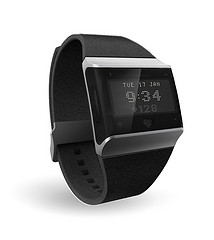
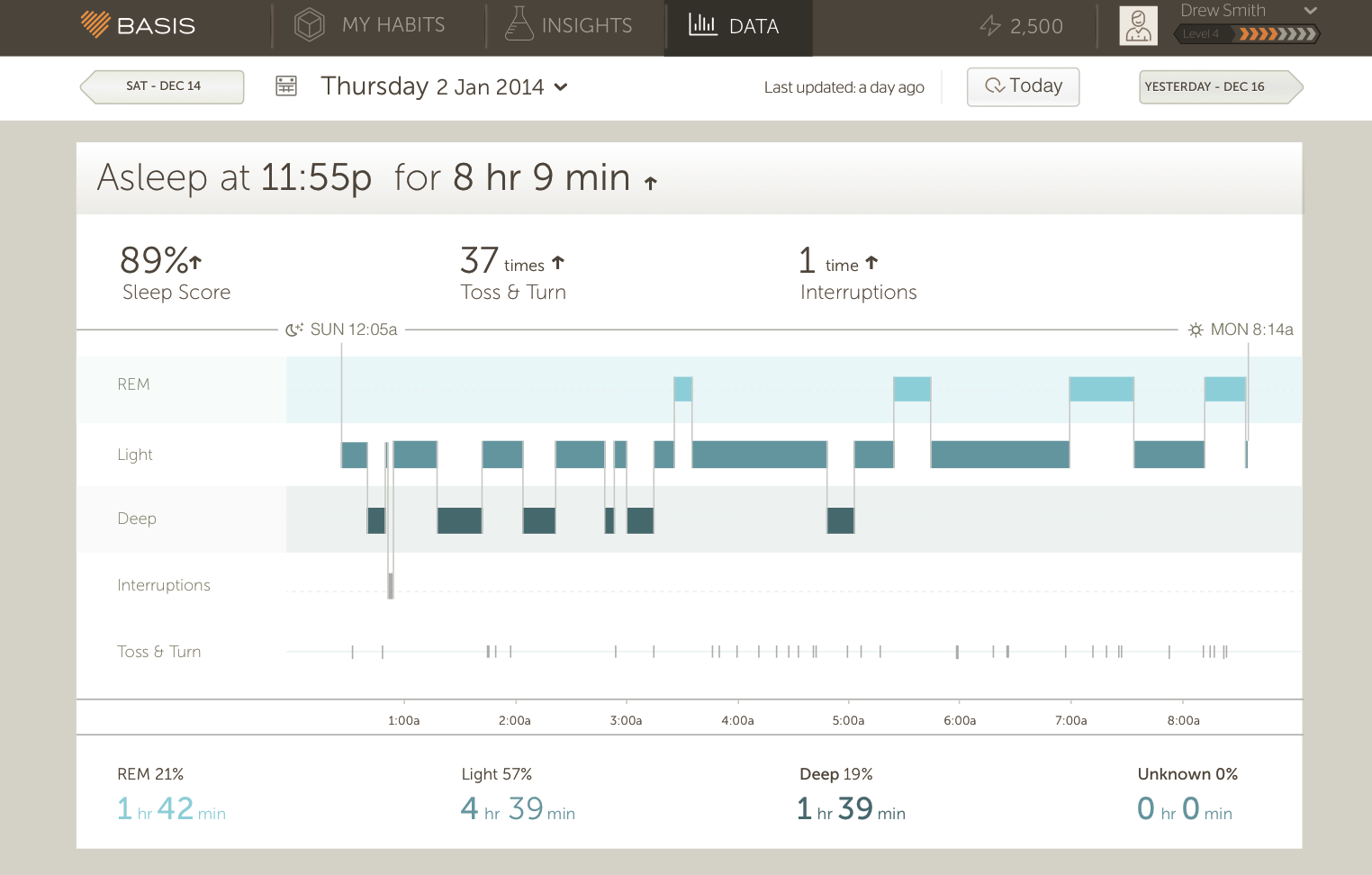
Gadgets. Yes. I like them. My latest is my birthday present, a Basis watch.  The basis keeps track of my steps (not so many in these winter days), calories burned (not so accurately for reasons I’ll make clear) and, most interestingly my sleep.  basis-sleep-tracking-web

Not quite sure how the sleep sensors work, but each time I nap or sleep at night the Basis records my sleep with several different variables:  time in deep sleep, light sleep, REM sleep.  It also records turns and turnovers and what it calls, interruptions.  At 67 you can imagine what my interruptions are.  These are done up in a neat graph that wouldn’t copy, but the overall data stream for last night is below.* (above is from their website)

But that’s not all. Overtime the Basis learns your patterns and gives you a sleep score based on Basis-Bandlength of sleep and all those other data points.  It also measures, helpfully, heart rate during the day, in particular resting heart rate which is a good measure of fitness.

I initially thought it would record my heart rate during exercise and give me feedback about my workouts, but it doesn’t do that.  I wanted to be able to upload my exercise data to the computer and save it, track my progress over time.

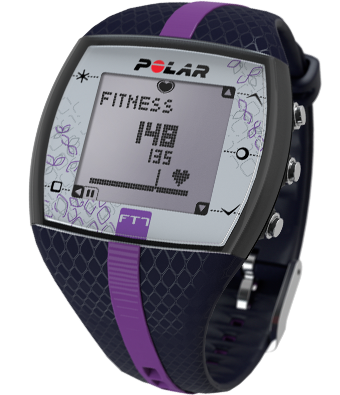
Though I’ve always exercised with a heart rate monitor (or at least I’ve done it so long I don’t recall when I started), the technology I had was only good for in the moment ft7_blulila_topleft_340x395_0readings.  That was good, but I wanted better data.  When I found the Basis wouldn’t do what I wanted (I was not the only one who made this mistake as the forum on the Basis website demonstrated), I went to Polartech.

They make a great, inexpensive watch and chest band (transmits heart rate to the watch) which, when coupled with a data synch plate, transfers a great deal of relevant data from the watch to the Polartech personal trainer website.  BTW:  I have the FT7 which the link displays and explains, but I got it for $73, not $119.00.

This means I don’t wear my Basis during exercise.  It didn’t do much helpful then anyhow. That means its calories burned per day reading is not accurate because it doesn’t reflect my workouts.  Still, it’s sleep monitoring and throughout the day heart monitoring give it a place, too.  Oh, and it tells time and the date, too.

Now I can monitor my sleep accurately, my resting heart rate and the intensity of my workouts.  With the workouts I see calories burned, maximum, minimum and average heart rate, training load (call it intensity), time in various training zones and I get graphs over time plus a calendar/diary that records each workout in a calendar format.  I like it.

*91%

Sleep Score

19 times

Toss & Turn

1 time

Interruptions

REM 25%

1 hr 48 min

Light 54%

3 hr 56 min

Deep 21%

1 hr 33 min

39 Billion Miles + On This Older Body

Imbolc                                                             Valentine Moon

Realized the other day that our age in years is actually shorthand for an odometer of sorts. This odometer measures our lifespan in miles, miles around the sun.  585,000,000 miles or so a trip.  At 67 that comes to 39,195,000,000 miles on this old body.

Looked at that way the 32,000 miles we have on our Rav4 doesn’t amount to much, does it?  That’s roughly 1,600,000 miles–a day.  Or, we may as well keep going, I have the calculator warmed up, 66,700 miles an hour.  Better speed than I get out of my Rav4, too. But, what the heck, lets do a minute: 1,100.  And, for a complete picture.  A second: 18 miles.  Each second.

That means, when I count off 6 seconds for my first infusion of Master Han’s 2013 pu’er, I’ve traveled 108 miles while I waited.  That’s a different perspective on how long it takes to make a cup of tea.

All of this is a convoluted way of saying that my 67th birthday is only 12 days away.  It has me thinking about that annual pilgrimage waypoint we all celebrate as our birthday.  It’s really a cairn stuck beside the imaginary line we travel as our home planet rockets its way around the nearest star.  It is a reminder of the cyclical, rather than the linear nature of time. Yes, we count the trips, but in fact each trip is the same as the last one. (sort of.  astronomical realities may vary.)


Back on Tailte, Peering Into the Climate Future

Winter                                                        Seed Catalog Moon

After a frustrating morning with a balky computer, I got into Robert Klein’s work on Missing.  He’s good.  Careful, detailed.  I’ve only rejected one of his edits so far and that one I understood what he did, but chose my construction over his.  I didn’t get far, but I’ll keep at it.

I wrote a private post earlier about my anxiety as I approached this stage.  It’s still there, but the anxiety decreased as I worked.  I hope that continues to be the case.

As I mentioned on Great Wheel, my computer is running a climate model with its unused processing power.  This is part of an Oxford Study to determine the results in a particular model if it is run many times with slight variations.  These slight variation can be very significant (think butterfly flapping wings), but without running these complex models over and over, tweaking them in slightly different ways each time, it’s impossible to know for sure what a particular adjustment will do.

Climate and weather modeling are big users of super computer resources and the work on my computer is part of a massively parallel processing strategy to, in effect, mimic super computers without having to buy them.  The concept is simple.  Each home computer has many times the computing power necessary for almost, if not all, the tasks it performs and, in addition to that, most of them sit idle most of the time.  By downloading parts of larger task onto many, many home computers use can be made of both the idle and under-utilized processing power.  The first one of these projects was SETI, the Search for Extra-Terrestial Intelligence, and I was part of that one, too.

They are resource intensive, however, so some of my computer frustrations might have come from it modeling global climate in the background.  I’m 95% with the task the Oxford folks assigned to me (well, my trusty Gateway is 95% done) and it may be a while before I take on another one.  This run takes approximately 350 hours of processing time.

I can and do shut it off at times.


Adrift Somewhere in Colorado

Winter                                                               Seed Catalog Moon

Expensive mistakes.  My phone, adrift somewhere in Colorado, not answering calls has moved beyond my reach.  Of course, Verizon was happy to replace it, demanding only a blood price and a new 2 year contract.  This phone contract business is great if you’re the phone company, for everyone else (most of us) not so much.

They did have a four propeller, camera equipped drone though, controllable from the phone. Would be fun.  But, I think for me, it would be a like a Christmas present of days gone by.  Used a lot for a while, then not at all.  Shaun Chenoweth, our Verizon salesperson, said realtors use them to show roofs and farmers use them to manage their land.  Both uses make sense to me.  Could help us find lost dogs but we have homebound canines at this point.  Still.

A smart phone is a great companion, especially once you have some reading material on it. That’s a generational attitude, I know.  All others have music.  Check e-mail.  Send texts. Take photographs.  Keep up with my Instapaper reading.  Keep notes.  Look up saved information in my Evernote account.  Even read a book if I want to.  Find the weather now and the forecasts.  Get warned about heavy weather.  A lot of work for one handheld gadget.  But wait.  There’s more.  You know, Internet, voice activated search, the flashlight, that chess platform, the calendar.  And on and on.

So, the phone is dead; long live the new phone.

This and That

Winter                                                              Seed Catalog Moon

Started another MOOC, see more on Great Wheel.  It’s gonna be work.  Note, Great Wheel is still undergoing development.  It won’t roll out officially until February 1st, but there are several posts up already.

Found some white tea I liked that is unavailable on the market.  So, I wrote the guy, who grows in his tea in Kurtistown, HI.  On Oahu.  He wrote back and offered to sell it to me wholesale.  Good deal.  Still expensive but it’s the best white tea I’ve had so far.  A low bar I’ll admit.

(not Maui Wowee.  Bob Jacobson’s white tea.)

The NYT has redesigned its webpage and I like the new look.  Cleaner.  But.  The types pretty small for these presbyopic eyes.

I see there that the Republicans plan to claim poverty as an issue, to make them look more compassionate and inclusive.  Wonder if they know they actually have to reduce it?