Category Archives: Feelings

Grief and Delight

Samain                                                                                Moving Moon

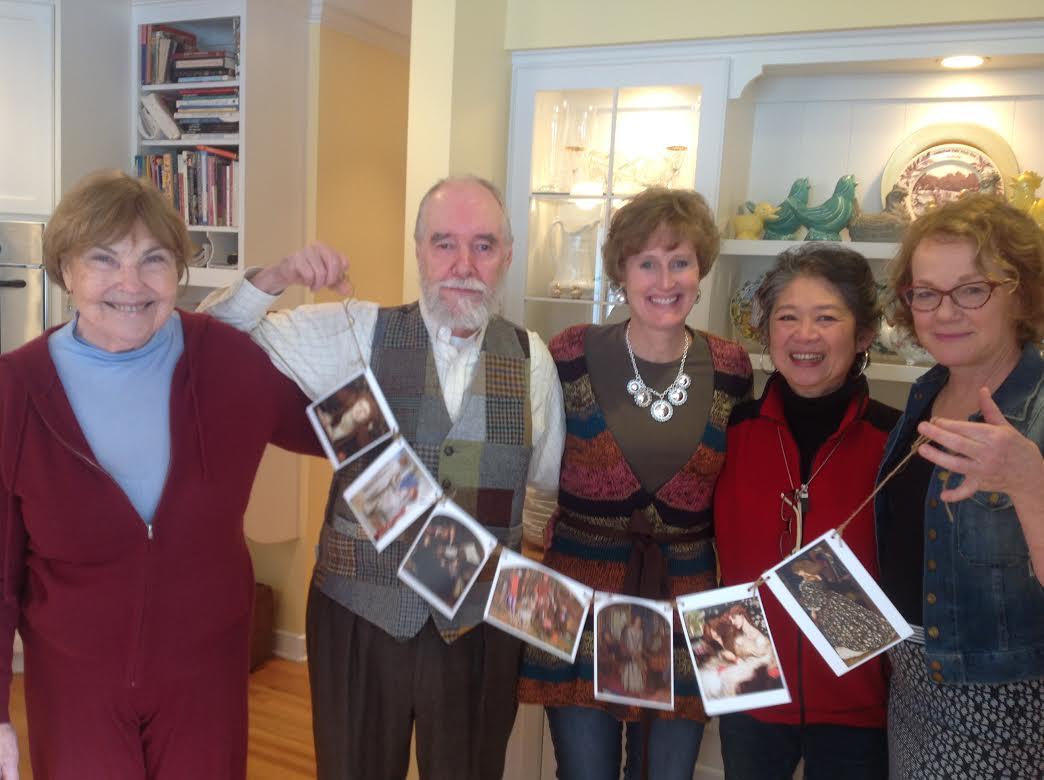
Antra, me, Wendy, Joy, Allison

Over the past seven and a half months we have lived with loss: friends, memories, arts and cultural opportunities, our home, even the belongings we have jettisoned. Our decision to move opened deep fissures in our day to day reality.

A turning point in this experience of loss came when Kate found our new home on Black Mountain Drive. At last we had a concrete spot, a place toward which our work aimed. Until then the consequences of our decision weighted toward grief, even though the decision itself was about joy and adventure.

This is, for me at least, a deep learning. That is, choices we make will often (always?) lead us away from as well as towards. When we move away from, we leave behind relationships, places, things and there is grief with each loss. This is not negative, just true. And grief is not bad, it reflects the bonds formed and now sundered. Grief readjusts our psyche to a life without whatever it was we left behind.

Now that the packing is almost done and the leaving Minnesota day is just two weeks photoRaway, my heart has begun to turn to Colorado and our new life. I’m feeling a sense of release from my life here, a release made easier by gentle leave takings, by having enough time to say farewells. There is a delight made more delicate and precious by knowing I can leave without regret.

Again, thank you to all who read this: especially the fellow docents: Tom, Allison, Jane, Morry, Sally, Bill, Vicki, Joanne, Kathleen, Lisa, Marcia, Joy, Mary, Antra, Cheryl, Florence, Ginny, Sharon, Carreen, Wendy,  the Woollies: Tom, Mark, Bill, Frank, Stefan, Scott, Warren, and the sheepshead guys: Roy, Bill, Dick and Ed. You have made leaving a source of nurture and grief the solace it is meant to be.

 

The 25th Is the New 50th

Samain                                                                               Moving Moon

The electrician comes today to remove the automatic transfer switch for our generator. Eric at Alpha Electric in Evergreen said they can cost as much as $1,000 to $1,200. Probably saved us the cost of the electrician today and the cost of installing the generator in Colorado.

While we decided to leave the Viking in place (so we can install an induction cooking surface in Colorado), we did decide to take the freezer with us. One less thing to buy out there.

At the Woolly restaurant meeting on Monday Stefan said, “I know you’re focused on logistics right now, but this is a big life change.” He’s right, in a way. The logistics have absorbed, helpfully, a lot of the angst. We could put our worry hats on about things we could resolve like choosing a mover, what to take and what to unload, when to buy a new home.

The larger question of whether this is a good decision or not, oddly, doesn’t really matter. We made the choice to go and accepted the consequences, positive and negative, of that choice. There’s little we can do now to effect that. As a result, the time between deciding for Colorado and now has been filled with making that choice a reality.

We gave ourselves long enough to say our good-byes and that has been a very nurturing, even healing process. It means that when we start our new life in Colorado it will not be with regrets about Minnesota, but with warm memories.

The new life will depend on us and our choices, too. We’re going open to a new place, to new friends, to stronger family relationships.  And, we’re looking forward to being with each other in a different environment. Our first anniversary in Colorado will be our 25th and for those of us of the divorce generation, the 25th is the new 50th.


The Jitters

Samain                                                                            Moving Moon

I’m an anxious guy and I have a diagnosis to prove it: Generalized Anxiety Disorder. Folks will admit to melancholy and depression-I’ve done so here-much more often than to anxiety.  In my case the over active anxiety gland I have probably stems most from my reactions to my mother’s sudden and very early death at 46. There have to be genetic predispositions, I imagine, too.

Anxiety causes us to scan the future, looking for problems, pitfalls, even catastrophes. Forewarned is forearmed might be the motto under the anxious person’s crest. It could have this MIA painting for its image.

As anyone ever in its grip can tell you, anxiety is no fun and most of us have experienced anxiety at one point or another. That closing couple of weeks in a quarter or a semester in college drips of it. Interviewing for a job or a grant. Testifying before a committee. Almost any public speaking, which apparently ranks higher than fear of death as a source of anxiety.

Anxiety is not destiny, however. It is possible to manage anxiety, lessen its stomach roiling and crippling effect. I take Zoloft which seems to modulate the extremes, making it less likely that I will descend into a full-blown anxiety attack. And I thank whatever gods maybe for this. It’s made my life much less miserable.

A major goal of living-in-the-move as an idea was to tampen down the holds and let the anxiety leak out in controlled doses. And here’s a revelation. Anxiety is good. In the right proportion. It’s not difficult to imagine that our non-anxious ancestors, those laid-back, flower wreath wearing hunter gatherers of yester millennia didn’t reproduce as much as those whose antenna were always up for the odd predator, the coming cold snap, the need to move on to better berry picking grounds.

Yes, I’m pretty sure anxiety is adaptive, a way of ensuring survival in a dangerous world. It can have benefits today. I’ve used it to scan the upcoming move for potential pitfalls, anticipate them and plan for them. The cliched plan for the worst, hope for the best would be a secondary motto, perhaps for another clan of us anxious folk. By doing this consciously, by talking about it with Kate, I’ve been able to identify matters easily addressed weeks in advance that would be teeth chattering otherwise.

The examples are many. I knew that if I didn’t start packing early I’d never get my books done in time. And I would be a mess of on edgeness. Same with running our budget out six months. Or, finding a new home. For some of you this is just common sense and bless you if you have it. In my world common sense intrudes because I’ve palpated the future and found a worrying mass.

This is not to say that I haven’t had my moments. When I got back from the closing the first of November, I spent time worrying about how the van would park at our new home and whether we would have too much snow and how they would get up the steps to the loft study and, and, and. Kate reminded me that we were paying these guys to solve those problems. Oh. Heh, heh. Yeah.

Anxiety, as I’ve come to understand, is neither friend nor foe, but a coping mechanism, probably passed down genetically and one that has its uses as well its abuses. It can help us plan for eventualities and, if we keep it in check, not overwhelm us.


A Sweet, Sad Thing

Samain                                                                                       Closing Moon

It is a sweet sad thing, this leaving. Tonight before sheepshead Bill Schmidt and I ate supper at the St. Clair Broiler. the last such meal before our monthly card game. We’ve played cards 60 different times over a period of 8 years. That’s a long time. Bill and I have eaten together most card nights for the last couple of years.

We ate, talked of his daughter, his grandchildren. He gave me a gift, a CD, a Celtic Thunder Christmas. It has two songs on it with a distinctly Celtic (Irish) flavor and the rest is well-done versions of various Christmas standards. But it was not the music so much, he said, but the idea of holidays and Celtic and Christian together, all part of my way: holiseason, long years in the Christian ministry and a now long standing immersion in Celtic sensibilities about the land, the nature of time and joy, life and death.

At the game tonight, which did not go well from a score keeping vantage point for either Bill or me, we played with a sense of ending. Dick, Roy and Ed had not been caught up on our purchase in Conifer, nor, really, our reasons for leaving. We spoke of them.

At the end of the evening Judy made an apple crisp that was delightful, Roy had written a closing piece that would be a good eulogy and Dick Rice gave me a t-shirt with the Celtic triskelion and the sacred raven. I was told I would I would be missed and felt it.

As I said in my post from last night, I am a rich man. Yet, it is this richness that makes leaving sad, and, the leave takings themselves, also sweet. And, precious.


Speaking Against

Fall                                                                                          Falling Leaves Moon

Psalm 90:10 (RSV)

10 The years of our life are threescore and ten,
    or even by reason of strength fourscore;
yet their span is but toil and trouble;
    they are soon gone, and we fly away.

In the middle of reading this long article by Ezekiel J. Emanuel in the Atlantic, “Why I Hope to Die at 75.” The argument so far has a rationale based on increasing life being linked statistically with a longer period of disability and illness. Why suffer yourself and why suffer the costs to your family and society? Why not just die at 75? The Jews believe 3 score and ten is a full life and anything beyond that is bonus time, so from that perspective 75 is within one metrics range.

How you respond to this article is of interest to me, and I’ll reserve my final opinion until I’ve finished, but here is my first response.

Emanuel has a lot of information about these issues as Professor of Health Care Management and Professor of Medical Ethics and Health Policy in the Perelman School of Medicine, University of Pennsylvania. I’ll stipulate his data. And, I’ll stipulate that all of us will have opinions on this issue whether well-informed or informed by anecdote alone or, more likely, some combination of the two.

What’s unusual, of course, is Emanuel’s bald claim that he has a limit in mind for his lifespan. The exercising, right-dieting, medically attuned crowd (put me squarely here) are what he calls The American Immortals. That is, a group of folks who want to believe in life everlasting, or at least life lasting as long as possible. This clever phrase says a lot about Emanuel, but is not so illuminating for its target group.

Here’s what I think is wrong with Emanuel’s position. He seems to have an instrumental view of human life, spending considerable time showing how creativity, cognition and overall productivity decline after peaking anywhere along a broad bell curve with its flattened top extending between 30 and 60. After 60, unless you are an outlier, (and he says American Immortals believe they are all, or will be, outliers) it’s a long slump toward vagueness and discomfort.

In other words, as I read him, Emanuel doesn’t want to go into the process of decline. He’d rather phase out before that all gets too far underway. He wants to be remembered as vital, productive, keen. So say we all. But. Life is about more than productivity, creativity, thinking.

It is also about loving, about following the journey where it leads, about mystery. The Great Wheel speaks in analogy about this exact matter, the journey from birth to maid to mother to crone, then across the veil. Or, from birth to youth to adulthood and the third phase. I suppose you could say Emanuel is a latter day Stoic. I can see him in his chair, slumped with his toga around, arms dangling, veins open. As for me, I’m following this ancientrail as far as it goes, not for immortality, not for more productivity, but for life itself.

It is, I think, too easy to make shibboleths of work, of peak performance, especially in American culture. What of the supper table around which sit mechanics and waitresses, toll-booth operators and farm hands? What of the holiday meal with its small table for the young ones, their parents and their parents eating together? What about the grandchild who still wants to hold grandpop’s hand, even though he’s infirm? Life is about more than work, more than vitality, even. Life is not individual only; life is also embeddedness in the lives of others.


Obey

Fall                                                                                      Falling Leaves Moon


Students in Jefferson County, Colorado and Hong Kong reacted strongly against authoritarian regimes that would limit the teaching of history and studies focused on the homeland. This is no accident. Children and teens are acutely aware of the BS factor in adult pronouncements. They learn some of that at home no doubt, matching parents words with their deeds, but school authorities often say one thing and do another. Kids always notice. Sometimes, like reasonable human beings, they dismiss it, probably saying something like, adults will be adults, but sometimes they notice a danger to their future, perhaps even to the adult’s future.

Especially when governments, the schoolboard in the instance of Jefferson County and Beijing in the instance of Hong Kong, try to shape teaching to conform to their own ends. In Jefferson County the schoolboard wanted a more “patriotic” curriculum that emphasized the values of free enterprise and loyalty. They also wanted a curriculum that downplayed the role of protest and other civil disobedience in the shaping of American history. In Hong Kong the movement led by Joshua Wong wanted public decision making in who would be chief executive of Hong Kong. They also opposed a moral and national educational program* that had critics among Hong Kong teachers, just like Jefferson County.

Children know that their birthright is a world in which they have a voice, in which their decisions and choices matter, in which the information on which they make those choices is as unbiased as possible. In particular they oppose bias by so called “authorities.” Why? Because children instinctively know that authority shapes reality for its own purposes.

As we grow older, we become that authority. If we are wise and can remember our own youth, we will listen to the voice of the young when they say, “I’m calling bullshit on that.”


*”The “China Model National Conditions Teaching Manual”, published by the National Education Services Centre under government fundings, was found to be biased towards the Communist Party of China and the so-called “China model“. The teaching manual called the Communist Party an “advanced, selfless and united ruling group” (進步、無私與團結的執政集團), while denouncing Democratic and Republican Parties of the United States as a “fierce inter-party rivalry [that] makes the people suffer”” analysis by teachers, from Wikipedia

Bored

Lughnasa                                                                                College Moon

A beautiful day. Odd for me since I woke up early, got some work done early as a result and have time now, since I only workout on MWF, that I really don’t know what to do with. I’m bored. Which is in unusual for me. At least to admit it.

If folks say they’re bored and act as if the world owes them something interesting to do, I lay it down to lack of imagination. So, I loop this smug comment back onto myself.

Boredom, like melancholy, has come to have a place in my life though. And for similar reasons. They are both caesuras, gaps between this action and that one, between that project and this one. Too often I can use a writing project or that gardening chore, or working on this blog, or whatever else is available to fill uncomfortable lapses in time.

When I engage tasks for tasks sake, I learn nothing, I press away whatever might come to me if I go still, become quiet, as I do sometimes at night. Accepted in this way both boredom and melancholy have a purging effect, a cleansing of the anxiety driven task completion mode so common among us Americans. And doubly so among us Americans of northern European ancestry.

You might even see boredom and melancholy as cousins to meditation, a certain stilling of the mind, letting the gears grind more slowly or even go to full stop. I hesitate to assign them a utilitarian purpose because both have their dark elements.  Boredom’s I really can’t be bothered accents and melancholy’s self-denigration are negative in themselves. But when either boredom or melancholy helps us step back from our life, examine it, see what might be missing or what’s too abundant, then they serve a real purpose in the psyche’s economy.


Dogs

Lughnasa                                                                          College Moon

Dogs. Vega clunks around, unable to navigate easily with the wide plastic e-collar (Elizabethan collar) attached to her neck. The e-collar keeps her from opening up the surgical repair of her cut, now stapled closed. It does not prevent, however, one of the other three from doing it for her, so we engage now in considered logistics as we move dogs from one room to another, always keeping Vega separate.

This is not a new situation for us, or for Vega.

Animals, be they cats or dogs, birds or fish, have special places in the homes of many people. It’s easy for an outsider, a non-pet lover, to wonder why. Pets, especially dogs, are expensive, time-consuming (we spent five hours with Vega yesterday), often messy and can make other life activities more difficult (think traveling, in particular).

What do they offer, these animals lodged somewhere between the wild and the domestic? Do they take the place of children? No. Do they take the place of friends? No. Are they vanity accessories? In some instances perhaps.

They are always life companions. No, they’re not children and mostly not even child substitutes. No, they are companions in their own animal way. Not a human friend, but, a canine or feline friend, under the particular terms of that sort of arrangement.

Each one comes with their own temperament, their idiosyncrasies, some breed determined, but most that same combination of genetics and experience that shape differences in humans. Rigel, Vega’s sister, on the first day at our house got her head stuck in the gate leading off from the deck. She wanted to see what was on its other side. I had to dismantle the gate. Her first day. Since then she and Vega have escaped numerous times, dug into the vegetable garden and the orchard and dug many deep holes.

On her own, though, Vega would do neither, escape or dig. Vega is a sweet follower outside. Inside she rules, outside she’s Rigel’s kid sister. Vega, on the other hand, finds thunder a non-event while Rigel goes back to her safe place by the garage door until the storm passes.

Celt, our first Irish Wolfhound, took a regal quality into his interactions with other humans. I.W.’s attract admirers. Their size and non-threatening demeanor encourage people to greet them. Celt took all this attention as merely acknowledging his special role n life. He would lie down, head up, paws crossed and allow people to pet him. When he was done, he got up.

Early on we thought Celt might like lure coursing, a racing event where sight hounds chase a lure around a course. When on the starting line, yellow vest with his number around his huge chest, Celt watched as the other dogs released yelping after the lure, turned and walked over to a donut stand. Much more interesting to him.

Each one Scot and Morgana, Tira and Tully, Sortia and Iris, Buck and Emma, Bridget and Kona, Hilo and Vega, Rigel and Gertie, Kepler and Simon brought their own unique personality to our home. It’s the ongoing relationship, the companionship that counts.

Dogs are pack animals, so we always try to have enough dogs to achieve some sort of pack. I imagine our true benefit from them is that we get to become part of the pack, too.

Bad Moon Rising. And Setting.

Lughnasa                                                                    Lughnasa Moon

Had some time over the last couple of weeks where my feelings began to spiral down, that heaviness began to creep into my bones and pointlessness was on the rise. That’s turned around. Could be a chemical bath, new or more neuro-transmitters sloshing in the cranial cavity. Could be diving back into the garden, the Latin, the packing. Could be a bad moon setting.

My energy level has begun to return, too. Might be because of the red meat I haven’t eaten-a mostly ban. Might be because I’ve cut back on dairy. A not as much commitment. Might be halo effect from making those decisions. Who knows? I am, right now any way, in a time when habit changes come more easily, with less undermining from the id or whatever drives me to the bagel late at night.

The older I get the more I believe these changes have a strong chemical component, a driver based not in our past or in our stars, but in our glands. Somehow the internal tides ebb and flow, bathing us in mood altering chemicals of our own creation. Can we influence them, counter them? Yes. Can we eliminate them and enter the happy pink cotton candy land that seems just over the hill of the self-help section? Absolutely not. Life is not easy. Has not not been easy. Will not be easy. But it can be fun, gratifying, exciting and fulfilling.


Fall Is In The Air

Lughnasa                                                              Lughnasa Moon

There is, among us and within us, a current that pulls toward deep water, toward a cold darkness. It takes the warmer waters of our surface interactions and draws them down into the crevasses of our psyche. There the surface loses its bounce, its vitality and becomes absorbed.

We often make the mistake of assuming that this current’s engine lies within our experience and our personality, in that highly fungible interface between who we believe ourselves to be and the swirling mass of life outside us. But for most the powerful motive force which takes us into the bleakness is both more and less personal.

It is more personal because its constituents are in the stuff which make us, our DNA. It is less personal for the same reason, it is pre-psychological, implanted not in our character but in our chemistry. Yet, it manifests itself, or at least brings its influence to bear through psychology, through the mood shifts and terrible ideas that flash up from below, rising like leviathans.