summit lake park, the highest city park in North America
In fact, the highest paved road in North America. Which happens to be only 46 miles from our front door, the Mt. Evans Road. It’s a joint project of the Denver Parks System and the National Park Service with the NPS controlling admission to the road leading to the summit and DPS controlling access to three fee areas: Mt. Goliath (bristlecone pines at the krummholz level), Summit Lake, which is a clear mountain lake with a small glacier poised high above it on Mt. Evans, and the summit itself.
Last year Ruth and I drove up, but were too late to get any further than Summit Lake, the road continuing on past there closed for the season. This year, today, Ruth and I went again. This time we made it all the way to the top. But. The Mt. Evans Road closes every year the day after Labor Day and the summit had a huge number of people with the same idea we had. I knew it would be that way, but it was an incremental improvement over last year.
mt. goliath natural area
Next year, during the week, early in the morning in June, July or August. It opens on Memorial Day, if, that is, it has no snow.
The road itself, especially the segment after Summit Lake is narrow and, as the orange sign said, Damaged. That makes crawling up and down it with others entertaining. The downhill side of the road, which shifts as it snakes its way up and down the mountain, has no barrier and for much of the road virtually no shoulder.
Since Colorado has many bikers, both bicyclists and motorcyclists, sharing the road with a car in the other lane and a bicycle or two can be challenging. Not to mention the road damage which can include, and in fact often did today, chunks of road missing, eroded away. This phenomenon almost always presented itself on the downhill side of the road. So there’s that big SUV pushing its way up, you’re on the way down, a good long drop with plenty of over and over and over and over again potential if you make the wrong move, and a bicyclist or two, bless their VO2 maxed out hearts, struggling up or down. Yowza.
In visiting it next year I plan to visit it as a mountain deity, one which took my breath away today, even sitting in my internal combustion powered chair. Mt. Evans is our weather god, altering the flow and intensity of weather patterns as they come from the west and cross the continental divide not far away. The result, in our little Evansonian microclimate, is increased precipitation both winter and summer, but more in the winter. Remember that 200 inches plus we had the second winter we were here? Mt. Evans for the assist.
Mt Evans Summit
There was one mountain goat visible to me today. Improbably it was standing among a bunch of hikers above the Meyer-Womble Observatory, which, until an Indian Observatory opened in 2001 was the highest operating telescope in the world. Apparently the mountain goats lick the soil on the summit to obtain needed salts.
If you ever visit during the summer, let’s go. I’m always up for a visit to the mountain top.
Vast, blue sky with puffy white clouds. Jagged mountains and flat plains, forests and wildlife. Wildfire. Snow, rivers, a few lakes. Air, earth, fire and water. The West is so elemental. It’s no wonder that it has enlivened the imagination of those who visit it or read about it, yet is so difficult a place to live. Here the natural world apart from the built world (also natural in its way) dominates. The cities like Denver and Salt Lake City, Cheyenne and Boise, Vegas, Tucson, Phoenix are islands, admittedly big islands, but islands nonetheless, of concentrated human habitat. They disappear around the bend of a mountain pass, or are obscured by arid land with few towns.
It is obvious that we humans are here on sufferance, ravaged by fire, made thirsty by drought in an already arid land, moving slowly even in our cars and trucks across mountain reaches, unable to grow enough to eat. It is, I think, this stark contrast between the wealth and power of human civilization humbled by the land and the sky that makes the west mythic, much like northern Minnesota and Michigan.
The west has begun to seep into my bones, become my home. I live here and have begun to feel it, the place. Still learning, though.
Trying to seat a new work habit. Write ancientrails, then my 750 words for Jennie’s Dead and after breakfast, do my 30 minutes on reimagining. Still cutting and filing posts. Workout. Lunch. Nap. Then, Latin and reading. After the writing, and before breakfast, catch up on the news. Worked yesterday. Ha. Takes awhile to get the body and mind to expect what I want at certain times of the day.
Kate went in to Jon’s new house on Tuesday after I got my hair and beard cut. New look! She took bedding for the kids. But going down the hill right now is fraught because our air conditioner has decided that above 85 degrees is just too hot for it to work. It blows, but it doesn’t cool. Denver, in the late afternoon, has been hitting the mid-90s. Kate’s not a warm weather gal. Not in any way. She got overheated and it’s taking her a bit to recover. And, yes, the ac goes to the shop on Tuesday.
Artemis Honey, a good year
I went over to Rich Levine’s house last night for pizza and a salad. He’s the lawyer who did our estate work and a member of Beth Evergreen. He has also put lot of work into the new Beth Evergreen preschool project. The old preschool was about to shut down, taking with it not only the service provided to the kids, but a revenue stream for the synagogue. Rich and a few others, including Hal Stein, the new board president and Rabbi Jamie, who was a preschool teacher, led the effort to keep the preschool going under Beth Evergreen’s aegis.
The evening was cool and his beautiful house, which sits above Evergreen on the aptly named Alpine Drive has a mountain lawn; that is, one filled with boulders and native rock. After supper we walked up from his house, first on a short boardwalk, then on a trail over exposed rock, the mountain side, really, to a large open deck with an enclosed room where he does his academic work. Rich teaches constitutional law at the Colorado School of Mines.
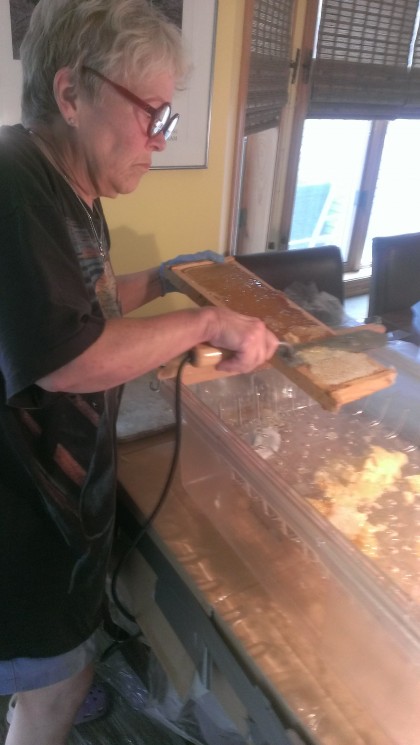
Kate, decapping with the hot knife
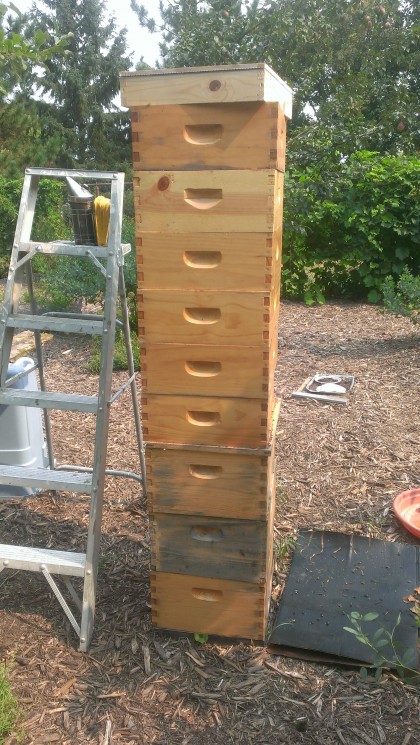
The preschool’s Bee Alive theme this year correlates to Rich’s bee keeping project, which he began a year ago. We looked at his hives, he wanted my advice. His bee hives hang from a steel cable attached to a roof beam for the deck and about 50 feet away, a large ponderosa pine. This is a novel set up, mimicking, but with beehives, the way many people suspend bird feeders. Bears create the need. They love bird food and honey. A pulley system allows him to raise and lower the hives. Having their homes hanging in the air is just fine for bees.
I’m now, I think, an unofficial consultant and fellow worker in the preschool Bee Alive program. A lot of bee related work ahead. I have to do some research about mountain beekeeping.
Bristlecone pines fascinate me. One of the subspecies, Pinus longaeva, has the oldest living entity on earth among its members, a tree over 5,000 years old. That puts its lifespan back before the development of Chinese civilization, a very long time ago. Pinus aristata, the Rocky Mountain Bristlecone Pine, can live only about half of that. Even so, 2,500 years is still a long, long time.
Our guides on Pennsylvania Mountain (see post below) pointed out several Bristlecones on our hike.
A second year cone, note the bristlesSecond and third year cones. Cones have a lot of resin.Clark’s nutcracker
This little bird, the Clark’s nutcracker, sticks its long beak inside the third year cones and pulls out the seed, collecting them in food caches out on the open ground. In the spring when the snow melts and well before anything else is blooming, the Clark’s nutcracker has food for its family. Though it has an excellent memory for its caches, it does occasionally forget one and the bristlecone pine propagates.
If you look carefully at the second picture, you can see small white dots on the needles. These resin dots plus the bristles on the cone are sufficient to identify the species.
When bristlecones die, they can lie for as long as a thousand years before rotting.
Took off yesterday morning about 7:30 am and drove west (or south) on Hwy 285 headed toward Park County, Bailey and Fairplay. I stopped at Grant, a place made visible only by its single, as near as I can tell, business, the Shaggy Sheep. There’s one of those yellow diamond signs just after it with a black silhouette of a bighorn sheep. This is one of several instances of displaced chefs seeking less frenetic lifestyles in the mountains. I mentioned the Badger Creek Cafe in Tetonia, Idaho in my eclipse post. There are others.
The breakfast I had was a deconstructed carnitas hash with green chili and two eggs on top. The deconstructed hash had carnitas laid over cut up chunks of potato, not mixed together as in corned beef hash. It was delicious. While I ate, I read a brand new book by an author from Boulder, Colorado, Megafire. Michael Kodas analyzes the sudden uptick of catastrophic wildfires since the 1970’s and why they’ll keep coming. It pleased me to see that the Shaggy Sheep had opened a second room, meaning they may stay in business, a far from certain conclusion for anything retail up here.
South Park (to the right) from Pennsylvania Mtn.
After breakfast, I drove on toward the Kenosha Pass, a cut through a huge granitic batholith that forms the western boundary of the Front Range. After the 9,997 foot pass, Hwy. 285 descends sharply, a 7% grade, into South Park. Yes, that South Park. At the top of the pass South Park spreads out below, a wide treeless plain that stretches to another range of mountains beyond. They mark the continental divide. That was where I was headed.
A Fairplay favorite, the Java Moose
Fairplay, the county seat of Park County, is a not unusual, for Colorado, meld of old mining town, tourist destination and current mining. A dispute reported in last week’s Flume concerns whether or not to rezone residential plots for mining so a gold mine, yes, a gold mine, can expand its operations.
Those of us hiking up Mt. Pennsylvania met at a Sinclair truck stop on the east side of Fairplay. I went in the car with our two guides and Rich Levine, a member of Beth Evergreen and the lawyer who drew up our new estate documents. On the drive we went past the disputed zoning plat. The gold mine, it’s no longer grizzled old men in long underwear with pans and picks, looked more like an aggregate pit.
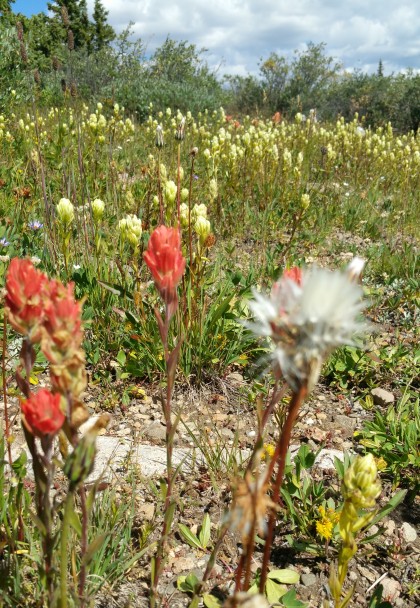
Indian Paint Brush
At the trailhead we began our hike at 11,700 feet through willow, lodgepole pine and a surprising abundance of wildflowers. The trail meandered a bit while traversing another 500 feet up to 12,200. We passed through the krummholz layer, crooked trees, that mark the tree line. Trees right at the tree line are stunted and crooked due to the inhospitable climate. It’s the tree line, after all.
After the krummholz comes tundra, flat and bare except for plants that hug the ground, mat plants, and a few hardy flowers. The air is thin here on Shadow Mountain at 8,800 feet, but 12,200 is thinner yet. It was a struggle to get to the highest point of the hike, requiring breath breaks for most of us; not, however, Tara’s three teenagers who seemed to run with exasperating ease (to this old guy) up the trail. As did Marley, their dog.
A tree island at the krummholz level
Those of us from Beth Evergreen were there because of the research being done on Pennsylvania Mountain. Forty years worth of investigation has been conducted there into alpine bees and some of the plants that they pollinate. Native dandelions, for instance, may be under threat from the expansion of the familiar, but invasive dandelion probably growing in your yard right now. Unfortunately, the scientists had vacated the site, presumably due to the academic year just getting underway, so we were left mostly with the stunning scenery as a benefit.
There was one other gain. The Beth Evergreen pre-school, now a wholly owned subsidiary of the congregation, has as a theme for the year, Bee Alive. It came up in the conversation that Kate and I have beekeeping experience. Rich has started two hives, which he has very cleverly suspended on steel cable high above the ground to foil bears. Otherwise an electric fence, and a strong one, is necessary. Rich invited me over to his house next week for a pre-school staff meeting. Kate and I may end up sharing some of our equipment and knowledge. Should be fun.
This old body doesn’t bounce back like it used to. Driving 13 hours from Idaho to Conifer means a slow return to normal. It’s still underway today, Saturday, after our late Wednesday night arrival back home. Not at all unexpected. Still.
On Thursday we had to return the RV, pick up the dogs and chose to attend mussar, so Thursday during the day was not a time for recuperating. Yesterday was easier, some unpacking, our business meeting and going to the post office for held packages.
Today and tomorrow are slow, too, since the grandkids are with Jen for a hemophilia walk. I’m driving to Fairplay for a hike with Beth Evergreen to see an alpine bee research project on Pennsylvania Mountain. Tomorrow Kate and I will take a load of stuff in to Jon’s new house. He has the kids during the week for the first time this coming week, so he has to get ready for them. The 50/50 parenting arrangement takes effect now that he has a house. A big change for all involved, including us. He will move in over the next couple of months.
Gradually replenishing the battery. Realized just now that I’m like an older lithium-ion battery. I take longer to recharge and the charge doesn’t last as long.
A saga of small proportions, but a saga nonetheless. After a late pickup of the RV due to the previous renter breaking a large outside storage container door, we were cramped in getting stuff into it. Ruth and Gabe slept in it in our driveway on Friday night and we finished packing Saturday morning.
We left around 7:30 am. Due to dire traffic predictions I picked a route that would minimize traffic though it would take a while longer to get there. I don’t mind using time on my own volition, but backed up bumper to bumper on an Interstate? Not so much.
Being a little bleary from the previous day I ended up missing the route I had chosen and finding the exit for an alternate instead. Instead of taking the turn for Empire and Granby, right next to Rocky Mountain National Park, we drove to my first idea, a routed going north out of Dillon on Co. 9. Some of the driving was on roads with narrow to no shoulders and I was still getting used to the hippotamus like wallowing of this big beast. One slight run off the road scared the bejesus out of me.
In an attempt to get back to the Granby route I took off east on Co 14. This was fun because it took us through the vast high plain known as North Park. There are three parks, South Park, Middle Park and North Park. South Park is in Park County, close to our home. We turned north again at Walden, a quaint little town that calls itself the moose viewing capital of the state.
Ruth, above the cab
Somehow though, after we passed into Wyoming, I missed Wy 130 and in the process took us off through the Medicine Bow National Forest. This was also beautiful, but much further south than I intended. This meandering took us about 100 miles out of the way. All good from a not all who wander are lost perspective, but it had a negative effect later on.
By the time we made it to Jackson, after a trip through another National Forest with mountains blued out as the sun sat behind them, a river flowing north beside the road, it was dark. Both Kate and BJ recommended against taking the Teton Pass at night, so I listened. We found a temporary home for the RV in the Jackson KMart parking lot.
For about three hours. At 12:30 pm a knock on the door and very bright lights outside announced the Jackson police department. Contrary to what we had heard KMart does not welcome overnight stays and “Jackson has an ordinance against illegal camping.” Oh. Well. If you put it that way.
So, again bleary eyed, this time after 12 hours or so of driving I put on pants and shoes, started the hippo and we moved away from KMart. Kate suggested we try the Motel 6, a place Jon stays when he comes to ski. $63 a night. They said rooms were $248 a night, a special rate just for the eclipse. Ha. However, the desk clerk kindly said we could stay in their parking lot for free. We did.
About 7 o’clock Sunday morning we fired up the hippo and drove to, wait for it, McDonalds for coffee, potato type food and an egg mcmuffin. We wanted to get out of Jackson and onto the Teton Pass. Which we did.
It’s not a difficult drive in the light, but it would have been treacherous in the hippo at night. Again, beautiful. Natural beauty surrounds us here in the West, especially following the Rocky cordillera north as we did. Sort of.
Once down the Teton Pass we passed into Idaho at Victor, then turned north toward Driggs. BJ, Kate’s sister, lives a half hour out of Driggs, up the side of the bowl that the mountains create here, a small version of a Park. Her home is rustic with wood flooring, weathered porches and an outbuilding that includes a sauna and a greenhouse. It’s quiet here, the opposite of Broadway and 78th in NYC, where she lives in the Beacon Hotel.
Tomorrow is the eclipse. We’ll see it from a meadow near here. More after that.
Losing the Sun
8/22/2017 Eclipse Moon
Kate, BJ, and Jon. On BJs deck.
A black sun. Coronal flares shooting out, white against a blue-black sky. No birds flying, a sudden cool silence. Two minutes and twelve seconds passing fast. At 11:35 am, against a clear, just moments before hot blue. Gasps and exclamations came over these lower hills of the Big Horn Range, the ragged Tetons across the Tetonia valley, mute.
A moment of the occult revealed by darkness. The sun always moves across our spinning planet with those vast, hot flames reaching for the edges of the solar system. Unseen. Even the sun itself, except at a quick glance, or in the periphery of vision, stands hidden in its own brilliance. Not yesterday. Not for two minutes and twelve seconds.
A sight reminiscent of a secret society. Only initiates can see the truth. And it is so. It may be a secret society of millions or billions, but it is exclusive, often, as for me, happening, if at all, only once in a lifetime.
Six Olson/Johnsons: Jon, Ruth, Gabe, Anne, BJ, Kate and one Welsh Teuton sat on BJ’s east facing deck, eyes covered in glasses dark enough to make walking with them on impossible. At first we baked, heat from a late Idaho summer crackling down from the sun, naked and fierce as it can be at midday.
Totality
A small pinch of black intruded on the faded yellow globe we could see through the eclipse glasses. Baily’s beads, sunlight bouncing through valleys created by lunar mountains, shimmered for just a second then disappeared. The small pinch became a bigger one as our usually nocturnal moon, and a new moon, usually invisible, at that, showed up, its shadow cone moving at hundreds of miles an hour, racing across the U.S. from Portland to Charleston, passing us here just across the Big Horns from the vast potato fields of southern Idaho.
That image, black sun, coronal flares across the deeply bruised heaven is now a permanent resident in my memory. Brief though it was, its violation of the natural order so consistent over my life time, much like an earthquake disturbs our sense of the stability of the earth on which we walk, was so intense that it will stay available to me.
How often in a life do we get to shock ourselves in such a way? The sun shines in through the window of the RV as I write this, back to its old dangerously luminous self, too shiny for my eyes. “There are more things in heaven and on earth than are dreamt of in your philosophy, Horatio.”
Our common sense philosophy allows us to move through our days without recourse to constant surveillance. The earth is solid. The air breathable. Night follows day. Our heart beats. During the day the sun shines unless obscured by clouds. When our experience deviates from these home truths, our inner world shakes. Can’t get enough oxygen? Heart pauses? Earth moves. Night comes near noon on a cloudless day. Even if we know the why, the empirical fact of such an insult to the received wisdom of our lives alters our confidence in what we believe. Alters it in a deep and profound way.
Alpine glow during totality, looking toward the Tetons
Perhaps such events are the key to humility. What we assume is true may be mistaken, mistaken in some fundamental way. Once one pillar of our inner temple is shaken, we may need to examine them all.
August 23, 2017 Lughnasa Eclipse Moon
The day of the eclipse has come and gone. Jon, Ruth, and Gabe left that day for Colorado. The eclipse was on the first day of Gabe’s fourth grade year and Ruth, though already in school for a week or so, missed classes on Monday, too. They had to get back. It took Jon 11 and a half hours to get home.
BJ, Kate, Anne at Kates birthday party apres eclipse
Later that day Kate’s two sisters, Annie and BJ, Kate and I, drove into Driggs for a post-eclipse return to this earth. Traffic in that small Idaho farm town was heavy, a traffic jam slowed us down getting to the art fair which was our destination. There were mumblings about how the expected 100,000 people had ended up being only 10,000 and artists seemed disappointed in their sales.
Since we never left BJ’s deck to see the eclipse we escaped any traffic getting into place for a viewing and the traffic coming up from Conifer was never heavy, even on I-80, so that small Drigg’s experience was it for us. Fine with me.
Annie and BJ put together a birthday party for Kate with a happy birthday banner, glow in the dark bracelets, flowers and color changing small candles. We had salmon, potato salad, baked beans and fruit for dessert.
Tetonia
The next morning we had breakfast up at the big house. (what Kate and I from the RV perspective called BJ’s place) Kate ended up feeling crummy and left early to spend the morning resting. I wrote a bit, read, talked with Annie and BJ.
In the afternoon Annie, BJ and I drove 15 minutes over to Tetonia, a smaller town than Driggs, with the same name as the county. As you drive east away from the Big Horn foothills where BJ lives, the Tetons dominate the horizon, especially four jagged peaks that have a distinct alpine feel. The tallest and most severe of the peaks is Grand. Between the Big Horn foothills on the west and the Tetons in the east is a flat plain dotted with fields of wheat, alfalfa and pastures with Angus and horses. There are barns with hay lofts, Harvestor silos, grain elevators and farm equipment dealers on the main road. If you bracketed out the mountains, it could be a location in Iowa or southern Minnesota.
We visited a small shop in Tetonia, a show case for Steve Horn, who makes furniture, carves wood into whimsical fire place mantels with dancing bears or curious elk. The quality of his work is high and the prices reasonable. There were also other local crafts such as white turquoise jewelry and woven pine needle baskets, various rugs of a rustic cabin sort and a few scattered antiques.
Ankole-Watusi Horn, an African breed of cow
There were also four horns, two smaller and two larger, that made me wonder what animal could possibly have worn them. So I asked. The owner came down from her office area above the store. “You know, I’ve been meaning to look them up. Give me a minute.” I did. “Come on up here, I’ll show you.” These were the horns of a central African cattle breed called the Ankole-Watusi. The largest horns of any cattle breed. The pictures she pulled up showed large cattle, perhaps oxen size, with enormous horns.
BJ wanted to eat lunch at the Badger Creek Cafe, a Tetonia restaurant a couple of blocks beyond Steven Horn’s place. “Put together by two chefs from NYC. Really good food.” Also closed on Tuesday and Wednesday. We all liked the name of a small woodworkers shop nearby, Mortise and Tenon.
Because BJ’s realtor and friend, Bobbie, had invited us over for dinner, we went back into Driggs to pick up some dessert. The Austrian pastry shop was closed as was Cicerolls, so we went to Broulin’s, a local supermarket. While there, I told BJ I liked it. For those of you familiar with Minnesota supermarkets, it would have been between a Lund’s and a Bylery’s, nicer than Colorado’s King Sooper.
from Bobbie and Barney’s deck
Turns out the locals, Bobbie for instance, view it as an intrusion by Jackson Hole prices and tastes into the area over the Teton Pass in Idaho. Probably so.
Later we met Bobbie and Barney at their home which overlooks the large agricultural plain with the craggy Tetons on display on its eastern edge. A very peaceful place.
On Samain of 2014 I came up here to Shadow Mountain for the closing on our home. In the backyard of our new home three mule deer bucks greeted me. They were curious about me and I about them. We stood with each other for some time. The mountains had sent three spirits to welcome me.
Bailey, Colorado is about 20 miles west of us on Hwy. 285. It’s an up and down, winding path with vistas of the Continental Divide and several fourteeners including Mt. Evans, the weathermaker for our neighborhood here on Shadow Mountain.
Bailey is also the first, coming from the east, town in Park County, which abuts our own Jefferson County. That’s significant because the marijuana laws here in Colorado give counties the authority to accept or include dispensaries. Jefferson County, one of Colorado’s largest, has said no for now. Park County though, said yes. Kate and I make the journey to The Happy Camper, located just outside of Bailey, every once in awhile.
Entrance to the Sasquatch Museum
I went yesterday while Kate entertained the Needleworkers at our home. On a whim, after my visit to the Happy Camper I decided to satisfy my curiosity and visit the Sasquatch Outpost. It’s in Bailey, down the steep 7% grade known as Crow Hill, about six miles from the dispensary.
While there, I spoke to some folks, a couple of employees and two men who seemed to be hanging out, sussing out the level of credulity. Turns out it’s pretty high. Voicing the expected level of uncertainty, “Could be natural phenomenon,” one man, six foot two, white haired, well spoken, showed me on his phone a photograph he’d taken on a recent research trip with some Australians. It showed an Aspen bent in a 180 degree arc and, he said, “Fastened to the ground.” This Aspen had branches leaning up against it. When they do research, he and his buddy go to places that have what he described as a high incidence of such things.
Sasquatch Museum
When I asked why we didn’t have more information about the Sasquatch, he replied, “We do. There’s the BigFoot Field Researchers Organization. It has over 30,000 sightings graded A, B, C. With A the most reliable, C the least.” He recounted a recent Park County incident outside Shawnee, about 8 miles further west from Bailey, up the Ben Tyler trail. “Not all that far up. There’s six switchbacks before you get into the Lost Creek Wilderness. Guy saw a bigfoot right there only three switchbacks up.”
(the archways shown here are what the guy showed me on his phone.)
It would be exciting to have a North American ape living in our mountains. I found myself enthralled by the idea that out there, living a reclusive life like the pine martens and lynx and bobcats we rarely see, is an 8 foot, bipedal creature in our own evolutionary path. But. Geez. Seems far fetched to me. Still.
Oh, and there’s also this, more Bailey culture, a bit changed from the last time I posted a photograph of it. Trump inflected, I think. The America Will Act banner is new.