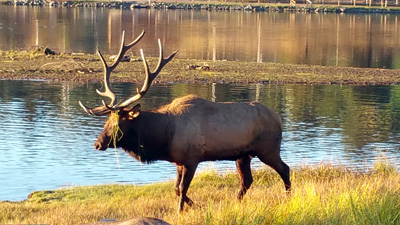
A video from 2:30 am today. This is very close in a straight line from our house, though that straight line goes over Black Mountain. The saying here is that if you have deer, you have mountain lions. We have plenty of deer and elk.
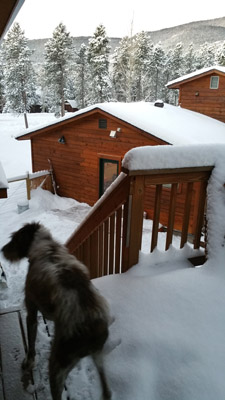
Flocked lodgepoles fill a south facing window. Black Mountain has become visible once again, lost in a whiteout all afternoon yesterday. The air is clear and cold, 8 degrees. Winter on Shadow Mountain.
More loft work over this weekend. Getting closer and closer to a finished space.
Kate and I had planned to go to services at Beth Evergree’n last night, a reggae shabbat, but snow closed I-70 from 470 to Silverthorne and made a mess of the mountain roads. So, we stayed home, concentrating instead on the chick flick series we’re watching now, Murdoch. Yes, Detective Murdoch and Dr. Ogden finally get back together. A relief.
Thanksgiving is coming with grandkids, their parents, and Barb, Jen’s mom. We’ve decided on a prime rib roast this year. Sugar cream pie, that sugar and fat dense Hoosier dessert, is on the menu, too. Some signs point to a big holiday storm. We’ll see.
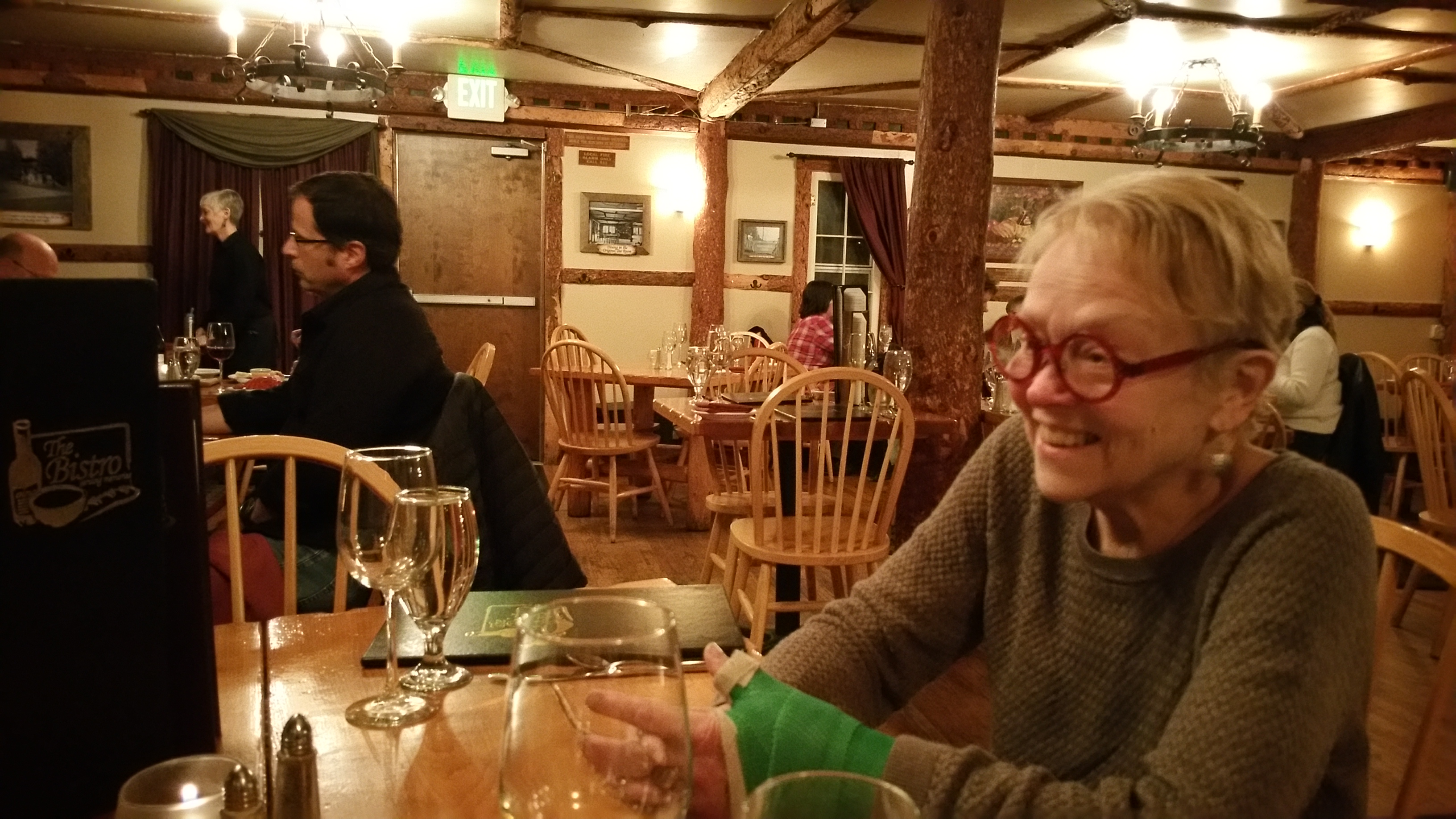
Date night. Kate and I found a new restaurant, The Bistro. It’s between Conifer and Evergreen on Hwy. 73. Excellent food, a piano man and a wonderful dining companion.
We both agreed last night that our move here has been good. Black Mountain Drive fits our lives extremely well. The surrounding geography is varied and beautiful. We’re closer to the grandkids.
Getting older has been wonderful. Sure, there’s the pain and the cancer, yes, but the joy of time together, time we can order as we wish, is delightful. We’re living into our highest and best selves.
After some ice cream, we left Georgetown and, since Ruth wanted to go back a different way, we drove the Guanella Pass south out of Georgetown. It comes out in the very small town of Grant on Highway 285 about 25 miles from Shadow Mountain. The pass reaches 11,669 feet at its highest point and includes several overlooks, national forest campgrounds and a large Xcel energy hydroelectric station.
As we climbed, the snow cover got heavier and heavier until we reached an area where the snow was thick on the ground somewhere close to the treeline. 24 miles long the Guanella Pass takes a while to drive because it’s both narrow and twisty.
Along the way we saw this guy sunning himself on the road. He never moved when I stopped the car, rolled down the window and took several pictures. A healthy looking red fox.
This is wild, forlorn country reachable, for now, by car. One socko storm though and the Guanella Pass will close for the season. The Mt. Evan’s road, which traverses a similar route further east, climbs one of Colorado’s fourteeners.
Ruth wanted to go to the Argo Gold Mine. We saddled up the Rav4 and drove through Evergreen, caught I-70 and found Idaho Springs. The Argo, in spite of its website, was closed. So, we had to regroup. Ruth thought Georgetown, a historic mining town, further west on I-70 might be fun, so we headed over there.
An Energy Museum caught Ruth’s eye, so we parked and wandered over to the smallish wooden building on the edge of downtown. It looked closed. Ruth had seen an open sign, but I was dubious. She still has faith in the veracity of signage. She was right.
It was open and turned out to be a fascinating place. Jason, the onsite employee, was an enthusiastic guy near my age. He explained that this was a working museum. Working? Yes, the museum was built around a functioning hydroelectric plant installed over a hundred years ago and still producing electricity with the same equipment today.
And, Jason said proudly, “It doesn’t produce any of that Edison direct current crap! It’s AC from the git go.” The first commercial AC plant was in Colorado, too. The Ames Hydroelectric Generating Plant outside Ophir, Colorado. It was built in 1890 and the Georgetown site came online in 1906.
This confluence of AC power generation probably has something to do with Nikola Tesla, inventor of alternating current. From 1899 thru 1900 he lived in the Alta Vista Hotel in Colorado Springs, carrying out experiments focused largely on the wireless transmission of energy. He liked the dry air in Colorado.
“What does it feel like to be the smartest man in the world?” a reporter asked Albert Einstein. “I don’t know,” Einstein replied, “You’ll have to ask Nikola Tesla.” Tesla is a protean figure whose relative absence from the public mind puzzles any who know the remarkable things he did.
Not only did he invent alternating current and champion it as an alternative to Edison’s direct current (AC maintains its strength much better while being transmitted from power station to consumers), he invented radio, though Marconi would eventually get the credit for it. Other notable Tesla inventions: Neon signs. X-Rays. Remote Control. Electric motor. Robotics. Laser. Wireless communications and limitless free energy.
Tesla has fascinate me for a long time and I’d like to see him get some attention here.
First snow today. Mixed with rain and gone now. But there it was, snow between and among the raindrops. Now the day has settled in wet and cold, great for fire mitigation. The cooler weather and overcast skies feels like November come a bit early.
More work in the garage today, moving things around because the solar panel people have to have room to store things inside for a couple of days before installation. As in the loft, there’s still a fair amount of organizing to do in the garage, but that is the last task downstairs. The loft still has some shelving to come and some more boxes to relocate.
The mountains become more intimate as the skies close in and the temperatures drop. Where once the sky expanded above them, now it lowers itself, covering Black Mountain all morning in a shroud of chill moisture, gray to the eye and to the touch. I welcome this weather since it encourages the inner life and that’s where I need to go.
A wet, cool Sunday here on Shadow Mountain, the aspens dropping their yellow leaves, creating golden splashes on roads and driveways. Rain is the best fire mitigator and it comes welcome.
48 degrees and snow forecast for Wednesday, snow showers only, but hey, snow!
We went over to Evergreen for our business meeting. When we got back, the garage was calling to me. Moved things here and there, organizing, creating space for bookshelves removed from up here. They’ll hold my journals. Some of the ikea shelving from the old office will hold bankers boxes that don’t stay up in the loft. Another two hours or so of work down there.
This afternoon we bought new cabinets for the kitchen and picked out a quartz countertop, finished up design elements. Main goal, increase storage and create better lighting, update the appliances. We bought scratch and dent appliances, saving literally thousands of dollars, accepting a few dings in return for smaller cash outlay.
Our remodeler is here right now, making final, precise measurements.
When I went into Evergreen yesterday, just after turning off Brook Forest Drive I went past a house that had a bull elk and his harem resting in their front yard, maybe 15 does. A stream runs between the highway and this house. The trees gave shade from the brutal morning sun. A domestic scene with wild animals. It came to my attention when a large bulk moving caught my peripheral vision. That’s the paleolithic helping in the here and now.
It amuses me, when I go to Evergreen, to see the number of people who gather at the lake. All these wonderful mountains and the locals come to look at the water. I imagine only a former native of a water rich state would notice the irony.
Vertical and flat. Humid and arid. Those are the big differences between our new home and our old one. Here I drive through canyons, over high passes, around stands of rock with the view often limited to a few hundred feet on either side, sometimes less than that. When we leave Conifer and go into Denver though, we immediately return to the far horizons common to the midwest. We frequently transit between the great plains and the mountain west, living as we do in the borderlands between the two.
Though we have had a wet summer and somewhat wet fall, when the rains cease, things dry out fast. We can go from low fire danger to high in a day. That’s why fire mitigation is constantly on my mind.
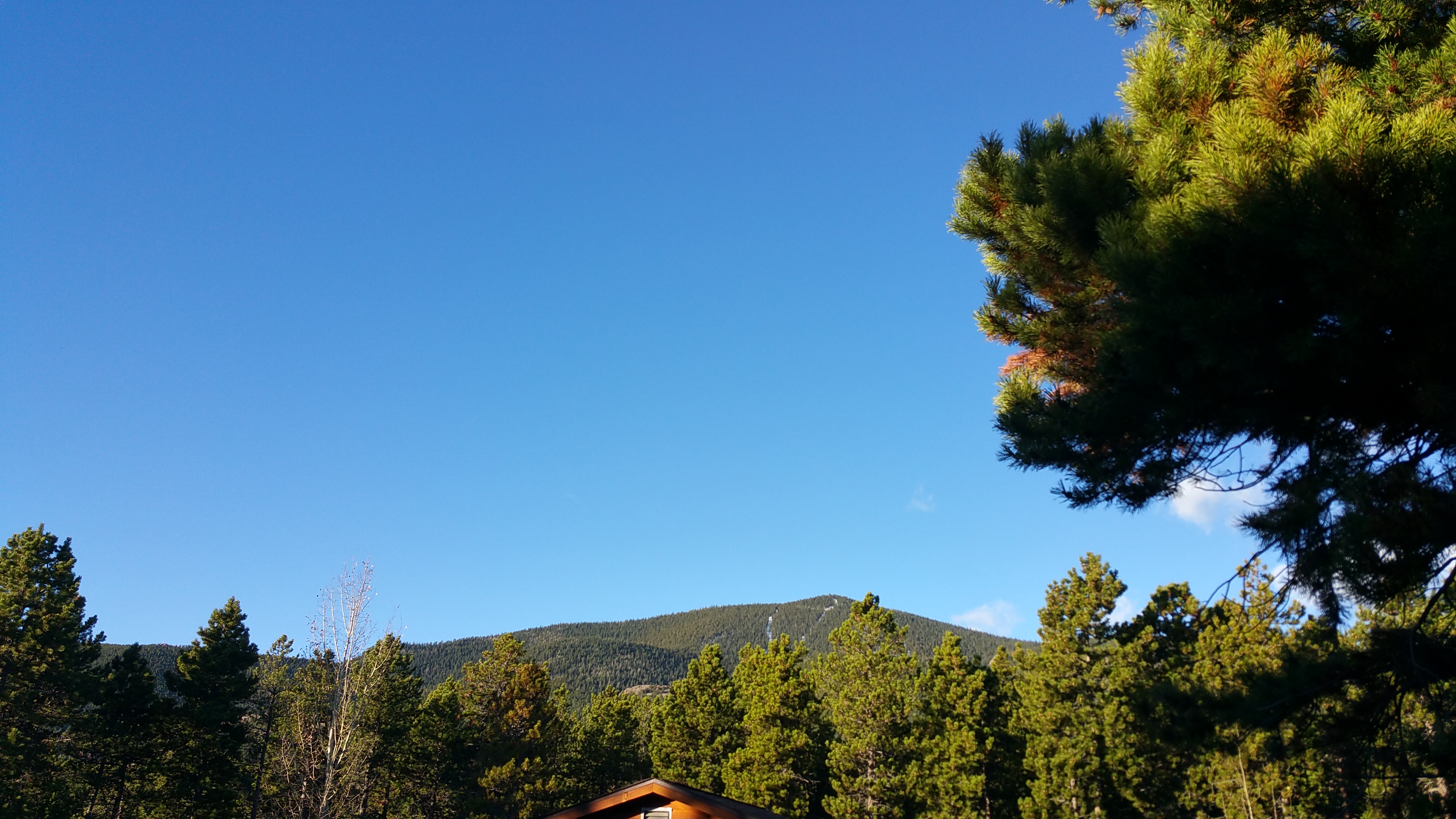
Black Mountain
When verticality and aridity intersect, as they do at 8,800 feet and above, a genuinely unfamiliar biosphere is the result. Unfamiliar to those from the rainy flatlands of middle America, that is. On Shadow Mountain we have two trees: lodgepole and aspen. Along streams there are more species of tree and shrub and there are microclimates that might support greater diversity, but on the bulk of the land that can grow anything, lodgepole and aspen. There are grasses, flowers, a few shrubs as understory, but just as often the rocky ground is bare. The mountains have strict limitations for plants.
The plant limits determine the fauna, too. Grass eaters like mule deer and elk do well, as do predators who eat them. There are small mammals that are prey for foxes and coyotes, but there are surprisingly few insects. That limits the birds. We have raven, crow, Canada and blue jays, the occasional robin, birds of prey that feed off food similar to that preferred by foxes and coyotes and other game birds. There are, as well, black bears. We’ve seen all of these save the bear.
Still learning about the mountains. Will not stop.
I now routinely take Turkey Creek Canyon Road to Deer Creek Canyon Road as a preferred route to medical services, most located in and around Littleton, a southern ‘burb of Denver. That meant I missed the road closure on Highway 470, the half ring road that defines the western boundary of the Denver metro area.
470 follows the Front Range starting at I-70, the main route into and through the Rockies going west. About 10 miles south from that point, on the way toward Colorado Springs, the old mountain range that preceded the Rockies creates an upslope that runs maybe 800 feet at a gentle slope from the highway and ends in a ridge of rock that resembles the jagged back of a stegosaurus, Colorado’s state fossil. Bowles Road intersects 470 there.
A helicopter caught my eye as I turned off Santa Fe onto 470 toward Bowles. A news helicopter?
It had a very long cable dangling beneath it with an orange looking pod suspended at the very bottom. Then, the pod opened and a brief spray of water fell toward the earth. Oh.
Okinawa Sushi, a favorite lunch stop is at the Ken Caryl exit, just one before Bowles and when pulling into the parking lot, I saw people standing, looking skyward toward the highway. More helicopters.
After lunch I saw the reason for all this. It was a grass fire that had run from the highway all the way up to the bony ridge of the first elevation. The ground was black in a 33 acre scar. 470 had only one lane open there with several fire trucks, police and other emergency vehicles parked in the other lane and up closer to the fire.
Another helicopter came chop, chop, chop over the ridge, an orange bucket again dangling below. It maneuvered into place and hung there for a bit, presumably awaiting instructions from the ground. Finally, again it released the water which fell onto a scrubby patch of land outside the burned perimeter. When the water hit, spray and smoke billowed up.
Since we moved here last December, the fire danger has been low with a few exceptions. Lots of rain, an anomaly of a year. This was my first exposure to the reality of wildfire. Good motivation for cutting down all those trees. And a reminder of the true nature of our new home.