Category Archives: Art and Culture

Docents

Samain                                                                           Closing Moon

A going away party this noon at Allison’s. This is the docent class of 2005 gathering.

A recent Washington Post article about the Hirshhorn eliminating their docent program had a flurry of e-mails among the docent corps. Is this a trend? Is the MIA headed this way? The consensus seemed to be no, the MIA still wants its docents. At least right now.

It’s been eighteen months or so since I left the Docent program, pulling back to finish my novel, Missing, and to cut down on the number of trips I made each week into the city. Maybe an insider, now outsider’s reflections, would be useful. (I did finish the novel, though it’s unsold and I did cut down considerably on the number of trips into the city.)

Over the time period from 2001 to 2013 I volunteered at the MIA, first as a Collection in 2005. Initially, there were two wonderful fringe benefits draw to volunteering at the MIA. First, the continuing education was substantive. It featured art historians, curators from other museums, visiting lecturers for special exhibitions and overviews of upcoming exhibitions by the curators who designed and mounted them. A four inch thick notebook is filled with notes from the first five years or so.

The second was that these continuing educations were held on Mondays. The museum was otherwise closed on Mondays, so this meant we could come in for an excellent lecture, then stay and wander the museum, the empty museum.  This time alone with the art was, for me, sacred. The quiet galleries contained the long, powerful conversation that is art over the ages. It was possible to enter into the stream of that conversation by walking only from, say, Doryphoros to the Jade Mountain, or from Goya’s Dr. Arrieta to Beckman’s Blind Man’s Buff.

The loss of these two fringe benefits grew, for me, into a longstanding malaise, not yet dissipated after 18 months. It was the altering of the felt relationship between the museum and its volunteers, reflected in these changes, but not limited to them, that made me feel the time exchange was no longer balanced. I felt I was giving far more, in hours, in study, in tours than the museum was giving back to me in education or support.

In retrospect I wonder if the changes that I felt were part of this larger reconsidering of the role of the volunteer in museum life, a devaluing of the volunteer role. In the Hirshhorn’s case they continue tours, but with interns and paid staff. This suggests to me that the trend is not away from tours and other museum interactions with visitors, but toward a more substantive one, a role they feel only more educated individuals can fulfill.

Here then is the peculiar intersection that seems to loom just ahead. Volunteers, largely a well-educated group, but mostly amateurs when it comes to art history, may seem to offer too low a quality of knowledge and interaction, thus not presenting either the museum or the collection in the way staff and boards now believe necessary. What’s peculiar about this is that the old continuing education model offered a vehicle for raising, quite substantially, the art historical knowledge of volunteers.

Furthermore, I would have been willing to devote a good bit more time to education, both class-room and at home, self-guided, if it had been valued and supported. And, I imagine, many if not most of the docents with whom I worked would, too.

Instead, the museum has pulled back from challenging its docent corps educationally, reducing both quantity and quality of continuing education. It has also been moved to a much less desirable afternoon time slot during the touring week.

While the MIA may not be moving explicitly toward the Hirshhorn model, it has said in many ways over the last 5-8 years that the volunteer simply doesn’t have as much value. That’s dispiriting to those who remain.
 

Classic

Samain                                                                              Closing Moon

Back to the Latin over the last few days. It’s surprising how much like weight lifting and cardio-vascular work outs studying a language is. It needs constant effort. I let go of the discipline of daily translation for about a month and my ease of work with the language suffered considerably. I’m back to it now, but it’s a challenge, will take awhile to get the flow back.

(Philemon and Baucis)

Surprised myself on Friday by telling Greg that I’m hoping for a synthesis between my study of Latin and my study of art history. I thought I was doing this to implant the stories of the Metamorphoses in my head. Turns out I have an additional agenda.

What would the synthesis look like? Not sure right now, but one obvious route in is to look at all the art inspired by Ovid, then translate all the relevant stories (I did several for the Titian exhibition at the MIA) and learn the backstory about artists, paintings, the myths, and the Augustan context for Ovid’s work. Somewhere in there is probably something pretty interesting.

Holiseason Is Almost Upon Us

Fall                                                                                 Closing Moon

Fall is in its last days. Samain comes on Friday. The seasons of the year that speak most directly to my soul arrive back to back. Samain, then Winter. Guess that tells you what it’s like to live inside my skin.

The sky today glowered over the landscape, a November sky ahead of its month. It felt like a homecoming to me.

A long while back I chose to identify the period from Samain to Epiphany, as holiseason. It’s a whole season of special holidays, moments and weather. They are distinct, yes, from Diwali to Kwanzaa, Posada to Hanukkah, Christmas to the Winter Solstice, Thanksgiving to New Years, Samain to Epiphany, but their proximity, their charged valence in their particular cultures adds up not in simple sums, but in layered complexity.

Put, for example, Samain’s celebration of the thinning of the veil between this world and the Otherworld in dialogue with the holiday of gratitude and family we call Thanksgiving. To do so reminds me of a small object in the art of the Americas collection at the Minneapolis Institute of Arts, the Nayarit house.

This is a tomb object, excavated from a ninety foot deep shaft grave made by the Nayarit culture of what is now western Mexico. We have little firm information about this object but we can infer from its presence in a tomb that it might convey something about life and death.

It contains groups of people, probably relatives of the deceased, eating and drinking with each other. As groups of kids investigate this ceramic object made between 300 BCE and 400 ACE, they usually conclude that the group above is living and the group below the ancestors. The key thing they also note is that they are eating and drinking together.

Of course this brings up the Mexican celebration known as the day of the dead, also a holiday in holiseason. It could be seen as the living generation celebrating Thanksgiving with each other, yet intimately connected to their ancestors, who carry on their own celebration, one we acknowledge at Samain. Or, one we might acknowledge at Samain if we took seriously the Celtic imagery of the veil between the worlds grown thin, a very similar idea to the one celebrated throughout Latin America, but especially in Mexico as the Day of the Dead.

The most mythic and sacred period of the year approaches. I’m excited about it.


Quirky

Fall                                                                                  Falling Leaves Moon

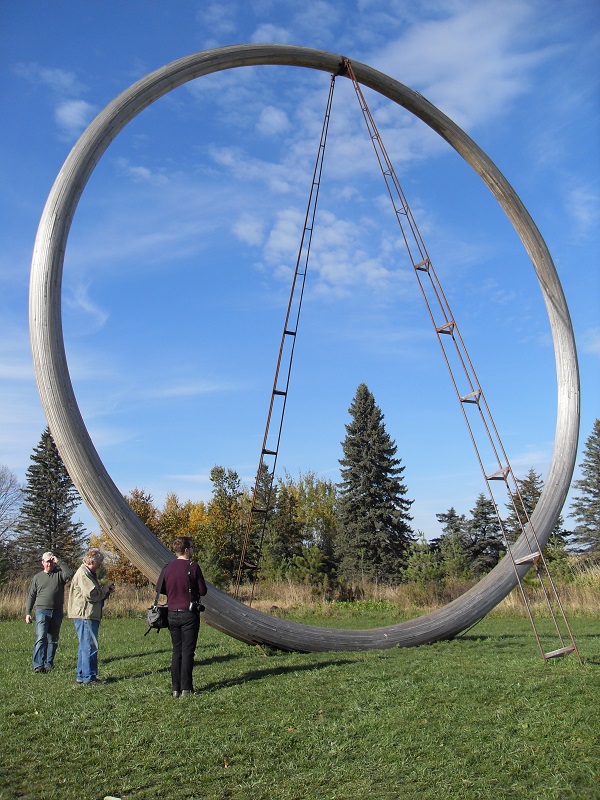
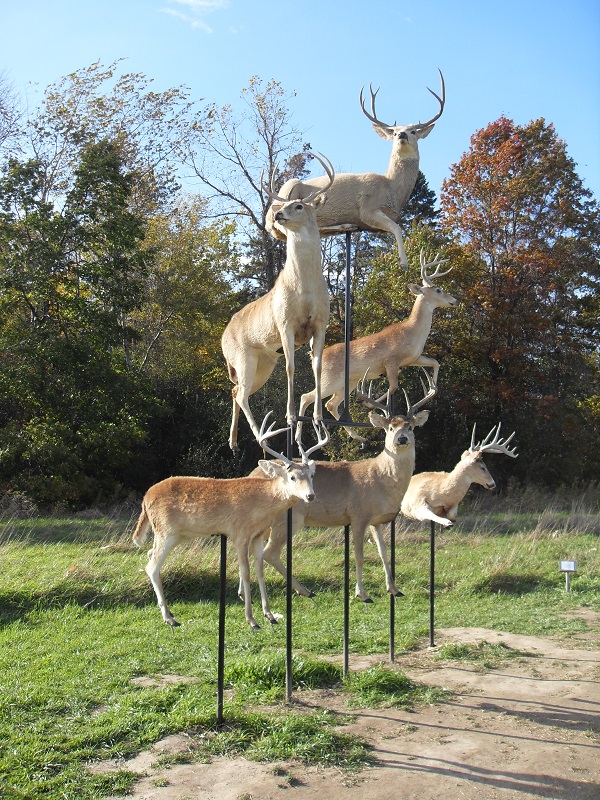
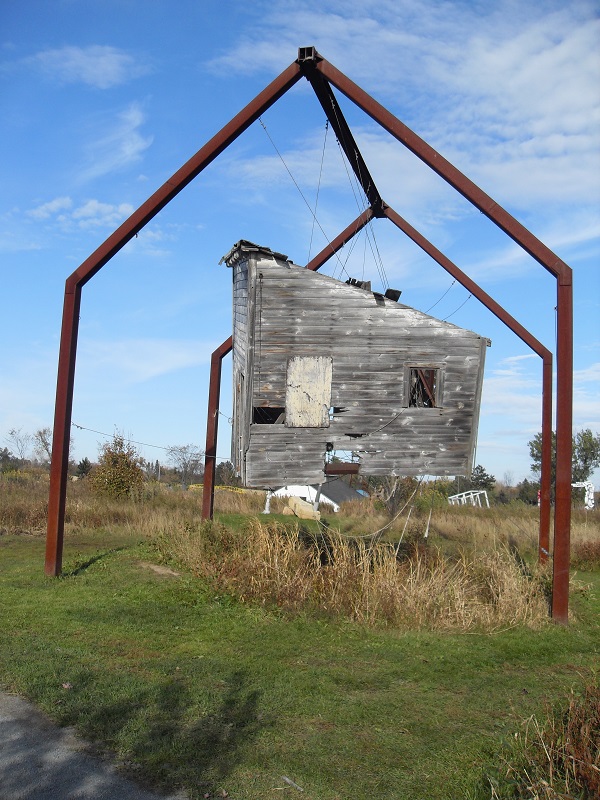
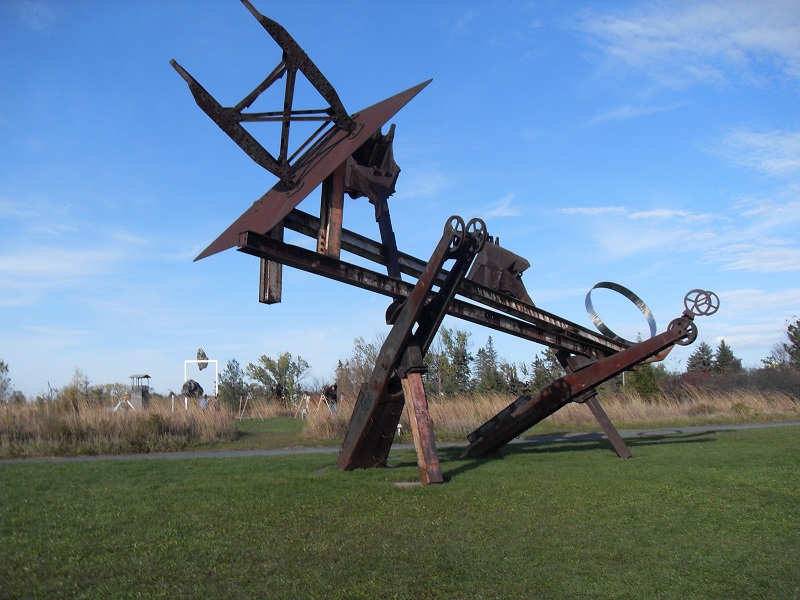
After lunch yesterday, Bill Schmidt went on further north, going up highway 95 from Marine toward the use to be town of Franconia, now home to a quirky, but sensational sculpture park. He took a few photographs.

Thanks Bill for sharing lunch and the photographs. BTW: Franconia sculpture park is on 95 just south of Highway 8.

Franconia5Franconia4Franconia3Franconia2

A Mind-Full Lunch

Fall                                                                                Falling Leaves Moon


At the Walker. Shocked out of my move fixation, gladly so. What I hoped for.  A major exhibition covering years when art turned over on itself and the Walker made its reputation as a nationally significant contemporary art space, Art Expanded, 1958–1978, challenges boring old representational painting, stiff granite sculpture, and anything else considered traditional or usual at the time.

It got me immediately into careful looking, following disinhibited artists as they struggled to use a radical new freedom, going with them to places absurd and funny. An example of the latter is a small notation for a happening:  Turn the radio on, turn it off at the first sound. This zeitgeist was mine as a young adult, traditional sexual mores, traditional career paths, traditional power structures, traditional decorum was all suspect and suspect in such a way that the burden of proving itself useful to the human project lay on tradition.

The Walker is an osmotic membrane, the world of art pushes at its curators and they try to let through only the most innovative, most balls against the wall, most beautiful, most lyrical of the very new. It is an antidote to burying myself in the minutiae of moving. So easy to do. Artists trying to replace sculpture with three video screens, two larger and one smaller between them, stacked vertically, with strings like those of a bass arranged in front of the screens and a stool behind for the screenist to use while playing push me away from the taskiness of the move and back into the realm of, “Oh! What’s this?” A place I consider my natural habitat.

So it did not surprise me when I sat down to eat lunch that my mind strayed to a mind-full meal. It went like this. I had a fruit salad and a grilled cheese and bacon sandwich. Fork into grape. Huh. Roots captured water, distributed it up a vine and into the developing fruit, swelling this taut case until it was full. The leaves captured solar energy and created carbohydrates. Sweet. Wine. Kate and I at the KSNJ dinner on Kate’s 70th. Mogen David. A melon. Kate makes melon salads every summer, puts them in a long plastic container and we eat them throughout the week. Pineapple chunk. A happy worker makes good fruit. The Dole plantation philosophy on Lanai, now abandoned to the techno-baron Larry Eliot and his desire to create a sustainable, profitable community. Strawberry. California’s Central Valley. Drought. The precious water contained in this strawberry might have come from last year’s snow pack in the Rocky Mountains. Then, the bread. I don’t eat bread anymore, but half a grilled cheese sounded so good. I went ahead. Diabetes. Why do the things I like a lot turn out to be bad for me? Days of grilled cheese and Campbell’s tomato soup. An Alexandria, Indiana gourmet lunch.

Now this is not mindful in the way of savoring the grape as a tight oval, bursting with juice, breaking the skin with sharp front teeth and feeling the first squirt of liquid on the tongue sort of mindful. No, this is a mind-full lunch in which I allowed free association to guide and slow my eating. The blueberries. Those Augusts on the North Shore wandering through burned over or clear cut forests, gathering wild berries, eating as many as I picked. The blueberries we have outside in our orchard. That sort of mind-full.

How’d You Do?

Fall                                                                                 Falling Leaves Moon

One other thing on Joshua Wong, buried deep in the particulars. As a high schooler about to graduate, he had to take exams for entrance to college. Ever since the Song Dynasty high stakes tests have determined social mobility and status for those not lucky enough to be aristocrats or, in the current version, of the Chinese Community party cadres.

Every one in Honk Kong wanted to know about his scores and he had to go on television to answer questions about them. Turns out he’s a middle of the score card kid. Not a future Mandarin or literati, nor a future member of the party. I don’t know this for sure, but I imagine those folks who were so interested in his scores were disappointed.

I hope Wong strikes a blow here not only for democratic freedoms, but for a society in which gifts like leadership, courage, and tenacity count as much as academic test scores.

A Crucifixion Moment…for the garden

Fall                                                                                    New (Falling Leaves) Moon

The river birch has begun to shed its golden leaves, small instances of light as matter falling toward the ground. The neighbor’s Norway maple has turned its autumn red, a reliable clue that the seasonal change is well underway.

Senescence becomes the word for gardens, vegetable and flower. Green turns to brown, then withers and falls onto the earth which has held it up so long. Tired, I suppose, from the long fight during the growing season to remain upright.

The water that fills out the cells flees back to the roots or out into the air through transvaporation, so leaves shrivel, stalks collapse. But this is not the field of ruins it appears to be. This is instead gathered nutrients ready to return to the soil following that

most necessary of almost hidden processes, decay.

We have arrived, from one perspective, at our crop’s crucifixion moment, when they give up their bodies on behalf of others. It is only an apparent crucifixion though because the dead will rise again, either from underground chambers where they lie dormant or from seeds. What a wonder. And it happens every year.

Sorting

Fall                                                                         New (Falling Leaves) Moon

Weather warms up over the next few days, more summerly temperatures, but with a welcome lower dewpoint. Today is art sort day for me. Kate’s taking a rest. And a well-deserved one.

(my stone sculpture from artisans d’angkor will go to Colorado)

I’m looking forward to deciding what gets sold and what goes to Colorado. Not sure why, but I am. Over the course of diminishing my library I came to enjoy the process of deciding what was important to me now and what to let go.

Tomorrow, instead of being here with the SortTossPack folks, I’m going in to work on the Sierra Club’s independent expenditure campaign for the November elections. The staffer who has these responsibilities had Friday morning open.

Another Layer

Lughnasa                                                                      College Moon

mod2011 05 06_0874Files and notebooks. Old magazines, posters, prints, objet d’arts, paintings, novel notes and manuscripts, office supplies. Perhaps more books as I admit I can let go of some of the ones I saved back and some of the books on my study bookcase. Not let go as in red tape, outta here, sayonara, but let go as in green tape box and inaccessible until the move is over.

This sorting is even more intimate and difficult than the books. Do I really need all those essays on the humanities I’ve saved over the years? Well, of course. Do I need this one on quantum mechanics? Maybe not. How about the files on the Great Wheel? Definitely. And what of the art do I love and which do I merely like? The likes go. The loves stay with me.

Those stone sculptures I bought at Artisans D’Angkor in Siem Reap? Stay. The Shiva Nataraja I bought in Boulder? Stay. The Open sign we bought at the going out of business Mod2011 05 06_0876sale at Lights on Broadway? Stay. O.K. This might be hard, too.

This is getting ready for SortTossPack who will come again on September 26th, a week from this Friday. We plan to have them pack the fragile stuff, some of the art, carry some boxes, take some furniture back to the consignment shop. It’s also, of course, getting ready for the actual move. Soon now we’ll need to contact moving companies, get bids. Wow.


Unasked Questions

Lughnasa                                                                   College Moon

A project, perhaps the smooth beast rising from the deeps, keeps coming at me, jostling me, prodding me to imagine it into being. I’m not ready to go all the way there yet so let me set down a few bars, perhaps really only a jumble of notes not yet ordered by staff and clef.

1. American art. Here would be American works that found their muse in the West as it came to be in the minds of a young country. Here the work of the Hudson River School, the Ash-can School, Wyeth, Homer and Hopper, even Ed Ruscha, artists whose work clawed away at the truth underneath the bones of American life and culture. Warhol and Pollock and Rothko, too. Morris Louis. Photographers like Anself Adams and Walker Evans and Diane Arbus and Cindy Sherman and Edward Weston. Seeking the American through our art.

2. American music: jazz, Copland, Gershwin, Ives. Seeking the American in our music. Seeking the sounds that issue from the various rivers that make us an ocean.

3. American thinkers like the American Renaissance, like Dewey and James, Wills and Veblen, DuBois and Douglas. What is our manner of thought, our direction? Our ideas that tear away at the fabric of this country, peaking behind it, looking for its connective tissue.

4. American literature: Melville, Emerson, Hawthorne, Twain, Poe, Lovecraft, not just the luminaries here, but the dark lights, too. Probing, seeking for the through line from the first immigrants to the most recent, how they wove their lives together. Sinclair Lewis, Sherwood Anderson, Theodore Dreiser.

Poets yes, of course. Whitman, Silliman, Dickinson, Moore, Oliver, Berry, White, Collins…a long, long line of persons using words as scalpels to flense the fat off the American soul and leave it bloody, but bared

These are the source material, the Americanness. And yes, I need more women and yes, I need more variety, but this is a long project, perhaps the last project, one focused on who we say, show, play that we are. Theater is not there in the list. Neither is invention. Nor war. Nor democracy. Nor politicians. Nor sport. Probably should be.

This is too nebulous, too diffuse, too broad. In danger of being too shallow, too thin on the ground to matter. Maybe so. Or, maybe it’s just a search for the roots of my Self, its American roots. Not sure yet, like I said.