Category Archives: Art and Culture

Gotta Get Out More

Beltane                                                                              Early Growth Moon

My docent class is on a 5 day jaunt to Chicago.  Were it not for Kona’s vet visits, I’d be there, too.  This is a full week now since I sent in my resignation to the MIA.  Nada.  Silence.  Nothing.  12 years.  Almost as weird as the weather.  It’s like the Institute has organizational autism.

It’s been a full day with work outside and inside, a quiet evening reading.

Though I can see that the chained mornings and the Latin in the mid-afternoons is very productive, I’m also seeing a desire in myself to get out more.  Kate had to sort of drop kick me into it, but now that she has I realize the path I’ve chosen will increasingly isolate me and us, if we’re not very intentional about getting out.

To that end I signed up us for a fund raiser for CSA Roots, apparently the former Community Design Center with which I did a lot of work in the late 70’s and early 80’s.  This fund-raiser features a hand-crafted, all locally sourced meal at the Heartland Restaurant across from the former site of the St. Paul Farmer’s Market.  Appropriately enough the dinner is on June 21st, the Summer Solstice.

We’re also planning a trip into the American Swedish Institute this week to see the Sami exhibition and eat at the Institutes new restaurant.  Hmmm.  Do most of our activities involve food?  Which by the way is ok since I’ve lost at least 14 pounds on this lower carb diet in addition to increasing the nutrient load of my food consumption and, the point of it, lowering my blood sugar well below levels of concern.


Like Attending My Own Funeral

Beltane                                                                                 Early Growth Moon

Sort of like attending my own funeral.   All day today notes have come in from docent classmates responding to my resignation from the program which I sent out in a private newsletter we have just for our class.  Mini-eulogies.  It’s interesting because it is often this kind of stuff that we don’t feel liberated to say until a relationship has been severed, either by death or by saying a permanent good-bye.  Would probably be good if we could learn to say these things more often.  Thanks to all of you who’ve written.

The revision process has legs now, new material being written, older material rewritten.  I’m back in the fictive dream of Missing, inhabiting the two worlds and living with their characters, their flora and fauna.  It’s a homecoming of sorts.  Though I’ve been into for a month or so in terms of writing, I’ve been at it for longer with reading material from beta readers, re-reading the text myself and plotting a strategy for this third revision.

Put another 5 verses of Book I into English today, making better and more notes about items for the commentary.  I really want this commentary to synch with Perseus, but I also want it to live on smartphones and tablet computers.  I want it to be the commentary for this media age.

Greg and I talked last Friday about how this kind of reading necessarily becomes close reading, a sort of reading often promoted, but less often executed.   You might call it slow reading.

Speed reading has its place, I guess, and I certainly tried to put it to use, having taken the Evelyn Woods program when I started college in 1965.  This program preaches adapting your speed to the kind of reading you’re doing.  So, say Time magazine or Sports Illustrated (of equal depth most of the time) might take your quickest scan, finger moving down the center of the page with some speed.  Philosophy on the other hand would go much more slowly, say 150 words a minute.  The idea preached by speed readers is that the quicker you go the more your mind concentrates on reading alone, not wandering away.  Maybe.

What I do know is that if you want to learn, slowing down to the pace translation forces, often word by word, looking up the word, its grammatical forms, figuring out how they fit together before the sense of the sentence begins to emerge, then you read slowly.  Letting the mind wander when it will, tracking words down through paths already in the mind, making connections, asking questions, probing the text.  This is how you make a work your own.

So, I’m for slow food, slow travel, slow reading, slow thinking.


Laboravi

Beltane                                                                     Early Growth Moon

Out to Famous Dave’s at 11:20 this morning, just ahead of the Mother’s Day rush.  We had a nice meal, discussing family, as the restaurant slowly filled up, the number of very large patrons noticeable unfortunately.

I’ve been back at work on Missing, now writing new material, most focused on John’s origins, where he came from and what if any implications that might have for his time on Tailte.  This will lead into the work of experimenting with point of view, which I’ve given a lot of thought but have not made any decisions about as yet.

Greg, Latin tutor, began to push me a bit this last time, saying how many verses he wanted me to tackle before our next time.  Up til now I’ve been learning at a pace comfortable for me, maybe a bit slow for him, but ok since I was the student.  Now, I’m closer to a colleague and we need to have adequate material before us each time we meet.  We’ve met in person once in the last three and a half years, at Kate’s retirement party at the MIA two Januaries ago.  Odd.

I sat down and pounded out five verses in a little more than an hour.  This includes making commentary notes in Microsoft Notes, words to highlight, helps, ways in which Perseus confuses the matter, words Perseus doesn’t have.

Here’s a strange, and a bit disturbing, thing.  I turned in my resignation from the MIA last Tuesday.  I’ve heard nothing from them.  12 years.  Nothing.  Weird.  And confirming of my decision.


The Veiled Narrative

Beltane                                                                       Early Growth Moon

Shane Carruth, Upstream Color (see below), was also the cinematographer.  Forgot that last night.

In answering questions, in particular about the density of his works, he made two points, both interesting.  First, he said he makes a narrative as it needs to be to tell his story.  That means it may take  more than one pass to take in all  the narrative has to offer.  Just like reading a book or seeing a painting.  Made sense to me.

(Barrias, French, 1893)

Second, all narratives, he believes, are veiled, which he emphasized in answers to more than one question.  In this he means the viewer or reader never knows the whole story and often knows a very limited portion of it.  I took from his overall answers that this conviction comes from life, where the future veils the narrative in every instance and, too, I suppose, since we never know the interiority of the other, veiled in that sense as well.

While I agree intellectually with this latter point, as an intention in a work of art, I’m suspicious.  It can too easily serve as an excuse for careless ambiguity and might enforce an aterminus approach to story telling; which, though it is true as Carruth said last night, that all film narratives must end (and by implication in that way deviate from the truly veiled nature of the narrative future) that departure from reality should not encourage pointless realism.

There may be some of that in this film.  Until I’ve had longer to consider it, and until I’ve seen it at least a second time, I’ll reserve my opinion on that.


Latin and Art

Beltane                                                                 New (Early Growth) Moon

I passed some kind of milestone this week with the Latin.  My copy of Anderson, the commentary on Ovid’s first 5 books in Metamorphoses, fell apart.  I went online and found a hard back version, something that can withstand the repeated referencing, turning back and forth, putting my placeholders across it.  That this should happen just as I decided to begin work on the translation/commentary seems fortuitous.

(Daphne and Apollo)

In celebration of beginning the translation I have posted a Translating Metamorphoses page on the site where the most recent work will go up.  At some point I may begin posting work on the commentary, too, but that’s a ways off.  Right now Greg and I have just begun to note stuff down as we move along.

Translating in this manner is harder work than what I’ve been doing up to now, which has been essentially learning through translating Ovid.  Now I want to produce idiomatic English that is still faithful to the Latin text.  Also, I want to know more about the problems and content that I encounter.  That’s why I’ve begun reading the Ovid texts I’ve collected over the last year or so.  This is close reading, a different animal from just translating to learn.

At the same time I’ve created a new page, Art: A Journey.  This page will be the repository for my work on and with art following my time at the Minneapolis Institute of Art.  The first published material there, two sheets of questions answered by me about Edward Hopper’s Nighthawks, represent an attempt on my part to use exegetical techniques I learned studying the Old and New Testaments on art.

This draws me firmly into the realm of hermeneutics, a discipline about which I believe I may have some things to say.  We’ll see.  I’m still reading there.

Writing.

Beltane                                                                            Planting Moon

Writing and revising all morning.  A 1,000 new words.  More thoughts on how the story can unfold with fuller descriptive details, deeper character development and a unified narrative line.

More Ovid this afternoon.

In the wake of my resignation from the MIA I feel liberated, as I knew I would.  The sadness has begun to lift.  I will stay connected to my class, that will suffice in terms of relationships.  Just what it will take to keep me connected to the world of art?  Still unclear, but it’s something I can’t let slide either.

In fact, I’ll also be working today some more on Nighthawks and my interpretive matrix.  The world has so many opportunities, no matter your gifts or motivations.  I’m grateful, as my buddy Bill Schimdt says, to be Still Here to enjoy them.

Pruning. Good-Bye to the MIA

Beltane                                                                             Planting Moon

Pruning allows a shrub or tree to put its energy into productive growth whether it is a stronger trunk or better fruit.  It’s important to prune when a plant gets overgrown or has grown in ways that cut off the flow of air through the branches.  It’s also important to keep a tree, especially fruit trees, at productive sizes, ones where the tree puts its energy into apples, cherries, plums and where the fruit can be harvested easily.

This common garden activity, however, often confronts the gardener with a task for which they feel ill prepared and perhaps a bit nervous.  If I prune too much, will I kill the plant?  You can.  What do I take off?  Why?  It’s not unusual for home gardeners to skip this chore because it feels laden with risk while doing nothing seems to avoid harm.

The third phase requires pruning.  Leaving a job or a career is an act of pruning.  A move to a smaller home is an act of pruning.  Deciding which volunteer activities promote life and which encumber can proceed an act of pruning.

Last year I set aside my political work with the Sierra Club.  Today I have set aside my work at the Minneapolis Institute of Arts.  This is pruning, too, and the kind of pruning necessary at this point for me.

The branches that I want to grow strong are my writing and my translation of Ovid.  They both require regular, sustained hours on a week by week basis.  Both the Sierra Club and the MIA took me away from that concentration.

These were not decisions I made likely, nor are they decisions I made without a sense of loss. In the case of the Sierra Club I gave up my sense of political agency, long a hallmark of my life.  With the MIA I’m giving up a chance to be with kids and adults on tours and the regular stimulation of art in my life.  These are not trivial for me.

Yet.  In this last phase of life I want to focus my efforts in ways that give me a chance to succeed, instead of scattering them in the interest of multiple passions.


Jazz Noir

Spring                                                                                       Planting Moon

And some rain.  Ta dah!

The Hamm Building in downtown St. Paul anchors a vibrant outdoor cafe scene.  A week ago today the snowplows would have been roaming St. Peter, tonight young couples sat at tables, drank beer, ate, talked.  The energy was good.

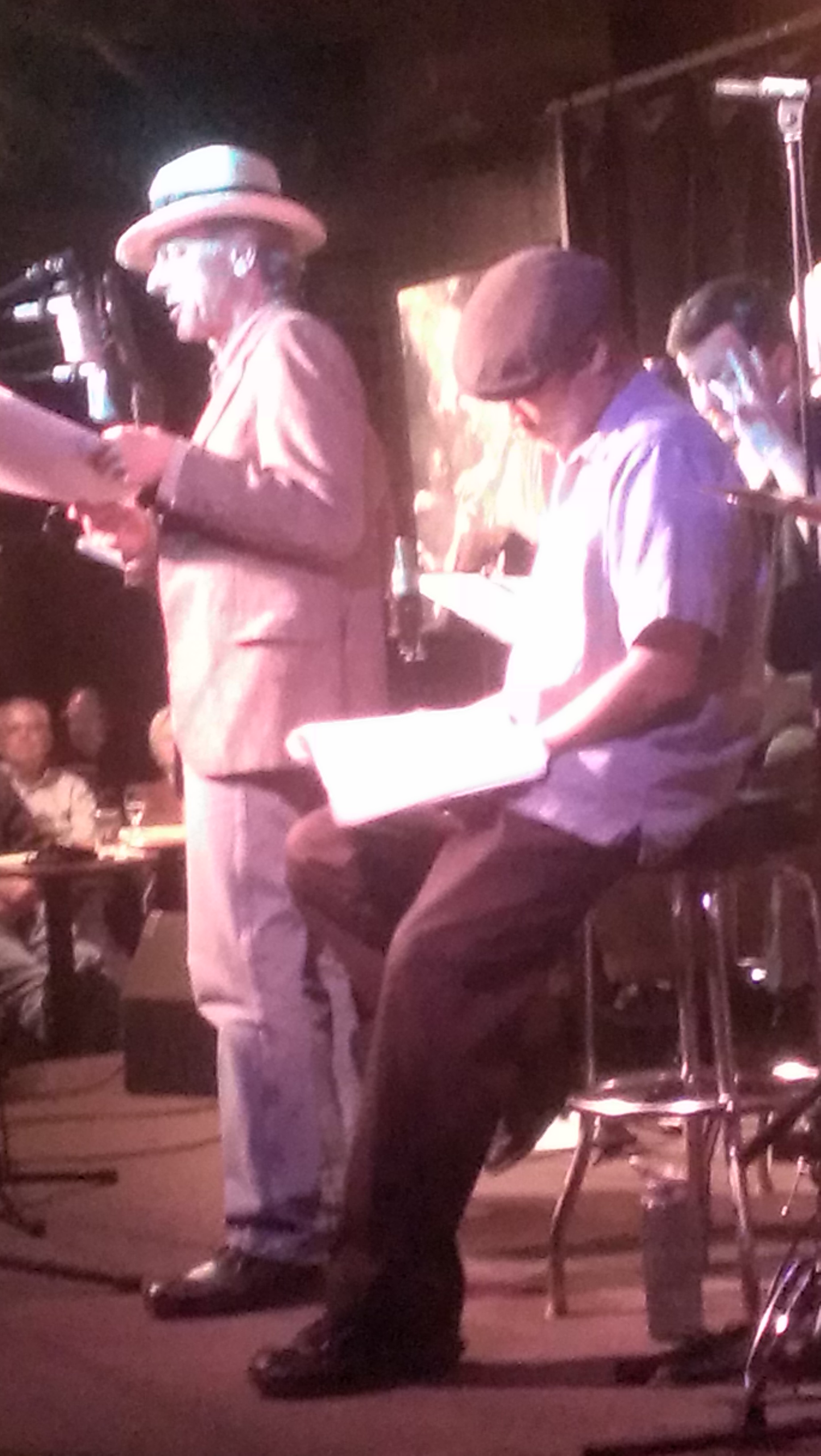
The Artist’s Quarter formerly of 26th and Stevens in Minneapolis, formerly of Lowertown St. Paul, is now in the basement of the Hamm Building.  A room light on decor, with lots of black it feels like a jazz joint.

The play tonight, the radio drama, broadcast live over KBEM to what is now its international audience, was a period piece set in 1929 just before and just after the crash, most of the play taking place in a boarding house run by Avon Davis and her Dad.  On Rondo Avenue, now under Highway 94.

It didn’t shy away from identifying Avon’s grandparents as former slaves or the pride Avon’s father had in owning and operating his own business.

Avon was a budding talent on the jazz piano, encouraged by a novelist and week by week resident of the boarding house who had been working on his novel for 17 years and now needed J. Beam to achieve the mood to write.

It was fun.  The audience had a part.  When the applause sign lit up, we shouted or spoke lines from one of two colored handouts.  “That’s hot.”  “She sure can play that thing.”  “Oh, baby.”

The place had all chairs and tables filled and it felt like the start of something, something uniquely Minnesota, yet going out to the nation and the world.


Night Terrors

Spring                                                                                  Planting Moon

Night terrors.  Slivers of dreams with metaphors like the trapdoor of life being opened as I fell through it.  Others, not so specific, but the same existential dread.  The mind trying to come to grips with the ungrippable, because it is the moment of letting go, not holding on.

That dread, the one that lurks beneath many, if not all of our fears, reveals us as the special animals we are.  Not only do we know their is an end, we know that it comes for us, waits around the bend of lives, just out of sight.  Until it isn’t.

(Arnold Bocklin, the Tomb)

As the New Testament says, we know not the day nor the hour.  And goes on to urge getting right with God.  Here on the plains of earth where God is still the one who invented death in the Garden, getting right is no surcease of sorrow, brings no balm to the wounded soul.

What can?  I’m inclined to go with the Tibetan Buddhists on this one, Yamatanka shows us the way.  We imagine our death, see it, embrace it, accept it.  Only in this way can the dread become knowing, become a doorway rather than a wall of fear.  How to do this?  A very good question.

One I’ve obviously not answered yet.  I’ve been thinking about visiting the Tibetan monastery here, the one supported by my friend Gyatsho Tshering.  See if I can learn more.

Right now I only know that death reached out its icy hand and squeezed my soul tonight.  And it scared me.