Category Archives: Garden

Your Plant Is In The Mail

Beltane                                                                                Early Growth Moon

The tomatoes, peppers and egg plants arrived in the mail yesterday.  They’re resting now, will go in the ground tomorrow morning.  Today is a bee day, move leaves to the vegetable garden, new lights in the garage and in the garden study day, plump up the sun trap day and begin outlining projects for Javier to bid.  Over the last three days I’ve laid the writing and translating aside in favor of poetry, analysis and today gardening.

I also worked out last night after missing Monday and Wednesday; this way I can get two sessions in this week.  I really miss working out and need to rethink my schedule since having a meeting or event in the evening can often screw it up.  I do three intense sessions a week, cardio and resistance combined in an interval training program that cranks up the heart rate, then extends it through a set of resistance work, a cool down to below 110 bpm, then up into the anaerobic range for a full minute followed immediately by the next resistance set.  4 sets altogether.

Soon, probably tomorrow, I’ll begin to feel the push back to the writing, translating rhythm, but right now I’m enjoying the break.

The Wall

Beltane                                                                          Early Growth Moon

I’ve hit some kind of wall.  All this straight at it time, working on Missing and translating Ovid, reading about the numinous and researching Edward Hopper, modernism and romanticism, all fun, all core to what I’m about in this phase of my life, but the weather and the constant intellectual push has me wanting some relief.  The garden often provides that balance for me, but the rain has kept us out of there and it looks like it might for the next couple of days, too.

Those tomatoes and peppers are in some UPS warehouse, supposed to be here today.  Kate bought annuals, laid in some root stimulator to support the transplants after they move from pot to ground.  So we have planting to do.  She also found a possible source of garden help for us while shopping at the Green Barn.  That would be nice.  We could do much more if we had an extra hand for the heavy and tedious stuff.

These walls come.  Then they go.  Right now I’m feeling over-stimulated, I think, too much going in and not enough going out.  Rewriting is no help in that it involves a lot of analyzing, decision making, recrafting.  Doesn’t have the same juice as writing from scratch.

A Grounded Faith

Beltane                                                                         Early Growth Moon

I walked through the garden alone, while the dew was still on the beet seedlings and apple blossoms.  Oh, wait.  That was roses, wasn’t it, from the old gospel tune.

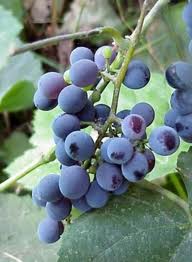
If you want a moment of intense spirituality, go out in the morning, after a big rain, heat just beginning to soak into the soil, smell the odor of sanctity, in this case fertility, coming up from the plants and their medium, see the beets and kale and carrots and cucumbers and sugar snap peas on the rise, look at the onions and garlic and leeks filling out, getting greener, taller and fatter.  Take a stroll past the cherry blossoms, the pear and plum blossoms, the apple blossoms that came out yesterday, past the bee colony hard at work, over to the blueberries and check out the new growth on the hard pruned wild grapes.   The sand cherries and quince and even the currants with their modest, tiny green flowerettes, all showing to the bees their best and sweetest offerings.  Each petal, each flower, each stalk, each leaf is a miracle, a wonder of the evolutionary path on which that particular organism travels, its genetic ancientrail.

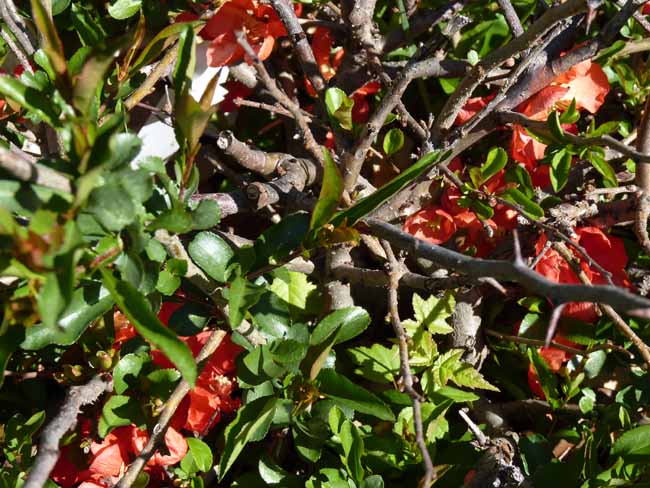
(our quince)

That walk, by the way, is not the walk of an individual, self-reliant and independent, but of a dependent creature glorying in the symbiotic relationship between his cells and these plants.  This is a community enterprise, the humans here, Kate and I, in partnership with the vegetables, the flowers, the fruit, the bees.

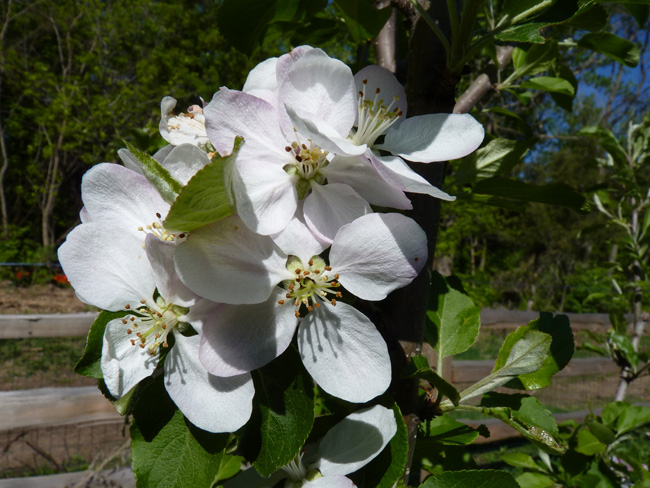
(our honeycrisp tree in bloom)

Which reminds me of the other partners, or co-habitaters at least, all the wild animals that live in the soil here, the gophers and earth worms and grubs and snails and voles, those who use the trees the squirrels, the woodpeckers, pileated and red-tailed, crows, hawks, Great Horned owls, robins, chickadees, blue birds, those who live on the land, under buildings and in brush piles the rabbits, chipmunks, woodchucks, opossums, raccoons, mice, the interlopers the wild turkeys, the deer, the coyote.  And of course, the woods themselves the ironwood trees, the poplar, ash, cottonwood, red oak, burr oak, cedar, spruce, yes even the black locust and the buckthorn.  The grass, yes, the dogwood yes, the amur maples yes, the alicanthus yes.

(a baby opossum in a dead tree in our woods)

We all share this land, to which we have the deed, but so little else.  When Kate and I leave, as we will one way or the other, the rest will continue, unaffected, unmoved by our passing.  Land is not for owning, but for cohabitation.  We know this, if we bother to look.

Root and Branch

Beltane                                                                       Early Growth Moon

Water and heat.  Sun and soil.  Roots, stalks and leaves.  There you have it.  And we’ve got it this week.  Rain, rain, rain.  Then some heat.  Seeds germinating, bursting up, ready to transubstantiate.  All for the great cycle of life, churning, moving, flowing, surging.  I can feel it, smell it at this time of year.  And I love it.

Just finished Dan Brown’s Inferno.  If you read the NYT review, you will discover that Dan has a mundane talent for words.  And that’s true.  The reviews I read didn’t add, but they should, that he throws in potted art history and architectural criticism, not to mention some odd rant on transhumanism.  Yet, did you notice, I finished it.  Why?  Well, reading like a writer, this guy knows how to plot.  He can make you wonder what’s coming next.

He pulls off one big twist in this novel and it’s a dandy, but it feels very contrived even though he sucked me in completely with it.  That’s sort of the thing he’s got going, you can see the holes in his works, where I wondered were the editors who could have easily fixed much of this, but you pass them by to find out what happens next.  That’s story telling and it’s the true game which every writer plays.

(Lucifer, trapped in the 9th circle. Canto 34, lines 20–21  Gustave Dore)

Hey, listen!  Have I got something to tell you.  Clumsy sentences, wooden metaphors, filler pages, yes, they matter, but in the end not as much if you keep me interested.

coda next morning:  I will buy and read your book if you can entertain me.  Whether I remember it or learn from it and, most important, whether I will return to it, however, depends on those skills Dan Brown seems to shunt aside as unnecessary.  No, I won’t be re-reading any of his work.

Welcome, Growing Season!

Beltane                                                                                  Early Growth Moon

We have turned the corner on winter it seems and now will begin the gradual invasion of a more southerly clime, with heat and humidity climbing like kudzu broken free from the Confederacy.  We are two distinct climates in one here in Minnesota.  The one for which we are best known and with which most of us here identify is the polar influenced late fall, winter and early spring.  Cold, often severe, snow and a long fallow time typify this one.

The second, one for which we are not known at all, but which we know well, is the briefer Northern summer in which all signs of that polar influence wane then disappear, giving way to temperatures often reaching the 90’s and sometimes into the 100’s–this has happened more lately of course–and dewpoints moist enough to make being outside like wrapping yourself in one of those turkey cooking bags sold around Thanksgiving and sticking yourself in your oven.

This means, the good part, that we can grow crops that mature in under 120 days or so, leeks stretch that, but I’ve done it consistently.  This is long enough to get most garden vegetables including tomatoes, peppers and others that require frost free conditions when planting. (which shortens the season).

The bees, long adapted to cold climate, are fine with these temperature swings; it’s the multivalent attack of pesticides, mites, loss of habitat, mite borne viruses or viruses aided by the mite weakened bee and reliance on bees not bred for hygienic behavior (cleaning out diseased larvae before they can infest the colony).

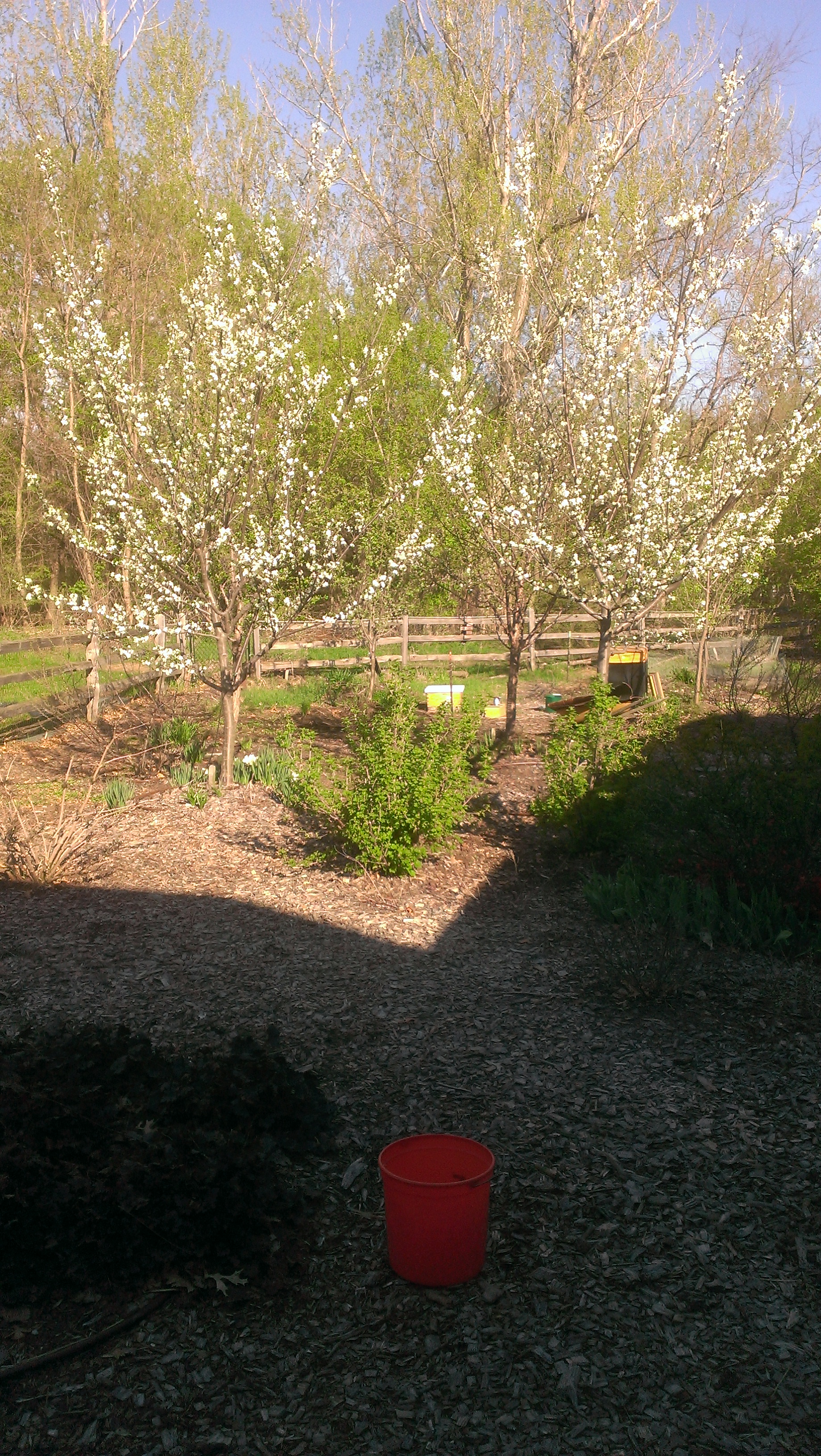
Our cherry, plum and pear trees all blossomed in Monday’s record heat.  The apples have not, yet, and I’m glad because once their blossoms fall I have to get out the ladder and bag each fruit set.  And, this year I’m getting more aggressive with the damned squirrels, those tree bandits.

It’s time to get out there and dig several holes in the ground, mash it up, put it in a plastic baggy and send it off to the lab.

A Good Day, Even If It Is 95

Beltane                                                                         Early Growth Moon

Got outside around mid-day and planted chard, kale and carrots.  Need to get a second round of beets in the ground, too.  We’re well under way now, with beets emerging, leeks going well, garlic beginning to curl skyward though a bit behind, onions still a bit pale at the top, but progressing.  No bees today due to the cloudy morning, the best time to check on them, but not when its cloudy and rainy.  So tomorrow.

Using the time, the mornings for Missing, writing and revising in turn, trying to remember all the pieces.  A little difficult.  Like juggling chainsaws, bowling pins, feathers and knives.

Not unlike the afternoon’s translating.   Holding those words and ideas in the air, not committing, or at least not over-committing, to a particular meaning until all the pieces have been considered.  Mentally tired.

Soil

Beltane                                                                            Early Growth Moon

The soil temps have exceeded 50 so I’ve got to get out there with the carrots and chard, hoping the tomatoes and peppers come soon.  They need to get in the ground.  I’m going to look at soil improvement over the next few years.  I’ve always done some amendments, composted manure goes on all my beds at the end of the growing season and I often lay it down as mulch once the temps get hot, then cover it with leaves, but I’ve not done any other fertilizing or soil supplementing, largely because I grow organic and I just don’t understand the organic soil supplement process.

Bill Schmidt hooked me up with some e-mails from an outfit in Farmington, International Ag Labs, and their stuff looks doable, though still somewhat complex for me.  I’ll need to look into it further, but it seems to have a focus that makes sense to me.  The basic thrust? Biosustainability created through soil improvement toward optimum soil health.  When you see the thin layer that is our atmosphere, the post below with the astronaut video, and then when you consider that it is the top six inches or so of soil that make plant life possible, you begin to understand how tiny is our margin of safety.

We can take active steps that ensure a healthy atmosphere and a healthy topsoil, why wouldn’t we do that?


Over the Years

Beltane                                                                     New (Early Growth) Moon

“When you recover or discover something that nourishes your soul and brings joy, care enough about yourself to make room for it in your life.”

Jean Shinoda Bolen 

A nice rain, drizzly and over a few hours.  The irrigation folks are coming out on Monday to start up our system.  We’re under way for year 19 at Artemis Hives and Gardens.  We’ve never aspired to large scale production or to garden beautiful flower gardening, but we’ve kept at improving our property over the years, starting when we hired a landscape architect and Otten Brothers Nursery to give us key features even before we moved into this house.

They graded, installed beds, planted trees, shrubs and some flowers, created the terraced garden in the back and laid in the boulder walls.  Over the course of the next year or two I cut down the scrub black locust trees to clear a large area in our back, an area that would eventually become our orchard, our vegetable garden and a general purpose back yard with the grandkids playhouse, a machine shed and a garden shed.

Later we had the permaculture folks, Ecological Gardens, put in our orchard, then they added plantings to our vegetable garden.  We’ve done a good deal with our land over the years, adding value incrementally.  The bees came along five years ago with the assistance of a friend of Kate’s from her work.

With each addition we’ve increased the level of our interaction with the land here in Andover, on the Great Anoka Sand Plain.  We added first vegetable production that Kate put in, then much more with our raised beds and finally the fruit trees, blueberry and raspberry and elderberry and currant and sand cherry bushes.  Each year we also take wild grapes from the vines native to our small woods.

It’s a good bit of work from May to October, but not overwhelming–except for that time period with the back–and it gives us part of our own food supply.  In the fall we harvest the honey, then Kate cans, freezes and dries.

Not to mention all the beautiful flowers we have all year.


Growing Up

Beltane                                                                   New (Early Growth) Moon

Cold, wet and occasionally sunny the short Minnesota growing season has finally begun.  Our cold weather planting is done, sometime in the next week we’ll put in our tomatoes and peppers.  Then, we wait for the sun to warm the soil, the rain to nourish the roots, carrying nutrients from the soil into the plants, elevatoring it up to the leaves where that true, abundant and necessary miracle photosynthesis will transubstantiate solar energy into the real body and blood.  Each leaf a priest, each plant a diocese.  A garden the whole catholic universe.

It is in here, somewhere, that reimagining faith will finally come home, right down here at that literally elemental level where the chemicals and elements of earth, soldered by sunlight make the essentials for life.  No photosynthesis, no life, at least on the surface of the planet where we live.  I understand there are different processes in the deep sea vents, strange creatures with arsenic in their veins, but up here, in the green world, we depend on–what a weak word–we live or die by this vegetative marvel.

It’s not as if there might not be gods, there may be.  There may be.  But I can think of no god that does more to sustain my life than the least of the leaves.  Here’s the nexus where sin and redemption must occur.  Sin makes our planet less hospitable for these; redemption conserves the planet’s soil, assures the availability of sun light.

(Gods Pantheon.  Ratteau)

Think of the crucifixion each year as soils leach out their nutrients, become so friable that they can blow away in the wind.  Think of the top soil, made fertile over hundreds of years, wasted in a season or two.  Think of the aquifers, draining themselves for our sake with no hope of replenishment in a hundred hundred human lifetimes.

How will we roll away the stone on this deep crime?  Who will stand at the tomb, that fine rising’ up mornin’, when the world cares for its soils and its forests and its lakes and its streams as if life of very life could not do without them?  Someday.  I hope.  Someday.

Pruning. Good-Bye to the MIA

Beltane                                                                             Planting Moon

Pruning allows a shrub or tree to put its energy into productive growth whether it is a stronger trunk or better fruit.  It’s important to prune when a plant gets overgrown or has grown in ways that cut off the flow of air through the branches.  It’s also important to keep a tree, especially fruit trees, at productive sizes, ones where the tree puts its energy into apples, cherries, plums and where the fruit can be harvested easily.

This common garden activity, however, often confronts the gardener with a task for which they feel ill prepared and perhaps a bit nervous.  If I prune too much, will I kill the plant?  You can.  What do I take off?  Why?  It’s not unusual for home gardeners to skip this chore because it feels laden with risk while doing nothing seems to avoid harm.

The third phase requires pruning.  Leaving a job or a career is an act of pruning.  A move to a smaller home is an act of pruning.  Deciding which volunteer activities promote life and which encumber can proceed an act of pruning.

Last year I set aside my political work with the Sierra Club.  Today I have set aside my work at the Minneapolis Institute of Arts.  This is pruning, too, and the kind of pruning necessary at this point for me.

The branches that I want to grow strong are my writing and my translation of Ovid.  They both require regular, sustained hours on a week by week basis.  Both the Sierra Club and the MIA took me away from that concentration.

These were not decisions I made likely, nor are they decisions I made without a sense of loss. In the case of the Sierra Club I gave up my sense of political agency, long a hallmark of my life.  With the MIA I’m giving up a chance to be with kids and adults on tours and the regular stimulation of art in my life.  These are not trivial for me.

Yet.  In this last phase of life I want to focus my efforts in ways that give me a chance to succeed, instead of scattering them in the interest of multiple passions.