Category Archives: Great Work

Just When I Discovered the Meaning of Life, They Changed It.

64  bar rises 30.00  0mph NNW dew-point 60 sunrise 6:05  sunset 8:32  Lughasa

Waxing Crescent of the Corn Moon

Just when I discovered the meaning of life, they changed it.  George Carlin, RIP

Kate takes off tomorrow for Grandparent land.  In our world that means Pontiac Avenue in Denver, just across Quebec Avenue from the old Stapleton Airport now enjoying a rebirth as Yuppieville.  She will visit with Gabe whom she hasn’t seen since his birth and Ruthie.  Ruthie runs up to her and says, “Grandma!”  Enough to make a grandparent keep coming back for more.

An electronic distress signal has sounded three times since I came down to make this post.  It finally dawned on me that it might be my cell phone.  Yep.  It needs juice and has used some of its last to tell me so.  Good boy!  Since I have a computer, a UPS, a router, two printers, a weather station and a modem all close by, it took a bit to sort out.

Writing has occupied me three days in a row full time.  That’s draining, at least for me.  I’m about 3/4’s done, perhaps a bit less.  As always, I have learned far more than I can compress, in this case even into two presentations.  There is a tendency to use all of it, or at least try, but that makes the piece turgid, reportorial.  It needs to have drama and depth, not breadth and length.

There is a cosmology kicking around, a soteriology, an anthropology, an ethic, a tradition with an American twist and the energy to work on it.  This is the stuff I tried to get at when I took the Paul Tillich course a couple of years ago.  Not yet finished.

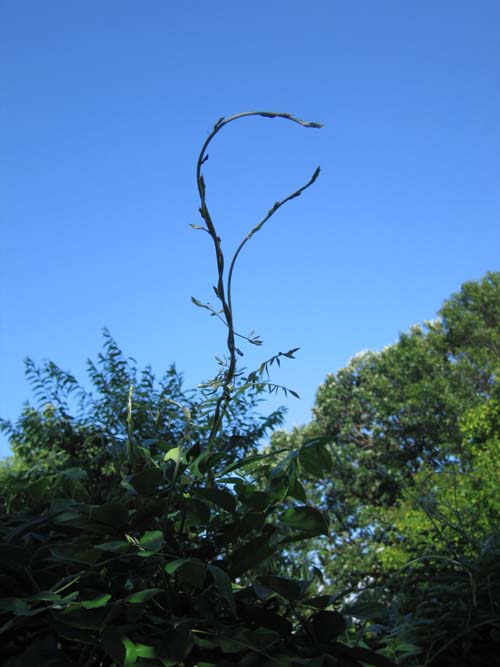
And, to finish this post, an alien reaches for the sky.  (our wisteria)

wisteriareach500.jpg

Hoosier Bodhisattvas

79  bar steady 29.85 5mph NNW dew-point  67  sunrise 6:02 sunset 8:35  Lughnasa

Waxing Crescent of the Corn Moon

“What happens to a dream deferred? / Does it dry up / like a raisin in the sun?” – Langston Hughes

To continue the raisin metaphor the next line might include the fact that raisins are nutritious and can, with adequate moisture, grow plump once again.

The corn tasseled out last week late and tiny ears of Country Gentlemen have begun to form.  The corn stalks soar an elegant, but seemingly fragile 7 to 8 feet above the garden bed.  Though there are only three rows and the rows extend only 8 feet or so in length, still it calls up all those corn fields of my youth, green jungles that flashed by as we drove on   crushed gravel roads, spreading a fine chalky dust behind us.  There was, in that time, a union between the maturity of the corn and our maturity, both green, filled with promise, but not yet ready for the harvest.  Corn, of course, has a shorter life span than most teenagers, but some of my Alexandria classmates were dead soon after our senior year, their maturation hastened by the fertilizer of war.

Though those afternoons and nights are long ago, 43 years at least, the marriage between my faith and the earth finds its true roots there.  The farms around home and the 4-H fair in late July gave the life of the land a prominence even to those of us who lived in town.  The sheds at the fair had rows of corn, tomatoes, beans, beets and cucumbers among many others, set out for the judges to assess.  Not the judgments, but the pride and the reality of these fruits imprinted on me those Madison County fields and the seasons through which they passed.

The family farm outside Morristown, which I visited and on which I stayed from time to time as a boy, had the same effect.  The corn shed with its slanted, open sides filled with the hard yellow ears of field corn had a mystery to me.  This shed found late fall and winter made one, the harvest stored for later use.  I loved the cool moisture of the concrete pools that held the milk pails until the milk truck came.  This was like a Celtic holy well, a place where the water burbled up from the ground, plentiful and free.  In the late summer the hay mow would have bale after bale of alfalfa hay, sweet and pleasant.

Below the hay mow the Holsteins would stand patiently waiting to be milked, their placid ways suggesting a Hoosier Bodhisattva.

Not far down the road, visible from the hill on which the Keaton family home stands even today, is Hancock Cemetery. There the harvest of generations of Keatons and Zikes lay, row by row, in family groups.  Not all that different from the hay mow in late summer.

Teasing Out the Pagan Lovesong

76  bar rises 29.89  0mph NE dew-point 67  sunrise 6:02 sunset 8:35  Lughnasa

Waxing Crescent of the Corn Moon

I saw the dentist today, oh boy.  He unscrewed a couple of fillings, refilled them, then closed what he insists on calling an “open contact.”  Does that sound like an oxymoron to you?  Does to me.  Dr. Mahler comes into my mouth unbidden, the occasion the retirement of the redoubtable Dr. Moghk, may he golf in peace.  Dr. Mahler is good, fast and communicative.  Sure of himself. Just what I want in a dentist.  No, seriously.  He’s a keeper.

The closing words of my last post have rung like a bell in my head since I wrote them:   This whole enterprise needs a rethink, a radical redo.  We have gotten thin and liberal, instead of profound and prophetic.

What to do? Part of the responsibility rests with me.  I have the task of articulating what I believe and have faith in right now.  This articulation must be clear and emotionally compelling.  And it is work I feel I can do, am ready to do.  Looks like I was off about ten years when I hoped for intellectual maturity in my early 50’s, it has come instead, in my early 60’s.  That’s all right.

The later maturity came because my individuation and maturation occurred more slowly than it might have thanks to alcohol and neurosis.  I regret the years I gave to anger, disappointment, drinking and smoking.  I regret the hurt I caused then and the overhang it left me.  Even so, I also know that regret is an emotion with no purpose, no forward motion, so I acknowledge it and set it to the side.  Today, the only time I have ever had and will ever have, is the day in which I take up this challenge, perhaps I could have ten years ago, but I didn’t.

Now it remains for me to tease out the pagan lovesong that courses through me when I  touch a lily or eat an onion grown in soil I have prepared.  There is an ancient language of love and awe for the natural world and for ourselves as part of and dependent on it.  This vocabulary of seasons, lunar changes, life’s stages, friendship and family has no nation, knows no creeds and depends on no books, yet it is as particular as the street on which you live and the air that you breathe.

This dream, what Thomas Berry called the Dream of the Earth, is a dream in the sense of the aboriginal dreamtime, it is a way of dreaming worlds into being and it is our great and primary gift as a species.  Like all gifts it can cause great good or great harm.   Over the next few years I will slip from time to time into the dreamtime and let you know what I find there.

Primal Eating

71  bar rises 29.87 0mph NE dew-point 58  sunrise 6:00  sunset 8:38 Lughnasa

New (Corn) Moon

A vegetarian meal  tonight.  Spaghetti squash, golden beets, cucumber tomato and onion salad and cooked whole onion.  Colorful and healthy.  All but the tomatoes were from our garden, including the garlic and cilantro sauteed in olive oil as a dressing for the squash.  After the OMG tomatoes the plants have settled into production with many fruits, but none mature right now.

I know some perhaps many of you who read this cook things straight out of your garden or meat from your stock, but I haven’t done it much.  Flowers and shade plants, shrubs and trees have occupied my time.  I love them and will always tend them but the vegetables now have my attention.

Primal eating happens when you go pluck five beets out of the earth, take them into the sink and wash them off, trim the leaves and roots away, then slice these hardy roots into smaller pieces, add tarragon and balsamic vinegar, some salt, cook and eat them.  The same tonight with the spaghetti squash, the cucumber, the onion, both in the salad and the one I cooked whole.   I knew these plants when they were tiny seeds, barely bigger than the lead in a pencil or when they were small potted specimens.  The onions and the garlic went into the ground as what they would become, only larger.  In each case though the same hands that harvested them prepared for eating.

10,000 years ago some hunters and gatherers first planted seeds and tended crops.  The effect on human culture still gathers momentum even today.  Nomadic life began to disappear for those people.  Settled villages sprang up around the fields.   The keeping of animals for food was more predictable than the hunt.  In both cases though our ancestors had to give up the moving from place to place depending on season and game patterns.  Our bodies, developed in the paleolithic to survive predators and hunt for prey, found themselves out of place.

They still do.  So, while gathering and cooking goes far back in our history, it does not go all the way back to that earlier phase of the moveable feast.  This fall, however, when Kate and I pick wild grapes that grow in our woods and turn them into jam we will travel back to those ancient times, the ancient trail of seeking food where it decides to be rather than where we care for it.

This meal tonight was a Lughnasa meal, a meal of first fruits, the harvest we do not plan to store either through drying or canning.  As a Lughnasa meal, it put us in contact with those early Celts whose gardens might spell the difference between survival and starvation.  We live in a wealthier time, but not in one any less dependent on the gifts of mother earth.

A Bell That Cannot Be Unrung

61  bar rises 29.87  0mph N dew-point 53  sunrise 5:59  sunset 8:39  Lughnasa

New (Corn) Moon

Outside tonight the sky has no moon.  This illustrates the paradoxical nature of light.  We think of light as illumination enabling us to see, but it has another, not often recognized property; it can obscure as well as reveal.   The night sky during the dark moon shines with stars, many invisible when the moon is brightest.  A cool night with a clear sky, a panoply of stars, ancient messages from faraway places gives a northern summer its true character.  Able to burn with heat in the daytime, the northern summer can cool down, remind us of the coming fall, just as Lughnasa, the Celtic first fruits holy day does.  A convergence of a new moon, Lughnasa and cooling temperatures make this a night made for myth.

The research for Heresy Moves West will probably end tomorrow.  I hope I can get at writing, too, but I doubt it.  Sunday.  This is a big task, one I set for myself, but I’d like to get a first draft done, so I can set it aside for awhile.  I have Stefan’s poems to edit and the Africa tour, too.  Not to mention a firepit to dig, hemerocallis iris and lilium to move.

A piece of this project troubles me.  Maybe troubles is not the right word, provokes, that could be it.  When Channing and the others split from the Standing Order Calvinist orthodoxy in New England, they started a cascade of controversy that has not ended.  Not long after the Unitarians had left the congregationalists behind, Emerson began writing his essays and giving his lectures.  With the strong push Transcendentalism got from Theodore Parker, there was soon a split over natural religion versus theistic religion.  The Civil War obscured this problem for the first half of the 1860’s, but it re-emerged as the Western issue as the more radical, Parkerite ministers began to dominate the Western Unitarian Conference.  This led to constant conflict with Eastern conservatives (used to denote those who wanted to retain Jesus as Christ, keeping Unitarianism’s original perception of itself as liberal Christianity).  The Free Religious Association and The Ethical Culture movement kept the Western issue alive in the east.  This split healed with a broad understanding of liberal religion, only to be sundered again in the 1920’s with the rise of humanism.  Humanism set aside theism for good in the interest of a scientific and humanistic approach to the ethical life.

Here’s the problem.  Conservatives predicted the gradual erosion of religious sentiment if there was not at least the glue of Jesus to hold the center.  Their predictions came true as the shift away from theism took its incremental, but, looking backward, inevitable progress toward an essentially secular movement focused on ethical living.  This leaves the field free for radical inquiry into the nature of the human experience.  A great, not small thing.

But, it can lose the faith that burns in the heart, that seeks the reality next to or beyond this reality; it can lose it in the same kind of scientistic move that linguistic analysis made, that Richard Dawkins and Sam Harris make.  It is, though, a bell that cannot be unrung, so we must seek this faith that burns in the heart elsewhere than in tradition.  Good.  Emerson thought so, too.  The question is, where?

Investigating this question will occupy some time, perhaps the next few years.

When I went out to check the drying onions, I found one with a bit of a soft spot.  I brought it inside to cut up for a salad for lunch.  Cut open I put my fingers on the white flesh.  It was very warm, almost hot.  That drying would take place inside the onion had not occurred to me.

The Beginning of Summer’s End

77  bar rises 29.83 3mpn NNW dew-point 61  sunrise 5:58  sunset 8:39  Lughnasa

New (Corn) Moon

As I note in the Lughnasa entry now posted on the Great Wheel page, we have come to the beginning of summer’s end.  The Celtic word for summer’s end is Samhain, also the name for the last of the harvest festivals celebrated on October 31st.  August 1st finds those of us with gardens and farms involved in some manner or another with our early harvests.  The first tomatoes, the garlic already in here, beans, beets, carrots and onions.  This is a time of thanksgiving, a day of gratefulness for the earth and for the plant life which offers itself to us and to our fellow creatures so that we might live.

A dish of green beans, onions in a salad perhaps garnished with tomatoes, garlic used to flavor a sautee all remind us that food does not emerge from the ether, rather it grows with care and attention, care and attention meted out over a growing season, not all at once.  It is not a matter of a moment to grow food.  Vegetables only reward those willing to practice attentiveness, to stay in the now.  The plant needs what it needs today, not tomorrow.  The pests that infest today will become worse tomorrow.  Act now.

Today is an all Heresy Moves West day.   The story of Unitarians and Universalist as they follow the frontier, especially the pioneers from New England, makes an American saga.  America’s exceptionalism often takes the form of manifest destiny, our version of Kipling’s White Man’s Burden, but a truer idiosyncrasy of this country lies in our embrace of religious freedom.  We take it for granted, imagine that if it’s not the case in another place, they just haven’t gotten around to it yet, but in fact we are very much the outlier when it comes to the firewall between the state and religious institutions/faith traditions.

That a peculiar brand of new thought that changed the flow of a millennia old faith tradition–the Judaeo-Christian–could not only flourish but spread as the country grew, that the new thought itself would become fractious and splinter along unpredictable lines, and that it would find its most radical expression in the Midwest rather than its place of origin in Boston and surrounds could only happen here.   The chance to tell this story makes me glad, for it is a story of vision, of unfettered thought, of reaching beyond the boundaries of the mind, a story that transcends its makers by breaking open new sources of authority for those searching for a place in this vast universe of ours.

Water, Water Everywhere. Even on Mars.

LOS ANGELES (AP) – The Phoenix spacecraft has tasted Martian water for the first time, scientists reported Thursday.

By melting icy soil in one of its lab instruments, the robot confirmed the presence of frozen water lurking below the Martian permafrost. Until now, evidence of ice in Mars’ north pole region has been largely circumstantial.

In 2002, the orbiting Odyssey spacecraft spied what looked like a reservoir of buried ice. After Phoenix arrived, it found what looked like ice in a hard patch underneath its landing site and changes in a trench indicated some ice had turned to gas when exposed to the sun.

Scientists popped open champagne when they received confirmation Wednesday that the soil contained ice.

“We’ve now finally touched it and tasted it,” William Boynton of the University of Arizona said during a news conference in Tucson on Thursday. “From my standpoint, it tastes very fine.”

Phoenix landed on Mars on May 25 on a three-month hunt to determine if it could support life. It is conducting experiments to learn whether the ice ever melted in the red planet’s history that could have led to a more hospitable environment. It is also searching for the elusive organic-based compounds essential for simple life forms to emerge.

The ice confirmation earlier this week was accidental. After two failed attempts to deliver ice-rich soil to one of Phoenix’s eight lab ovens, researchers decided to collect pure soil instead. Surprisingly, the sample was mixed with a little bit of ice, said Boynton, who heads the oven instrument.

Researchers were able to prove the soil had ice in it because it melted in the oven at 32 degrees—the melting point of ice—and released water molecules. Plans called for baking the soil at even higher temperatures next week to sniff for carbon-based compounds.

The Heart of What Ails American Culture

75  bar steady 29.84  0mph NE dew-point 68  Sunrise 5:50  Sunset 8:59pm Summer

Last Quarter of the Thunder Moon

A Deborah Madison recipe I used this noon called for tomatoes, beet greens, oregano, olive oil and garlic.  The beet greens came from the golden beets I picked just before the lunch.  The oregano from Kate’s herb garden.  We had a couple of dried garlic bulbs. I thought they had not differentiated. but I decided to use it as it was.  When I peeled back the white, papery layers over the bulb I found cloves.  This meant  two things.  I had enough garlic for the recipe and the garlic in the bed could be harvested now.  The dish was great, but the cloves excited me.

There is no reason why growing garlic bulbs with cloves should excite me so much, except it entered my head early in the gardening season–last September.  They grew throughout the winter and were ready to harvest in July, just as the cultural recommendations for it said.  Their taste is more intense and more sweet, at least this variety.  I planted three.

In the furnace room, hanging from green gardening twine are four bunches of garlic bulbs.  Set aside from them are the largest 2 bulbs from each variety.  They will go in the ground in late September or early October to produce more garlic for next July.  Kate will take a large head from each bunch out to Jon and Jen so they can have garlic in their garden.  They too will be able to harvest the largest heads and plant from them.  This chain of living things, nurtured and in turn nurturing, is the true great chain of being.

Watched 10,000 BC on the recommendation of a friend.  Well, the anachronisms were many: iron, boats, buildings, captive mammoths and the story line fed on coincidence.  On the other hand the Woolly Mammoths and the Sabre Toothed Tiger were very real.  A mish-mash of times, cultures and continents.  Just what I thought when I was the first ads.  In fairness, the same friend watched There Will Be Blood on my recommendation.  He thought it was too violent and the lead character, played by Daniel Day-Lewis, a poor guy with whom to spend a couple of hours.

There Will Be Blood is a mythic movie of great power.  It speaks to the heart of what ails American culture and it speaks the truth.  The truth is neither pretty nor easy and the film knows it.  It is uncomfortable, but that it is different from bad.  10,000 BC is an entertainment and it works sometimes and not others, but it is not mythic, either in truth or in story.

The History of Ideas

75  bar falls 29.90  0mph ESE dew-point 60 sunrise 5:49  sunset 8:49  Summer

Waning Gibbous Thunder Moon

The mayfly lives only one day.  And sometimes it rains.    George Carlin, RIP

Freud, Marx and Hegel expelled from school.  The article to which the first sentence here links refers to the strange disappearance from the college curriculum of these three seminal thinkers in psychology, economy and philosophy.

Here’s an e-mail I sent to its author:

Hello, Mr. Jacoby,

In 1965 I began the study of philosophy with the pre-Socratics, moved onto Plato and Aristotle, and then on toward the present.  The early study of philosophy excited me so much I chose it as my major.  The methodology, the history of ideas, has remained with me as the most important intellectual tool I have.  When I switched schools, I entered a school dominated by logical positivists.  The most important and interesting questions of philosophy, questions which mattered to individuals and to public discourse did not matter to this department.  I left philosophy behind, sad that it refused to engage matters of ontology, values and beauty. 

I write to you because I felt then what the gist of your Chronicle of Higher Education article suggests is a contemporary problem.  It is a problem with its roots, I believe, in the logical positivist and linguistic analysis movements which tried to align philosophy with the scientific method.  There would have been nothing wrong with this as an adjunct discipline, but the arrogant dismissal of metaphysics, for example, for reliance on what I would call a shallow epistemology gutted philosophy of its humanist core.

This same attempt to bring economics and psychology into the scientific realm, and sociology too for that matter, has identical problems.  The quantifiable in these disciplines is fine and produces important insights, but, again, the core of these disciplines, with the possible exception of economics, is humanistic, not scientific. 

Your article reminded me of those long ago days when I moved on to anthropology.  The dismissal of historical perspective leaves us with the need to reinvent all those old arguments and to approach their resolution without the aid of some of humankinds most creative thinkers.  Too bad.

As I grow older, history looms ever higher and higher in my intellectual pursuits.   As I said in the e-mail to Mr. Jacoby, the history of ideas, learned during classwork for my philosophy major, has informed everything  I do.  I gravitate naturally at this stage of my life toward the historical record.  Where did that word originate?  How has it been modified over time?  Where did this artistic movement come from and what questions did it try to answer?  What are the roots of the so-called New Age thinking?  Why are not its current proponents interested in its intellectual history?  What is the source of liberal and conservative political thought and how does their history help us modify them to fit present needs?  Why is the issue of climate change such a problematic one?  What in the history of humanities relationship to the natural order created such a situation?

These are the questions that get me up in the morning, that drive my decision making about what to do with my time and how to direct my own work.


Six Degrees Can Change the World

66  bar rises 30.07  2mph NNE dew-point 56 Sunset 7:22  Summer night, cool and clear

Waning Gibbous Thunder Moon

National Geographic Channel had a program called Six Degrees Can Change the World.  Geez was it depressing.  A lot of the early stuff was material I’d heard before, but as it went on from 1 degree to 2 degrees, then to 3 degrees with the Amazonian rain forest becoming a scrub land and the Greenland ice sheet melting down and other very nasty stuff, I began to feel powerless, a victim before the inevitablity of increasing energy consumption which will drive the very worst scenarios into being.

Those of you who know me well know I don’t like victim status.  A passive victim does not act, but allows reality to act on them.  Not my way.  So, once I got over the feeling of powerlessness, I reminded myself that I have made several distinct decisions related to effecting change.   The Sierra Club work.  The optimal suburb/exurb home.  Keeping the red car intact.  Our plan to purchase a hybrid or all electric when Kate retires.  Growing vegetables.  Turning off the computer at night.  Working over the next few years to find even more ways major and minor that we can reduce our carbon footprint and encourage alternative energy.  I am not a victim, nor do I want to be a rich world antagonist of mother earth’s.   The struggle of our time.