Category Archives: Myth and Story

Nocturne

Lughnasa                                                          Lughnasa Moon

from the Episcopal service for Compline:

Psalm 91

3    He shall deliver you from the snare of the hunter *
and from the deadly pestilence.

4    He shall cover you with his pinions,
and you shall find refuge under his wings; *
his faithfulness shall be a shield and buckler.

5    You shall not be afraid of any terror by night, *
nor of the arrow that flies by day;

6    Of the plague that stalks in the darkness, *
nor of the sickness that lays waste at mid-day.

There was a time, during the mid-1980’s, when I shared an office with an Episcopal priest. During those years, we often said the daily prayers out of the Book of Common Prayer. It was soothing. Its repetition brought a sort of order to the day, or, in the case of Compline, to the coming night.

(Hieronymus_Wierix_-_Acedia)

Religions take key moments of the past and preserve them, some might say in amber, others would say in a living tradition. The emphasis in the religious life, no matter how it might claim otherwise, is to repeat the message over and over again. Taoist and Buddhist, Jew and Muslim, Hindu and Parsi all return to certain truths learned by the great men or revealed by the great gods, all in times that have long ago faded out.

The Compline service for instance promises surcease from the sorrows of life: night terrors, the sickness that lays waste at mid-day (acedia*), the arrow that flies in the day, the snares of the hunter and the deadly pestilence, by quoting the 91st Psalm. And by using it night after night.

The surcease depends on faith, of course, faith in the God who covers you with pinions (the feathers on the outer edge of the wing) and the wings, whose faithfulness to you is a shield and buckler.

There is a comfort here for me as I read this Psalm. It is a message about the universe coded for me, that is, it is a religious message within the Western tradition and even more, in the Judaeo-Christian tradition, the tradition that shaped our civilization and much of our values.

This faith is no longer my faith. There is, however, in its quick outline of anxiety and its profoundest sources, a knowledge of the existential dilemma we all face. In this I see my daily struggle acknowledged by the Psalmist, a Jew of ancient times. His answers may not be my answers, but his sensitivity to the human condition, my condition, makes him my brother. His search for a solution to acedia, to the night terrors, to the snares of the hunter makes my quest for answers to these very questions one with his.

I’m glad he has an answer. It is not the answer that is the key to the comfort in these words, but in their recognition of the question, or rather, questions, that confront us all. That’s what I find so useful about religion, its willingness to define, to name the psychic and spiritual ills that plague us all. Even the answers, though I may not share them, can point to paths I might take. (more on this one later.)


*Acedia (also accidie or accedie, from Latin acedĭa, and this from Greek ἀκηδία, negligence) describes a state of listlessness or torpor, of not caring or not being concerned with one’s position or condition in the world. It can lead to a state of being unable to perform one’s duties in life. Its spiritual overtones make it related to but arguably distinct from depression.[1]

Mid-Season Slump

Summer                                                             Lughnasa Moon

I’ve slipped into a late summer pensive mode, obvious from the posts lately. It’s not far off from melancholy, a land I can see from this spot in my inner landscape.

It comes, in part anyhow, from being fed up with garden work, tired of the responsibility. At first this year I described this as pulling away from the land, a pulling away occasioned by our pending move. And, yes, there is that element to it, but then I recalled other late July, early August feelings. Similar ones.

Around the time of Lughnasa, the Celtic festival of first fruits, we’ve been at the garden since April. That’s 4 months and my emotional response to it follows a predictable pattern. There is, first, eagerness. This often comes in January with the arrival of the seed catalogs. Paging through these girly magazines of the horticultural world, flashing pictures of mature vegetables and gorgeous flowers draw the eye and stimulate the imagination. A new year’s garden begins to take shape with scribbled plant lists, drawings of the beds, conversations about what went well last year, what might be fun this year. This is around Imbolc, the Celtic festival of lambs-in-the-belly.

Then, the grip of winter loosens and the soil can be worked. This is the time for planting cool weather crops. Now there’s a mild fever, a feeling that the weather is holding things up. Last year’s mulch gets pulled off, the beds for cool weather plants get worked a bit and seeds go in the ground.

Waiting for seeds to germinate is a sweet time, part concern, part withheld joy. Then the shoots begin to pierce the earth. Often here in Minnesota this is around the Celtic festival of Beltane, the beginning of the growing season, May Day.

Another period of impatience occurs. Frost sensitive plants can’t be planted with confidence until after May 15th, some even after Memorial Day, though each year there’s a temptation to test the weather in order to benefit from a longer growing season.

All of May is garden intensive with clean-up, planting, weeding, bed preparation, dead-heading of perennial flowers. May might be the best garden month because it combines the restless anticipation of the frost sensitive plantings with thinning and weeding of the cool weather crops.

With the gradual climb of the sun toward the Summer Solstice the plants accelerate their growth. All the plants. Including weeds. By the Solstice insects have begun to have their way with some of the growing plants and weeds become a constant. Mulch goes back down to hold in moisture and keep the ground cooler. June sees the full garden, the vegetable garden, growing. The cool weather plants are racing to maturity and the frost sensitive plants gain height and leaves, some fruits.

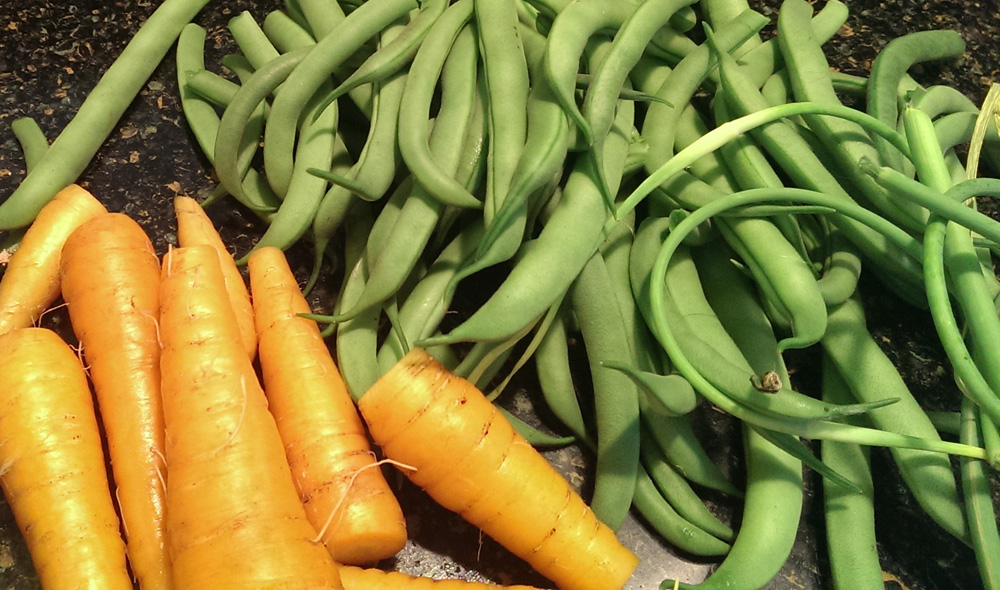
In late June and July beets and carrots of the cool weather plantings, green beans and sugar snaps, chard and collard greens are ready. Harvests begin and second plantings go in. The sun’s height, though now in recession, continues high and solar energy strong.

July is the peak of the garden with most plants high, green and bearing fruit. Harvests croppedIMAG0327already begun continue and often tomatoes are ripe, peppers, too. The first of these. By now the eagerness has waned, replaced by a steady rhythm of spray, weed, thin, pick.

Yes, it’s true that the harvest is the point of it and, yes, it’s true that harvesting is a satisfying work. But sometime around Lughnasa, right now this year, the garden’s grip on my imagination and heart begins to weaken. I begin to resent its hold on my time, on having to be present to it. Also, plants begin to die back, this is the end of maturation, senescence.

This feeling lasts a couple of weeks, until a hint of coolness hits the nights. It might come from my sensitivity to the changing light, a signal that the more thought-focused, inner world seasons have already begun to assert themselves. I am a child of the dark fallow months, a time when the world outside demands nothing, leaving me alone with my books, my Latin, my writing.

In another week or so I’ll get another boost for garden work. Anticipation will grow for the raspberry ripening and the triumphal weeks of tomato, egg plant, pepper, cucumber harvests. By September the garden will demand less time. I’ll put in a new crop of garlic later in the month, possible early October. Clean up and memories will dominate then.

All this is to say that I’m not really pulling away, not quite yet. This is mid-season weariness, a regular event. Part of the gardening year.

The Song of the Earth, Herself

Summer                                                            New (Lughnasa) Moon

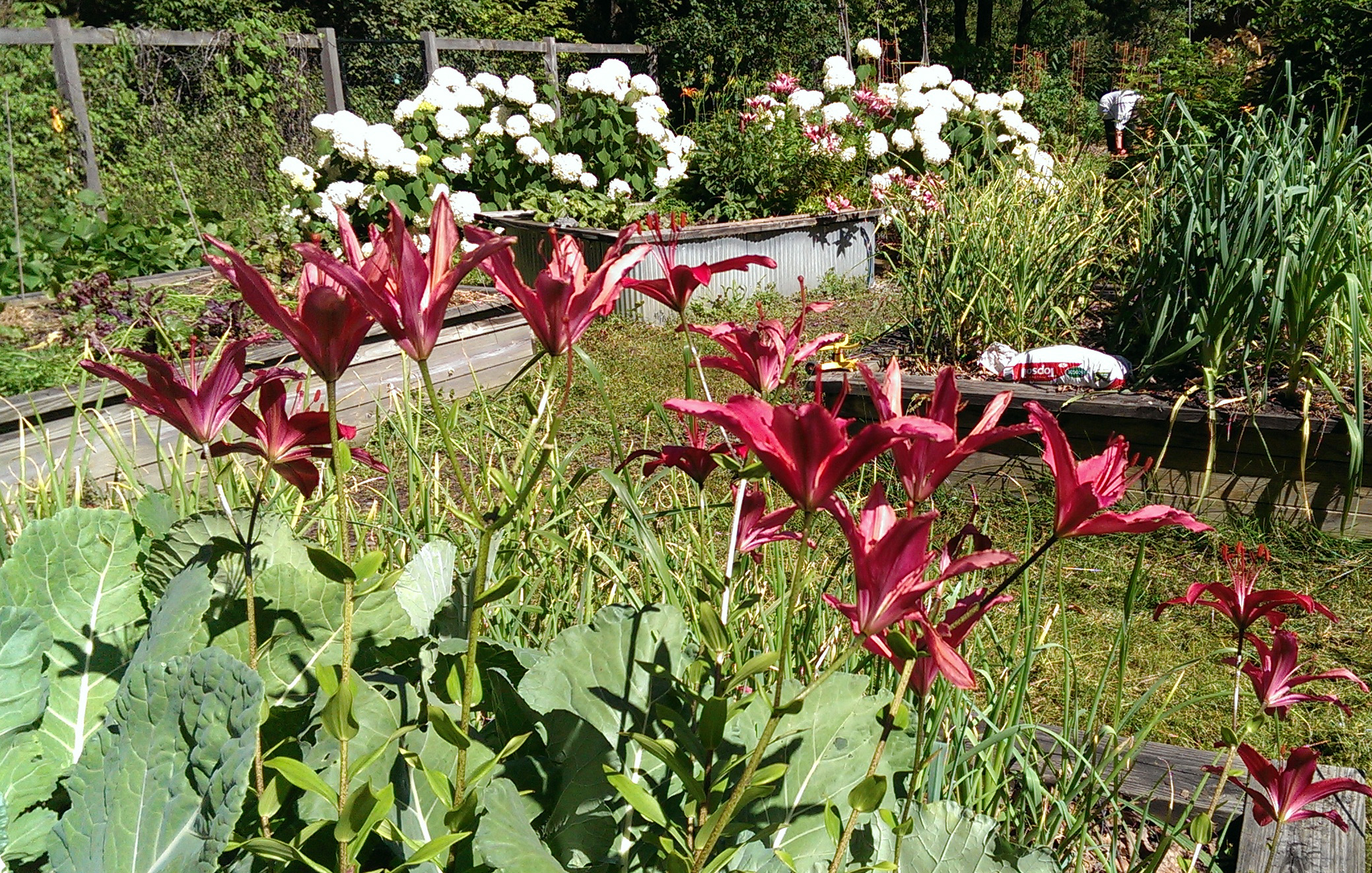
croppedZOE_0022At first, as I dug my way into a new faith, it was about a symphony: the early crocus, snowdrops, grape hyacinths followed by tulips, then iris and hosta and bleeding hearts, giving way in July to a the bold notes of the asiatic lilies until the daylilies and clematis, both bushy and climbing, the liguria and the snakeroot began to dominate followed by the soft crescendo of asters and chrysanthemums. This literal rising and falling, in palates of color always framed by many shades of green, played out in my mind, a curious analog to the mental images inspired by listening to Mozart or Haydn or Pachibel.

Then, with Kate’s guidance vegetables came to have more and more importance. They too come in their own season, following their own melodic lines, as do the fruits and the nuts. Even, I would later learn, so did honey and the concerto of the honey bee.

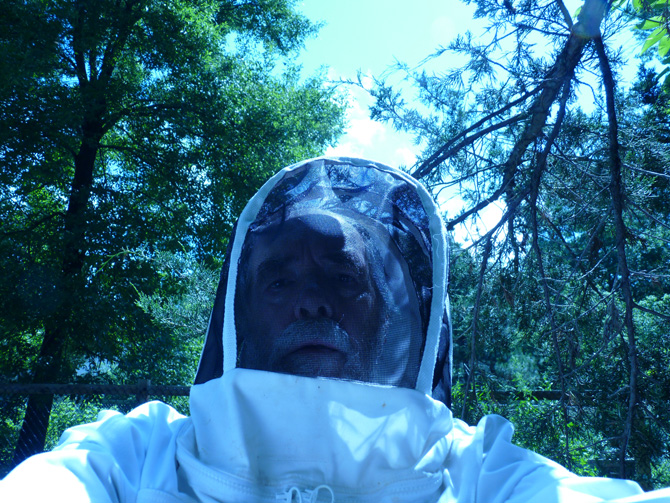
Amending the soil with compost and peat moss and decayed leaves and hay, finding the 06 27 10_beekeeperastronautheirloom seeds for the vegetables we grow and the beautiful varieties of perennials like the iris and the lily, made the whole a process laced with memory and filled with change.

It is no surprise that the Great Wheel, the ancient calendar of a people whose blood runs in my veins, came into this earthy process as a celebration, as a sacred abstraction of a very real lived experience. This was not systematic theology. This was neither dogma nor holy book. No, this was and is the song of the earth herself, composed in her own medium, the plants whom her body supplies with nutrients and her body which receives their dead bodies to replenish herself.

So this is a material spirituality, a spirituality that lives in the praxis between human awareness and the earth’s ordinary wonders, a paradoxical sacredness created by the essential, the necessary bond between the human body and the plant body and the earth’s body. It may be, probably is, that paradox exists here only when seen against the various gnosticisms of the world’s many religions. In fact, a faith rethought and reimagined without religion entering into the mix needs no spirituality other than that mysterious, miraculous link that binds the entire web of life into one interdependent whole.

Into This World We’re Thrown

Summer                                                             New (Lughnasa) Moon

Into this house we’re born
Into this world we’re thrown…
Riders on the storm             The Doors, “Riders on the Storm”

Reimagining faith. This has been a project of mine for over ten years. It started as an attempt to create a ge-ology as opposed to a theo-logy. (which, I just recalled, began long after a faith focus which saw me out in the woods and wild places of Anoka County for Celtic holidays.) My idea then was to put the earth in the place of God in a value system, a philosophical system for understanding life and its choices. In that vein I took a course on the systematic theologian Paul Tillich. If I could understand in close detail how a thinker like Tillich went about creating a theology, I might follow a similar path toward a ge-ology.

(Johann Wilhelm Cordes: Die Wilde Jagd” – Skizze zum Gemälde 1856/57)

The course was instructive, but not in the way I had imagined. Tillich’s work was too systematic, too neat and tied together with multiple logical bows. It was a product of the enlightenment, a philosophical system built on a clever and sensitive reading of the Christian theological tradition. It was not something I wanted to emulate, perhaps could not emulate. (Tillich was a really, really bright guy.)

After various fits and starts, I eventually set aside the ge-ology idea and turned toward reimagining faith. This idea came from feedback to a long ago post in Ancientrails where I referred to my spirituality as a tactile spirituality. Somebody appreciated this paradox, a material spirituality rather than an ethereal, post-Platonic soul based spirituality.

The starting point for both the idea of the ge-ology and reimagining faith is the Great Wheel. I’ve spoken elsewhere about how the Great Wheel has influenced my life and faith, but the short version is that following this ancient Celtic calendar through the seasons, and following through the season not as an intellectual abstraction but as a lived reality with flowers, vegetables, fruits and other plants subtly changed my understanding of faith.

I say subtly because it took me a long while to notice how deeply I had embraced it. Reimagining began as a second grand intellectual experiment like the ge-ology, but one focused on the Great Wheel. Not the Great Wheel as a pretty round calendar, nor as a neo-pagan liturgical calendar, though it is both of those things, but as experienced by the earth, through the changing seasons. It would not, in other words, proceed from the mind out, but from the ground up. Literally.

How was that going to happen? Didn’t know. Still not sure, but I did change the project a sun calendarthird time to reimagining my faith. Trying to be less grand, less global, more in a realm for which I have both responsibility and authority.

Then, recently, I came across an article in Foreign Policy magazine. It’s premise was a rethinking, a reimagining of the U.S. military. What if we designed a military for today’s reality, was the question it asked.

Aha. That’s the question at the root of my quest. What if we designed a faith for today’s reality? This is similar to Emerson’s notion of a religion of revelation to us, not to them, but it is not the same. I’m not necessarily interested in religion, especially religious institutions which serve to fossilize and deaden lived faith. A religious institution is anathema to a lived faith since lived realities change constantly and religious institutions live to fight change.

So, I’m not interested in revelation since revelation is a Christian idea. What I’m trying to do is rethink, reimagine what faith can look like in a world shorn of classical metaphysics, in a world moving toward a dystopian climactic future, in a world… Well, that’s just the point, I think. We’re rethinking now in a world context, not in a given ethnic enclave, not even within with the broad outlines of Western and Eastern, but on the rough and watery surface of our planet. All of us now, together. What can carry us forward, help us understand who we are and what we need to do, for each other and with each other? For the planet and for the future of all living things.

I’d love to think I could answer those questions. But the truth is I can only make my best effort at answering them for myself. That’s the project I’m engaging right now, reimagining, rethinking my faith for today’s reality and for the future toward which and for which we live.


Heading Toward the Festival of First Harvests, Lughnasa (August 1st)

Summer                                                           New (Lughnasa) Moon

The harvest now. Onions, more and more lying down. The batch from last week have had their curing in the sun and are now in the shed on the screen. The garlic has begun to mature as well, about half of it is in the sun now as are the onions newly ready. The garlic are not large, at least the ones I’ve pulled so far and last year’s were not either. Last year we got a garlic crop when many who farmed garlic got none. Not sure what the issue is but it’s cut into the bulb size for sure.

This next week’s cool temperatures do not favor the tomatoes, so their ripening might be delayed. More green beans, collard greens, chard are ready. Overall, an abundant harvest so far.

Nocturne

Summer                                                            New (Lughnasa) Moon

It’s not a new idea, I know, but tonight I’m feeling the truth of each day as a microcosm of a life. We wake to begin our day from a state of unconsciousness, born anew into a world that has no mark on it. Our life goes on with or with out loved ones, with or with out work, with or with out health, just as a new born babies must.

It’s that element of being thrown into the world (I love this idea of Heidegger’s.) that gets repeated each day. The wonder and the vibrancy of life comes from just that unpredictability. What will this day bring? What will this life bring?

As the day goes on, our efforts are strong and effective or not, are loving and compassionate or not, are creative and exciting or not. And as night falls, our body grows weary and demands sleep.

Just as it will do one day for the last time. And on that day, it will have been a day just like any other. Except, as far as we know, we’ll not be thrown into this world again. Mayhap another. Or not.

It is now the end of this day, of this smaller life, this 26th of July in the year 2014 by Western reckoning. My body needs to rest. And so I shall. Good night.

The Street

Summer                                                                 Most Heat Moon

After dropping Mary off at the airport, I drove into Minneapolis, taking Lake Street from Hiawatha all the way to the Fuji Ya, then after the Fuji-ya Bento special, on three more blocks to the Highpoint Print Co-operative. Lake Street is alive, predominantly Latino from Hiawatha to the 35W overpass, then changing briefly to urban poverty and quickly picking up scale as it heads toward Uptown.

There was much al fresco dining, including a place I’d not seen before “Louie’s Wine Dive.”  A slogan on the window said, “Where foodies meet winos.” That got a laugh. From me. Fuji Ya had outside dining but I sat inside, watching the people come and go, young mostly, hip with flowing skirts, sleeves of tattoos, body piercings, hip young haircuts, one guy with an inexplicable mustache that featured a left side Fu Manchu and a right side more mundane trim close to the face. He looked imbalanced, but maybe that was the point.

The energy all along Lake, but especially in the area around the Bryant Lake Bowl, Louie’s and the Highpoint was buzzing. Sex was in the air with short skirts, young men and women dressed in their best Friday night out and cool casual attire, looking at each other with the uh-oh what am I doing with him, her look so familiar from another life era.

Shiva, Aprhodite, Isis all out for a stroll, winking and nodding at the sound, the colors, the heat generated by persons trying to get to know each other, to bridge the chasm between one universe and another. The multiverse on the hoof.

In this period of my life I was of the city, not living in the city, rather part of it, a blood cell swimming in the arteries and veins of urban politics. Different faces, a different time, but the same groping, flailing, hoping.

Tonight was the first time Minneapolis felt really big city to me. A young man, skateboard under his arm, pressed his entry code. This was a metal and brick apartment building right on Lake Street, a block from the Bryant Lake Bowl, on the same block as Louie’s. His life was of Lake Street. It was his milieu.

I was a bit intoxicated by the energy, surfing it, the years shedding off my shoulders until I was 28, 30 and standing there, ready to dive in.

At the Highpoint opening I went first as this younger me, having bathed in the waters of eternal youth along Lake Street. I wanted to fall in love, to find a print I couldn’t imagine life without-a striking image that would hang on a Colorado wall and call back Minneapolis, this adult home of mine. I wanted to fall in love, but I couldn’t find a partner. The prints were interesting, some of them, but nothing reached out and made an effort to cross the divide into my space.

(Lucas The Elder Cranach: The Fountain of Youth)

When I realized I wasn’t finding that image, the years came back on me and I was tired, a week of work outside and inside, playing host and chauffeur, dog rangler. No, I was not young, nor did I want to be. What I wanted was to go home.

Driving out, away from Lake Street and Uptown, away from the Dionysian street, I made my way toward the exurbs, the place where Dionysus gives way to Apollo, to Minerva, an ordered, thoughtful, peaceful place. My study is the antithesis of Louie’s Wine Dive, neither foodie nor wino here.

But I like the opportunity to visit that time of heat, of searching and yearning. Some of its fire remains on board, even as I write this. It’s that dialectic between fertile youth and stable old that makes culture exciting.


Aurora

Summer                                                               Most Heat Moon

Well. The dogs have encouraged me to see another dawn. No, this is not some heroic clawback from the edge of terminal illness attained by the promise of canine companionship, rather it’s occasioned by canine demand for outside and food. So, here I am posting an Aurora just after a Nocturne. This might not be unusual for many, but for me, it’s downright odd.

The front page of the three papers I read consistently all feature the Malaysian Airlines disaster. The New York Times follows it with a long story about preparation by Israel for a ground assault on the Gaza Strip. Grim news from a part of the world that has been and continues to be a flashpoint for international conflicts.

Crimea, a major part of the Ukrainian/Russian violence, has featured in many wars and as part of the Great Game, the struggle between Great Britain and Russia for control in Central Asia. The Middle East, not far away, and its oil resources has become more prominent of late, particularly since the partition of Israel and Palestine. No one covers themselves with glory in any of these disputes and the politics are intractable, the product of ancient grudges coupled with the very modern demand for oil.

The ancient grudges often have their roots in this region’s other primary export, monotheistic religions. Though there were many polytheistic faiths in cultures there-from Babylonia to Assyria to Persepolis-it was with the Abrahamic covenant and the Egyptian diaspora of his descendants that monotheism began its ascendancy. In sequence came Christianity, then Islam both variants of that original turn toward one god.

The bitter soup concocted from petroleum and theological certainty, endemic to all three faiths, has bloodied nations and peoples over the whole globe. Where will it end? Oddly enough climate change might bring a peace of sorts in both central Asia and the Middle East. As the world backs away from its dependence on carbon based fuels, the relative importance of the oil rich regions and their conduits to markets (much of Central Asia, with pipelines headed toward China and toward the West) will decline.

Could be.

Long Projects

Summer                                                      Most Heat Moon

In regard to work on a new food crop as a part of our move. I want to find a native plant, native to the eco-region of our new home, then work toward domesticating it with as much help as I can get from the academics. As I wrote this, I recalled that there is a Spitler apple, named after a great uncle who developed it. Maybe botany has a gene.

(a possibility, Creeping Thistle)

A pattern for translating the Metamorphoses is emerging. I will translate individual stories whole.  For example, the one I’m working on now, Daphne, is in Book I:452-566. The preceding story of the Python was Book I:416-451 and the next one, Io. Argus. Syrinx., Book I:567-745 and the story of Phaethon ends Book I, running from 746-778.

Here’s the method I see from how I’m working right now. I will continue translating a few verses (4-7) a day, hopefully increasing these numbers somewhat over time. While doing these translations, I will consult my usual resources: Perseus, the commentaries, grammars and occasionally the consensus Oxford text going to the english translations only when I’m confused and find myself unable to move forward.

Once I get a story done, I will set it aside for a day to a week while I continue translating into the next story. At some point before a week passes, I will pick up the story from the preceding week and using my notes, retranslate it without reference to the translation I created. If I believe I have as good a literal translation as I can make, I will then proceed to trying for a more lyrical prose translation, one using the best english I can muster. Again, I will proceed by using the resources mentioned above, but not check the english translations.

Only after I have created my best english translation, and then only after letting it sit for a couple of weeks, a month, will I then work with my translation in light of other english translations, resolving conflicts and improving my translation where I can.

I’ve not yet decided whether I want to try to make a commentary or not. It’s a big, big project, but much of the work will be done already and I’m still a naive learner, therefore able to see what another newcomer might most appreciate or need.

When I put together the classics and art history, I find myself where I belong.


Theogony

Summer                                                             Most Heat Moon

“Rage — Goddess, sing the rage of Peleus’ son Achilles,
murderous, doomed, that cost the Achaeans countless losses,
hurling down to the House of Death so many sturdy souls,
great fighters’ souls, but made their bodies carrion,
feasts for the dogs and birds,
and the will of Zeus was moving toward its end.”      Iliad opening lines, Fagles translation 1990

Let’s see. What I was trying to say in the post below was this: political life and our opinions, our proclivities do not have to be all one thing or another. We confuse ourselves and others if we pretend it is ever other.

We make a similar error with individuals (and with ourselves). We define people based on what we see of them, usually just a small slice, and that is true of even our closest friends. We imagine that the clues, the defining moments we know of, adhere in a package that makes some sort of sense.

No. People are not one thing or another. They are as Walt Whitman observed of himself, “multitudes.” To say it philosophically we are one, we are many. I’m not identifying a psychological pathology here, rather stating that even the most rule bound of us violate our own rules and sense of duty, probably daily. The least rule bound among us may stagger through life from one interest to another, one opinion or another, one activity to another. And all this is usual, normal.

Coherence is a naive tool for understanding. We have our reasons, yes, we do, but our reasons often contradict each other. We know this when we are honest with ourselves. And our emotions. Well, they come unbidden, sometimes riding us like storms, other times calming us in periods of upheaval. Notice, too, that we try to guide ourselves both by reason and by emotion, when in fact these two faculties are not two, but one, or if not exactly one, then inextricably woven together, woven so closely that we cannot without great effort separate one from the other.

It is no wonder, when we consider these complexities that there is the saying, African I believe, that when a person dies, so does a universe. What I take from all this is to be easy with myself, forgiving, since the universe that I am does contain multitudes and at times this version of the universe holds sway, at other times this one.

It may be, probably is, that such an observation reveals the origin of the gods. There are those within us, anger for example and its more intense cousin, rage, that can take control of us, organize our lives in ways surprising to ourselves and to others. (see the opening lines of the Iliad above.) Or, grief. Or, love. Or, fear. Or, vengeance. Or, delight. Or, abandon. Or, control. Or, poetry. Or, thought. To go against Hillman I would say not that we meet our gods in our pathologies, but in our inner selves.

(Banquet of the Gods, Frans Floris)

In Voudoun the practitioners talk of being ridden by the god, an enraptured state brought on by intoxication and dance and openness. I say we are ridden by gods and goddesses all the time. To our great joy and our great sorrow.

To paraphrase Whitman, “I contain within me many gods, I am a pantheon.”