Category Archives: Myth and Story

Religion Collapse Disorder

Spring                                                           Bee Hiving Moon

Had a chance to speak to Groveland UU this morning, a regular event each year for me for over 20 years now.  Some years more, some years less, always congenial.

The Reimagining Faith piece (see Current Work at the top of this page) resonated in a way a bit different than I had intended.  The conversation was not so much about reimagining faith as it was about the falling away of religious life and what that might mean.  That’s where the discussion led.

The Reimagining Faith project needs to deliver a fuller account of what I call religion collapse disorder.  Better documentation of this accelerating trend in the US and more on its implications for individual and group spirituality will be important.  I had sort of skipped over that and gone directly to the challenge facing deinstitutionalized Americans.

Between now and the Summer Solstice I’m going to start investigating possible Asian resources.  I’ll look especially at Taoism, Shinto, and the ukiyo-e artist Hokusai who belonged to a Buddhist sect that worshiped the north star.

There is also more work to be done on tactics, or methods, of constructing a new faith and I think the constructive theology exercise lined out below will be fun and a good step in this direction.

Realized, with a bit of surprise, that I’ve spent a lot of my life putting myself in front of people:  preaching, organizing, acting, touring, writing.  Never thought of it all like that before and it made me wonder what drives it.  Don’t know.

Sheer Lunacy

Winter                                   First Moon of the New Year

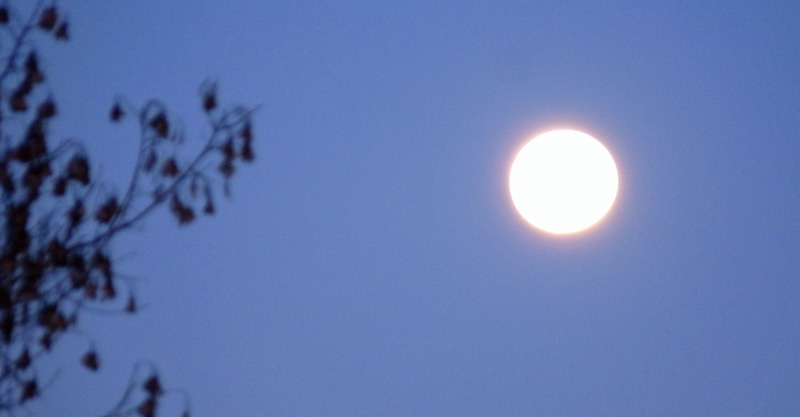
What a moon tonight, full and low in the northeastern sky, that golden tan color just before twilight.  It hung there, as Kate said, as if someone had taken a photograph of a beautiful moon and cut and pasted it onto the sky.

(sadly, this photograph doesn’t do it justice, but it was splendid.)

There is no heavenly phenomenon that gives me more moments of sublime beauty, more catch my heart moving moments, more stand still and stare moments than the moon.  A crescent moon with Jupiter in its arms.  A full moon shining on new fallen snow.  A half moon sending shadows down from tomato plants and iris.  That full moon in the first month back on campus.  A sweaty moon pushing lambent light through a hot and humid night, crickets chirping and lightning bugs flashing.

A moon standing high in the sky with the aurora borealis behind it.  A moon reflected and shaken by ripples in a still pond.  Koi pecking at the image.

I remember a moon one night, north of Ely in the Boundary Waters.  It was January and my week long class on the timber wolf had driven out to an opening in the woods.  We howled into the darkness, trying to get the wolves to howl back.  The full moon that night.  It said lunacy.

A Morning During Our Long November

Winter                            First Moon of the New Year

Our long November continues.  Patchy snow, mostly bare ground and leafless trees.  Occasional sunshine, like today, otherwise gloomy and gray.   I’m disappointed in the season since I believe we have to earn our springs here and I’m not sure we’re going to this year.  Of course, last year may have counted for two.

Action method and Evernote have both made my work on the computer much more productive.  I can switch seamlessly among projects now without having to do a lot of hunting for files and resources.  Since my days have become more and more study oriented this means a lot to me.

(remember last winter?)

Kate’s out having lunch with a friend, Penny.  I worked on Ovid, finished up my ten verses for this week.  This afternoon I’ll check out my objects for my two China tours tomorrow and probably enter some more of the material I wrote last March at Blue Cloud.

I’m getting close to having that finished.  Once I do, I’ll go back over my notes and start writing again.  I expect I’ll have a rough draft finished in February if things go well.  I’ll start on Book II after that.


On Moving Toward Doing the Work Only I Can Do

Winter                              First Moon of the New Year

Spent yesterday shifting to my new work schedule.  A couple of hours on Ovid, plus analyzing some of Caesar’s Gallic Wars.  Edited three portions of the Tailte Mythos:  Book I and began clipping postings from Ancientrails to consult for my first essay in the Reimagining project.

Also learned that I can’t go to sustaining status at the MIA until I’ve had 8 years as a docent.  Sustaining would cut my tour requirements in half.

This means I’m going to have duck out of the Sierra Club sooner than I had planned.

No plant starts this year.  I’m going to buy already started plants and of those only those we decide to grow for particular, planned uses.  We’re going to shift our gardening now toward minimalism, toward those things we’ll preserve.  Two colonies of bees.  Emphasizing less maintenance everywhere, planting towards a time when the gardens will need even less, eventually very little care.

Life’s focus changes as our lives change and now I’ve become focused on those kind of things only I can do.  Only I can write the Tailte books.  Only I can set down my scattered thoughts about a sort 0f ur-faith, a common reverence all of us on the planet might share.  Others might/will translate Ovid, but only I will work toward a beginner’s level commentary, one similar to Pharr’s commentary on Vergil.

Not sure why now for this shift except to say that I know my time is finite.  Yes, it always has been, that’s true, but now it seems existential.  No, I’m not covering something up here, I’m not ill, in fact, I just got a set of labs that Kate says are typical of a 40 year old.

Long ago, in my 20’s, I read an article about when certain professions reach their maturity.  You know the material about mathematicians and scientists, early ripe, but certain other professions matured much later, writers and artists, for example, with the oldest age of maturation according to this reckoning being 50, for philosophers.

Factoring in my drinking and an early career emphasis on politics and the practical side of religion, I don’t find 65 to far out of range for me.  I feel mature in my thinking and writing skills now and I need to deploy them or my unique contribution will be lost.

How the New Year Might Look

Winter                                           First Moon of the New Year

At an inflection point with the Latin.  Either I keep the pace I currently follow, maybe 6 hours a week; or, I ramp up, say to 10 or 12, maybe a couple of hours each day.  Some analysis of other texts–maybe Caesar or Suetonius or Julian, I have all of these in Loeb Library volumes–plus more translating of the Metamorphoses.  My inclination is to ramp up, do more, focus on Latin and the novel.  That’s what my heart tells me.

That other project, too.  The one I’ve got slotted for 5,000 word essays each month next year.  Where I’m going to give voice to my whirling ideas about the earth, about ge-ology, about what would help us help our home planet.  That one, too.

When you add these things together, they constitute real work and I feel good about that, not trapped or bummed.  Now all I need is a way of allocating my time so I can work them all in and still manage the art, the garden, the bees and family.

That may be my new year’s work.  Pruning activities and creating a new schedule.


Ovid. Again.

Winter                              First Moon of the New Year

An Ovidian morning.  Holding words, conjugations, meanings, clause types, prepositions and adverbs in the head while whirling them around like a Waring blender.  It’s satisfying when a sentence finally pops up, like a good smoothie.  Not always a straight on logical process, though logic can critique the result.

About ten verses a week now.  Takes, hmmm, 4-6 hours.  So, if there are 15,000 verses, that’s 1,500 weeks or 6 to 9,000 hours.  Which is, what?  3 to 4.5 working years full-time or 30 years a week at a time, taking some time off for vacation.  Mmmm.  Don’t look for that book jacket anytime soon.


Solstice Celebrations. What Might They Mean?

Winter                                  Moon of the Winter Solstice

Something new seems to be happening.  Not sure if I’m reading the rustling in the ether of our culture right, but it feels like the Great Wheel may have begun to reemerge.  Not in a Wiccan or alt-pagan way, though that’s certainly there, but in a from the ground up way (so to speak).

A friend called me tonight to wish me a salubrious solstice.  Kate wants to do a fire tonight. First Universalist has a solstice celebration as do many UU congregations.  There has been, for a while now, solstice celebrations on the continent.  I’m most familiar with ones in Scotland and Sweden.

These celebrations, rituals whatever we might call them are not confined to the Winter Solstice though the spreading knowledge of Christmas’s relationship to the Saturnalia, itself a winter solstice holiday, has given the Winter Solstice a cultural leg up, as has a more general appreciation for the other festivals of light around this time:  Deepavali, Hanukkah, Christmas trees and home decorating–neither one of which has any obvious link with the Christian holiday.

I don’t know quite how to go about measuring the cultural penetration of solstice and equinox awareness, or the depth of its relation to individual’s religious yearnings, but my own sensibilities suggest the penetration has gone far past the surface and has, for some folks, like myself, reached the point of religious sentiment.

The Minneapolis Institute of Arts, in a somewhat ham-fisted way, changed its holiday traditions focus from a sort of Victorian dress up for Christmas to what is now called a Winter Lights celebration.

I’d be interested to know what you think, what you see from your standpoint.

Winter Solstice 2011

Winter                                           Moon of the Winter Solstice

Darkness has fallen.  The solstice has begun.  The longest nights of the year occur over the next few days.

The summer solstice, now a half year away in either direction on our orbit around Sol, has faded, faded, faded until the longest day of the year has become the longest night; in the other direction, toward which we move, the summer solstice is a half year away.

Starting now, we will begin, second by second, minute by minute, then hour by hour to turn ourselves toward the light until, at the moment of light’s triumph on June 20th at 6:09 pm, we will begin again a sure glide into winter.

On the Great Wheel it is neither the longest night nor the longest day by itself that matters, rather it is the certainty of their coming, light followed by increasing darkness, darkness followed by increasing light.  This reality, as metaphor, reminds us that no light is so fulsome that it is without darkness and no darkness so total as to be without light.

Too, we can see our lives as a turn of the wheel. In late winter we quicken, growing small within the mother.   We emerge during Beltane, the sun’s heat and the day’s length increases and we mature, grown into adults, as the turn moves toward Mabon and Samain, summer’s end.  Our lives develop fruit and we harvest; as Summer’s End moves toward the Winter Solstice, our hair turns gray and our bodies decline.  In Winter we move toward the darkness, back to the enveloping womb that is our mother, the earth.

Tonight we celebrate the winter season of our lives, the time when our life finishes its run.  This bears no sorrow, nor any fear, since we know that on the morrow, as it has since time begun, the light will again gain strength.  Living or not, it will shine on us, too.

The Simple Life. Bah, Humbug

Samain                               Moon of the Winter Solstice

“Simplicity, simplicity, simplicity. I say let your affairs be as one, two, three and to a hundred or a thousand. We are happy in proportion to the things we can do without.” – Henry David Thoreau

(Walden Pond, 2010)

When I bought my farm up near Nevis, Minnesota, Thoreau and I would have been on the same page.  The Peaceable Kingdom had its own well, a septic system and heat provided by the forest I owned.  Of course, that year the simple life saw a divorce, the temperature hit -50 and a heavier yet reliance on beer and scotch.

Don’t get me wrong.  I think simplicity is a beautiful thing.  Then again, so is complexity.  If my body simplified itself, there wouldn’t be much me left.  If my consciousness simplified itself, the rest would slip away.

There will always be, of course, the few who take the Taoist monk approach, a life lived close to nature.  There will be, too, those folks who just find wilderness better company than the rest of us and who’s to say they’re wrong?

Me, though, I love samsara, this whole roiling, boiling mess we have for a place to live.  I love computers and television and movies and books, philosophical and political thought and action.  I love relationships, messy and unwieldy and complicated as they can be.  I love art, often complex and difficult.

I suppose this means I’ll never have a Walden experience or the insight of wandering through the Tao.  I’m ok with that.  If you need simplicity, then seek it, make it so.

As for me, give me complexity or give me, well, what?  Greater complexity.


The Death of an Honest Man

Samain                                      Moon of the Winter Solstice

Christopher Hitchens died.  An honest man, Diogenes would have stopped searching.  He faced death as a non-believer, a man whose God Is Not Great made him a name in the theist–anti-theist debates of this millenia’s early days.

His angry anti-religious bias fit in well with the Richard Dawkin and Sam Harris crowd, agreeing with their totalizing, methinks-they-protest-too-much screed.  If religion is so bad, why has it persisted for so long?  A scathing atheist has backed himself into a metaphysical box, one much like the box he insists all religionists occupy.

To adamantly claim God’s non-existence is just as silly and unwarranted as the claim of God’s existence.  Neither can have, by definition, empirical validation, so, in each case we enter the realm of faith, of conjecture believed because it feels right, true.

Faith in its purest forms is a beautiful aspect of human culture, allowing us to transcend the often bleak realities of the day-to-day, finding a blissful reality where others see only pain and boredom.  Marriage, for example, requires faith in another human being, another human being as wonderful and amazing as yourself and as awful and horrible.

Monotheism as practiced in the dominant Western religious traditions is only one item on the menu of faith as offered by human culture and even it comes in three flavors:  Christian, Jewish and Muslim.  The ancient traditions of the West synch up better with the pluralist pantheons of India, Nepal, Tibet, Africa and the indigenous Americas.

Monotheism, rather than religion per se, seems the better target, since it makes definitive and often absolute claims, claims which sometimes pose as divine law, unbreachable and final.  The nature of monotheism’s claims rather than its actual content or institutional form are the problem.

With one deity and one book the temptation to sure knowledge, certain dogma too often overwhelms these believers, though in all three traditions there are, too, the more measured, more humble ways.  In fact, strange as it may seem given the all too charged dialogues of the past twenty years, the liberal orientation–former mainline Christianity, reform Judaism and the Sunni/Sufi mainstream Islam–is numerically dominant.