
The TLF Maintains Its Presence

Winter                                                             Moon of the Winter Solstice

On the way back from buying groceries I encountered the TLF again.  The TLF long time readers of this blog might recall is the Turkey Liberation Front.  I gave this rafter or gang (look it up) their name when I encountered their predecessor several years ago returning from the same store with additional butter for the Thanksgiving dinner then underway.  That first rafter was smaller, less than 10, but this one had perhaps 18-20, mostly adults, but a few young adults.  Their feathers were a rich dark brown, lustrous.

(Great Northern Sky)

Round Lake gathers enthusiasts of various sorts, some with more common sense than others.  The ice fishermen are staid, quiet types.  Ice houses or small tents covering their holes, they sit still, waiting for something to happen.

The snowmobiles you would expect though there’s been fewer of them than normal this year.

This year has drawn several ATV drivers and, to my surprise, one dirt biker.  The first I’ve seen though I know it’s done.  I heard the noise, the steady drone of a small engine, looked out over the lake expecting to see a snowmobile when what to my wondering eyes should appear but some kid on a motor bike riding in circles, defying the friction defeating ice with the occasional part sideways skid.  Nobody’s out there with their truck or car this year.  Wise.
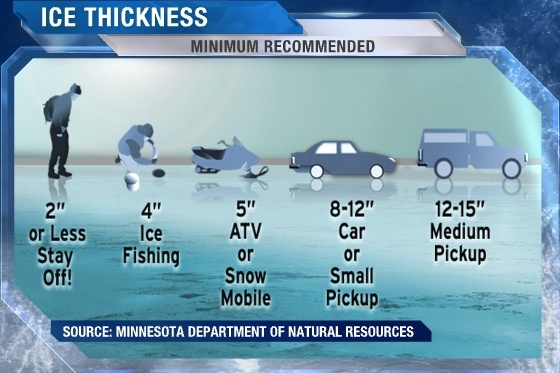
(I picked this up from a national weather website.  But they’re using our DNR’s illustrations.)

Last week I read in the newspaper the following advice for the cold weather over New Years.  Keep your gas tank half full.  Pack winter boots and warm coats.  Call ahead and let people know when you plan to arrive.  That sort of thing.  We’ve also had the illustration showing what thickness of ice can bear what kind of weight.

Minnesotans take this kind of thing for granted, part of the season.  But imagine you were a visitor here.  Reading this stuff.  With a rental car.  No wonder people don’t move here in droves in spite of the great cultural and political life.


Going to the Movies

Winter                                                                   Moon of the Winter Solstice

Kate and I saw Les Miserables and Django Unchained today, our new year’s party.  Afterward we had dinner at Tanner’s, a restaurant near the theatre.  A fun start to the new year.

You’ve probably read the reviews, but if you haven’t, both of these movies are worth seeing.  Les Mis is a known tear jerker and this one lived up to that reputation at several spots.  I found Valjean’s doggedness as a father and the revolutionary French youth at the barricades especially moving.

Funny, angry, sensitive, homage and satirical at turns Django shows Tarantino for the great director that he is. Django Unchained is a swipe at the Western, the fate of black actors in movies and the bounty hunting trade.  Christopher Waltz as Dr. King Schulz and Jamie Foxx as Django have great chemistry, forming an unlikely team.


The New Year? Says Who?

Winter                                                          Moon of the Winter Solstice

The new year.  An interesting idea, if you to stop to consider it.  In those parts of the world like ours, the temperate zone that runs in the middle latitudes between the poles (generally), we have more or less four seasons:  spring, summer, autumn and winter.  Even those distinctions are arbitrary, a fact proved by the concept of meteorological spring, summer, autumn and winter which divide the year in four parts by average temperature.  They do not coincide with customary dates like May, September, December, March.

Instead, even in the temperate zones, the earth’s position relative to the sun changes gradually, modulating the amount of solar energy any given square meter of surface receives and thereby modulating heat and cold.  This gradual change has its peaks and valleys and because plants have adapted their life cycles to this gradual change we celebrate, with plant life as a proxy for the astronomical, seasons.

The seasons relate to the status of the plant world.  Right now, plant life is in a fallow time, made necessary by limited sun light and rapidly varying temperatures very often below the freezing point of water.  So we turn away from the agricultural and the horticultural to our life inside our dens.  Later, as the solar energy available increases, the plants will begin to appear from their winter safety and we will engage them again.

When in this cycle does the new year begin?  Take your pick.  The Celts, somewhat counter-intuitively for us today, said the New Year began at the growing season’s final moment, Summer’s End or Samhain.  Many cultures, the Chinese still and European culture until the 18th century, saw the beginning of a new year in the quickening of the plant world or the signs that it would happen soon.

Whatever cues you take from the plant world, January 1st is an outlier.  It has no obvious astronomical or horticultural logic, no roots in culture other than, it appears, the Roman pantheon of Julius Caesar’s day.  He was, you might recall, the one who created the modern calender now in use globally.  The Gregorian modification to the Julian calendar made the calendar work with the slightly more than 365 day year we get from our journey around the sun.

But it was Caesar who decreed that January, named after the god Janus who famously looked backwards and forwards, was the logical time for the change of a year.  Logical only in Caesar’s mind, but even today the Roman dictator still has his way with the world.

As this article in Wikipedia shows, you can celebrate New Year’s at several points throughout the year, so, I guess, today’s as good any of those. Happy New Year!  For now.